How Umbrella Samples Are Approved Before Mass Production
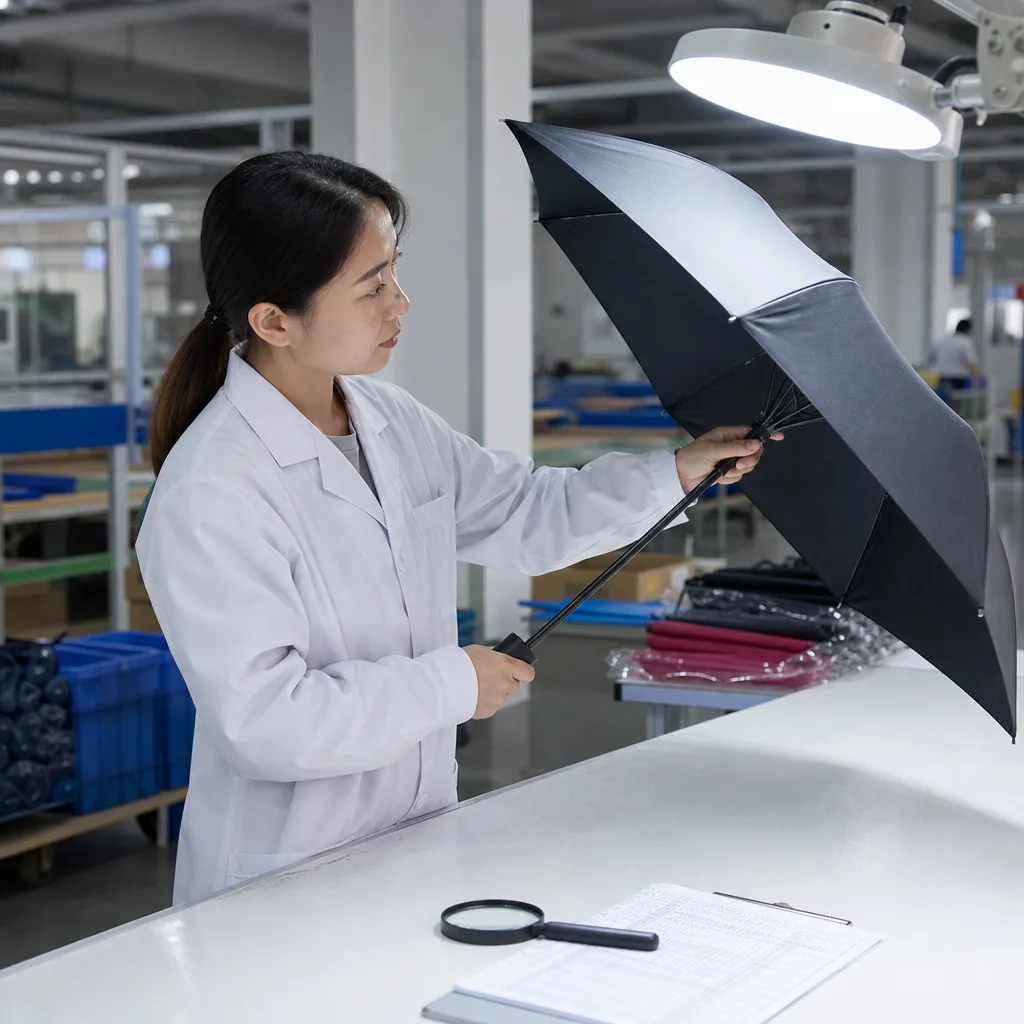
Before a bulk umbrella order goes live, most costly mistakes are still hiding in fabric shade, frame fit, printing registration, or the open-close action at the runner. Our umbrella sample approval process moves step by step from prototype to pre-production to golden sample, with factory-floor checks on canopy tension, pantone matching, stitching, and mechanism tolerance so buyers can lock the standard before mass production starts.
Which Sample Stage You Actually Need
Most delays come from approving the wrong sample stage. In the umbrella sample approval process, a concept mockup is for artwork only: panel layout, logo scale, print position, color blocking, and handle color callouts. It does not validate the live canopy fabric, frame construction, runner fit, stitching, or whether an auto-open-close shaft cycles cleanly. If the decision is material-dependent, move to swatches instead. For fabric umbrellas, that usually means 190T or 210T pongee; for clear canopies, POE, EVA, or PVC. A swatch is where buyers should confirm color on the actual substrate, print method compatibility for screen print, heat transfer, or sublimation, and any coating requirement such as Teflon water repellency or UPF 50+ treatment. If artwork is the only open issue, stop at a mockup or swatch. Ordering a full physical sample before fabric, coating, and print method are fixed adds sample cost and usually extends umbrella lead time by 5 to 10 days without lowering production risk.
The counter sample is the first stage that proves the product can actually be built and used. Treat it as a custom umbrella prototype made to target specs: 21-inch compact, 23-inch straight, 27-inch golf, or 30-inch oversize; 8K, 10K, or 16K frame; fiberglass or steel ribs; manual, auto-open, or auto-open-close mechanism. This is the right gate to check canopy tension, rib geometry, ferrule alignment, shaft play, spring force, stitching quality, and opening action under repeated cycles. The pre-production sample comes later and should match the mass-production BOM, approved artwork, sewing method, hangtag, carton marks, and unit packing. Once approved, it becomes the golden sample used as the sealed reference for line checks and final AQL 2.5 inspection. Use the rule plainly: mockup or swatch for artwork and material approval, counter sample for structure and function, pre-production sample and golden sample for packaging, QC alignment, and shipment-risk control. Typical timing is 3 to 7 days for mockups, 5 to 10 days for counter samples, and 7 to 12 days for a full pre-production sample.
Critical Specs to Lock Before Sign-Off
In the umbrella sample approval process, lock every spec that would force new tooling, revised cutting patterns, or a different frame after sign-off. Start with canopy size, folded length, and frame geometry as one package. A 21 in. compact, 23 in. straight umbrella, and 27 in. golf umbrella do not share the same rib curvature, panel width, or carton footprint, and folded length directly affects retail pack-out and whether an auto-open-close frame retracts fully into the handle. Rib count is another non-negotiable checkpoint: 8K is standard for many compact and straight models, while 16K changes panel count, seam layout, logo breaks, sewing time, and unit cost. Approve shaft and rib construction by exact material, not broad descriptions. A steel shaft with fiberglass ribs, a full fiberglass frame, and an all-steel frame each carry different weight, flex, and wind-resistance tradeoffs. Buyers should also sign off on handle style and opening mechanism at the pre-production sample stage, because a crook handle, EVA grip, rubberized ABS handle, or wood handle may require different molds or sourcing lead times, and manual, auto-open, and auto-open-close systems use different spring assemblies with different failure risks.
Lock fabric, print layout, and color tolerance in measurable terms before releasing the golden sample. For most custom umbrella prototype programs, 190T pongee is the usual choice for cost-sensitive orders, while 210T pongee gives a smoother hand feel and a cleaner print surface. If the canopy uses a UV or Teflon coating, approve that on the sample because coatings can change drape, water beading, and perceived color. Logo placement should be written as a millimeter tolerance, including panel print position, seam offset, and tip-to-logo distance; otherwise, a sample that looks acceptable by eye can still create disputes in bulk production. Pantone approval needs a separate checkpoint: approve printed logos from a physical strike-off under neutral light, and approve dyed canopy fabric from the closest lab dip with the acceptable shade tolerance recorded in writing. Dyed lots can still vary slightly from batch to batch, especially on dark navy, red, and fluorescent shades, and coatings can make the same Pantone appear glossier or slightly cooler. Put that allowance into the golden sample notes so it is not misread as a defect during AQL 2.5 inspection. This step protects umbrella lead time, because spec changes after fabric booking or frame assembly commonly add 7 to 15 days.
Functional Testing on the Sample
Functional testing should outweigh graphics in the umbrella sample approval process because most claims come from frame or mechanism failure, not small print variance. Start with opening and closing force. A 21 in. or 23 in. folding umbrella with auto-open-close should deploy fully and re-close without excessive thumb pressure, and the runner should travel straight on the shaft with no snagging at the spring notch, rib joints, or handle cap. For manual and auto-open stick styles, run at least 20 open-close cycles on the pre-production sample to check for spring fatigue, latch drag, runner side play, or misalignment at the top notch. Stitch quality also needs to be locked before bulk production. On 190T or 210T pongee, canopy seams typically target about 8 to 10 stitches per inch, with no skipped stitches or loose tension at the tips, top notch, and tie-wrap anchor, where seam failure usually starts. If stitch density and seam execution are not confirmed on the sample, the later AQL 2.5 inspection becomes a sorting exercise instead of a control point.
Water repellency and wind performance also need proof on the custom umbrella prototype before the PO is released. On pongee canopies, confirm that water beads and rolls off after repeated folding pressure instead of wetting through along seam lines; a Teflon finish does not perform the same as a basic clear coating in repeat-use conditions. For POE, PVC, or EVA canopies, shift the test to panel clarity, cold-weather stiffness, and whether stitched or heat-sealed areas pucker after opening. Wind resistance claims should be checked with controlled fan or pull testing, especially when a supplier quotes 50+ mph performance. Validate fiberglass versus steel ribs and any double-canopy vented construction at this stage, not after PO release. Fiberglass ribs flex and recover; thin steel ribs usually cost less but are more likely to take a permanent bend. Changing from an 8K steel frame to fiberglass, or from single canopy to double-canopy, affects unit cost, sewing method, carton size, MOQ, and umbrella lead time. The golden sample should freeze those choices so mass production follows a verified spec, not an assumption.
Packaging, Labeling, and Carton Approval
Treat packaging as part of the pre-production sample, not a late-stage add-on after canopy color and print are approved. In the umbrella sample approval process, the sleeve, hangtag, woven label, care label, barcode sticker, and export carton marks need one locked pack spec, because a correct umbrella can still be rejected at a retailer DC for a bad FNSKU position or incorrect outer-carton marking. On 21" and 23" folding umbrellas, sleeve fit is a functional test: if the opening is too tight, packers drag the folded canopy through the sleeve and leave rub marks before shipment. The risk increases on auto-open-close frames, thick rubberized handles, and double-canopy designs that add folded diameter. A custom umbrella prototype should therefore carry the production-intent sleeve material, hangtag, label set, and carton layout whenever possible. Buyers should sign off on barcode location, label text, country-of-origin wording, and carton marks from the physical sample, then lock marked photos into the packing spec used by the sample room, sewing line, and packing line.
Approve barcodes for how they are actually packed and handled, not only from flat artwork. A barcode that scans on screen may fail once it wraps over a fold, crosses a perforation, or sits under a sleeve seam, so the golden sample should show final code size, quiet zone, sticker stock, and exact placement on both the unit pack and master carton. Care-label placement also needs material-specific review: adhesive labels can lift on POE or PVC canopies, while a sewn label placed too close to a rib pocket on 190T or 210T pongee can distort the panel when opened. Carton quantity affects freight, damage risk, and warehouse labor. A 48-piece master can reduce FOB cost per unit versus a 24-piece carton, but the higher gross weight raises corner-crush risk and handling strain, especially on 27" golf umbrellas or 30" promotional styles with fiberglass ribs. For e-commerce and retail parcel programs, require drop-test approval on the sell unit or inner pack, upgrade corrugate where needed, and confirm carton dimensions, gross weight, stacking method, and shipping marks. Lock those points before production, then verify them again during AQL 2.5 inspection to protect umbrella lead time and avoid chargebacks or rework.
Approval Workflow, Lead Times, and Change Control
Do not start bulk production from a chat reply that says “looks good.” The umbrella sample approval process begins only when the revised pre-production sample matches the signed spec sheet point by point: 21", 23", 27", or 30" size; 8K, 10K, or 16K rib count; fiberglass or steel frame; manual, auto-open, or auto-open-close mechanism; canopy material such as 190T or 210T pongee, EVA, POE, or PVC; print method; and packing details. Check the custom umbrella prototype against the defects that later drive claims: runner wobble, crooked top notch, loose ferrule fit, off-center logo registration, weak seam stitch density, and poor canopy tension when fully opened. For vented windproof styles, confirm fiberglass ribs recover after inversion and the double-canopy opens without fabric catching at the tips. If the canopy uses Teflon or UV coating, approval should also cover color, hand feel, water beading, and any mill support for UPF 50+ claims.
Lead time stays stable until the spec changes. A revised sample for a standard straight or folding umbrella usually takes 5-7 working days when the existing frame is unchanged and edits are limited to artwork, handle color, or sleeve details. A new mold, a nonstandard POE or EVA canopy, or a new auto-open-close mechanism typically pushes sampling to 10-15 working days. After written sign-off by email or PDF, that unit becomes the golden sample held by both buyer and factory. Record the approval with a version number, Pantone references, fabric code, frame spec, packing method, and photos in open and closed positions; freeze procurement only after that file is issued. MOQ also affects the decision: custom handles, woven labels, or special export cartons are usually inefficient at 300 pieces, while 1,000-3,000 pieces is more workable for unit cost and material allocation. Any post-approval revision—such as changing steel ribs to fiberglass or revising artwork after printing is booked—should trigger written change control and a revised ship date, because it commonly adds 7-12 days. Before balance payment and shipment under FOB or DDP, the finished order should pass final inspection to AQL 2.5 for appearance, function, quantity, carton marks, and random open-close tests to confirm bulk goods match the golden sample.
Frequently Asked Questions
What is the difference between a pre-production sample and a golden sample?
A pre-production sample confirms the factory can build the item to spec with intended materials and processes. A golden sample is the final signed reference used by production and QC to judge bulk output.
Can buyers skip physical samples and approve from photos only?
It is risky for custom umbrellas, especially when color matching, handle feel, mechanism smoothness, or print registration matter. Photo approval may work for repeat orders with unchanged specs, but new programs should use a physical pre-production sample.
What should be locked in at the golden sample stage for a custom umbrella order?
The golden sample should freeze canopy fabric color, logo size and placement, frame and rib specification, handle material, closure method, and packaging details. For B2B orders, this approved sample is typically the reference used by QC during inline and final inspection, so any later change can add 7-15 days to lead time.
How many sample rounds are normal before mass production starts?
For most OEM umbrella programs, 2-3 rounds are common: an initial prototype, a pre-production sample, and a final golden sample. If a buyer requests custom-molded handles, Pantone-sensitive canopy colors, or new opening mechanisms, sampling can extend to 4 rounds.
Does AQL 2.5 inspection replace sample approval before production?
No. AQL 2.5 is a bulk inspection standard used after or during production, while sample approval happens first to define what the finished umbrella must match. Without an approved sample, defects like off-shade fabric, loose auto-open action, or incorrect logo scale become harder to judge consistently.
Looking to Launch Your Custom Umbrella Line?
ZheBrella is a Zhejiang-based OEM/ODM umbrella manufacturer with 17 years of export experience. Free design, low MOQ from 100 pieces, windproof construction, full-color print.
Get Free Quote Now »People Also Search For
Related Articles
Umbrella Factory PPAP: How to Approve Parts Before Mass Run
Learn how umbrella PPAP-style approvals reduce defects by locking materials, dimensions, and golden samples before bulk ...
Read More »How Umbrella Frame Prototypes Are Tested Before Mass Production
See how frame prototypes are checked for cycle life, corrosion, wind resistance, and assembly accuracy before production...
Read More »
How to Audit Umbrella Samples Before Approving Mass Production
Use a practical sample-audit checklist to catch fabric, frame, print, and packing issues before umbrella mass production...
Read More »