Logo Colorways for Multi-SKU Umbrella Programs
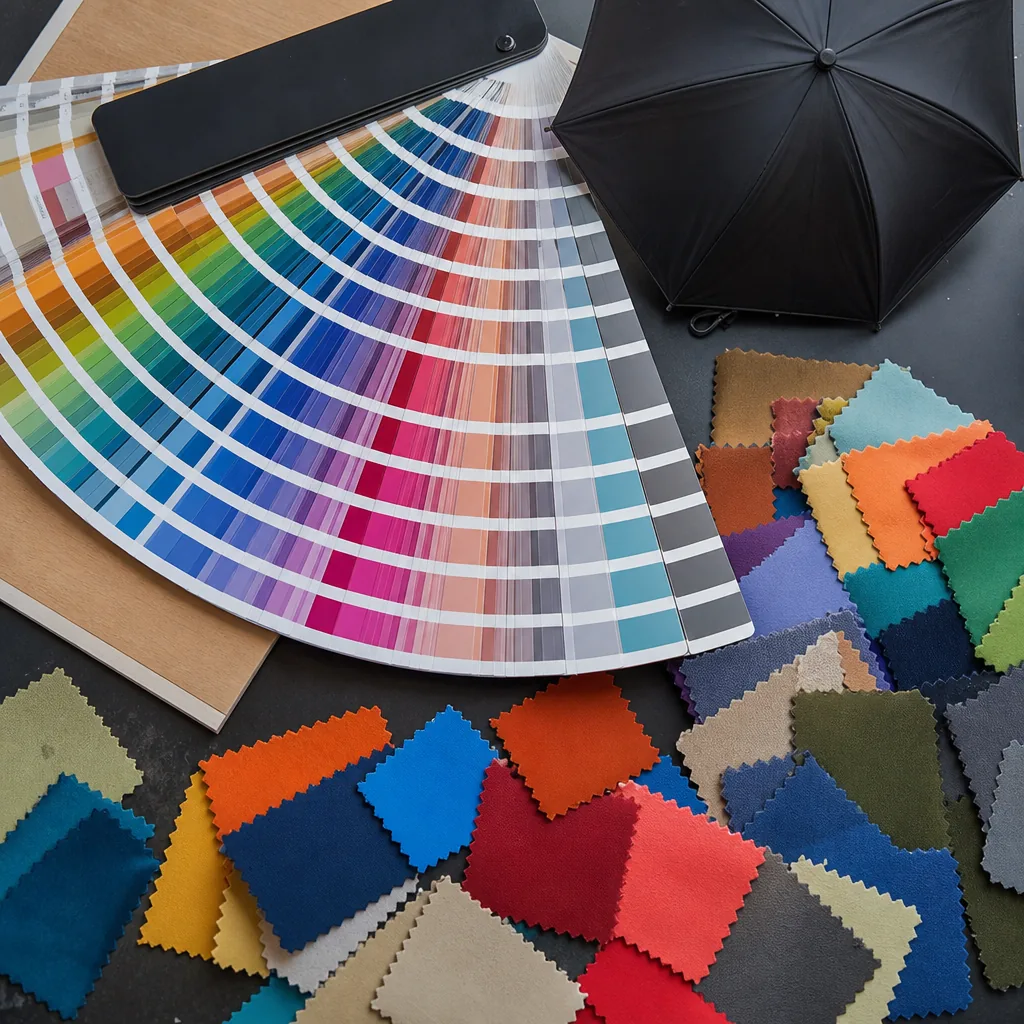
When a program expands from one umbrella to five or twenty SKUs, the logo that looked clean on a single sample can disappear on dark panels, fight with printed patterns, or slow approvals across factories and buyers. On our Songxia production floor, logo colorways for umbrellas are planned around fabric shade, ink or heat-transfer limits, panel cutting variation, and packing accuracy so each SKU stays brand-consistent without creating unnecessary production risk.
Start With the Brand System and Sales Channel
The first mistake I see in logo colorways for umbrellas is letting the canopy fabric drive the brand decision instead of starting with the brand system. A corporate guideline usually defines Pantone spot colors, minimum clear space, reverse-logo rules, and what happens on dark backgrounds; those rules must be translated into real production methods before any SKU chart is approved. A white logo on navy 190T pongee may look clean with screen printing, while the same logo on black PVC might need heat transfer because ink adhesion and opacity behave differently. For umbrella logo color matching, we normally request coated Pantone references, vector artwork, and one approved physical sample under D65 lighting. Digital mockups are useful for sales approval, but they cannot predict dye-lot shift on 210T pongee or the gloss difference between POE, PVC, and EVA canopies.
Sales channel changes the color plan. A corporate procurement buyer may only need two conservative SKUs: black canopy with white logo and navy canopy with silver or white logo, usually on 23-inch auto-open or 27-inch golf umbrellas. A retailer needs shelf logic: core colors that stay in stock, seasonal colors that refresh the wall, and maybe a premium UPF 50+ sun umbrella in ivory, sage, or khaki. Distributor catalogs are different again because they need broad appeal, fast decoration, and low risk across many end customers. For a multi SKU umbrella program, I prefer three layers: core black/navy/gray, seasonal 2–4 colors tied to the buying calendar, and event-specific colors that can be produced under a controlled MOQ without disrupting the main line.
Approved logo standards should not be treated as flexible just because the umbrella assortment gets wider. If the brand allows only one-color white, black, or full-color marks, then branded umbrella color planning has to choose canopy shades that support those marks, not invent unapproved contrast combinations. For retail umbrella customization, this matters because a red canopy in one dye lot and a burgundy canopy in another can make the same logo look inconsistent across 21-inch folding, 23-inch stick, and 30-inch golf models. Our standard practice at ZheBrella is to lock a color matrix before sampling: canopy fabric code, logo print method, Pantone target, rib/frame color if visible, handle color, and packaging label color. That document prevents a seasonal promotion from quietly drifting away from the brand book while still giving buyers enough variety to sell through different channels.
Plan Logo Visibility Across Light and Dark Canopies
Logo visibility should be planned before canopy colors are approved, not after the artwork is locked. On navy 190T or 210T pongee, white logos are usually the safest choice because they hold contrast in shade, rain, and under LED retail lighting. Metallic-look silver can work on navy, but only if the ink or heat-transfer film has enough opacity; cheap silver turns gray-blue once the fabric is wet. On black canopies, white and light metallics read well, while reversed logos depend on the background panel staying consistent. Red is more difficult than buyers expect: white is clean, black is bold but can feel heavy, and metallic gold often shifts orange against warm red fabric. For logo colorways for umbrellas, I normally reject tone-on-tone red unless the buyer accepts reduced visibility beyond 10 to 15 feet.
Yellow, light gray, and patterned canopies need stricter contrast checks because outdoor light changes the result fast. Black logos are strongest on yellow 190T pongee, especially for event and promotional umbrellas where the logo must photograph clearly. White logos usually fail on yellow unless outlined, and metallic silver can disappear in direct sun. On gray canopies, black works on light gray, white works on charcoal, and metallic-look logos should be tested at both dry and wet stages because water darkens pongee and lowers edge definition. Patterned fabrics are the real trap in a multi SKU umbrella program: a logo placed over stripes, florals, or geometric prints may pass on the digital mockup but break apart after sewing tension, panel curvature, and seam alignment. A reversed logo inside a solid badge or knockout box is often more reliable than printing directly on the pattern.
For branded umbrella color planning, we check logo panels outdoors at midday, in overcast light, and after spraying the canopy until the fabric surface is uniformly wet. 210T pongee has a tighter weave and smoother print face than 190T, so fine logo details and small registered trademarks usually come out cleaner, but both fabrics darken under water and can reduce contrast by one to two visual grades. Our standard practice at ZheBrella is to make a printed strike-off on actual bulk fabric, then review it at arm’s length and at 3 meters before approving retail umbrella customization. Umbrella logo color matching should also account for print method: screen printing gives strong white and black opacity, heat transfer handles gradients and metallic-look effects better, and sublimation is poor for true white because it relies on the base fabric color. For mixed navy, red, yellow, gray, and patterned SKUs, one universal logo color rarely performs equally well.
Reduce Complexity With Shared Frames and Components
The cleanest way to control a multi SKU umbrella program is to keep the mechanical platform identical and change only the canopy and trim colors. For example, a brand can run one 8K 21" compact auto-open frame across navy, black, red, and seasonal colorways, using the same shaft, runner, springs, ribs, ferrules, and handle mold. On golf umbrellas, the same logic works with a 30" double-canopy frame using fiberglass ribs and a steel or fiberglass shaft, then changing 190T or 210T pongee panels by SKU. This reduces tooling risk, keeps replacement parts consistent, and makes AQL 2.5 inspection cleaner because the inspector is checking the same open-close action, rib tension, and canopy alignment across the full assortment. It also helps with logo colorways for umbrellas because print testing can focus on fabric shade and ink behavior instead of revalidating a different frame every time.
Handles, straps, tips, caps, and sleeves should be planned as a system, not selected one SKU at a time. If the black umbrella uses a matte black rubberized handle, the navy and gray versions should usually use that same handle unless retail positioning requires a contrast accent. Matching woven straps, snap buttons, sleeve binding, and plastic tips gives the program a more disciplined shelf appearance and avoids small-lot component purchasing, where costs rise quickly. In branded umbrella color planning, these parts are often where inconsistency shows first: one batch has a shiny black tip, another has a charcoal sleeve zipper, and the logo suddenly looks less premium. Our standard practice at ZheBrella is to lock the component BOM before print strike-offs, then match canopy, sleeve, and strap colors under D65 light so the approved sample is not misleading.
Shared frames also make umbrella logo color matching more predictable. A white logo printed on black pongee, navy pongee, and forest green pongee will not read the same unless opacity, underbase, and Pantone tolerance are controlled. For retail umbrella customization, I prefer approving one master logo spec per fabric family: screen print for solid pongee, heat transfer for sharper small text, and sublimation only when the canopy is light-colored polyester and full-panel artwork is required. If a program needs 12 SKUs, split them by frame first: compact 8K auto-open, compact auto-open-close, and 27" or 30" golf umbrella with fiberglass ribs. Then build logo colorways for umbrellas inside each platform. This keeps MOQ realistic, usually 500–1,000 pieces per color depending on components, and helps maintain 35–60 day production lead times instead of turning every SKU into a custom engineering project.
Sampling a Colorway Matrix Before Bulk Production
The safest way to control logo colorways for umbrellas is to sample the matrix in layers, not jump straight to a full set of pre-production samples. Start with canopy lab dips on the actual fabric: 190T pongee, 210T pongee, recycled polyester, POE, or PVC all read color differently under daylight, warehouse LED, and rainwater. For a multi SKU umbrella program, I usually ask the buyer to approve one master canopy color standard using Pantone TCX or a physical fabric swatch, then create controlled variants for each SKU. Black, navy, red, and white canopies are not difficult, but mid-tone greens, warm grays, and corporate blues often shift after PU, Teflon, or UV UPF 50+ coating. If the program includes steel ribs on value 21" folding umbrellas and fiberglass ribs on 23" or 27" golf umbrellas, rib color should be checked at the same time because powder-coated metal and dyed fiberglass will not match fabric exactly.
After fabric approval, printed logo strike-offs are the real test for umbrella logo color matching. Screen printing on 190T pongee gives a different edge and ink density than heat transfer on a compact auto-open-close canopy or sublimation on white polyester. Metallic ink, fluorescent ink, and white underbase all need a separate strike-off because they affect opacity, hand feel, and dry-rub resistance. For branded umbrella color planning, approve the logo at actual size and position, not as a flat artwork PDF. A 6-inch logo on one panel of a 23" 8K umbrella may look balanced, while the same mark on a 30" 8K golf umbrella can feel too small. Our standard practice at ZheBrella is to record ink formula, mesh count or transfer temperature, curing time, and Delta E tolerance before bulk printing, because vague approvals like “close enough to Pantone 186C” create arguments after shipment.
One full PP sample should be made for the most complex SKU, not necessarily the highest-volume SKU. Choose the umbrella with the hardest combination: dark canopy with light logo, contrast ribs, custom soft-touch handle, sleeve printing, hangtag, barcode sticker, and export carton marks. That sample should confirm canopy fabric, logo ink, rib and shaft color, handle finish, runner function, tips, Velcro strap, polybag warning text, inner box, and retail packaging before MOQ and lead time are locked. For retail umbrella customization, the PP sample is also where you catch assembly conflicts: a thick heat-transfer logo may crease badly on a 21" 3-fold auto-open-close umbrella, or a painted wooden handle may not match the rib color under warm store lighting. Once the colorway matrix is signed, the factory can quote realistic MOQ by color, usually 300–500 pieces per SKU for standard materials, and set a production lead time of about 25–45 days depending on printing load and hardware availability.
Quality Control for Color Consistency by SKU
For a multi SKU umbrella program, color control has to start before final packing, not after cartons are sealed. Our standard practice is AQL 2.5 inspection by SKU, with separate checks for canopy shade variation, logo placement, ink coverage, and print edge sharpness on every production lot. For logo colorways for umbrellas, the biggest failure is not a dramatic wrong color; it is a small drift in PMS matching between batches of 500 or 1,000 pieces that only shows up under retail lighting. We check against approved shade bands, confirm that the logo sits within the agreed centerline or panel offset, and verify that screen print, heat-transfer, or sublimation coverage is even with no pinholes, banding, or double-hit buildup. In branded umbrella color planning, one bad panel dye lot can make an otherwise acceptable order look inconsistent across the shelf.
Mechanical and packing control matter just as much as print color. Every SKU should be sampled for open-close performance, locking action, spring tension, rib alignment, and tip-to-tip symmetry, because a retail umbrella customization program fails fast when the hand feel differs between colors even if the artwork is correct. Mixed-SKU packing needs a second AQL 2.5 pass for assortment accuracy: correct model, correct canopy color, correct handle, correct barcode, and correct carton label on each inner and master carton. Carton marks should include SKU code, quantity, shade name, country of origin, and PO number, with barcodes matching the retailer’s item master. For FOB or DDP shipments, the commercial invoice, packing list, and carton manifest must align exactly, or the receiving team will block the whole container over one mislabeled case in a multi SKU umbrella program.
Frequently Asked Questions
How many umbrella colorways should a first retail program launch with?
Many buyers start with three to five colorways: one core neutral, one brand color, and one or more seasonal options. This keeps MOQ and inventory risk manageable while giving retailers enough variety.
Can different colorways use the same logo ink color?
Yes, but only if contrast remains strong on every canopy color. A shared white or black logo can simplify production, but some colorways may need a reversed or adjusted logo version.
How many colorways are practical for a first multi-SKU umbrella program?
For a first launch, 3 to 5 colorways is usually the most efficient range. It gives retail buyers enough shelf variety without forcing the factory to split fabric, trims, and packaging into too many small runs that can raise MOQ pressure and extend lead times.
Can one logo color work across every umbrella SKU in the same program?
Sometimes, but only if the canopy palette is controlled for contrast. If your assortment includes both dark and light canopies, buyers often approve 2 logo versions, such as white for navy or black umbrellas and black or dark gray for light umbrellas, to keep print visibility consistent.
What production detail most affects color consistency across multiple umbrella SKUs?
The main factor is locking the canopy fabric and print standard before sampling, including Pantone references and decoration method. Keeping the same fabric family and print process across SKUs reduces visible shade variation and usually makes bulk approval faster, especially on programs above 500 to 1,000 units per color.
Looking to Launch Your Custom Umbrella Line?
ZheBrella is a Zhejiang-based OEM/ODM umbrella manufacturer with 17 years of export experience. Free design, low MOQ from 100 pieces, windproof construction, full-color print.
Get Free Quote Now »People Also Search For
Related Articles
Packaging Artwork Control for Multi-SKU Umbrella Lines
Build a packaging artwork system for umbrella lines with multiple colors, sizes, ribs, and features while reducing SKU m...
Read More »
Umbrella Tie Strap Branding for Repeat Retail Programs
Learn how printed and woven tie-strap branding improves retail consistency, with guidance on materials, logo limits, MOQ...
Read More »
Brand Color Consistency Across Umbrella Collections
Keep umbrella colors and logo finishes consistent across multiple SKUs with clear Pantone targets, fabric limits, and fa...
Read More »