Mascot and Character Printing on Branded Umbrella Panels
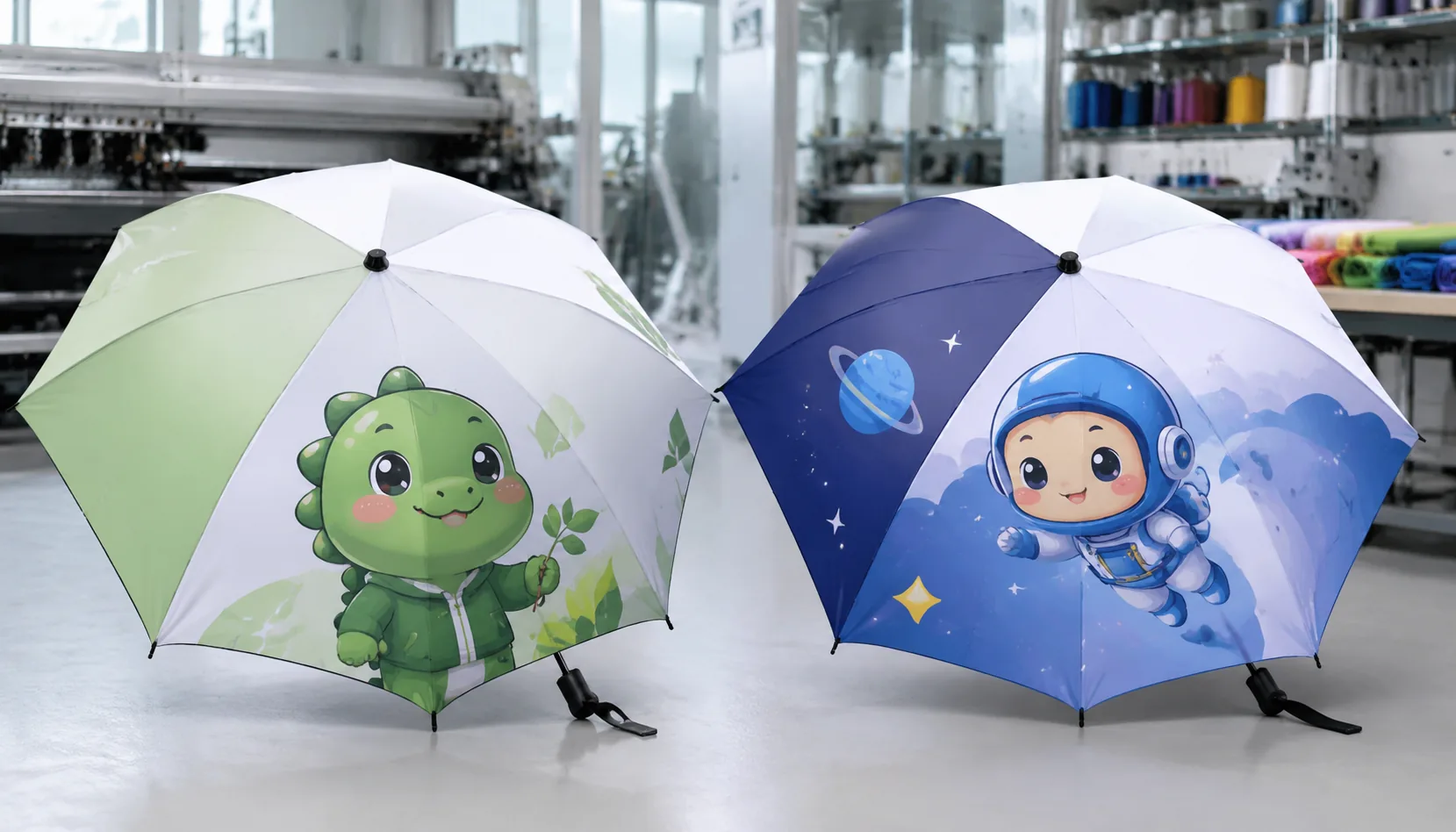
Mascot umbrellas fail fast when the artwork is treated like a flat poster instead of eight moving fabric panels. In our Songxia factory, character umbrella printing starts with rib alignment, seam allowance, fabric shrinkage, ink limits, and sample checks before bulk cutting, because a face split across a seam or a color shift under coating can ruin an otherwise strong promotion. For licensed characters, that control also protects approvals, consistency, and reorder quality.
Adapting Character Artwork to Curved Canopies
Character art has to be rebuilt for the umbrella’s geometry, not just scaled from a flat poster. A 23" or 27" canopy is usually divided into 8K panels, while larger golf umbrellas may use 10K, 12K, or 16K layouts; every seam changes the viewer’s perception of a face, mascot body, or wordmark. If an eye crosses a seam, it can look misaligned after sewing because the operator needs 6–8 mm seam allowance and the fabric stretches slightly under the presser foot. On 190T or 210T pongee, the distortion is moderate, but POE, PVC, and EVA clear panels can pull differently, especially near heat-sealed or taped joins. For character umbrella printing, we normally place the “identity zone” — eyes, mouth, logo badge, and any readable text — inside the center 60–70% of one panel whenever possible.
The worst artwork failures happen when buyers approve a flat AI/PDF layout without checking rib lines, tips, vents, and fold memory. Ribs create hard visual breaks every panel, so a mascot umbrella design with a face centered on the crown may split the nose or mouth unless the pattern is rotated correctly. Tips and ferrules eat into the outer 20–35 mm of usable print area, and that edge is also where screen print registration is least forgiving. Double-canopy vented windproof umbrellas add another trap: the upper vent layer may cover part of a character’s hair, ears, hat, or speech bubble. If promotional character umbrellas use auto-open or auto-open-close folding frames, the fold lines are even more important because repeated creasing can weaken ink film on heavy plastisol or heat-transfer graphics.
Licensed umbrella graphics need stricter control because small changes to a character’s expression can trigger brand rejection. Our standard practice at ZheBrella is to mark ribs, seams, stitch lines, panel grain, vent overlap, and safe zones on the production template before sampling branded umbrella artwork. Text should not run across more than one seam unless it is large, bold, and intentionally broken; thin slogan fonts below about 8–10 mm cap height often disappear after canopy tensioning. For sublimation, we allow more edge-to-edge freedom, but color shift and panel alignment still need a strike-off before bulk cutting. For screen or heat-transfer printing, we keep key features at least 25–40 mm away from ribs and 40–60 mm from tips, then verify on a real frame under AQL 2.5 inspection rather than judging only from a flat proof.
Selecting Umbrella Styles for Character Visibility
For mascot campaigns, the first decision is not fabric color; it is viewing distance. A 23" straight umbrella gives the cleanest panel geometry for character umbrella printing because each of the 8K panels is broad enough for a face, body, logo lockup, or campaign slogan without slicing the artwork into awkward wedges. A 21" folding umbrella is easier to distribute at events and fits retail gift sets, but the shorter ribs, compact frame joints, and smaller canopy radius reduce the readable area by roughly 25–35% versus a 23" straight model. If the mascot has fine eyes, outlines, or licensed umbrella graphics with legal approval marks, I usually push buyers toward straight auto-open models with 190T or 210T pongee, fiberglass ribs, and a smooth matte coating rather than shiny polyester that reflects flash photography.
Golf umbrellas are the best format when the mascot must be seen across a stadium entrance, outdoor queue, or retail activation. A 27" or 30" golf umbrella with 8K ribs gives large uninterrupted panels, while a 16K structure creates a rounder canopy but divides the character into narrower slices, so it works better for repeating mascot heads, step-and-repeat branded umbrella artwork, or alternating sponsor colors. For windy outdoor use, a double-canopy vented windproof structure with fiberglass shaft and ribs is worth the extra cost; steel frames feel solid in hand but bend permanently after strong gusts, while fiberglass flexes and recovers. Our standard practice at ZheBrella is to prototype mascot umbrella design at full scale because a character that looks balanced on a flat PDF can look stretched once sewn over rib curvature.
Kids and bubble umbrellas solve different visibility problems. Kids umbrellas, usually 17" to 19" with rounded tips and manual openers, are good for promotional character umbrellas tied to schools, theme parks, toy brands, and family events, but the print area is small and safety matters more than mechanism speed. Bubble umbrellas in POE, PVC, or EVA make the character visible from the side rather than only from above, which is useful for parade photos and retail window displays; however, transparent materials need heavier ink laydown, and white backing may be required so the mascot does not look washed out. Auto-open mechanisms are practical on adult straight and golf umbrellas because one-hand opening improves perceived quality, but for children’s items I prefer manual-open with controlled runner resistance. Character umbrella printing succeeds when style, rib count, and mechanism support the viewing angle instead of fighting the artwork.
Print Method Choices for Detailed Character Graphics
Digital printing is the safest choice when the mascot has gradients, fur texture, watercolor shading, or a full CMYK brand palette that cannot be reduced cleanly to spot colors. For character umbrella printing on 190T or 210T pongee, we usually print on white or light panels first because dark navy, black, and red grounds mute mid-tones unless an underbase is added. Sublimation gives the softest hand feel on polyester pongee and keeps the canopy flexible, but color management matters: a mascot face that looks warm on paper can shift slightly yellow after heat fixation. For retail or licensed umbrella graphics, I ask buyers for vector outlines plus a Pantone reference and a raster file at 150–300 dpi at final print size, not a small web PNG stretched across a 23" or 27" canopy.
Screen printing still wins when the mascot umbrella design is bold, flat, and limited to 1–4 solid colors. A simplified bear, school tiger, sports-team face, or event character prints very cleanly by screen, especially on 8K and 10K stick umbrellas where each panel is a manageable print area before sewing. The advantage is opacity and repeatability: a white mascot eye, black outline, and red cap can stay sharp across 500, 5,000, or 50,000 units if the mesh, squeegee pressure, and curing temperature are controlled. The trade-off is setup cost and artwork discipline. Thin strokes below 0.3 mm, tiny trademark symbols, and soft cheek shadows should be thickened, removed, or converted to digital printing before mass production, otherwise AQL 2.5 inspection will flag inconsistent edges and registration drift.
Heat transfer is useful for smaller placements such as a character badge near the lower panel edge, a sleeve logo, or a handle tag, but I do not recommend it for a full-panel mascot unless the buyer accepts a slightly heavier hand feel. Transfers are practical for promotional character umbrellas with many SKU variations because the same blank canopy can receive different branded umbrella artwork late in production, reducing inventory risk. Clear POE bubble canopies need special care: ink sits visually against a transparent surface, so mirrored printing, white backing layers, and scratch resistance must be confirmed by sample. PVC and POE also react differently to heat than pongee; too much pressure can haze the film or leave a platen mark, especially on dome-shaped 48"–52" bubble umbrellas.
Approval Workflow for Licensed Brand Programs
Licensed programs fail most often at approval control, not printing capacity. For character umbrella printing, the first gate should be a locked artwork proof showing panel position, rib alignment, bleed, seam allowance, closure strap placement, and handle tag or sleeve graphics if they carry the same IP. I would not accept “close enough” color notes on mascot umbrella design; every key color needs a Pantone call, especially skin tones, eyes, logo reds, and franchise-specific blues. For 190T or 210T pongee, screen printing can hold strong spot colors, while heat transfer and sublimation handle gradients better but need tighter proofing because fabric whiteness and coating change the final shade. Licensed umbrella graphics should be reviewed as flat panel layouts and as a 3D mockup, because a face that looks centered on a PDF can distort once sewn across 8K or 10K panels.
The sample chain should move from digital proof to strike-off sample, then to a full pre-production sample before bulk cutting. A strike-off is usually one printed fabric piece or panel set used to confirm Pantone match, line sharpness, ink hand-feel, and coating compatibility; it is not enough for licensor approval when the character crosses seams or wraps across multiple panels. The pre-production sample should use the final frame, fabric, printing method, binding, tips, sleeve, hangtag, and carton marks. For promotional character umbrellas, I normally plan 5–7 days for artwork proofing, 7–10 days for strike-offs, and another 10–14 days for pre-production samples, assuming the buyer and licensor answer quickly. Our standard practice at ZheBrella is to keep revision numbers on every proof and sample label, because one outdated logo file can contaminate an entire PO.
Licensor approval must be treated as a production hold point, not a courtesy email. Bulk fabric should not be printed until the approved pre-production sample is signed off, photographed, and sealed for line control. One sealed sample stays with the factory QC team, one goes to the buyer or agency, and one may be kept for the licensor when the contract requires it. Inspectors should compare bulk output against the sealed sample under consistent light, then apply AQL 2.5 checks for print defects, panel orientation, canopy tension, and packaging accuracy. MOQ also changes with complexity: a simple one-color logo umbrella may start at 300–500 pieces, but character umbrella printing with full-panel artwork, multiple Pantone inks, or sublimated all-over graphics often needs 1,000–3,000 pieces to justify setup, waste, and approval sampling. Add 10–20 days to normal lead time when licensors require multiple approval rounds or lab testing for children’s retail programs.
Quality Control for Retail and Event Use
For retail and event orders, character umbrella printing has to be inspected like a consumer product, not a giveaway trinket. Our standard AQL 2.5 checklist starts with print registration across each panel: mascot eyes, outlines, logo lockups, and repeated licensed umbrella graphics should not drift more than 2 mm from the approved strike-off, especially on 8K and 10K layouts where every seam cuts through the artwork. Color accuracy is checked against Pantone or approved digital proof under D65 light; for sublimation on 190T or 210T pongee, we allow slight fabric texture variation but not visible banding, ink bleeding, or muddy skin tones. Heat-transfer prints need edge adhesion testing after opening and closing the umbrella 20 cycles, because peeling usually starts near the fold lines.
Canopy construction is where many promotional character umbrellas fail in the field. Inspectors should open the umbrella fully and check that each panel tension is even, the branded umbrella artwork is centered between seams, and the top notch, runner, and tips align without twisting the frame. For steel ribs, we check rivet tightness and rust marks; for fiberglass ribs, we check splitting at the joints and recovery after wind flexing. Safety tips matter for public events: ball tips must be firmly attached, sharp rib ends covered, and auto-open or auto-open-close mechanisms should release smoothly without slamming. A 23 inch or 27 inch umbrella with a cartoon mascot may look harmless, but a weak spring or exposed tip can create real liability at a stadium gate or school event.
Packaging inspection should match the sales channel. Retail programs need clean sleeves, barcodes, warning labels, hang tags, and carton markings that match the PO; event drops usually need faster counting accuracy, inner polybags, and carton sequencing by venue or activation date. For mascot umbrella design launches tied to movie releases, sports seasons, or trade shows, shipment planning should work backward from the in-hand date: allow 7 to 10 days for final inspection and rework buffer, then choose FOB Ningbo/Shanghai for buyer-controlled freight or DDP when the distributor needs landed delivery to multiple U.S. or EU addresses. I prefer locking mass production samples before booking vessels, because one late color correction on a licensed character face can cost more than the freight savings.
Frequently Asked Questions
Can a mascot be printed across multiple umbrella panels?
Yes, but the artwork must be adapted for seam breaks and canopy curvature. Important facial features and brand text should remain within one panel whenever possible.
Which umbrella type works best for character campaigns?
Kids and bubble umbrellas offer strong visibility for character artwork, while golf umbrellas give more print area for large mascots. Folding umbrellas are better when portability and retail shelf space matter most.
What artwork files work best for character umbrella panel printing?
Vector files such as AI, EPS, or PDF are preferred because they preserve line quality and make panel registration easier. For complex mascots, send layered files with color references and a clear placement map for each panel.
How do you control print alignment across multiple umbrella panels?
The factory should build a panel-by-panel layout before sampling and check seam-to-seam registration on a physical prototype. For branded character umbrellas, it is common to approve one pre-production sample before mass production, especially when the graphic crosses panel edges.
What MOQ and lead time are typical for licensed mascot umbrella orders?
For custom OEM/ODM runs, MOQ often starts around 500-1000 pieces per design, depending on canopy style and print complexity. Sampling usually takes 5-10 days, and bulk production is commonly 20-35 days after sample approval.
Looking to Launch Your Custom Umbrella Line?
ZheBrella is a Zhejiang-based OEM/ODM umbrella manufacturer with 17 years of export experience. Free design, low MOQ from 100 pieces, windproof construction, full-color print.
Get Free Quote Now »People Also Search For
Related Articles
Character and Mascot Printing on Branded Umbrella Canopies
Plan mascot umbrella printing with clear artwork rules, fabric and rib choices, approval samples, and inspection checks ...
Read More »
Brand Mascot and Character Printing on Umbrella Canopies
Turn mascots and character art into manufacturable umbrella prints with correct panel layout, fabric choice, sampling, s...
Read More »
Mascot and Character Printing on Branded Umbrellas
Build mascot umbrella programs with clear artwork rules, fabric choices, print methods, approval samples, and QC standar...
Read More »