Brand Mascot and Character Printing on Umbrella Canopies
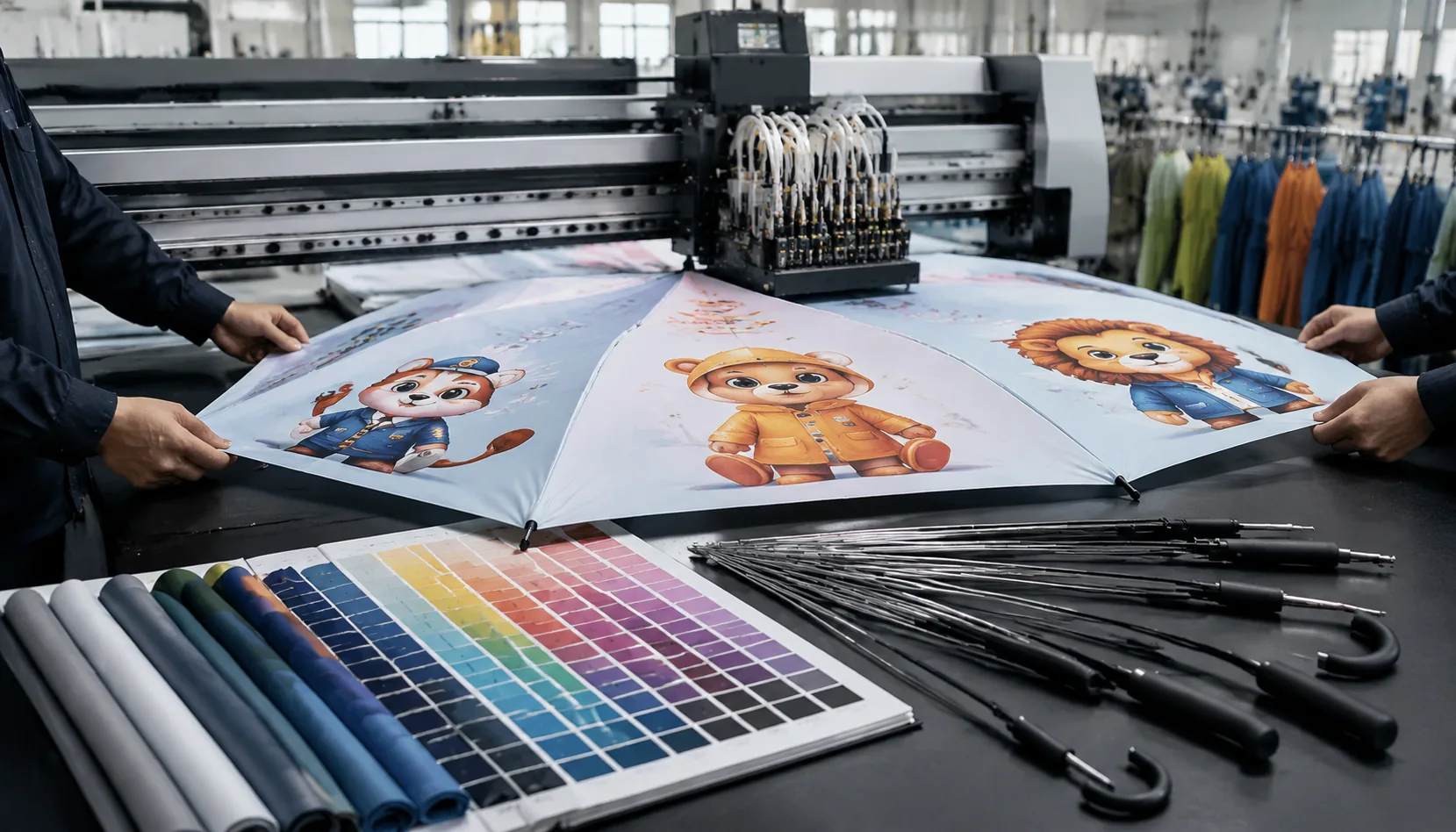
Turning a mascot into a clean umbrella canopy print is not just a file-to-fabric job; every panel seam, rib position, fabric coating, and ink system can change how the character reads when the umbrella is open. On our Songxia factory floor, mascot printed umbrellas usually need early artwork separation, panel-by-panel layout checks, strike-off sampling, and safety review before bulk cutting. The risk for buyers is paying for vivid art that distorts, bleeds, or fails QC at scale.
Decide the Role of the Character Artwork
The first decision is scale: is the mascot a small trust mark, a selling character, or the whole reason someone buys the umbrella? For sports clubs and schools, I usually recommend a restrained mascot printed umbrellas layout: crest or character head on two opposite panels, team color on the remaining panels, and a clean 23" or 27" frame that spectators will actually carry. This keeps the umbrella readable from 10–20 meters without turning it into a noisy billboard. On 190T pongee, screen printing works well for 1–3 solid colors; if the mascot has gradients, fur texture, or comic-style shadows, heat transfer or sublimation gives cleaner edges. A small mascot accent also protects budget because registration tolerance is easier to control across 8K steel or fiberglass ribs, especially when the canopy is being sewn after printing.
A hero graphic across one panel is better when the character has emotional value: theme parks, beverage brands, retail collaborations, and event merchandise. One oversized face, pose, or scene on a single canopy panel can be stronger than repeating the same artwork eight times. The limitation is geometry. Umbrella canopy artwork is not a flat poster; each triangular panel narrows toward the top, and ribs interrupt the viewing angle. For 21" and 23" folding umbrellas, keep the hero character below the top cap area and away from seam allowance by at least 15–20 mm. For 27" or 30" golf umbrellas, a full-body character can sit on one or two adjacent panels, but we still split the file by panel before printing. Our standard practice at ZheBrella is to proof the layout on a paper canopy mockup before opening production screens or transfer films.
A repeated story pattern suits character printed umbrellas when the goal is retail shelf appeal or collectible merchandise rather than long-distance recognition. Schools may use small mascots, stars, books, and graduation years; beverage brands may repeat cans, fruit, slogans, and branded character umbrellas across alternating panels; theme parks often mix the mascot with ride icons or seasonal elements. This approach works especially well with sublimation on white 190T or 210T pongee because the print can run edge-to-edge with multiple colors and no heavy ink hand feel. For promotional umbrella printing, I would avoid tiny facial features under 3 mm, because they blur after coating, stitching tension, and normal viewing distance. If the order uses POE or transparent PVC/EVA canopies, simplify the character into bold outlines; transparent materials show every registration mistake and scratch more clearly than woven pongee. Always choose the role first, then size, rib count, coating, and print method.
Simplify Artwork for Curved Canopy Panels
The biggest mistake with mascot printed umbrellas is treating the canopy like a flat poster. A 23" or 27" umbrella canopy is a set of curved triangular panels pulled tight over ribs, so thin outlines, tiny eyes, whiskers, badge details, and small trademark symbols disappear faster than buyers expect. For screen printing, I like main character outlines at 1.2–1.5 mm minimum after scaling, with internal facial lines no thinner than 0.8 mm; for heat-transfer or sublimation on 190T/210T pongee, you can go slightly finer, but only if the artwork has clean contrast. Text under 12–14 pt on the final panel usually looks weak from normal viewing distance, especially on dark fabric with white underbase. If the mascot has a smiling mouth, glasses, paws, or a product held in its hand, those features should be enlarged before sampling, not “fixed” later on press.
Panel planning matters as much as the logo file. On an 8K umbrella, each canopy panel gives more uninterrupted printable space, so one large mascot face or full-body character can sit cleanly across one or two panels without too many seam breaks. On 16K frames, the umbrella looks premium and rounder, but there are twice as many ribs and seams, which means more places for eyes, noses, brand names, or character hands to get cut visually. Our standard practice at ZheBrella is to place critical facial features at least 20–25 mm away from seam stitching and rib lines, then check the layout on a real panel template before making screens. For branded character umbrellas, I would rather shift the mascot slightly off geometric center than let a rib run through the mouth or pupil.
More ribs are not bad; they just change the artwork strategy. A 16K canopy can work very well for smaller repeated graphics, such as a mascot head pattern, speech bubbles, icons, or alternating character poses, because each panel becomes its own controlled print area. For character printed umbrellas, repeated elements should be simplified into bold silhouettes or two- to four-color artwork so registration stays stable during promotional umbrella printing. Large wraparound umbrella canopy artwork is harder because fabric stretch, sewing tolerance, and panel angle can create 3–5 mm misalignment at seams even when cutting is accurate. Before bulk production, ask for a strike-off on the actual canopy fabric, not only a digital mockup. The strike-off should be opened on a frame and inspected from 1.5–2 meters away, because that is how customers actually see the mascot in rain, sun, and event photos.
Choose Printing Method by Detail Level
For mascot printed umbrellas, the printing method should be chosen from the artwork file, not from a price sheet. Screen printing is still the strongest choice for bold mascot marks: one to four solid colors, thick outlines, simple eyes, big logos, and repeatable brand colors. On 190T pongee, ink sits cleanly if the canopy has a standard water-repellent finish and the surface tension is controlled before production. On denser 210T pongee, the hand feel is smoother and the print edge can look slightly sharper, but ink deposit and drying time must be adjusted so the panels do not block during stacking. I would not use screen printing for small gradients, fur texture, or cartoon shading; it will either lose detail or require too many screens to stay economical. For 23 inch and 27 inch promotional umbrellas, screen printing normally gives the best balance of durability, cost, and color consistency when the mascot is a bold brand asset rather than a full illustration.
Heat transfer works better when character printed umbrellas need crisp spot graphics, thin linework, or a mascot badge with multiple colors but limited print area. The film carries detail more cleanly than direct screen ink, especially on curved canopy panels where small facial features can break up during manual printing. It is useful for branded character umbrellas with sharp outlines, event names, QR codes, or a mascot combined with a sponsor logo. The caution is coating compatibility: heavy Teflon-style water-repellent treatment, UV coating, or silicone-rich finishes can reduce adhesion if the factory does not test temperature, dwell time, and peel behavior. Our standard practice at ZheBrella is to press test panels first, then run tape pull, rubbing, folding, and water-spray checks before approving bulk production. Heat transfer can feel slightly thicker on 190T pongee and more controlled on 210T pongee, but either fabric can work if the film, glue layer, and canopy coating are matched correctly.
Digital printing is the right tool for full-color umbrella canopy artwork: gradients, shadows, anime-style characters, watercolor mascots, and photographic brand scenes. Sublimation is excellent on white or light polyester pongee because the dye bonds into the fabric instead of sitting heavily on top, while UV or digital pigment methods may be considered for darker canopies or special layouts. For promotional umbrella printing, digital also avoids high screen setup costs when the order has many character versions, but buyers should expect tighter control on fabric shade, ICC color profiles, and panel alignment. A 21 inch folding umbrella with eight panels is less forgiving than a 30 inch golf umbrella because small cutting or sewing movement can shift facial features across seams. Always approve a pre-production sample, not just a flat digital proof. Check the opened umbrella under daylight, spray it with water, fold it after drying, and confirm the mascot still looks correct across the canopy curve before releasing bulk production.
Match Frame, Size, and Audience
For promotional umbrella printing at outdoor events, size and coating usually matter more than adding another color to the mascot. A 30" 8K or 16K golf umbrella with 190T or 210T pongee, silver UV coating, and UPF 50+ rating gives real shade for festivals, golf days, and amusement parks where the umbrella functions like moving signage. Our standard practice at ZheBrella is to confirm whether the artwork is screen print, heat transfer, or sublimation before locking the frame, because heavy full-panel character art on thin pongee can show rib marks after tensioning. For mascot printed umbrellas ordered as giveaways, I would rather quote a 23" manual-open steel frame that passes AQL 2.5 than over-spec an auto-open model with weak tips and inconsistent canopy alignment.
Compliance, MOQ, and Bulk Quality Control
Licensed characters need paperwork before screens, films, or digital print profiles are made. For character printed umbrellas tied to cartoons, sports mascots, game IP, or school marks, the buyer should provide authorization from the rights holder, approved usage zones, and the exact umbrella canopy artwork file in AI, PDF, or layered PSD. I always ask for Pantone TCX/TPX or coated Pantone references, not just RGB screenshots, because 190T and 210T pongee absorb ink differently than POE, PVC, or EVA panels. For mascot printed umbrellas, the approval sheet should show logo size, character placement by panel, bleed allowance near seams, and whether the design is screen printed, heat-transfer printed, or sublimated. If the mascot crosses two canopy panels, we add a tolerance note because sewing and rib tension can shift alignment by 2–3 mm after assembly.
MOQ should be stated by SKU, not only by total order quantity. A 23-inch auto-open straight umbrella with 8K fiberglass ribs, a 21-inch folding auto-open-close model, and a 30-inch golf umbrella with double-canopy venting are different production jobs, even if they share the same mascot. For promotional umbrella printing, practical MOQ often starts around 300–500 pieces per SKU for simple one-color screen print and 1,000 pieces or more for all-over sublimation or custom dyed fabric. Pre-production sample lead time is usually 7–10 days after artwork approval, or 12–15 days if color strike-offs and packaging mockups are required. Bulk lead time commonly runs 25–35 days after sample sign-off and deposit, depending on rib count, handle tooling, carton labeling, and whether shipment is FOB Ningbo/Shanghai or DDP to the buyer’s warehouse.
Final inspection should not be treated as a carton-count exercise. Our standard practice at ZheBrella is AQL 2.5 for major defects, with checks covering print clarity, color consistency against the approved standard, rib alignment, runner smoothness, sharp edges on tips and stretchers, canopy tension, and packaging labels. For branded character umbrellas, inspectors open sampled units fully, rotate the canopy under neutral light, and check whether eyes, outlines, text, and mascot borders remain sharp at seam lines. They also confirm hangtags, barcode stickers, inner polybags, master carton marks, and country-of-origin labels match the purchase order. Functional checks should include manual, auto-open, or auto-open-close operation for at least several cycles, plus a basic water-spray test on coated pongee. If windproof claims are made, the inspection file should reference the agreed structure, such as fiberglass ribs, steel shaft, vented double canopy, and any 50+ mph wind-tunnel rating.
Frequently Asked Questions
Can a mascot be printed across multiple umbrella panels?
Yes, but the artwork must be engineered to avoid critical details crossing seams. A full open-canopy proof and physical sample are needed before bulk cutting.
What file format is best for character umbrella printing?
Vector files are best for simple mascot marks, while high-resolution layered files work for digital full-color art. The factory should place artwork onto the exact umbrella panel template before sampling.
What artwork files are needed for mascot or character umbrella printing?
Vector AI, EPS, or PDF files are preferred for line art and logos, while high-resolution PSD or TIFF files at 300 dpi are used for detailed character illustrations. Artwork should be separated by canopy panel with bleed, seam allowance, and Pantone or CMYK color references.
Can one character design continue across multiple umbrella panels?
Yes, but the artwork must be adjusted for panel seams, rib positions, and fabric stretch so the character aligns after sewing. A pre-production sample is recommended before bulk production, especially for full-canopy mascot layouts.
What MOQ and lead time should buyers expect for branded character umbrellas?
Typical OEM orders start around 500 to 1,000 pieces per design, depending on frame, fabric, and print method. Sampling usually takes 7 to 12 days, with bulk production often requiring 25 to 40 days after artwork and sample approval.
Looking to Launch Your Custom Umbrella Line?
ZheBrella is a Zhejiang-based OEM/ODM umbrella manufacturer with 17 years of export experience. Free design, low MOQ from 100 pieces, windproof construction, full-color print.
Get Free Quote Now »People Also Search For
Related Articles
Character and Mascot Printing on Branded Umbrella Canopies
Plan mascot umbrella printing with clear artwork rules, fabric and rib choices, approval samples, and inspection checks ...
Read More »
Mascot and Character Printing on Branded Umbrellas
Build mascot umbrella programs with clear artwork rules, fabric choices, print methods, approval samples, and QC standar...
Read More »
Mascot and Character Printing on Branded Umbrella Panels
Build mascot or character umbrellas with better artwork control, panel placement, fabric selection, sampling, and licens...
Read More »