Character and Mascot Printing on Branded Umbrella Canopies
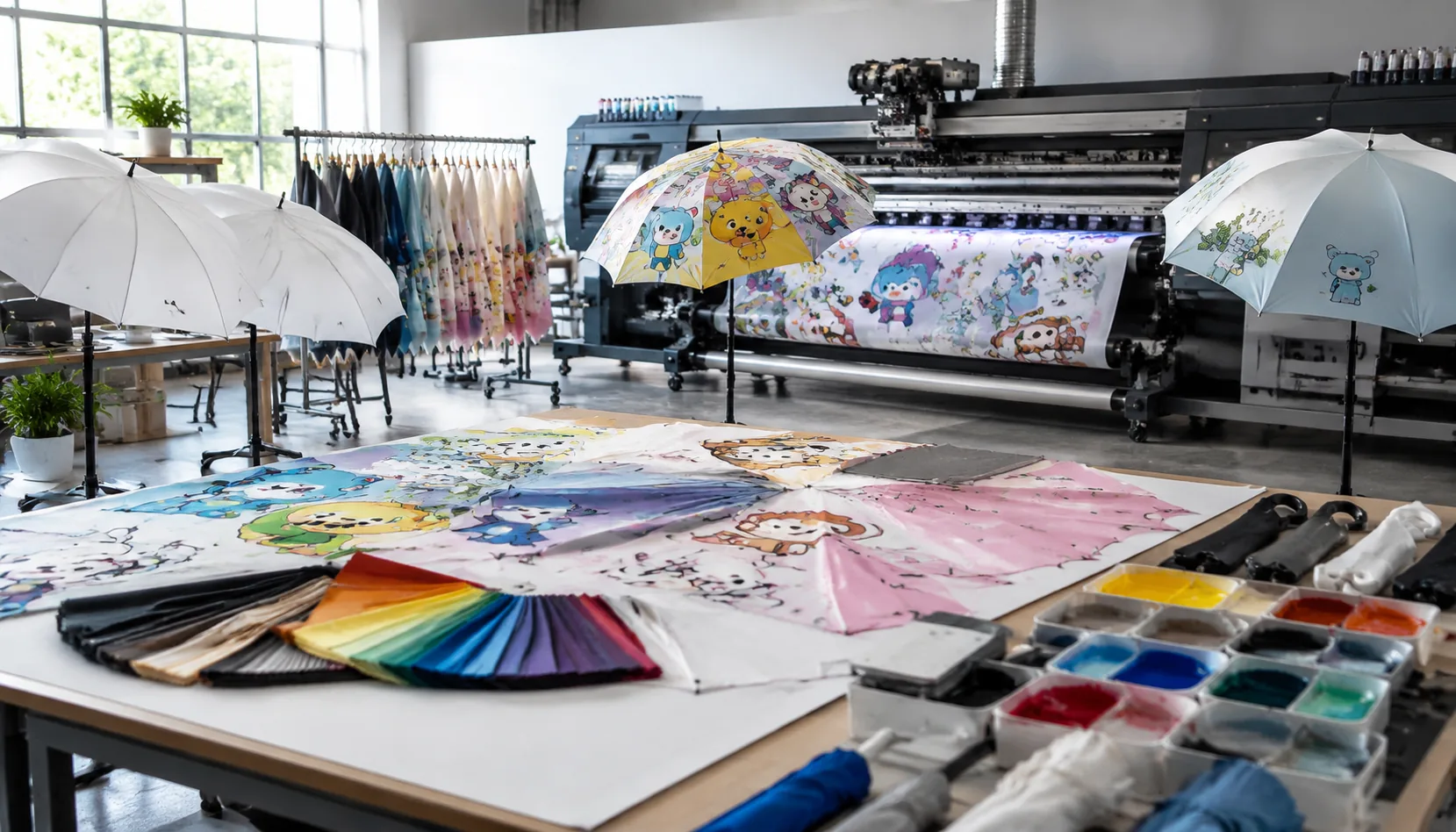
A mascot canopy looks simple on a mockup, but on the cutting table every panel seam, rib position, and fabric stretch can distort the character if the artwork is not engineered early. For licensed brand campaigns, mascot umbrella printing needs tighter control than a standard logo job: color tolerance, panel registration, sample approval, and final inspection all have to match the buyer’s sign-off. On our Songxia production floor, most problems are prevented before screens, heat transfers, or digital files ever reach bulk production.
Why Mascot Artwork Needs Different Planning
Mascot artwork is less forgiving than a normal one-color logo because the human eye notices faces before it notices text. If an eye shifts 2 mm, a mouth line thickens, or a black outline does not land cleanly over a color fill, the character looks “wrong” even when the umbrella is technically usable. This is why mascot umbrella printing needs tighter artwork review, better panel positioning, and more careful sampling than a basic corporate mark on 190T pongee. On an 8-panel 23" auto-open umbrella, the canopy is not a flat poster; each triangular panel stretches over ribs, seams, and a curved frame. A round face printed across two panels can distort at the seam, while a full-body character may lose proportion when the canopy is tensioned. For branded canopy artwork with faces, paws, helmets, school mascots, or cartoon outlines, we usually recommend placing the main character inside one panel or designing intentional breaks around seam lines.
Sports teams, schools, amusement parks, retail brands, and event sponsors all run into the same issue: their mascot is often protected, emotionally recognizable, and heavily reviewed by stakeholders. A character logo umbrella for a university alumni campaign may need exact school colors, while a theme-park giveaway may require licensed umbrella branding rules for line weight, eye shape, costume details, and trademark clearance. Promotional mascot umbrellas for stadium nights or children’s retail sets also have viewing-distance requirements; a mascot that looks sharp on a PDF can become muddy when reduced to a 120 mm chest badge on the canopy. For spot-color screen printing, we check trapping between colors and usually avoid hairline outlines under 0.4 mm. For heat transfer or sublimation on 210T pongee, we watch gradients, skin tones, and edge sharpness because over-saturation can make cartoon faces look dirty rather than bright.
Planning should start with the final umbrella structure, not just the mascot file. A 21" folding umbrella gives less print area and more panel curvature, so large faces need simplified detail. A 27" golf umbrella or double-canopy windproof model gives more space, but vent seams and overlapping panels can interrupt tails, cap brims, or trademark symbols if the layout is not mapped correctly. At ZheBrella, our standard practice is to request vector AI/PDF artwork, Pantone references, licensing notes, and a marked print position before making a pre-production sample. For important licensed programs, buyers should budget 5–7 days for digital mockups, 7–10 days for physical sampling, and AQL 2.5 inspection focused on registration, color deviation, seam alignment, and panel-to-panel consistency. That extra planning costs less than rejecting 3,000 umbrellas because the mascot’s face looks slightly off.
Choosing the Right Canopy and Frame Format
For mascot visibility, the umbrella shape matters more than most buyers expect. A 21" compact is convenient for mailers and retail bundles, but the curved canopy is broken into small visual zones, so a full-body character often looks chopped unless the artwork is simplified into a head, face, or repeating icon pattern. A 23" stick umbrella gives better street visibility and a cleaner arc for a character logo umbrella, especially when the mascot sits across two adjacent panels. A 27" or 30" golf umbrella is the strongest choice for event photos, team sponsorship, and parking-lot use because the canopy becomes a walking billboard; however, freight volume rises fast, so FOB unit cost is not the only number to check. For mascot umbrella printing, I usually push buyers toward 190T or 210T pongee rather than cheap polyester because it holds tighter registration in screen printing and accepts heat-transfer edges without fuzzy bleeding.
Panel count changes how the mascot reads from five meters away. An 8K canopy gives eight larger printable triangles, which is better for bold faces, animal heads, school mascots, and promotional mascot umbrellas where instant recognition beats fine detail. A 16K canopy looks premium and rounder, but the narrow panels cut artwork into more seams; it works best for step-and-repeat branded canopy artwork, small character badges, or alternating color panels. If the design must cross panel seams, expect more sewing tolerance risk: even a 3–5 mm shift at the seam can make eyes, teeth, or outlines look wrong. For licensed umbrella branding, I recommend approving a 1:1 panel layout before strike-off, not just a flat JPG mockup. Double-canopy vented golf styles add wind value, often surviving 50+ mph in tunnel-style checks when built correctly, but the upper vent can interrupt large mascot graphics unless the layout is planned around it.
Frame choice should match the user, not just the price target. Steel ribs are cheaper and feel solid on basic stick umbrellas, but they bend permanently after inversion; fiberglass ribs cost more but recover better, especially on 8K and 10K golf frames exposed to wind at sports events or theme-park queues. Auto-open is useful on 23" stick and 27" golf umbrellas because one-hand operation feels retail-ready, while auto-open-close makes sense mainly for compact models where commuters value convenience. For kids' umbrellas, I avoid aggressive spring mechanisms, sharp metal tips, and heavy 16K frames; safer builds use rounded plastic tips, pinch-proof runners, lighter fiberglass or coated steel ribs, and POE or EVA canopies when visibility through the umbrella is needed. A kids' mascot canopy should keep the character large and friendly, usually on 8K panels, with UPF 50+ coating only when the coating does not stiffen the fabric or distort print color.
Print Method Decisions for Fine Character Detail
For bold flat art, screen printing is still the most stable choice on 190T or 210T pongee when the mascot has clean outlines, solid brand colors, and limited shading. A 23" or 27" canopy panel gives enough print area for a character logo umbrella, but the artwork must be separated correctly: each Pantone color needs its own screen, and fine black key lines should usually stay above 0.25 mm after fabric stretch. On the sewing floor, I see most failures come from buyers sending web graphics with thin gradients and expecting them to behave like vector art. Screen printing can hold crisp mascot eyes, jersey numbers, and flat cartoon shapes, but it is not the right process for airbrushed fur, watercolor shadows, or complex full-color game characters.
Digital printing is better for mascot umbrella printing when the character includes shadows, skin tones, 4-color costume details, or soft transitions across the canopy. It works especially well for branded canopy artwork that crosses multiple panels, but the file must be built around rib positions, seam allowance, and panel distortion; a perfect circle on a PDF can look slightly pulled after stitching on an 8K or 10K frame. For licensed umbrella branding, we normally ask for AI or layered PSD files at full size, plus a brand color guide and approved character sheet. Digital print samples should be checked under daylight, warehouse LED, and wet-fabric conditions because pongee absorbs and reflects ink differently after calendaring and water-repellent treatment.
Transfer printing is useful for smaller placements: a chest-style mascot on one panel, sponsor logos beside a character, or promotional mascot umbrellas where the main canopy stays solid color and only a compact graphic changes by event. Heat transfer can give strong color on 190T pongee, but heavy films may feel stiff and can telegraph a border if the press temperature, dwell time, or pressure is wrong. Coated UPF 50+ fabric adds another complication: UV coatings and Teflon-style water-repellent finishes can reduce ink bite, slow curing, or change gloss between printed and unprinted areas. Our standard practice at ZheBrella is to test the exact production fabric before quoting bulk, then run adhesion, rub, fold, and rain-spray checks before approving AQL 2.5 inspection criteria.
Licensing, Approvals, and Pre-Production Samples
Licensing must be settled before the factory opens a screen, because character artwork is not the same as a normal corporate logo. For mascot umbrella printing, the buyer should provide original vector files, approved raster artwork at 300 dpi if gradients are involved, Pantone Solid Coated references, and written authorization from the brand owner or license holder. I have seen orders delayed 12 days because a distributor sent a low-resolution PNG of a cartoon face and assumed we could “make it sharp.” We can redraw, but that creates approval risk. For licensed umbrella branding, every visible element matters: eye shape, outline thickness, facial expression, character spacing, and even the white gap between colors. If the umbrella is going into retail, amusement parks, school programs, sports events, or children’s promotions, the PO should name the IP owner, territory, use period, and whether the artwork is approved for promotional mascot umbrellas or only for packaging and digital ads.
Branded canopy artwork should be locked before sampling, not adjusted casually after the first print strike-off. For a character logo umbrella, we normally ask for panel-by-panel placement drawings showing whether the mascot sits on one 23-inch panel, repeats across 8K panels, or crosses seams on a 27-inch golf umbrella. Crossing seams looks good in a rendering but is harder in production because pongee 190T or 210T stretches slightly during cutting and sewing; a 2–3 mm shift at the rib seam can make a character’s face look crooked. Color references should include Pantone numbers plus tolerance guidance, because heat-transfer, screen print, and sublimation do not hit color the same way on dark navy, red, or custom-dyed panels. If custom panel colors are required, approve fabric lab dips first, then approve printed strike-offs, then move to a full pre-production sample. Skipping that order creates arguments no AQL 2.5 inspection can solve later.
Golden sample sign-off should be physical whenever the artwork is complex, especially when the design includes detailed eyes, fine outlines under 0.4 mm, metallic ink, glow effects, or multiple characters on alternating panels. A realistic sample lead time is 5–10 days after final files are confirmed: 5–7 days for screen or heat-transfer on stock 190T pongee, and closer to 10 days when custom panel colors, sublimation matching, POE/PVC/EVA panels, or special coatings such as Teflon or UPF 50+ are involved. At ZheBrella, our standard practice is to photograph the sample under daylight and factory light, but still treat the signed physical umbrella as the control sample for bulk production. The buyer should approve canopy color, print position, handle logo, sleeve artwork, hangtag, carton mark, and opening mechanism—manual, auto-open, or auto-open-close—before deposit production starts. Once bulk fabric is cut, changing a mascot position is no longer a small artwork revision; it becomes wasted panels, lost days, and avoidable cost.
Quality Control for Character Accuracy
Character accuracy is not a “looks close enough” item; it belongs in the AQL 2.5 visual inspection checklist because a small face error can make a mascot look off-brand or legally unacceptable. For mascot umbrella printing, our inspectors check face distortion first: eyes must stay round, mouths cannot stretch across sewn seams, and the head shape must not warp after the canopy is tensioned on 8K or 10K frames. Outline registration is checked at normal viewing distance and close range; black keylines should not drift more than about 1 mm from the color fill on 190T or 210T pongee. Missing color is treated as a major defect when it affects facial features, sponsor marks, or licensed umbrella branding elements. We also inspect panel placement against the approved layout: a character logo umbrella printed across two panels needs the face centered away from rib tips, bartacks, and the top cap area where fabric curves most aggressively.
Production units must be opened on the frame during inspection, not judged as loose fabric on a table. A print that looks straight before assembly can twist once the canopy is sewn, stretched, and fixed to fiberglass or steel ribs. For branded canopy artwork, we check cracking by opening and closing the umbrella several times, then flexing printed areas near fold lines; heat-transfer prints and thick screen inks are more prone to hairline cracks than sublimation, especially on dark pongee with heavy white underbase. Canopy stains are also part of AQL 2.5 because light POE/PVC/EVA panels and white printed faces show oil marks, chalk dust, needle dirt, and packing rub very quickly. On promotional mascot umbrellas, even a tiny stain near a cheek or eye reads as a printing fault to the end user, so inspectors separate true ink defects from handling contamination before counting defects.
Inspectors should compare production units against an approved physical sample, not only the PDF artwork, because digital files do not show fabric shrinkage, ink absorption, seam loss, or color shift after curing. A PDF may specify Pantone colors, but the actual red on 210T pongee with a water-repellent coating can dry flatter than expected, while sublimation on white polyester often looks brighter. The physical sample also confirms the real tolerance for mascot umbrella printing: line weight, cheek color, eye spacing, logo size, and the exact panel where the character lands after sewing. Our standard practice at ZheBrella is to keep the signed sample at the inspection table and check random opened umbrellas beside it under consistent lighting, then record defects by type and location. That prevents arguments later, especially for licensed umbrella branding where the brand owner approved the sample, not an abstract file viewed on different monitors.
Frequently Asked Questions
What file type is best for mascot umbrella artwork?
Vector AI or PDF files are preferred for outlines and flat colors, while high-resolution PSD or TIFF files may be needed for shaded digital prints. All files should include color references and approved logo usage rules.
Can mascot artwork be printed across two umbrella panels?
Yes, but it requires careful seam planning and buyer approval because stitching and rib breaks can interrupt faces or text. Critical facial details should usually stay within one panel when possible.
What artwork files are needed for mascot umbrella printing?
Vector files such as AI, EPS, or PDF are preferred for logos, outlines, and licensed characters. For raster artwork, provide 300 dpi files at actual print size, with Pantone color references for brand approval.
Can each umbrella panel carry a different character or pose?
Yes, each canopy panel can use different artwork, but panel alignment and seam allowances must be built into the layout. For most 8-panel umbrellas, factories typically request 10–15 mm bleed and a production proof before bulk printing.
How are licensed umbrella samples approved before mass production?
A pre-production sample is usually made with the final fabric, frame, print method, and packaging. Buyers should confirm color accuracy, character placement, rib alignment, and print adhesion before approving bulk production, which commonly takes 30–45 days after sample approval.
Looking to Launch Your Custom Umbrella Line?
ZheBrella is a Zhejiang-based OEM/ODM umbrella manufacturer with 17 years of export experience. Free design, low MOQ from 100 pieces, windproof construction, full-color print.
Get Free Quote Now »People Also Search For
Related Articles
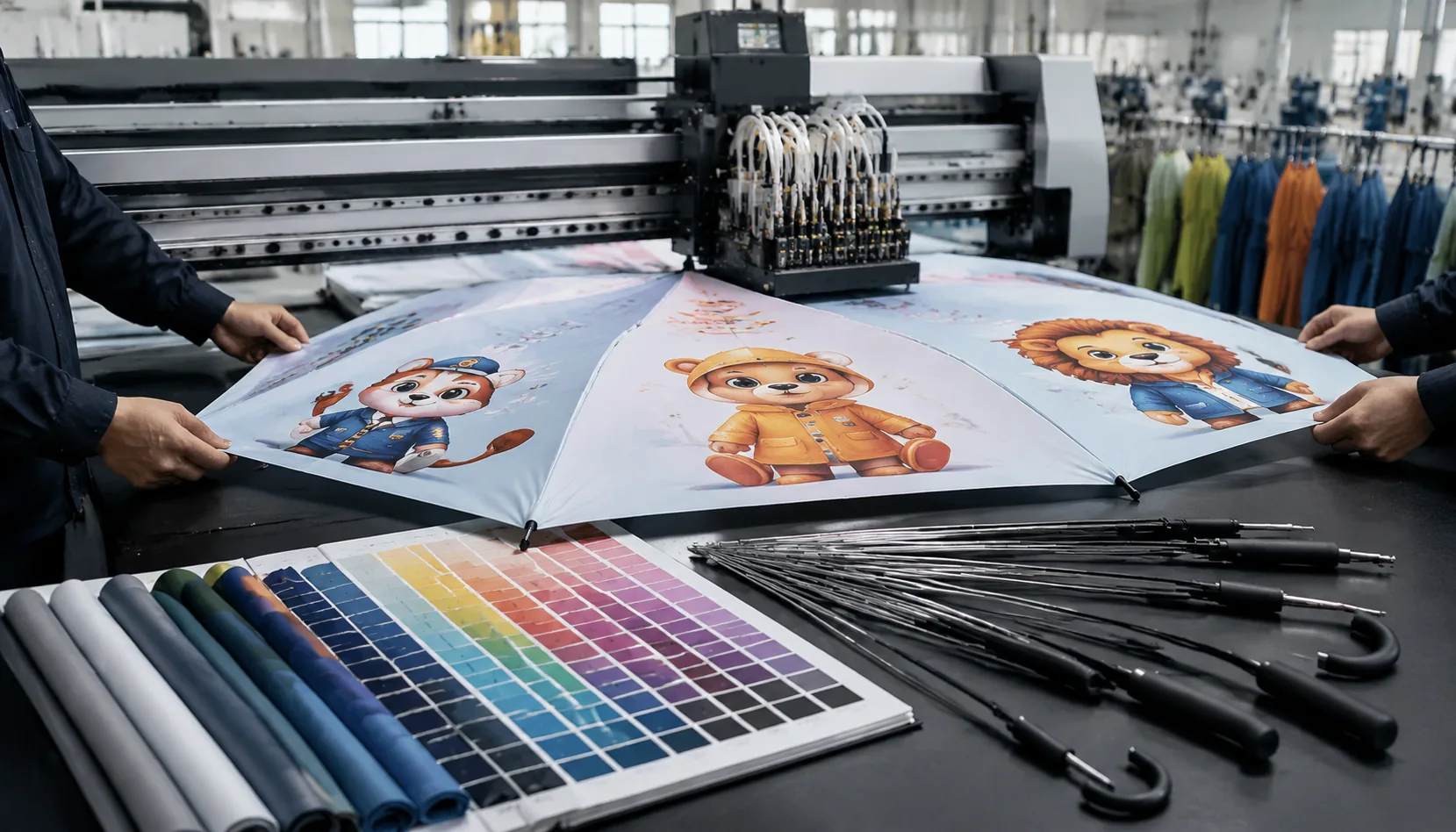
Brand Mascot and Character Printing on Umbrella Canopies
Turn mascots and character art into manufacturable umbrella prints with correct panel layout, fabric choice, sampling, s...
Read More »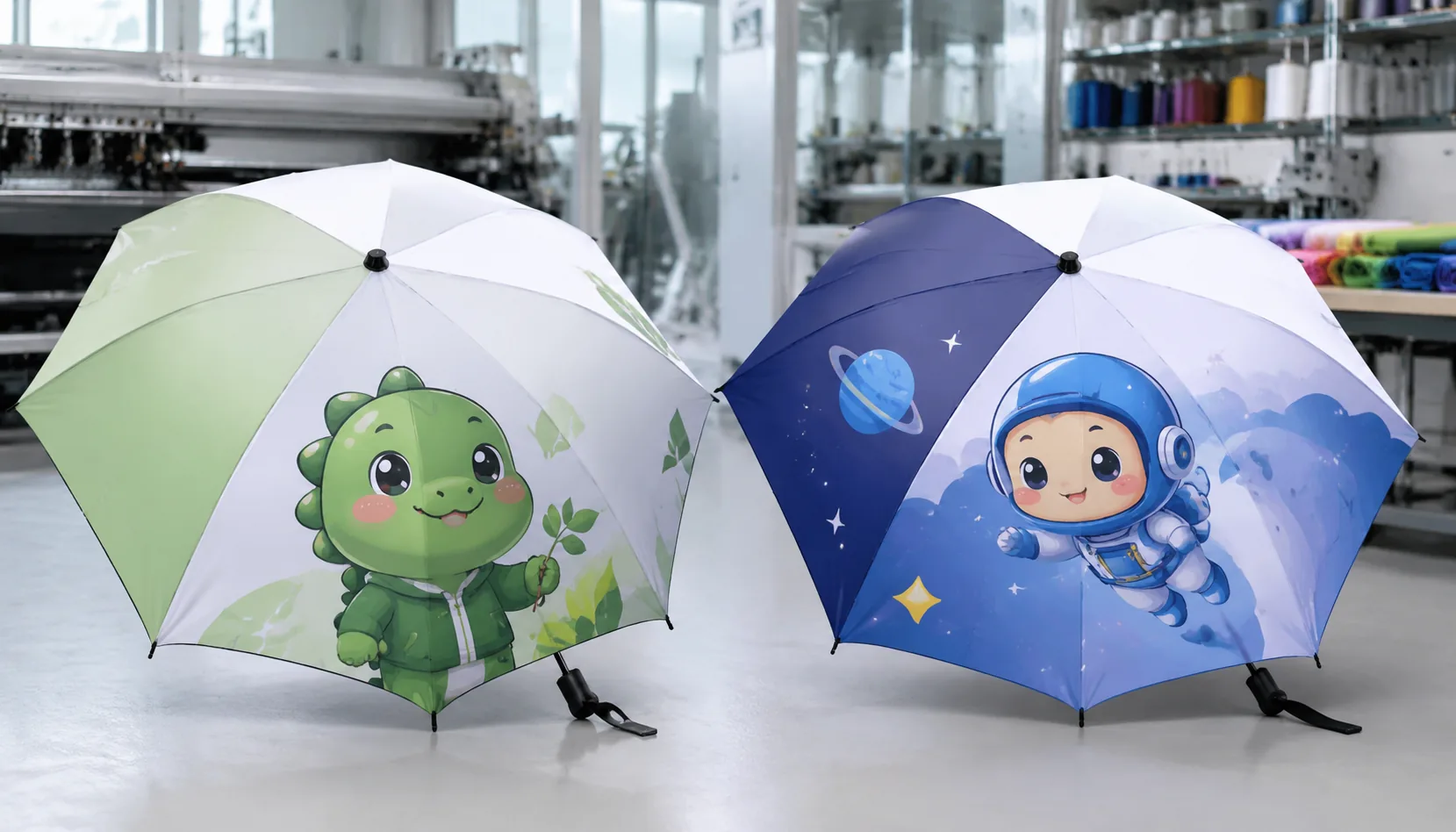
Mascot and Character Printing on Branded Umbrella Panels
Build mascot or character umbrellas with better artwork control, panel placement, fabric selection, sampling, and licens...
Read More »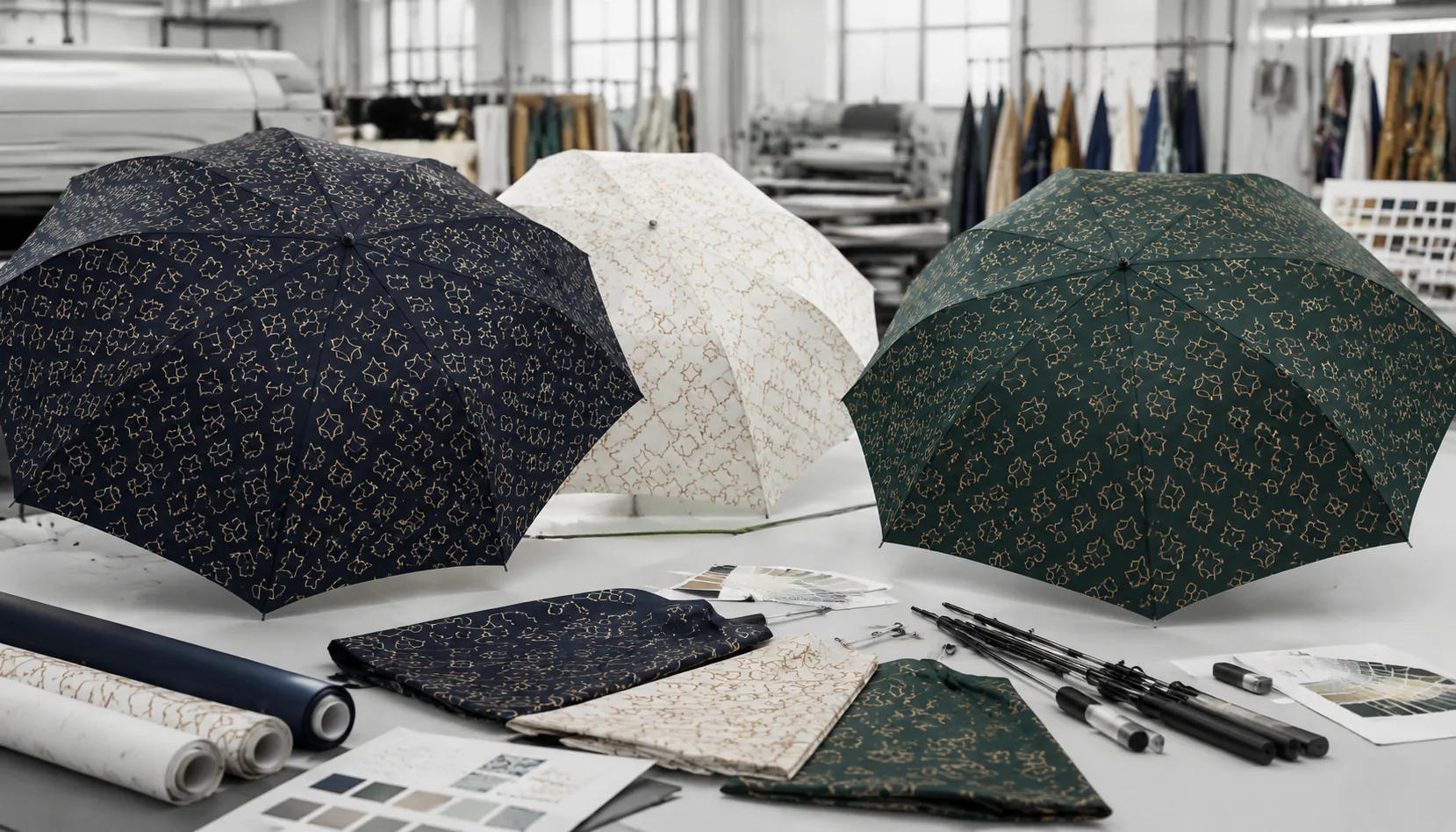
Step-and-Repeat Logo Patterns for Branded Umbrella Canopies
Plan repeated logo umbrella canopies with clean spacing, panel registration, fabric choices, sampling steps, and AQL che...
Read More »