Matching Logo Methods to Umbrella Order Volume and SKU Mix
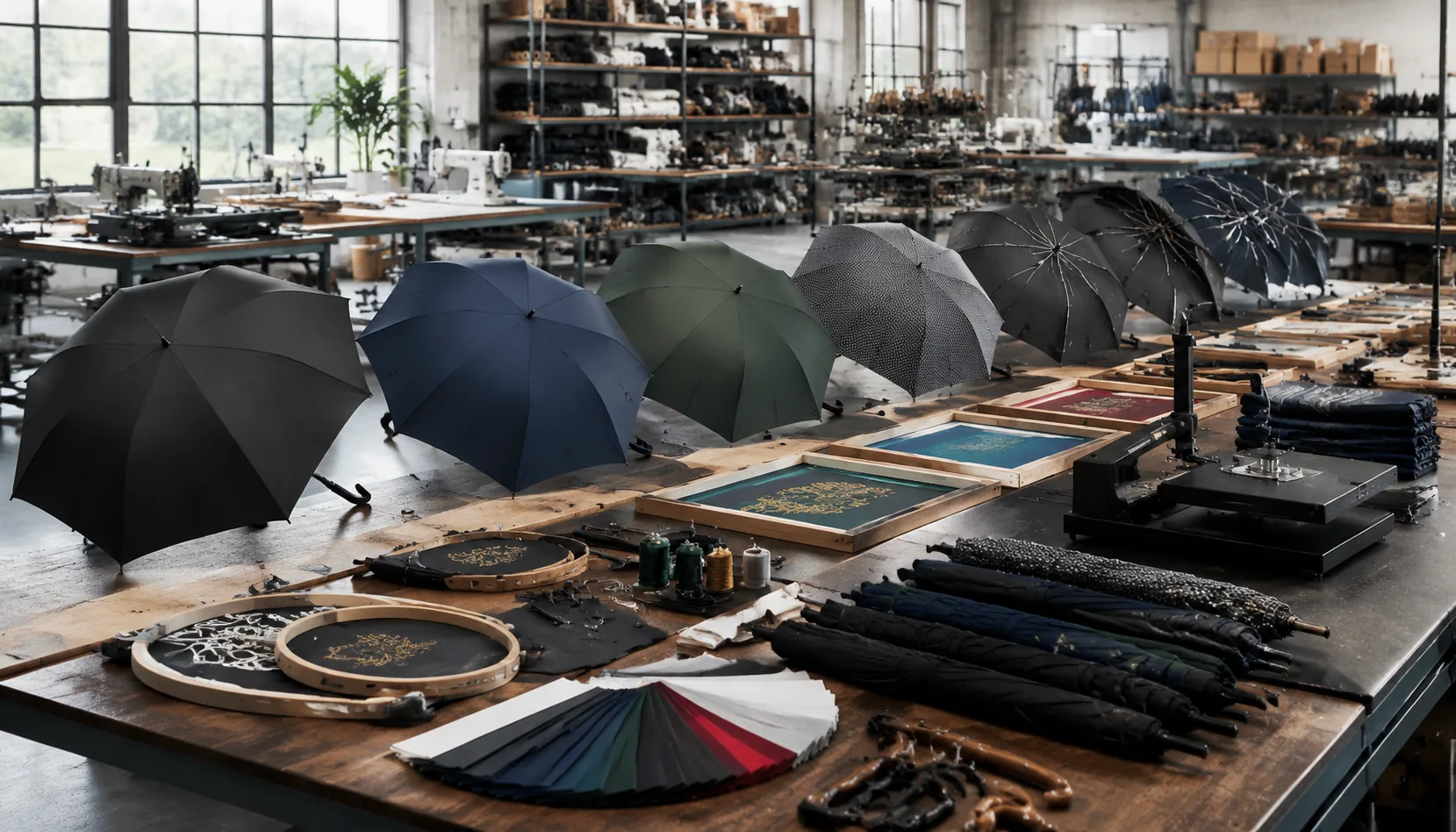
When you're sourcing custom umbrellas, the mismatch between your order volume, SKU complexity, and the chosen logo method can quietly erode margins—whether you're running a 500-piece promo run or a 50-SKU retail line. The right umbrella logo method by order volume isn't just about cost per unit; it's about lead time feasibility and setup waste across multiple designs.
Start With Order Volume, SKU Count, and Brand Goals
Start with three variables: total units, number of SKUs or colorways, and the target landed price. A single-SKU bulk order of 500-5,000 umbrellas usually supports screen print because one setup can spread across the run, and a $80-$150 setup per color is easier to absorb when the same logo repeats. Once the order breaks into 6-12 promotional umbrella SKUs at about 200 units each, screen print minimums per colorway start to dominate the quote, so digital print or heat transfer becomes more feasible. That is the core umbrella logo method by order volume decision: check MOQ umbrella printing against both SKU count and decoration colors before you commit, or you will approve a method that looks cheap at total volume and expensive at each variant.
Use the order type to narrow the method. Retail assortments often run 3-5 colorways at 1,000 units per SKU; that volume can still work with screen printing if the artwork stays at 2-3 colors and the margin can carry the setup charge. Event orders are different: 300 units split across 10 branded versions usually favor digital print because the setup is lighter and digital print lead time is typically 10-14 days, compared with 20-25 days for screen printing. The trade-off is higher unit cost, often $0.50-$1.00 more, and weaker opacity on dark canopies. For buyers managing dozens of promotional umbrella SKUs, that difference matters more than the headline print price.
Close the decision with fabric and finish requirements. If the umbrella needs UPF 50+ or a Teflon-coated canopy, confirm the decoration method will tolerate the required cure temperature and will not damage the finish; screen print is usually the safer choice on treated fabric. For a low-cost giveaway under $3.00 FOB, digital print on uncoated polyester is often the cleanest fit. A practical umbrella logo method by order volume is straightforward: under 500 units per SKU, digital or heat transfer; 500-3,000 units with 1-3 colorways, screen print; above 3,000 units with 4+ colorways, sublimation for full-canvas coverage. That keeps procurement aligned to cost, lead time, and feasibility instead of forcing one decoration method across every buying pattern.
How Canopy Material and Frame Specs Limit Print Choices
Pongee 190T and 210T change what a printer can hold before the logo starts to spread, fade, or lose edge sharpness. On 190T, the weave is lighter and more open, so screen print can sit cleanly if mesh count, squeegee pressure, and cure time are matched to the fabric. On 210T, the denser surface usually improves color consistency and reduces show-through on light canopies, but it can also mute fine lines unless the ink deposit is tuned. For an umbrella logo method by order volume, the real check is a press proof on the actual canopy, not a PDF. That is how you verify ink holdout, edge definition, and repeatability across panels before you commit to MOQ umbrella printing.
Double-canopy windproof designs add registration risk because the outer and inner layers can shift relative to each other after stitching and again under wind load. A logo placed near the vent line may look centered when flat but drift once the umbrella is open, so placement needs a wider tolerance than on a single-canopy build. This affects screen print minimums and digital print lead time because the print fixture, panel indexing, and seam clearance all have to line up before production starts. Frame count changes the usable print area too: 8K and 16K constructions keep the same branding method, but 8K panels are wider and offer more uninterrupted space, while 16K panels are narrower, more curved, and closer to the stitch line.
For planning promotional umbrella SKUs, treat panel geometry as a hard limit, not a preference. A 23-inch or 27-inch umbrella on an 8K frame can usually take a larger centered mark than the same size on a 16K frame, even when the logo method stays the same. If the order mixes 8K and 16K structures, size the artwork to the narrowest panel and confirm registration in both open and closed positions before release. That reduces rework, keeps artwork consistent across SKUs, and avoids surprises when the same logo has to fit different canopy widths, seam counts, and curvature levels across one order.
Where Different Logo Methods Make Financial Sense
Screen printing is usually the lowest-cost umbrella logo method by order volume when the artwork is one or two spot colors, the placement is repeatable, and the panel has enough open area. On a standard 8K umbrella, a centered logo on one panel gives the best return because the screen setup is spread across 500, 1,000, or 5,000 pieces with tight placement and low variation. That is why screen print minimums are the first benchmark for MOQ umbrella printing on 23" or 27" promotional umbrellas made with pongee 190T. Once the art needs halftones, tight registration, or gradients, waste and labor rise quickly. In practice, a simple logo on a larger 8K panel often beats more complex branding on a smaller-panel 16K frame because the extra print area improves legibility and lowers the risk of rework.
Transfer printing sits between low-cost screen work and fully digital decoration. It is the better fit when the design needs 3 to 4 colors, sharper lines, or cleaner edge detail than a screen print can hold, but the order is not large enough to justify multiple screens. For buyers running several promotional umbrella SKUs under one artwork, transfer reduces prepress risk and keeps the same design usable across different canopy materials, including coated fabrics such as Teflon-finished cloth, POE, and PVC canopies. The tradeoff is extra handling, so it rarely wins on unit cost at high repeat volume. Its financial logic is simple: pay a little more per piece to avoid the setup burden and quality loss that come with forcing detailed art through a screen process.
Digital printing makes sense when the artwork itself drives the sale: full-color photos, gradients, variable data, or short runs split across many SKUs. With little or no screen setup, the main cost driver is file preparation and per-piece output, so the digital print lead time is often shorter than a screen-based job with multiple approvals. The limit is panel geometry. On 16K umbrellas, narrower panels compress the printable area, so detailed logos often need to be scaled down or simplified to stay readable. That is why buyers should judge break-even by volume, panel size, and art complexity together, not by decoration type alone. In many cases, a cleaner logo on a standard 8K model delivers better value than complex branding on a 16K umbrella because it lowers setup risk, protects legibility, and keeps total decoration cost under control.
Production Risks Buyers Should Confirm Before Approval
Treat approval as a production-risk gate, not a design review. Before sampling starts, lock the proofing checkpoints in writing: artwork orientation, Pantone target, panel alignment, seam placement, and the exact logo position relative to the runner, ferrule, and tie strap. That is the real basis for an umbrella logo method by order volume, because a method that looks clean on a flat proof can shift once the canopy is cut into gores and tensioned on the frame. For promotional umbrella SKUs, the factory should issue one signed sample, one pre-production print reference, and acceptance criteria for density, registration, edge bleed, and panel-to-panel repeat. MOQ umbrella printing and screen print minimums should be confirmed before approval, or setup cost will usually reappear as delay, forced SKU consolidation, or a higher unit price.
Auto-open clearance needs the same discipline. The button housing, stem travel, and runner spring must leave room for print build, sleeve thickness, and seam bulk so the umbrella opens cleanly after repeated handling; a sample that works once on the bench can bind after a few dozen cycles. Rib material matters here only as a durability and test context: fiberglass and steel ribs respond differently to repeated open-close checks, and that changes stress at joints, tips, and stitch points during approval. Buyers should require repeated cycle testing, print rub checks, shaft alignment checks, and a close test after handling, especially on auto-open and auto-open-close models. For print and assembly review, AQL 2.5 is the right release benchmark, with separate callouts for logo placement, missing stitches, loose tips, uneven canopy tension, and functional failures at the mechanism.
Inspection criteria should be set before bulk release, not after the first carton lands. The report should separate cosmetic defects from structural defects and show how each was counted against AQL 2.5, especially when multiple promotional umbrella SKUs share one order. That keeps logo quality, frame assembly, and mechanism performance from being mixed into one vague pass/fail judgment. Digital print lead time also has to be confirmed against sample approval dates, since artwork revisions can add several days even when the frame is already ready. The practical rule is simple: approve the print method, the mechanism clearance, and the inspection standard together, or you are approving three different risks with one signature.
Build the Final Quote Around Logistics and Reorder Speed
For repeat programs, quote the job on landed cost and calendar time, not factory price alone. Compare `FOB` and `DDP` line by line: `FOB` works when you already control ocean freight, customs clearance, duty, and last-mile delivery; `DDP` is easier when you want one delivered invoice, but only if the margin covers duty, brokerage, inland trucking, terminal handling, and destination fees. For a first run, budget 5 to 10 days before production for artwork approval, sample confirmation, panel strike-off, and carton proofing. A reorder should move faster because the `umbrella logo method by order volume`, logo position, and SKU packout were already approved on the last PO, so the factory can skip most of the setup loop and go straight to production.
Separate each promotional umbrella SKU before you compare quotes. A 23-inch auto-open fiberglass umbrella, a 21-inch manual fold, and a 27-inch golf umbrella may share the same logo, but they do not share the same panel layout, carton size, or shipping cube. Lock one vector file, one Pantone reference, one placement spec, and one carton label format before you ask for pricing. That matters for `MOQ umbrella printing` because screen print minimums, multi-color setup, and mixed-SKU cartons can change the quote more than the ink cost itself. If the order mixes canopy sizes or handle styles, ask the factory to price each SKU separately so you can see where setup and packout costs sit.
The fastest replenishment orders are the ones that remove rework before the PO is released. Freeze final artwork, exact logo size, carton counts, outer marks, and shipping labels, then confirm whether the factory will hold the same screens, digital files, or transfer plates for the next run. `Digital print lead time` is usually shorter on small mixed orders, but only when the artwork is approved and the canopy fabric is in stock; if the buyer keeps changing color, placement, or panel count, the time gain disappears. A practical MOQ strategy is to place a larger first order to lower unit cost and confirm fit, then reduce the reorder quantity once the approved specs are locked. That lets repeat orders bypass new samples and move directly into cutting, printing, and assembly.
Frequently Asked Questions
Does a larger MOQ always mean a cheaper logo method per umbrella?
Not always. Higher volume usually lowers unit cost, but only if the chosen print method matches the artwork and SKU structure. A large order split across many canopy colors or logo versions can erase the expected savings.
Why does SKU count matter so much in branded umbrella quoting?
Each colorway or logo variation can add setups, proofing time, and inspection points. A 5,000-piece order across one SKU is usually simpler and cheaper to brand than 5,000 pieces split across ten SKUs.
How should a buyer choose a logo method when ordering multiple umbrella SKUs?
For mixed SKU programs, digital print or transfer methods usually work better when each style has a smaller quantity. Screen printing is more efficient when one artwork is repeated across a larger run, often 300 to 1,000 pieces per SKU depending on ink count and panel size.
What MOQ differences should a procurement team expect between screen print and digital print?
Screen print setups usually need a higher MOQ because each color and artwork requires a separate screen. Digital print can often start at lower volumes, sometimes 100 to 200 pieces, but unit cost is usually higher than screen print on larger runs.
How does umbrella SKU count affect lead time for branded production?
More SKUs usually add setup time because each model may need its own proof, placement check, and packing allocation. A simple one-SKU run may finish in 15 to 25 days, while a multi-SKU order can extend to 25 to 40 days depending on artwork approvals and decoration method.
Looking to Launch Your Custom Umbrella Line?
ZheBrella is a Zhejiang-based OEM/ODM umbrella manufacturer with 17 years of export experience. Free design, low MOQ from 100 pieces, windproof construction, full-color print.
Get Free Quote Now »People Also Search For
Related Articles
Matching Logo Methods to Umbrella Order Quantities
Compare logo methods by MOQ, setup cost, and lead time so buyers can choose the right branding route for small runs, rol...
Read More »
Screen Print, Digital Print, or Heat Transfer for Umbrella Branding
Compare umbrella logo printing methods by cost, MOQ, color range, and fabric compatibility so buyers can choose the righ...
Read More »
Choosing the Right Logo Decoration Method for Branded Umbrellas
Compare umbrella logo methods by cost, detail, wash durability, and MOQ so buyers can match the right decoration to each...
Read More »