Metallic Ink Umbrella Logos for Premium Brand Programs
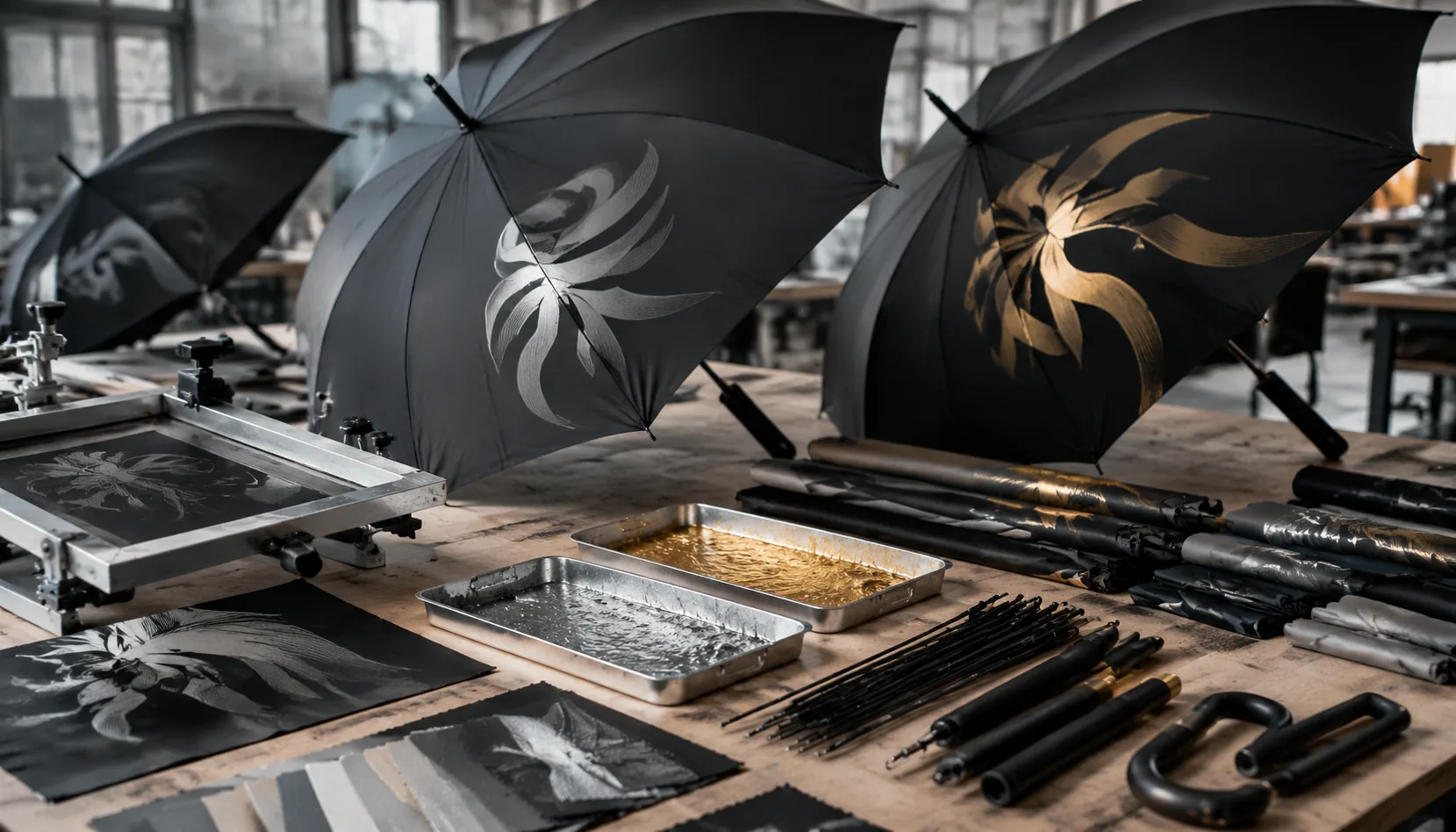
Premium buyers usually approve a shiny logo on a lab sample, then run into dull print, edge bleeding, or panel-to-panel color drift once the order hits production. For metallic logo umbrellas, the real work is matching coated pongee or polyester to the right metallic ink system, screen mesh, curing window, and placement tolerance before bulk printing starts. On our Songxia factory floor, those controls decide whether a premium program looks consistent across 500 pieces or 50,000.
Metallic Ink Use Cases for B2B Umbrella Orders
Metallic silver, gold, bronze, and pearl inks make sense when the umbrella is part of a premium visual program, not when the buyer only needs the cheapest giveaway. I recommend them for retail capsule runs, luxury gifting, five-star hotel guest umbrellas, VIP event kits, automotive launches, liquor promotions, and finance or real-estate client gifts where the logo needs to read as elevated from 2–3 meters away. On a black 23" auto-open golf umbrella or navy 21" folding umbrella, metallic ink gives a sharper brand cue than standard white screen print, especially for monograms, crests, serif wordmarks, and thin border lines. For metallic logo umbrellas, keep the artwork disciplined: one metallic color plus one flat support color usually prints cleaner than a full multicolor layout. Silver works well for tech and automotive, gold for hospitality and luxury gifting, bronze for outdoor or heritage brands, and pearl for bridal, beauty, or fashion programs where a softer reflection is preferred.
Metallic ink umbrella printing has a higher setup burden than standard screen print because the pigment load is heavier, the mesh choice is different, and press operators must control ink deposit more carefully. A normal one-color screen print order may start around 500 pieces per SKU in many factories, while metallic effects are more realistic from 1,000 pieces, sometimes 2,000 pieces if the buyer needs tight color matching across multiple panels, sizes, or shipments. The ink itself costs more, but the bigger cost is production control: extra drawdowns, slower curing, more frequent screen cleaning, and higher rejection risk if the logo floods or loses edge definition. Our standard practice at ZheBrella is to approve a physical strike-off before bulk production, then inspect adhesion, rub resistance, and alignment under AQL 2.5 rather than relying only on a digital mockup.
Metallic effects look best on darker 190T or 210T pongee because contrast and reflection are doing the work. Black, charcoal, navy, bottle green, burgundy, and dark purple give the pigment enough background depth to show the metal flake; on white, yellow, or light gray canopies, the same ink often looks weak unless the logo is large and simple. A 190T pongee logo print is usually the practical choice for promotional and hotel orders, while 210T pongee gives a tighter hand feel for premium branded umbrellas with better perceived retail value. I avoid metallic ink on heavily textured polyester, cheap PVC, or very stretch-prone panels because the surface can break up fine strokes. For OEM umbrella branding, metallic ink also pairs well with matte handles, black electroplated shafts, fiberglass ribs, and double-canopy windproof frames, but the buyer should lock fabric color first because metallic appearance changes noticeably under daylight, hotel lobby lighting, and event spotlights.
Fabric and Canopy Color Requirements
Metallic ink needs a tight, stable surface more than it needs a “premium” fabric name. For metallic logo umbrellas, 190T pongee is usually the safest starting point because the weave is fine enough to hold edge detail, but not so slick that the ink sits on top and cracks after opening cycles. A 190T pongee logo print with silver or champagne gold ink can pass normal tape-pull and wet-rub checks if the fabric has been heat-set properly and the water-repellent finish is not over-applied. 210T pongee gives a smoother hand feel and slightly sharper logo edges, but adhesion testing becomes more important because dense yarn and heavy coating can reduce ink bite. Standard polyester works for budget premium branded umbrellas, but the rougher filament texture can scatter metallic particles, making the logo look less mirror-like under retail lighting.
Canopy color changes the result as much as the ink formula. Deep navy, black, burgundy, and forest green usually give the strongest contrast because metallic pigments reflect cleanly against a dark field; gold on black and silver on navy are still the two combinations I trust most for executive gift programs. White, cream, sky blue, pale pink, and other pastel canopies are less forgiving because metallic ink loses visual weight without a dark background. On light colors, we often recommend a darker outline, a double-hit print, or switching from metallic ink umbrella printing to heat-transfer foil if the buyer expects a bright luxury finish. Metallic inks are not fully opaque like plastisol on T-shirts, so approving a lab dip and strike-off under both daylight and indoor LED light is not optional.
UPF 50+ coated fabrics need extra caution because the coating stack can interfere with adhesion. Silver-coated, black-coated, and some Teflon-treated pongee can repel ink if the surface energy is too low, especially on folding umbrellas where repeated panel flexing stresses the logo. Our standard practice at ZheBrella is to test metallic ink after canopy coating, not before, using cross-hatch adhesion, dry/wet rub, and 24-hour curing checks before bulk OEM umbrella branding starts. If the order uses auto-open 23" umbrellas or 27" golf umbrellas with 8K fiberglass ribs, the canopy panels flex differently, so we check logo placement away from heavy seam tension and panel tips. For production, I prefer artwork with strokes above 0.35 mm, MOQ-confirmed fabric from the same dye lot, and pre-production samples signed off before cutting all panels.
Logo Size, Placement, and Rib Interference
Logo size has to follow panel geometry before it follows the buyer’s artwork file. On a 21" compact umbrella, I normally cap a metallic logo at 90–120 mm wide by 35–55 mm high on one panel, because the folding ribs and panel curvature make anything larger look broken when the canopy is half closed. A 23" straight umbrella can usually take 130–170 mm wide by 50–75 mm high, while a 27" or 30" golf umbrella allows 180–240 mm wide by 70–110 mm high if the artwork is not too dense. For premium branded umbrellas using 190T pongee logo print, I prefer one strong panel mark over many small metallic hits; metallic ink reflects best when the print area is flat, open, and not chopped by stitching. Keep at least 25 mm from the hem and 18–25 mm from the center seam, or the ink edge will distort during sewing and final tensioning.
Rib interference is where many metallic logo umbrellas fail visually, even when the print itself passes adhesion testing. On standard 8K frames, every panel is bordered by two rib lines, so the safest logo position is centered between seams with a 12–18 mm clearance from each seam allowance. On 16K golf umbrellas, the panels are narrower, and a wide horizontal logo may cross too close to rib pockets; in that case, reduce width or split the design into a stacked layout. Metallic ink umbrella printing is less forgiving than normal plastisol or water-based ink because the aluminum or bronze pigment highlights wrinkles, stitch pull, and uneven canopy tension. Our standard practice at ZheBrella is to check logo placement on a printed paper panel template before cutting production fabric, especially for OEM umbrella branding jobs where the same logo must scale across compact, straight, and golf models.
Auto-open and auto-open-close umbrellas need stricter placement because the canopy flexes hard at the fold points. On 3-fold compact models, avoid metallic logos across the main fold valleys; keep the print inside the middle flat zone of the panel, typically 40–55 mm away from the outer folding rib joint and away from the runner stress line near the top. For 2-fold executive umbrellas, metallic artwork can be larger, but I still avoid printing over the crease line created during packing. If a buyer insists on a large logo, I recommend heat-transfer metallic film only after testing, because thick foil can crack faster than screened metallic ink after 300–500 open-close cycles. For metallic logo umbrellas used in retail or corporate gifting, the better solution is controlled placement: one or two clean panels, moderate ink deposit, AQL 2.5 inspection for cracking and registration, and pre-production approval on the actual frame size rather than a flat fabric swatch.
Production Controls for Metallic Print Consistency
Bulk inspection needs hard reject rules, not a vague “looks good” standard. Under AQL 2.5, we inspect metallic logo umbrellas for print registration across adjacent panels, pinholes in dense metallic areas, smudging near fold lines, uneven sparkle caused by poor ink stirring, and color shift between first and last production lots. A 1.5 mm registration drift may pass on a large event logo but fail on a retail crest with fine borders, so tolerance must be agreed before production. We run dry rub and wet rub tests on printed panels, usually 10 cycles with white cotton cloth, then compare transfer marks against the approved sample. Random finished umbrellas are opened under light to check whether metallic ink breaks at rib tips, seam tension points, and the cap area. This is especially important for 23 inch and 27 inch auto-open models, where canopy tension is higher than compact 21 inch folders. Consistent metallic printing comes from controlling artwork, ink, curing, sewing tension, and inspection as one process.
Cost, Lead Time, and Shipping Considerations
Metallic screen printing usually costs more than a standard one-color logo because the ink system is slower, heavier, and less forgiving on press. For a normal white or black screen print on 190T pongee, the factory may charge a screen/setup fee plus a low per-panel print cost once the screen is made. Metallic ink umbrella printing adds a higher ink cost, more wash-up time, and often a slower pass speed to keep the aluminum or bronze pigment evenly suspended. On a 23-inch auto-open umbrella, I normally treat metallic print as 20–40% higher than standard one-color screen print, depending on logo size and panel count. Digital print is different: it avoids some screen setup limits and handles gradients, but metallic shine is usually simulated, not truly reflective. For premium branded umbrellas, real metallic screen ink still looks more convincing on dark navy, black, burgundy, and forest green canopies.
Sampling takes longer because metallic ink must be tested on the actual canopy fabric, not just approved from a paper color card. A 190T pongee logo print with silver ink may look sharp after curing, while the same artwork on coated 210T pongee or recycled RPET pongee can lose edge definition if the mesh count, squeegee pressure, or drying temperature is wrong. Standard logo samples can often be finished in 5–7 days after artwork approval; metallic samples are safer at 7–12 days, especially when the buyer requests Pantone matching, rub testing, or a folded-canopy check. Bulk production for metallic logo umbrellas is typically 25–35 days after sample approval for 1,000–5,000 pieces, and 35–50 days if custom frames, color-matched handles, or special hangtags are included. Our standard practice at ZheBrella is to run a small pre-production print on cut panels before sewing, because rejecting printed finished umbrellas is far more expensive.
Quoting should separate FOB and DDP clearly because shipping and packing decisions affect the final landed cost more than many buyers expect. FOB Ningbo or Shanghai is clean for experienced importers: the factory controls production, export carton marking, and delivery to port, while the buyer’s forwarder handles ocean freight, duty, and local delivery. DDP is easier for event planners and promotional distributors, but the quote must include destination ZIP code, tax treatment, customs classification, and whether delivery is to a warehouse dock or inside address. For OEM umbrella branding programs, I prefer stronger carton packing for metallic logos: each umbrella in a polybag or paper sleeve, canopy fully dry before folding, logo panels not pressed directly against metal tips, and export cartons kept around 12–18 kg to reduce crushing. For high-gloss metallic prints, add tissue or non-woven separation on premium orders; it is a small cost compared with abrasion marks after 30 days in transit.
Frequently Asked Questions
Can metallic umbrella logos be matched exactly to a Pantone color?
Metallic inks can reference Pantone Metallics, but the final effect depends on fabric color, weave, and coating. A strike-off or pre-production sample is recommended before bulk production.
Are metallic logos suitable for folding umbrellas?
Yes, but placement matters. Keep metallic prints away from repeated fold creases and test adhesion on the selected 190T or 210T pongee before approving mass production.
Is 190T pongee suitable for metallic ink umbrella logos?
Yes, 190T pongee is a common choice for premium branded umbrellas because it has a smoother surface than many polyester fabrics. For metallic ink, buyers should approve a strike-off sample to confirm shine, adhesion, and color consistency before bulk production.
What logo placements work best for metallic umbrella printing?
Panel-center placement is usually the safest for metallic logos because the surface is flatter and easier to control during printing. Edge or seam-adjacent placements can be done, but they require tighter registration checks and may increase reject rates.
What QC checks should be specified for metallic logo umbrella orders?
Typical QC checks include ink adhesion testing, rub resistance, logo position tolerance, color comparison against the approved sample, and inspection under consistent lighting. For premium programs, importers often request pre-production samples plus inline and final AQL inspection.
Looking to Launch Your Custom Umbrella Line?
ZheBrella is a Zhejiang-based OEM/ODM umbrella manufacturer with 17 years of export experience. Free design, low MOQ from 100 pieces, windproof construction, full-color print.
Get Free Quote Now »People Also Search For
Related Articles
Metallic Gold and Silver Logos on Branded Umbrellas
Specify metallic gold or silver umbrella logos with realistic shine, fabric limits, sample checks, MOQ, cost factors, an...
Read More »
Metallic Ink and Foil Logos for Premium Umbrella Branding
Compare metallic ink and foil logo options for premium umbrellas, including fabric limits, durability tests, MOQ, sampli...
Read More »
Metallic Ink Logo Printing on Premium Branded Umbrellas
Learn when metallic ink works on umbrella canopies, how to control shine and adhesion, and what buyers should approve be...
Read More »