Metallic Logo Effects on Premium Branded Umbrellas
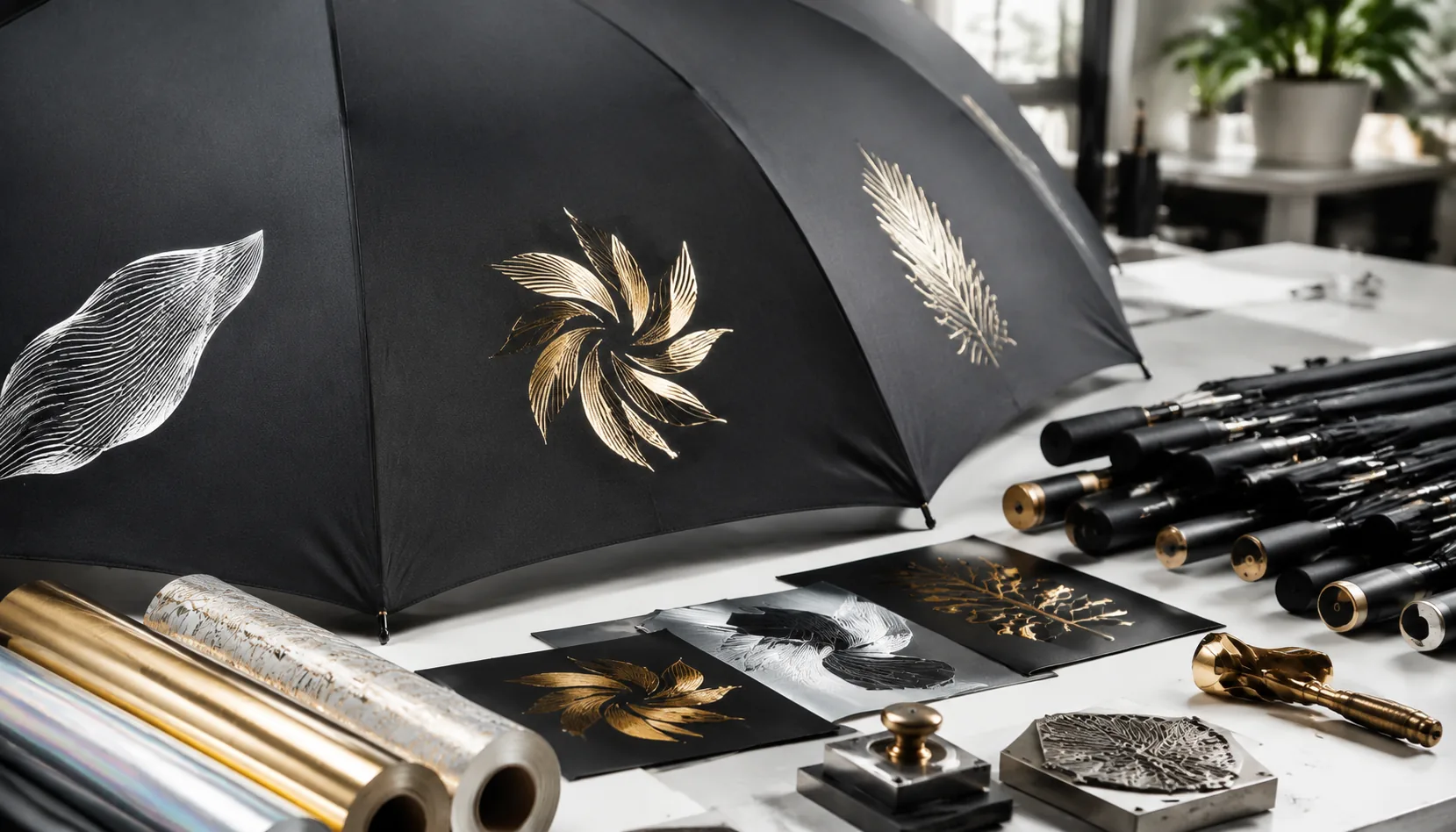
For premium umbrella programs, the logo finish often decides whether the product feels retail-grade or promotional, but metallic effects behave very differently on pongee, polyester, and coated canopy fabrics. On our Songxia production floor, metallic logo umbrellas require early decisions on ink system, foil transfer pressure, curing, rub resistance, MOQ, and AQL inspection points, because a finish that looks perfect on a flat swatch can crack, dull, or misregister once the canopy is cut, sewn, and tensioned.
Where Metallic Branding Adds Real Value
Metallic branding earns its cost when the umbrella is treated like a kept object, not a throwaway rain item. Executive gifts, luxury hotel room umbrellas, automotive launch handouts, VIP golf events, and retail collaborations are the right places for metallic logo umbrellas because the buyer wants restraint, not shouting. On a 23" or 27" straight umbrella with a matte black 190T or 210T pongee canopy, a 55–75 mm silver or champagne-gold mark near one panel edge often looks more expensive than a 180 mm white logo across the center. The same is true on compact 21" auto-open-close models for finance, real estate, and travel brands: a small metallic placement reads like a product detail, while oversized contrast printing reads like event signage. If the frame is also upgraded, such as fiberglass ribs, a rubber-coated handle, and a Teflon water-repellent canopy, the logo finish matches the physical quality instead of pretending to create it.
The best applications are usually one- or two-panel branding, not full-canopy decoration. A foil print umbrella logo works well on dark pongee when the artwork has clean lines, enough stroke width, and no tiny serif details that can break during heat transfer. Metallic ink umbrellas are a better choice when the design needs more flexibility on curved panels or the order quantity is too high for slower foil handling, but the shine is softer and depends heavily on ink laydown and curing. I avoid metallic effects on very textured fabrics, cheap 170T polyester, and low-cost steel frames because the mismatch is obvious in hand. For premium umbrella branding, the total package matters: 8K or 10K fiberglass frame, black nickel shaft, stitched sleeve, retail tag, and AQL 2.5 inspection for logo position, adhesion, scratches, and panel symmetry.
A small metallic mark also protects the brand from looking dated after the event. Luxury promotional umbrellas often stay in offices, cars, hotel lobbies, and concierge desks for months; a quiet gunmetal or brushed-gold logo does not fight with the user’s coat, car interior, or corporate setting. For automotive launches, I prefer metallic branding that matches the vehicle trim: chrome silver for EV and technology launches, warm champagne for luxury sedans, and dark graphite for performance models. Hotels usually do better with a discreet crest on one panel or sleeve, especially on 30" golf umbrellas used by doormen, because guests perceive the item as part of the property’s service standard. Our standard practice at ZheBrella is to approve metallic placement with a pre-production sample under both indoor light and outdoor cloud cover, since a logo that looks subtle in the showroom can become too reflective in daylight.
Metallic Ink, Foil Transfer, and Heat-Press Options
Metallic screen ink is usually the safest choice when the buyer wants shine without making the canopy feel like a sticker. On 190T or 210T pongee, a good silver or gold metallic ink sits in the fabric weave and flexes better than a thick transfer layer, so it handles 8K or 10K panel movement, rib tension, and repeated folding with fewer cracks. The shine is softer than mirror foil because the aluminum or bronze pigment is suspended in ink, not laminated as a continuous film. For metallic logo umbrellas used by banks, hotels, and automotive dealers, I normally recommend metallic ink when the logo has medium line weight above 0.5 mm and the brand can accept a satin-metal look instead of a chrome finish. It also tolerates water exposure better after proper curing, but we still run wet rub and fold tests because umbrella canopies are under curved stress, not flat like a tote bag or T-shirt.
Foil transfer gives the brightest result, especially for a foil print umbrella logo in gold, rose gold, holographic, or chrome silver. The problem is that foil is less forgiving on umbrellas than on flat promotional textiles. The adhesive layer must bond to a water-repellent canopy, often with Teflon or PU coating nearby, and then survive opening tension, canopy curvature, and compression inside a sleeve. If the logo crosses a seam or sits too close to the rib tip area, foil can wrinkle or fracture after 200 to 300 open-close cycles. I avoid foil on compact 21 inch auto-open-close umbrellas unless the artwork is small and placed in the lower center of one panel. It performs better on 23 inch straight umbrellas, golf umbrellas at 27 or 30 inch, and luxury promotional umbrellas where the canopy is stored less aggressively. Foil has the strongest showroom effect, but it needs stricter artwork control and pre-production sampling.
Heat-transfer metallic films sit between ink and foil: brighter and cleaner-edged than metallic ink, but usually more flexible than traditional foil if the film is thin and elastic. They are useful for premium umbrella branding with small batch color matching, gradient metallic effects, or logos that cannot be made cleanly by screen printing. The trade-off is hand feel. Even a high-quality film leaves a detectable patch on 190T pongee, and thick films can make a folding umbrella panel stack unevenly. For metallic ink umbrellas, MOQ can stay close to normal screen-print minimums, often 100 to 300 pieces depending on color and model; custom heat-transfer films may push lead time by 3 to 7 days. Our standard practice at ZheBrella is to test metallic decoration on the exact canopy fabric, coating, and frame type, then inspect under AQL 2.5 for edge lift, cracking, pinholes, registration shift, and wet-rub failure before bulk packing for FOB or DDP shipment.
Matching Effects to Fabric and Canopy Color
190T and 210T pongee are the safest base fabrics for metallic logo umbrellas because the weave is tight enough to hold a clean edge but not so slick that ink or foil floats on the surface. On a 23" auto-open or 27" golf umbrella, 190T pongee works well for promotional budgets, while 210T gives a denser hand and smoother face for premium umbrella branding. For metallic ink umbrellas, we normally specify a slightly thicker ink deposit than standard spot-color printing, then run a curing test so the silver or gold pigment does not dull after rubbing. A foil print umbrella logo can look sharper than metallic ink on simple marks, but it needs steady heat, pressure, and a flat sewing panel before canopy assembly. Once the ribs and seams are already built, foil transfer near the crown or panel edge becomes harder to register cleanly.
Dark canopy colors usually show metallic shine better because contrast does half the work. Gold on black 210T pongee, champagne on navy, and brushed silver on charcoal are reliable combinations for luxury promotional umbrellas; pale gray or white can make the same metallic logo look weak unless the artwork has a dark outline or heavier coverage. I am less enthusiastic about metallic decoration on very bright red, royal blue, or orange unless the buyer approves a physical strike-off, because those colors can visually fight the metallic pigment under trade-show lighting. Panel position also matters: a logo centered between two ribs looks flatter and reflects more evenly than one pushed close to a seam. For golf umbrellas with 8K or 10K frames, we usually print before sewing so the fabric sits flat and the metallic layer does not bridge over stitch lines.
UPF 50+ coatings need extra caution because the coating chemistry can reduce adhesion or change the way heat transfer foil releases. A silver-backed UV canopy may pass rain testing but still show edge lift after 300 to 500 open-close cycles if the print system is not matched to the coating. Double-layer vented windproof canopies add another issue: the outer layer may move against the inner layer during folding, so a metallic logo placed too close to the vent overlap can scuff faster than a normal screen print. Very textured fabrics, such as oxford, jacquard, or recycled PET with a rougher yarn, break up reflected light and make metallic effects look grainy. Our standard practice at ZheBrella is to request final fabric, final coating, and final canopy color before confirming artwork, then run adhesion tape testing, wet rub testing, and a folded-panel aging check before bulk production.
Frame and Hardware Choices for a Premium Look
A metallic logo looks expensive only if the frame does not feel cheap in the hand. For most premium umbrella branding projects, I would not put a foil print umbrella logo on a thin 6K promotional frame; the shine draws attention to every weak part. A better baseline is an 8K frame with fiberglass ribs, a black electroplated steel shaft, and a 190T or 210T pongee canopy. Fiberglass ribs give better rebound than painted steel ribs when the umbrella is twisted in wind, and they do not show rust at the rib tips after a wet season. For retail or executive gifts, an aluminum shaft can reduce weight, but it must be thick enough to avoid flexing at the runner. In our factory checks, the first impression usually comes from three touchpoints: opening force, shaft straightness, and handle finish. If those feel controlled, metallic logo umbrellas read as premium instead of decorative.
For price-sensitive programs, an 8K manual or auto-open umbrella with black steel shaft, fiberglass ribs, and a rubberized straight handle is the cleanest balance. Auto-open adds cost, but buyers feel it immediately; a smooth spring and stable runner can make a 23 inch umbrella feel much more valuable than its BOM suggests. For luxury promotional umbrellas, I prefer 16K construction on 23 inch or 27 inch models, especially when using metallic ink umbrellas for banks, hotels, spirits brands, or automotive events. Sixteen ribs create a rounder canopy profile, which keeps the logo plane flatter and reduces distortion around panel seams. Wood crook handles work well for classic brand positioning, while matte rubberized handles fit technology and sports clients. Avoid shiny plastic handles beside metallic graphics; the two finishes compete, and the plastic usually loses.
The highest perceived value comes from combining the metallic logo with a double-canopy vented windproof frame. A 23 inch auto-open or 30 inch golf umbrella with fiberglass ribs, steel center shaft, and vented 210T pongee canopy can survive 50+ mph wind-tunnel testing when the rib joints and stretchers are correctly matched. The vent matters because metallic print areas, especially foil transfer, have less fabric breathability and can slightly stiffen the panel. On larger golf sizes, 8K fiberglass is common, but 16K gives a denser, more architectural look if the budget allows. Hardware color should stay restrained: black nickel, matte black, dark gunmetal, or brushed aluminum. Bright chrome ferrules and tips often make the umbrella look like a low-cost souvenir. For metallic logo umbrellas, the frame should support the decoration quietly, not fight for attention.
Testing, MOQ, and Bulk Quality Expectations
Metallic decoration has to be tested harder than a normal one-color screen print because the failure mode is visible: dull foil, cracked edges, or silver dust rubbing onto the pongee. For metallic logo umbrellas, I would require pre-production samples on the exact canopy fabric, usually 190T or 210T pongee with the same Teflon, UV, or water-repellent coating planned for bulk. Test the foil print umbrella logo with a dry rub and wet rub, then fold the panel along the rib line 50 to 100 cycles to see whether the metallic layer fractures. Adhesion should be checked with cross-hatch tape pull, especially on coated polyester where curing temperature and dwell time decide whether the logo survives real use. After that, expose the printed panel to sprayed water for 30 minutes, let it dry naturally, and inspect for edge lifting, whitening, or stain transfer onto adjacent canopy folds.
MOQ planning should start from the decoration process, not only the umbrella frame. Metallic ink umbrellas often need separate ink setup, screen setup, or foil tooling, so a realistic MOQ is commonly 500 to 1,000 pieces per design for 23-inch auto-open models, and higher if the buyer wants multiple logo positions or mixed canopy colors. Luxury promotional umbrellas with fiberglass ribs, 8K or 10K frames, wooden handles, and double-canopy windproof construction usually need 25 to 35 days after sample approval, while urgent event orders can only be compressed if raw frames, 190T pongee, cartons, and handle parts are already in stock. Our standard practice at ZheBrella is to lock the golden sample before mass production, including logo brightness, placement tolerance, handle finish, sleeve print, hangtag, carton mark, and any barcode or retail labeling requirement.
Bulk quality expectations should be written into the purchase order before production starts. For premium umbrella branding, AQL 2.5 is a sensible inspection level for major defects such as poor opening, bent ribs, loose tips, visible logo peeling, misaligned panels, rust marks, or cracked metallic print; minor defects can cover slight thread tails, small print shade variation, or sleeve creasing within agreed limits. Inspectors should open and close manual, auto-open, or auto-open-close units repeatedly, check rib symmetry, measure logo position, and confirm the canopy sheds water without wetting through at seams. For FOB or DDP shipments, packing matters because metallic logos scuff easily when umbrellas rub inside cartons. Use individual polybags, tissue or non-woven sleeve protection over the printed area, firm inner cartons, and carton drop-test discipline; otherwise the factory may pass inspection, but the buyer opens cartons overseas and finds abrasion caused entirely by poor export packing.
Frequently Asked Questions
Will metallic foil last on a folding umbrella canopy?
It can work, but the logo area should avoid heavy fold lines and high-stress seams. A pre-production sample should be folded, opened, rubbed, and sprayed with water before approval.
Which canopy color is best for metallic umbrella logos?
Black, navy, charcoal, burgundy, and forest green usually provide strong contrast for silver or gold effects. Very light canopies can reduce perceived shine unless the metallic layer is bold and well tested.
Which umbrella fabrics work best for metallic ink or foil effects?
Smooth polyester and pongee usually give the cleanest metallic result. Coarser or heavily coated fabrics can reduce edge sharpness, and very dark panels typically show foil effects more clearly than light colors.
What MOQ is typical for premium umbrella logo effects?
For metallic ink or foil transfer, many factories set MOQ around 300-1,000 pieces per design, depending on panel count and ink setup. Multi-color or multi-location decoration often increases the minimum and setup cost.
How should a buyer check durability before approval?
Request rub testing, bend/fold testing, and 24- to 48-hour adhesion checks on the exact fabric and print method. For production, many buyers also specify AQL inspection with print-position and color-consistency checks before shipment.
Looking to Launch Your Custom Umbrella Line?
ZheBrella is a Zhejiang-based OEM/ODM umbrella manufacturer with 17 years of export experience. Free design, low MOQ from 100 pieces, windproof construction, full-color print.
Get Free Quote Now »People Also Search For
Related Articles
Metallic Ink and Foil Effects for Premium Umbrella Logos
Compare metallic ink, foil transfer, and subtle shine effects for premium umbrellas, including fabric limits, durability...
Read More »
Metallic Ink and Foil Logos for Premium Umbrella Branding
Compare metallic ink and foil logo options for premium umbrellas, including fabric limits, durability tests, MOQ, sampli...
Read More »
Metallic Logo Printing on Premium Branded Umbrellas
Compare metallic inks, foil transfers, and shimmer logos for premium umbrellas, with durability, MOQ, lead time, and ins...
Read More »