Pantone Color Matching on Custom Umbrellas: Getting Brand Colors Right
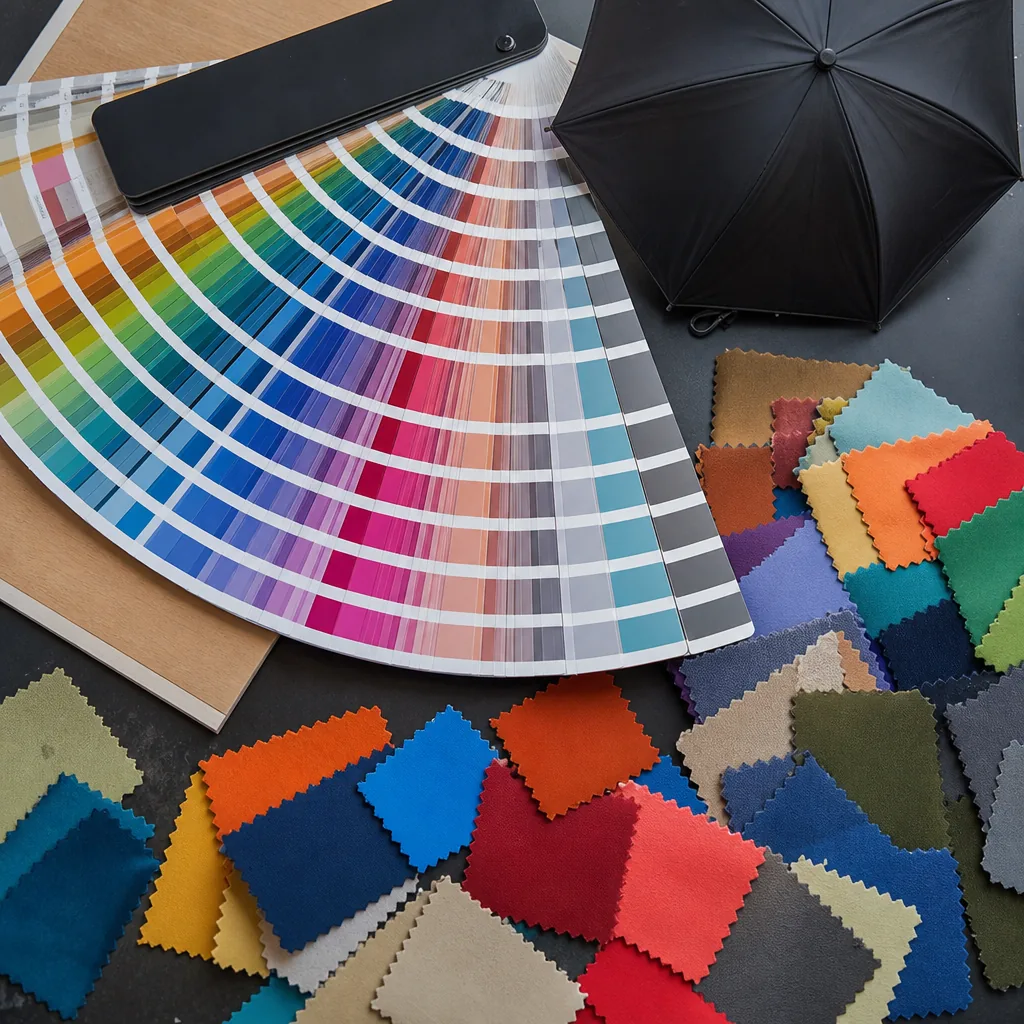
Matching brand color on a custom umbrella sounds simple until you have to hold it across canopy fabric, seams, prints, and trim in real production. On the factory floor, we treat every pantone umbrella order as a process control problem: fiber, coating, dye lot, and print method all shift the final shade. The only reliable way to protect a brand color is to approve the target early and lock it before bulk cutting and sewing begin.
Why fabric color matching is harder than print
Fabric color matching on a pantone umbrella is harder than logo printing because you are controlling the base material itself, not just laying ink on top. Printing can sit on the surface and still look close under one light source, while dyeing or solution-coloring the cloth changes how the fibers absorb light, how the yarn structure reflects it, and how the final canopy reads once it is cut and curved. A 190T pongee canopy will not mirror the same shade as 210T pongee, and the difference gets worse when you switch to POE, PVC, or EVA. That is why a custom umbrella brand color often looks correct in swatch form but drifts after stitching, heat-sealing, or panel assembly. In real production, the canopy color has to be checked against the actual fabric substrate, not against a flat paper chip.
Pantone references also need to be handled correctly. TPX and TCX are textile-oriented references, but the same number still shifts depending on whether you are matching on woven polyester, nylon, or coated film. TPG is the greener, more current library for textiles, and it is usually a better starting point when the goal is a color matching umbrella program that has to survive bulk production. The mistake I see most often is treating a print spec like a dye spec: a brand sends a chip, the factory matches it under lab light, then the first shipment fails outdoors because the canopy color looks lighter, bluer, or duller in daylight. The substrate effect is not a minor tolerance issue; it is the main reason a pantone umbrella passes approval in the sample room and misses the target on the line.
The practical way to control this is to approve the fabric first, then the printed details, then the finished umbrella under the same light standard. For a custom umbrella brand color, I would always ask for a physical strike-off on the exact canopy fabric, seam construction, and coating that will be used in mass production, because a vented double canopy, UV coating, or Teflon finish can all change the visual depth of the shade. If the order uses 8K, 10K, or 16K frames, the panel count and tension can also affect how dark the fabric appears when stretched. Our standard practice is to compare against Pantone under D65 lighting and keep the approval sample on the actual substrate, not just the color code. That is the difference between a usable production reference and a file that only looks right on screen.
The lab-dip and strike-off process
For a dyed canopy, the real work starts with a lab dip, not with the bulk fabric order. We cut a small swatch of the chosen pongee, polyester, or EVA, then dye it in the target Pantone range and compare it under D65 daylight and standard factory light, because a color that looks correct under one lamp can shift badly on a wet canopy or in direct sun. A proper color matching umbrella program usually needs two to four lab-dip rounds before the buyer signs off, especially for deep reds, navy, and corporate greens where the delta-E is easy to see. At this stage we also check whether the dye lot holds after heat setting and whether the umbrella canopy color stays stable across the fabric width, because edge-to-center variation is a common failure on cheap mills.
Strike-offs are the equivalent step for printed panels, but they are less forgiving because the ink sits on top of the cloth and any registration error shows immediately at seam lines and panel joins. For a custom umbrella brand color, we print a full-size panel or a partial repeat on the actual substrate, then confirm ink density, hand feel, and whether the logo color still reads correctly after curing. On screen print jobs, a slight change in mesh count or squeegee pressure can shift the Pantone umbrella target enough to matter, so we usually approve the strike-off before touching the production screens. If the order uses sublimation, we also review the transferred sample on final canopy fabric, since the heat press can darken or flatten tones compared with the digital proof.
The approval process should be treated as a control point, not a formality. The buyer reviews the physical sample against a Pantone book or a signed master, then we lock the approved reference, fabric lot, ink formula, and production date code so later cartons can be traced back if there is a complaint. Our standard practice is to keep the signed lab dip or strike-off with the order file and to pull an in-line check at the first 50 to 100 pieces, because once an umbrella run is fully cut and sewn, correcting a shade problem means scrapping labor, not just cloth. For large promotions, I recommend approving one master for each fabric type, since the same Pantone can look different on 190T pongee, 210T pongee, and PVC-backed material due to sheen and absorbency.
Managing dye-lot variation across a bulk run
Pantone matching on a pantone umbrella starts with a realistic tolerance, not with a promise of perfect identity. On coated polyester pongee, we usually hold bulk production to a Delta-E target around 1.5 to 2.0 against the approved strike-off, but that number moves with fabric base, coating thickness, and print method. A color matching umbrella that looks dead-on under showroom light can read slightly warmer or duller in outdoor daylight, especially on dark reds, navy, and corporate grays. If the buyer wants a custom umbrella brand color to stay exact, the right control point is the lab dip or printed strike-off approved before cutting the full order, because once panels are sewn and heat-sealed, you cannot fix a bad canopy color without scrapping real inventory.
Batch consistency is where most large orders drift. A 3,000-piece run often gets split across multiple dye lots, and each lot brings its own small shift in dye uptake, finishing temperature, and coating cure. Even when the formula is unchanged, a newer batch of 190T pongee can land slightly brighter than the first batch, while the same pigment on 210T can look deeper because the weave and surface reflectance are different. Our standard practice at ZheBrella is to lock the approved fabric lot, keep canopy panels, vents, and sleeve material from the same shade group, and inspect against a master swatch under D65 light. That is the only way to keep umbrella canopy color uniform when the order is split across multiple sewing lines or packed over several days.
Huge orders show slight shifts because production is physical, not digital. The first 500 units may come from one dye batch, the next 1,000 from another, and by the time you are into the last cartons, humidity, storage time, and machine tension can change how the color reads on the finished canopy. For premium retail programs, I tell buyers to allow a practical Delta-E window instead of demanding an impossible zero-drift spec, and to approve one master panel before mass production begins. If the brand color is unusually sensitive, we will suggest a higher MOQ for a single lot, or a narrower shipment window, because breaking a run over multiple weeks increases the risk of visible shade variation across the final pantone umbrella delivery.
Coated fabric and color shift
Silver and black UV coatings change how a pantone umbrella reads in the hand, and that is where many color complaints start. A silver-coated canopy usually reflects more light back through the face yarn, so reds can look brighter, whites can look slightly cool, and dark brand colors can lift a half-step in perceived value. A black UV coating absorbs more light, which makes colors look deeper and less reflective, but it can also mute low-chroma shades and make them appear heavier than the approved swatch. On a glossy umbrella canopy color, specular reflection exaggerates both effects, especially under showroom LEDs or sunlight at an angle. The same ink, on the same 190T pongee, can look different once the coating is added, so a color matching umbrella must be judged with the final fabric construction, not just the print file or the lab dip.
The practical fix is to approve color on the actual coated fabric, not on uncoated yardage or a screen image. For a custom umbrella brand color, we usually test against a physical Pantone chip under D65 light and then check it again outdoors, because silver backing and glossy finishing change metamerism and viewing-angle shift. If the target is a corporate blue or a deep red, the recipe often needs a small correction in ink density or transfer temperature to compensate for the coating underneath. A pantone umbrella order should also define whether the standard is the outer face only or the full visual effect after stitching, panel tension, and seam overlap, since all three alter the final read. That is the difference between a color that looks matched on paper and one that actually stays on brand in production.
Locking color before you pay for production
The fastest way to avoid a bad pantone umbrella job is to lock the color on real fabric before you approve mass production. A PDF or phone photo is not a color standard; the same pantone shade can read differently on 190T pongee, 210T pongee, POE, or PVC because the weave, gloss, and coating change how light bounces off the canopy. Our standard practice at ZheBrella is to make a physical strike-off on the exact fabric, with the same printing method, ink system, and coating that will be used in production. That sample should be signed and dated by both sides, then kept as the master reference. For a color matching umbrella order, that physical approval matters more than any email note, because it gives the factory one clear target and gives the buyer a defensible sample in case the bulk lot drifts.
A tolerance agreement should be written before you pay for production, not after the first cartons arrive. Spell out what is acceptable for the umbrella canopy color under standard light, ideally D65, and define whether you are judging by visual comparison, spectrophotometer reading, or both. If the brand color is critical, state a maximum Delta E and say where the measurement is taken, because edge panels, seams, and curved canopy surfaces can look slightly different from a flat swatch. For a custom umbrella brand color, I would also lock the ribbing color, handle finish, and logo ink separately instead of treating the whole umbrella as one color match. That avoids arguments later when the canopy is close but the black trim, thread, or coating sheen is not.
Buyers often lose money by approving a pantone umbrella from a loose lab dip and assuming the bulk will match automatically. It will not if the factory changes dye lot, fabric mill, or print setup. The safer sequence is: confirm the Pantone number, approve a physical sample on actual production material, sign a tolerance sheet, and require the pre-production sample to reference the same approved master. If the order is large, ask for a first-batch comparison sample before full packing so any drift can be caught while the dye lot is still on the line. That is especially important on promotional runs where one brand color has to stay consistent across 21-inch and 23-inch models, because the same shade can look darker on a smaller canopy with more panel overlap. Color control is not glamorous, but it is cheaper than reprinting 5,000 umbrellas.
Frequently Asked Questions
Can you match my exact Pantone color on an umbrella?
We match to a Pantone TCX/TPX reference within a commercial Delta-E tolerance, confirmed by a physical lab dip you approve. Screen and digital colors are not reliable references - always supply the Pantone code or a physical swatch.
Why does my bulk order look slightly different from the sample?
Fabric is dyed in lots, and large orders may span multiple lots with minor shifts within an agreed tolerance. Approving a signed lab dip and setting a Delta-E limit upfront keeps variation acceptable.
How many color samples should a buyer approve before bulk umbrella production?
For branded umbrellas, one physical lab dip for canopy fabric and one printed logo proof is the minimum. Many factories will also keep a signed pre-production sample on file, which becomes the reference for the bulk run.
What color tolerance is realistic for Pantone matching on umbrella fabric?
A common target is a Delta E of around 2 to 3, but exact tolerance depends on the fabric, coating, and printing method. Solid woven panels usually hold color better than coated or recycled fabrics, which can shift more between dye lots.
How does lead time change when a custom Pantone color is requested?
Adding a custom color approval step usually adds 5 to 10 days before production starts, especially if a lab dip or strike-off is required. After approval, bulk production timing is usually unchanged unless the color needs a special dye or fabric base.
Looking to Launch Your Custom Umbrella Line?
ZheBrella is a Zhejiang-based OEM/ODM umbrella manufacturer with 17 years of export experience. Free design, low MOQ from 100 pieces, windproof construction, full-color print.
Get Free Quote Now »People Also Search For
Related Articles
Pantone to Canopy: Approving Umbrella Colors for Brands
Learn how to approve umbrella colors with Pantone references, swatches, and lab dips to reduce mismatch, rework, and bra...
Read More »
Brand Color Control for Umbrella Decoration Programs
Keep logo and canopy colors consistent across umbrella orders with practical specs for Pantone targets, fabric limits, a...
Read More »
Color Consistency Across Umbrella Branding Programs
Build repeatable umbrella branding with controlled canopy colors, trim rules, and approval steps that keep retail and co...
Read More »