QR Codes on Umbrella Packaging for Brand Storytelling
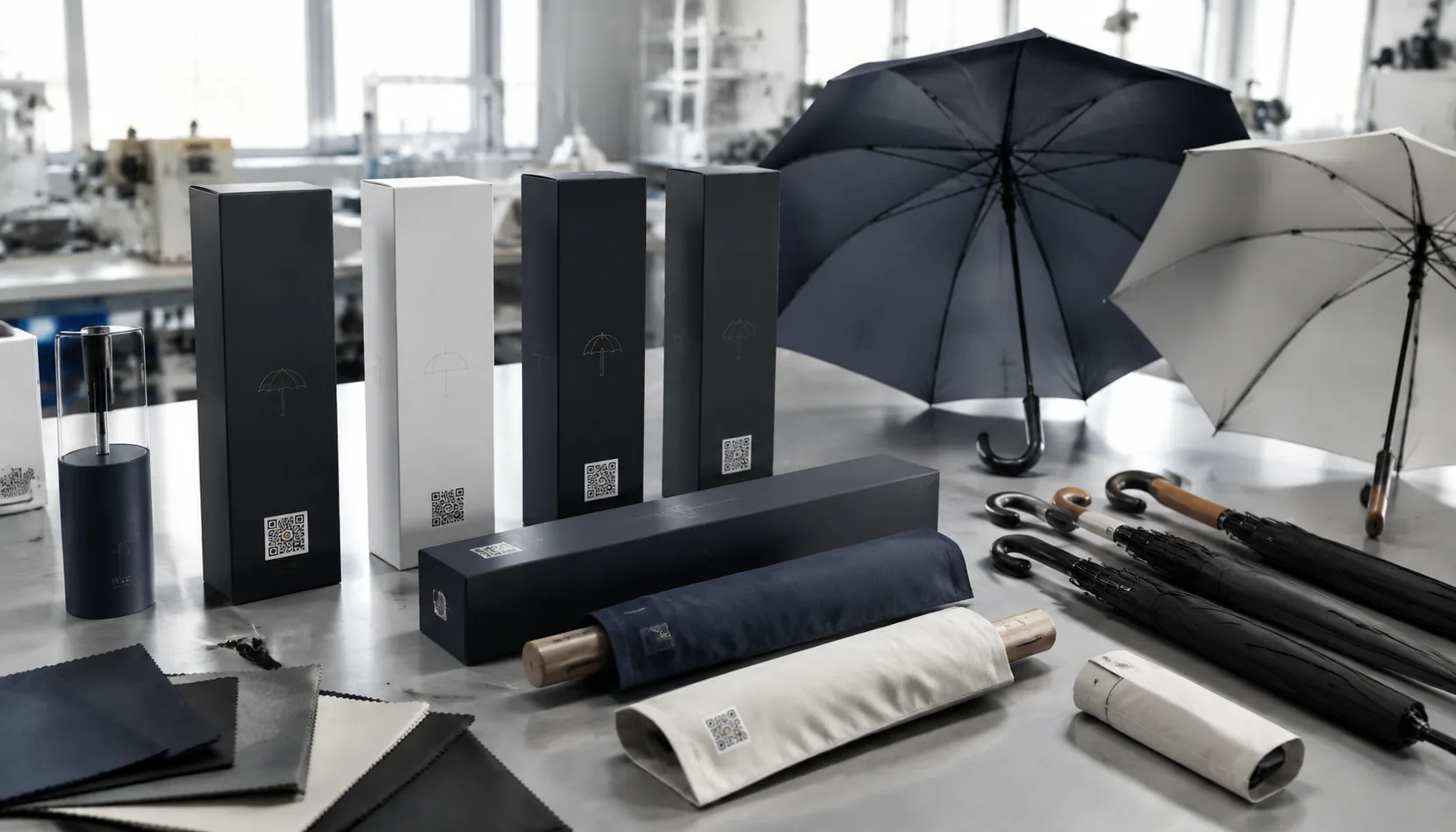
Retail buyers want more product story and after-sale support, but every extra logo, hangtag, or canopy print can add cost, delay approvals, and weaken the umbrella’s clean look. From the packing line, QR codes on umbrella packaging are a practical way to link care guides, warranty registration, brand videos, and campaign tracking while keeping the canopy artwork simple and production repeatable.
Why QR Codes Belong on Packaging
QR codes on umbrella packaging work because the box, sleeve, hangtag, or belly band is the part buyers actually inspect before opening the umbrella. A canopy is curved, wrinkled after folding, and often printed with a logo that should stay clean; forcing a QR mark onto 190T or 210T pongee can interrupt retail umbrella branding and create scanning failures when ribs distort the fabric. On packaging, the code sits flat, prints sharply in one color, and can be sized 18–25 mm for reliable phone scans at checkout, hotel reception, or event distribution. I prefer putting the code near the barcode or care icon block, not beside the hero logo, because branded umbrella packaging should first sell the brand and second route the user to deeper content.
The best umbrella packaging QR code does not just open a generic homepage. It should lead to care instructions for drying and storage, warranty registration tied to batch or PO number, a campaign landing page for promotional umbrellas, or umbrella product storytelling that explains fiberglass ribs, double-canopy venting, Teflon coating, UPF 50+ fabric, or a 50+ mph wind-tunnel claim. For hotels, the scan can open a local guide, rain-day restaurant list, or return policy for borrowed umbrellas. For retail, it can show size comparisons like 21 inch compact versus 27 inch golf umbrella, explain auto-open-close mechanisms, or collect reviews after purchase. That is much more useful than crowding a canopy panel with fine print nobody reads in rain.
Packaging also lets production control quality more tightly. A QR printed on a coated paper sleeve, kraft gift box, or PET window carton can be checked during AQL 2.5 inspection with a simple scan test under warehouse lighting; a canopy print needs unfolding, tensioning, and sometimes drying time before inspection. Our standard practice at ZheBrella is to test QR contrast after lamination or varnish, because glossy coatings can reflect light and reduce scan speed. For export orders, the QR destination should be live before mass packing, especially on FOB or DDP shipments where repacking after customs labeling is expensive. If the campaign will change by season, use a redirect URL so the same packaging artwork can support multiple retail launches without changing plates or delaying a 30–45 day production schedule.
Placement Choices Across Packaging Formats
Belly bands are the cheapest place to put a QR code, but only if the band wraps onto a flat front panel and the code stays away from the seam. For branded umbrella packaging, I prefer belly bands for simple landing pages, care instructions, or a short umbrella packaging QR code that links to a product registration page. Minimum practical size is about 20 x 20 mm for a clean, high-contrast code; if the artwork is busy or the print is flexo on textured paper, move closer to 25 to 30 mm. Keep a quiet zone of at least four modules on every side, and do not place the code over a fold, emboss, or varnish edge. A flat, matte, light background with a dark code scans far better than a glossy finish with metallic ink.
Inserts and hang cards are better for retail umbrella branding because they give you a flat, rigid surface and more room for umbrella product storytelling. An insert can carry the code plus origin story, fabric specs, care notes, and a claim like fiberglass ribs or UPF 50+ coating without crowding the scan area. Hang cards work well in stores because shoppers can scan before touching the umbrella, but the code should sit on the lower half of the card, away from the punched hole and string. I would not go below 18 mm on a hang card, and I would avoid reversed-out codes unless the printer can hold sharp edges. Heavy coating, spot UV, or soft-touch lamination can help the card look premium, but they must not blur the module edges.
Gift boxes give the best scan reliability because they are flat, square, and easy to control in print, which is why premium programs usually use them for the main QR destination and not just a backup link. Sleeve labels are weaker. A sleeve wraps around a curved umbrella tube or rolled cover, and that curve distorts the code, compresses the quiet zone, and makes phone cameras work harder, especially if the sleeve shifts after packing. If a sleeve label is unavoidable, keep the code on the flattest panel, enlarge it to 25 mm or more, and use strong contrast on a matte stock. In practice, the more curved the surface, the less reliable the scan, so the safest approach is to reserve sleeve labels for branding and use a flat insert or box panel for the actual scan target.
Content Strategy for Different Buyer Channels
The QR destination should match the buyer channel, not just dump every customer onto the same homepage. For promotional-product distributors, the best landing page is usually a fast reorder and proofing portal: PO number, artwork version, PMS color record, canopy spec such as 190T pongee or RPET 210T, frame type, and previous carton marks. If the distributor sold 2,000 auto-open 23" umbrellas for a bank campaign, the QR should help their end client reorder without hunting through old emails. I like adding a 20-second clip showing the printed logo under real rain spray, because buyers trust a physical product video more than a render. QR codes on umbrella packaging also work well for care instructions: dry the canopy before closing, avoid twisting auto-open-close shafts, and rinse salt spray from fiberglass ribs after coastal events.
Retail brands need more storytelling and more proof. A hangtag or gift box with an umbrella packaging QR code can open a product page showing UPF 50+ test documentation, Teflon water-repellent coating notes, recycled fabric certificates, or wind-tunnel footage for a double-canopy vented frame surviving 50+ mph gusts. This matters for retail umbrella branding because shelf space is unforgiving; the package may only show a logo, size, barcode, and a few icons, but the QR page can explain why a 16K fiberglass frame costs more than an 8K steel frame. For children’s POE dome umbrellas, the page should focus on transparent canopy visibility, phthalate-free material declarations, and simple safety warnings. For golf umbrellas, lead with 30" coverage, EVA handle grip, reinforced tips, and rib count.
Hotels and event planners should use branded umbrella packaging to reduce operational friction. A hotel gift-shop umbrella can link to a page with the property story, rainy-day walking routes, guest-service contact, and a discreet reorder form for the purchasing manager. Event planners need short-lived pages tied to the event date: sponsor logos, venue map, shuttle instructions, photo upload prompts, and post-event lead capture. For a 5,000-piece conference order, I would print one QR on the belly band for guests and a separate carton-label QR for staff to verify SKU, color mix, carton quantity, and AQL 2.5 inspection photos before distribution. Our standard practice at ZheBrella is to lock the QR URL before mass packing, then scan random cartons after sealing, because a beautiful print is useless if the landing page is still in draft.
Technical and Compliance Requirements
The QR file should be supplied as vector artwork, not a 300 dpi screenshot dropped into the carton dieline. For branded umbrella packaging, we ask for AI, EPS, or press-ready PDF with the QR built in pure black or a tested spot color, minimum 18 x 18 mm for a hangtag and 22 x 22 mm for a retail box panel. Keep a quiet zone of at least 4 modules around the code, because varnish creep, die-cut drift, and carton folding can eat the edge faster than buyers expect. If the umbrella packaging QR code sits near a curved PVC window or a glossy PET sleeve, increase size by 15–25% and avoid fine reverse-out codes. On the factory floor, the common failure is not printing resolution; it is artwork compressed through WhatsApp, then stretched by a packaging supplier during layout adjustment.
QR codes on umbrella packaging must be scan-tested after the actual finishing process, not only on the prepress proof. Matte lamination usually gives cleaner scans under retail lighting, while gloss lamination, UV varnish, and metallic ink can reflect into the phone camera and reduce contrast. For gift boxes using black paper, silver foil, or spot UV, we normally make 20–30 pilot samples and test with iPhone and Android devices at 10 cm, 20 cm, and 40 cm distances before approving mass production. The landing page should also be localized by market: English for U.S. retail umbrella branding, German or French for EU chains, and Japanese if the product is going into department-store promotions. Umbrella product storytelling works better when the page recognizes the market, shows the exact SKU, and loads under 3 seconds on mobile data.
Do not let QR codes on umbrella packaging interfere with GS1 barcodes, warning labels, or retailer-required compliance marks. The UPC/EAN barcode needs its own flat, high-contrast area and must not sit beside a decorative QR graphic that confuses handheld scanners at receiving. Retail compliance labels may include country of origin, fiber content for 190T/210T pongee canopy, manual or auto-open mechanism warnings, polybag suffocation text, carton marks, and importer address; these are not optional storytelling space. Under AQL 2.5 packaging inspection, we check wrong label placement, unreadable barcode, missing warning text, color deviation, crushed box corners, and carton mark errors as defects. Our standard practice at ZheBrella is to lock the QR, GS1 barcode, and compliance block in the approved dieline before bulk printing, because late artwork moves create the most expensive packaging rework.
Factory Coordination and Cost Control
QR packaging should be sampled at the same time as the umbrella prototype, not treated as an afterthought after the 8K or 16K frame is approved. When we build a 23" auto-open retail umbrella or a 27" double-canopy golf umbrella sample, the packaging sample runs in parallel: hangtag, sleeve, insert card, gift box, inner carton, and master carton mockup. The umbrella packaging QR code must be printed at final size on the actual substrate, because a code that scans cleanly on white coated paper can fail on matte kraft, glossy lamination, or a dark PMS flood. Our standard practice at ZheBrella is to test scans on iPhone and Android under warehouse light, daylight, and low-light retail conditions before locking artwork. For branded umbrella packaging, I prefer a minimum QR size of 18–22 mm for hangtags and 25–30 mm for boxes, with quiet-zone protection kept clear of logos, fold lines, and barcode labels.
Cost control starts with deciding whether the QR is static, batch-specific, or unit-specific. Static QR codes on umbrella packaging are the cheapest because the same plate, film, or digital file can run across the full order. Batch-specific codes are manageable for normal MOQs, usually 500–1,000 pieces for custom umbrellas and 1,000–3,000 pieces for custom boxes or printed inserts, depending on paper stock and finishing. True variable data, where every umbrella has a unique code, changes the workflow: digital printing or label application replaces standard offset or screen printing, inspection slows down, and carton reconciliation becomes more serious. For promotional umbrellas, I usually advise one QR per PO, colorway, or campaign unless the buyer needs warranty registration or serialized redemption tracking. Variable data also creates AQL questions: inspectors can check scanability and placement under AQL 2.5, but they cannot manually verify 10,000 unique landing pages without a database-driven audit file.
Lead time impact is usually modest if the buyer freezes the landing page URL early. A printed insert adds about 3–5 days after artwork approval; a full-color retail box with lamination, spot UV, or die-cut window can add 7–12 days, especially during peak rainy-season orders. If the umbrella itself uses custom 190T or 210T pongee printing, UV coating, fiberglass ribs, or an auto-open-close mechanism, packaging should be placed on the same critical path as canopy strike-off and frame sample approval. FOB shipments need the QR artwork, SKU, carton marks, and packing list to match the purchase order; DDP shipments also need HS code consistency, country-of-origin wording, and Amazon or retailer carton-label compliance where applicable. Good retail umbrella branding is not only a logo on the canopy. The QR link can carry umbrella product storytelling, care instructions, windproof test claims, UPF 50+ certification, or event campaign content, but the factory needs locked copy before mass packaging starts.
Frequently Asked Questions
Can each umbrella have a unique QR code?
Yes, but variable QR printing requires extra data handling, proofing, and inspection. For most B2B orders, one campaign QR per SKU is simpler and more cost-effective.
Where should a QR code go for the highest scan rate?
Flat surfaces such as insert cards, belly bands, and box panels scan better than curved fabric sleeves. Use strong contrast and test scans on final printed packaging, not only on digital proofs.
What should a QR code on umbrella packaging link to first: care guide, warranty, or brand story?
For most B2B buyers, the care guide and warranty page deliver the fastest support value and reduce after-sales questions. A brand story landing page works best as a second QR destination or a campaign-specific link for retail packaging.
How small can the QR code be on an umbrella box and still scan reliably?
A printed QR code should usually be at least 0.8 to 1.0 inch wide on a carton or hangtag, with enough quiet space around it for scanning. If the code is going on glossy packaging, larger sizing and higher contrast improve scan success.
Can one QR code support multiple markets or languages for umbrella packaging?
Yes. A single QR code can route users to a dynamic landing page that detects language or country, which is useful for importers selling into several regions. This also lets you update content without changing the printed packaging.
Looking to Launch Your Custom Umbrella Line?
ZheBrella is a Zhejiang-based OEM/ODM umbrella manufacturer with 17 years of export experience. Free design, low MOQ from 100 pieces, windproof construction, full-color print.
Get Free Quote Now »People Also Search For
Related Articles
Umbrella Insert Cards for Private-Label Brand Storytelling
Use insert cards to explain fabric, frame, care, warranty, and brand values while improving perceived value in private-l...
Read More »
Umbrella Retail Insert Cards for Brand Storytelling
Use insert cards to explain umbrella quality, care, and brand story while keeping the canopy, pouch, and retail packagin...
Read More »
Custom Umbrella Belly Bands for Retail Brand Storytelling
Use printed belly bands to add brand story, size cues, and retail polish to folded umbrellas without changing sleeves or...
Read More »