Umbrella Retail Insert Cards for Brand Storytelling
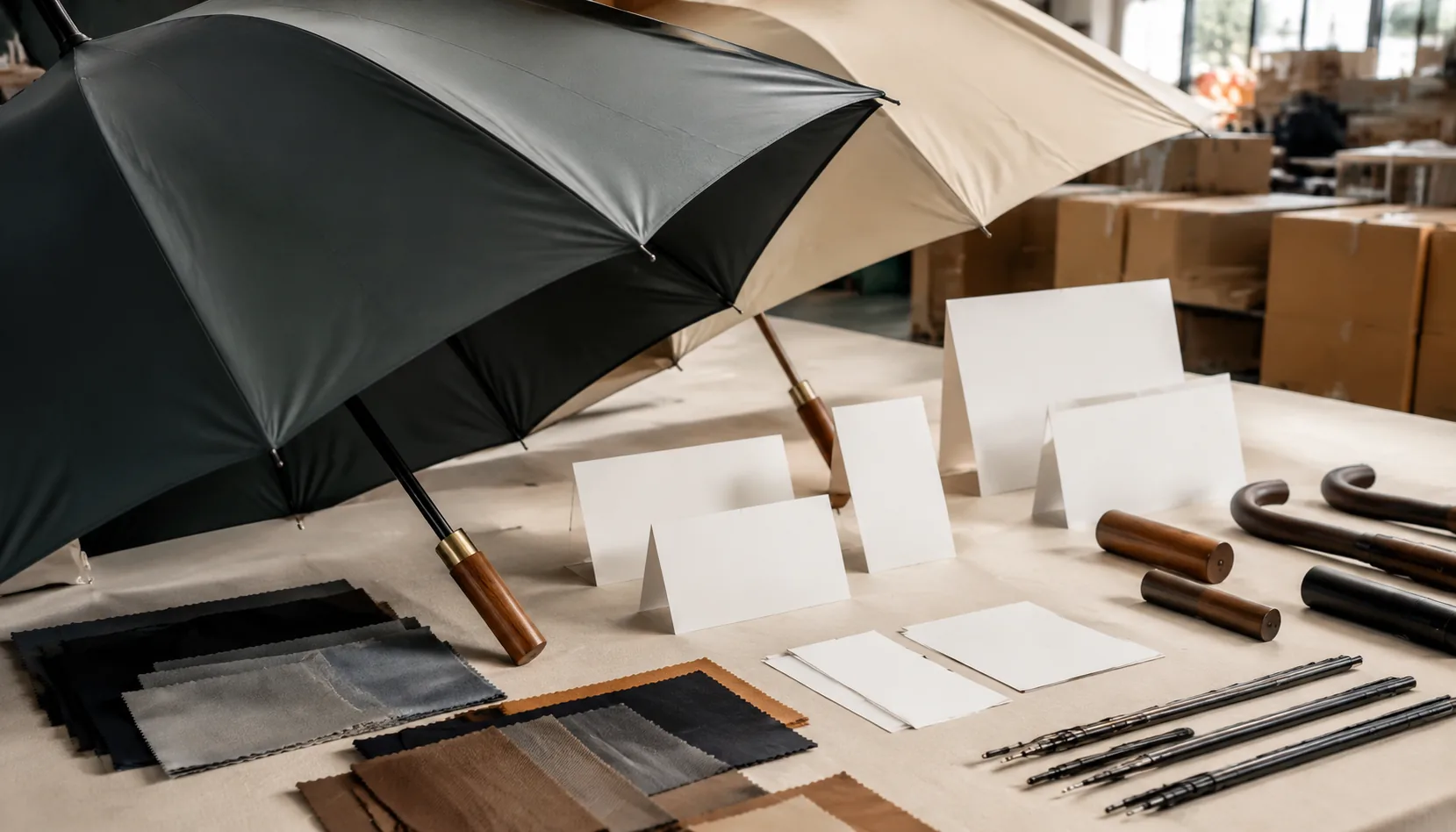
When a buyer wants a premium umbrella to tell a bigger story, the first mistake is usually printing too much on the canopy, pouch, or box. On our Songxia production floor, we use umbrella retail insert cards to carry care instructions, frame strength details, UV or waterproof claims, and brand messaging without cluttering the product surfaces. The challenge is making that card feel intentional, not like a loose afterthought.
Define the Role of the Insert Card
The insert card is the only paper item the buyer actually reads after opening the umbrella, so it should carry information that needs more space and more trust than a hang tag can provide. I use umbrella retail insert cards for four jobs: a short brand story, clear operating instructions, warranty limits, and the technical reasons the umbrella costs more than a basic street model. For example, a 23" auto-open stick umbrella with 190T pongee, fiberglass ribs, a Teflon-type water-repellent finish, and UPF 50+ coating deserves a simple explanation inside the package. The same applies to a 21" auto-open-close compact with a reverse-fold shaft or a 27" golf umbrella with a double-canopy vented frame rated for 50+ mph wind. Without an insert, those details get compressed into icons or ignored by store staff.
Hang tags are for fast shelf scanning: size, barcode, color, material callouts, and maybe one claim such as “windproof” or “UPF 50+.” Sewn labels are for compliance, fiber content, care symbols, and origin. Branded umbrella packaging protects the product and creates shelf impact, but it is usually too crowded with logos, QR codes, and retail marks to explain how the product should be used. The insert card should not repeat all of that. It should answer the questions that reduce returns: how to dry the canopy before storage, why not force an auto-open-close frame by hand, how to close a reverse umbrella properly, and what damage is excluded from warranty. Well-written umbrella care cards prevent bent ribs, rusty tips, and mold complaints better than a beautiful box ever will.
For private label umbrella inserts, I recommend treating the card like a small technical manual with brand tone, not like a flyer. One side can carry retail umbrella branding: origin story, sustainability note, gift message, or campaign copy. The other side should be practical: canopy fabric, rib count such as 8K or 10K, frame material, opening mechanism, care steps, warranty period, and customer-service contact. Our standard practice at ZheBrella is to confirm insert card size, paper weight, folding style, and barcode placement during pre-production approval, because a 300 gsm card that fits a 30" golf umbrella sleeve may crease badly in a slim 21" compact pouch. If the card includes warranty promises, the wording should match the buyer’s after-sales policy before mass production, not be decided during final AQL 2.5 inspection.
Choose Card Format Around the Pack Structure
Card format should follow the umbrella pack first, not the artwork idea. For compact 3-fold umbrellas in a fabric sleeve or OPP/CPP polybag, I normally keep umbrella retail insert cards flat and small: about 70 x 110 mm or 80 x 120 mm, on 250–350 gsm art card, with rounded corners if the card sits beside a metal shaft or plastic tips. A folded card can work, but only if the folded size stays under the sleeve width; otherwise operators force it in, wrinkle the sleeve, and slow packing by 3–5 seconds per piece. For boxed compact umbrellas, a 90 x 130 mm half-fold card is safer because the box protects the edges and gives enough room for brand story, warranty terms, UPC, and umbrella care cards without making the layout unreadable.
Golf umbrellas and straight umbrellas have different limits because the pack is long, not tight. A 27-inch, 30-inch, or 32-inch golf umbrella in a PVC sleeve can carry a hangtag-style flat card near the handle, typically 90 x 160 mm, but a large loose insert will slide down the sleeve and look messy at retail. For straight umbrellas in long kraft boxes, I prefer a narrow accordion leaflet, around 70 x 180 mm folded, because it can explain fiberglass ribs, 190T or 210T pongee, auto-open mechanism, UPF 50+ coating, and windproof double-canopy construction without crowding the box face. Our standard practice at ZheBrella is to test the insert during final packing trial, not after mass printing, because a 1 mm box tolerance can decide whether branded umbrella packaging feels premium or jammed.
QR-linked cards are useful when the buyer wants multiple languages, registration, care video, or retail umbrella branding without stuffing the package with paper. A simple flat card with one QR code, SKU, batch number, and care icons is enough for most private label umbrella inserts; the landing page can hold the longer brand story, AQL 2.5 inspection notes, replacement policy, and DDP reorder contact. Still, do not rely on QR alone for critical care instructions. Basic drying guidance, warning text, and open-close instructions for manual, auto-open, or auto-open-close frames should be printed on the card itself, especially for department-store and promotional-product channels where the umbrella may be gifted without the outer carton. For polybagged event umbrellas, keep the card light and visible; for boxed retail umbrellas, use the insert to add story without stealing space from barcode and compliance labeling.
Translate Product Specs Into Buyer-Friendly Claims
The fastest way to make umbrella retail insert cards useful is to translate mill language into a promise the shopper understands without lying. 190T pongee should not be written as “high-density polyester” and left there; say “smooth, tight-weave canopy fabric that dries faster than basic polyester and feels cleaner in hand.” 210T pongee can support a stronger claim: “finer, denser canopy cloth for better drape, color depth, and water beading.” If the canopy has a Teflon finish, name the benefit as “rain rolls off instead of soaking in,” but avoid implying permanent waterproofing. For UPF 50+, the insert should say “blocks over 98% of UVA and UVB rays when the canopy is intact,” which is much clearer than printing a lab acronym by itself. I prefer pairing one spec with one buyer result: fabric equals feel and dry time, coating equals repellency, UV rating equals sun protection.
Frame specs need the same discipline because shoppers do not buy rib counts; they buy confidence in wind and daily use. Fiberglass ribs should be described as “flexible ribs that bend under gusts and spring back,” while steel ribs are better positioned as “rigid support for reliable structure,” especially on value models. A steel shaft can be called “a firm center pole for stable handling,” but if the umbrella uses fiberglass shafting, the insert can claim lighter weight and better corrosion resistance. For 8K, 10K, and 16K frames, do not pretend more ribs automatically means better windproofing. An 8K compact umbrella is easy to carry; a 16K stick umbrella gives a fuller, more architectural canopy and a premium look at retail. Double-canopy windproof construction should be explained plainly: “vented top layer lets wind pressure escape, reducing inversion in strong gusts.” If tested, add a real number such as “wind-tunnel tested to 50+ mph,” not a vague “storm proof” claim.
Mechanism language matters because it sets expectations before the first return happens. Auto-open should read “opens with one button for quick rain coverage,” while auto-open-close on a 21" or 23" compact can say “one-button open and close for entering cars, trains, and buildings.” Manual open is not inferior if positioned honestly: “simple manual frame with fewer moving parts.” For branded umbrella packaging, the insert should connect specs to the brand story in a tight hierarchy: one headline claim, three proof points, and one care note. Umbrella care cards can add practical instructions such as “shake off water, leave open to dry, and avoid forcing the frame if inverted.” For retail umbrella branding and private label umbrella inserts, our standard practice at ZheBrella is to verify every printed claim against the actual bill of materials, because a 210T, 16K, UPF 50+ umbrella can justify stronger language than a basic 190T, 8K promotional model.
Control Artwork, Languages, and Legal Details
Control the insert card before the umbrella goes into mass packing, because a small artwork error becomes expensive once 5,000 pieces are folded, sleeved, and carton-loaded. For umbrella retail insert cards, I usually reserve the front for the brand mark, one product promise, and 2–4 simple icons such as windproof frame, UPF 50+, auto-open-close, or recycled 190T pongee. The back side should carry umbrella care cards content: dry open after rain, do not force the runner, keep away from fire, and rinse salt or sand after beach use. Leave a fixed block for importer name, address, country of origin, age or safety warnings, and a QR code with at least 3 mm quiet zone so it still scans after matte lamination or slight print shift.
Multilingual copy needs real proofing, not machine translation pasted into Illustrator. English, French, German, Spanish, Arabic, and Japanese all change line length, so the layout must be tested at actual card size, usually 80 × 120 mm, 90 × 140 mm, or a hangtag-style insert around 60 × 100 mm. Private label umbrella inserts often fail because legal text gets reduced below 5 pt, or warning icons sit too close to a die-cut hole, staple, or plastic hook. If a barcode is used, keep it flat, high contrast, and away from folds, rounded corners, and glossy foil areas; for EAN-13 or UPC-A, we prefer 100% magnification unless the retailer has approved a smaller scan-tested version.
Color consistency matters because the buyer sees the canopy, sleeve, insert, and master carton as one retail umbrella branding system. Match Pantone references across branded umbrella packaging, woven labels, sleeve printing, and the insert card instead of trusting screen colors from a PDF. Dark navy on 210T pongee may look rich, while the same CMYK build on coated paper can turn purple under store lighting. Our standard practice at ZheBrella is to issue a digital proof first, then a printed pre-production sample checked against the approved umbrella panel print, with barcode scan, QR scan, spelling, logo clearance, and legal blocks signed off before bulk packing starts.
Production Workflow and Inspection Requirements
Insert cards look simple, but they become a production-control item the moment they carry a brand story, QR code, warranty promise, or country-specific compliance text. For umbrella retail insert cards, our normal MOQ is tied to the umbrella order MOQ, but the print shop usually prices efficiently from 1,000 to 3,000 pieces per artwork; below that, digital printing is possible, but unit cost jumps and color consistency is weaker than offset. The clean workflow is artwork in AI/PDF with 3 mm bleed, CMYK color, barcode at 300 dpi or higher, then a digital proof for layout and spelling approval before mass print. I do not release card printing from a screenshot or a WhatsApp image because one wrong care instruction can affect the full shipment. Typical lead-time impact is 2 to 4 days after proof approval for digital print, 5 to 7 days for offset with lamination or spot UV, and longer if the card needs FSC paper certification or multiple language versions.
Packing-line placement must be defined before final assembly, not after finished umbrellas are already in export cartons. For stick umbrellas, private label umbrella inserts are usually placed inside the sleeve, tied to the shaft, or packed in the individual polybag; for 21 inch and 23 inch folding umbrellas, the safest position is between the folded canopy and the pouch, so the customer sees it before discarding branded umbrella packaging. If the order includes hang tags, UPC stickers, umbrella care cards, and retail story cards, the packing SOP needs photos showing exact sequence: umbrella, pouch, insert, sleeve, master carton. Our standard practice at ZheBrella is to run a pre-production packing sample with the approved card and final carton mark, because line workers can easily mix left-hand/right-hand pouch openings, hangtag holes, or market-specific inserts when three SKUs share the same 190T pongee canopy color.
Inspection should treat inserts as part of the finished retail unit under AQL 2.5, not as loose paper accessories. During inline and final inspection, we check card count, artwork version, QR scan result, barcode readability, spelling, color shift, placement, and whether the card scratches coated handles or catches in the auto-open-close runner. For retail umbrella branding, carton-level SKU separation is critical: each master carton should carry SKU, color, size such as 23 inch or 30 inch, insert version, and destination market. Mixed cartons cause trouble in Amazon FBA, club-store routing, and DDP delivery because relabeling in a bonded warehouse costs far more than sorting at the factory. For FOB shipments, inserts should be approved before mass umbrella packing begins so the goods can load directly after final inspection. For DDP shipments, align the insert version with destination labeling, importer details, and customs invoice descriptions; otherwise, a harmless care card can delay booking by several days.
Frequently Asked Questions
Should technical specs be printed on the insert card or outer packaging?
Use the insert card for detailed explanations such as rib material, fabric denier, care steps, and warranty terms. Keep outer packaging focused on logo, product name, barcode, and key selling claims.
Can insert cards support multiple umbrella SKUs?
Yes, if the language is written generically and avoids SKU-specific details such as exact diameter or rib count. For premium retail lines, separate cards reduce confusion and improve perceived quality.
What information should be printed on an umbrella retail insert card?
A practical insert card usually includes canopy fabric details, frame material, opening instructions, drying and storage care, warranty terms, and a short brand story. For retail orders, many buyers use one side for care instructions and the other side for branding or QR code registration.
What insert card size works best for private label umbrella packaging?
Common sizes are A6, 4 x 6 inches, or a folded 3.5 x 5 inch card, depending on whether the umbrella is packed in a pouch, sleeve, or gift box. The card should fit flat without bending the ribs, pouch, or retail carton.
Can insert cards be customized for different umbrella models in the same order?
Yes, insert cards can be versioned by model, fabric, care method, or sales region. For OEM production, buyers should confirm artwork files, language versions, barcode or QR code placement, and carton allocation before mass production.
Looking to Launch Your Custom Umbrella Line?
ZheBrella is a Zhejiang-based OEM/ODM umbrella manufacturer with 17 years of export experience. Free design, low MOQ from 100 pieces, windproof construction, full-color print.
Get Free Quote Now »People Also Search For
Related Articles
Umbrella Insert Cards for Private-Label Brand Storytelling
Use insert cards to explain fabric, frame, care, warranty, and brand values while improving perceived value in private-l...
Read More »
Custom Umbrella Insert Cards for Brand Storytelling
Use umbrella insert cards to explain brand value, care steps, UPF 50+ claims, and warranty details while improving gifti...
Read More »
Umbrella Insert Cards That Strengthen Private-Label Branding
Use insert cards to explain features, care, warranty, and brand story while supporting premium presentation for retail a...
Read More »