Rain-Reveal Umbrella Printing for Event Brand Campaigns
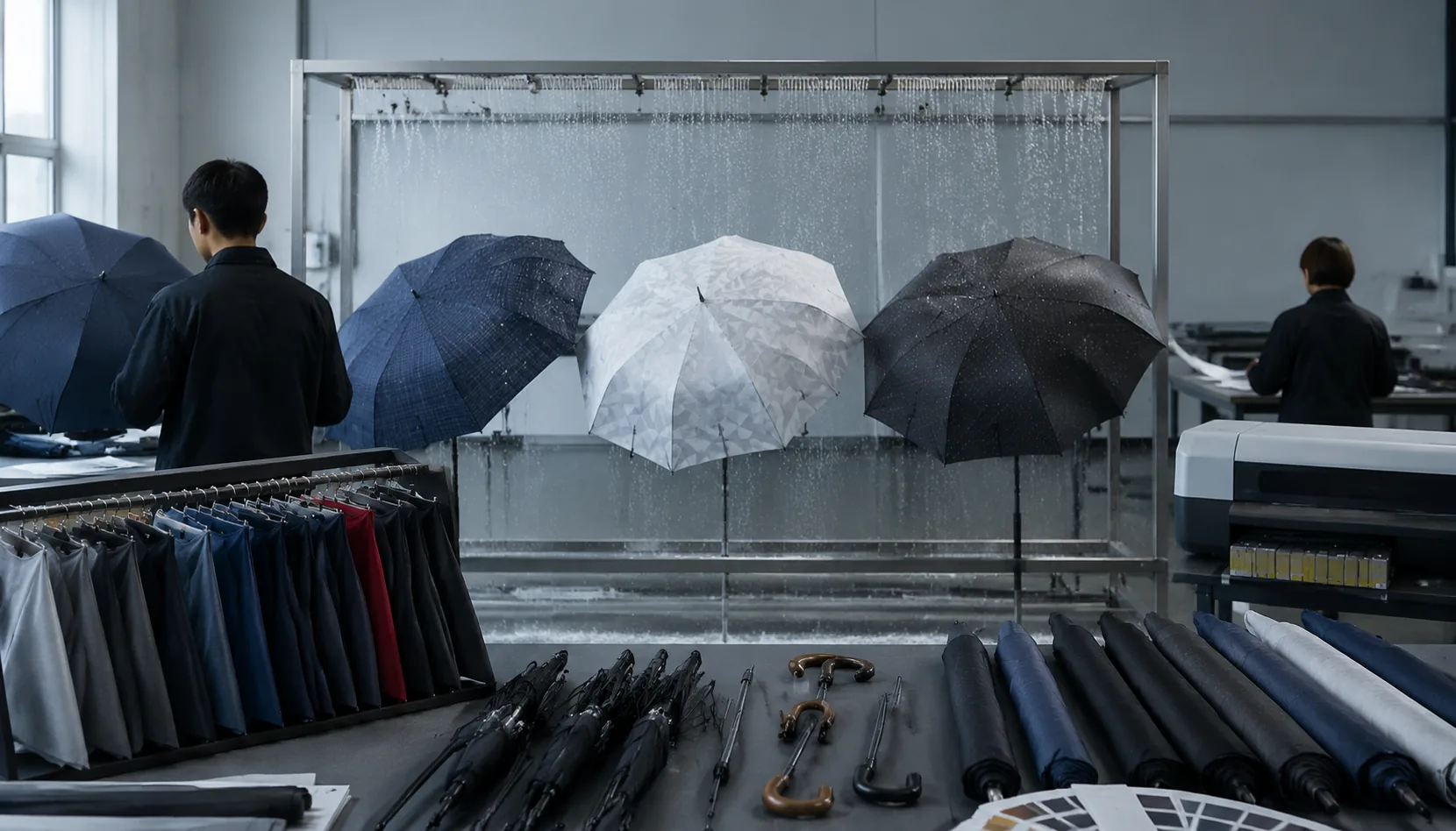
Event buyers want a rain effect that guests notice instantly, but the real risk is ordering a design that looks sharp in sampling and turns weak, patchy, or slow-reacting in the field. With rain reveal umbrella printing, the result depends on hydrochromic ink laydown, pongee coating, drying control, and how the hidden artwork is positioned across panels before cutting and sewing. On our Songxia factory floor, we plan these jobs around sample testing, MOQ realities, and QC checks before bulk production.
How Rain-Reveal Umbrella Printing Works
Rain reveal umbrella printing uses hydrochromic ink, a water-reactive coating that looks nearly invisible or very low-contrast when dry, then turns readable once raindrops hit the canopy. In production, we usually print the normal artwork first—brand logo, border pattern, sponsor marks—then screen print the hydrochromic layer over selected zones after the base ink has cured. The effect works best on 190T or 210T pongee because the fabric surface is tight enough to hold a clean print edge, while still allowing the wet/dry transition to show clearly. On POE clear umbrellas, the effect is possible but less dramatic because light passes through the canopy and reduces contrast. I do not recommend hydrochromic ink on heavily textured oxford fabric or cheap PVC because the message can feather after repeated wet cycles.
The practical value is surprise, not full-canopy decoration. A hydrochromic umbrella logo can reveal a short campaign line, hidden mascot, event hashtag, or secondary brand message only when the umbrella is actually being used. For event branded umbrellas, that timing matters: the audience sees the message during a concert queue, golf tournament, product launch, campus tour, or outdoor conference when photos and social sharing are most likely. Hidden QR prompts also work, but the code should be at least 45–55 mm square with a quiet zone, printed on a flatter panel away from rib seams. We test scanning after wetting because small QR modules can blur if the hydrochromic layer is too thick or if the canopy has a strong water-repellent finish.
For stable rain reveal umbrella printing, the biggest control points are ink thickness, curing temperature, and compatibility with the water-repellent coating. If the factory applies Teflon or strong PU coating after printing, the hydrochromic reaction can be weakened, so our standard practice is to confirm the coating sequence during sampling and run a wet/dry cycle test before bulk production. A custom rain activated print is usually quoted with a higher MOQ than standard promotional umbrella printing because the ink setup, screen cleaning, and inspection time are different; 500–1,000 pieces is a realistic starting range. Buyers should also approve both dry-state and wet-state samples under daylight, not just studio photos, because the reveal contrast changes between black, navy, red, and white canopy colors.
Canopy Fabric and Color Requirements
For rain reveal umbrella printing, the base canopy matters more than most buyers expect: 190T or 210T pongee gives the most stable result because the weave is tight enough for clean hydrochromic ink edges but still flexible during panel sewing and frame assembly. I prefer 190T for cost-sensitive event branded umbrellas and 210T when the buyer wants a smoother handfeel or a higher retail-grade finish. A solid darker ground — black, navy, charcoal, forest green, burgundy — usually performs better than busy artwork because the hidden message needs visual contrast once water hits. If the canopy already has gradients, photos, or dense all-over promotional umbrella printing, the rain-activated layer gets lost, especially under street lighting or cloudy outdoor conditions.
A hydrochromic umbrella logo is not just another top print; it depends on controlled wetting, so coating selection can make or break the job. Heavy Teflon-style water-repellent finishes, thick PU layers, and some UPF 50+ UV coatings can block water contact and stop the custom rain activated print from changing clearly. If UPF 50+ is mandatory, we normally test the fabric first with the exact coating stack, because two “210T pongee” fabrics from different mills can behave differently after finishing. Our standard practice at ZheBrella is to run strike-off panels, soak and spray them, then dry-cycle them before approval; a design that looks sharp on uncoated pongee may fail after a high-repellency treatment. For event deadlines, keep the visible base design simple, place the reveal artwork on broad panels, and approve both dry-state invisibility and wet-state contrast before mass cutting.
Artwork Limits for Hidden Logos and Messages
Hidden artwork has to be bolder than normal promotional umbrella printing because the hydrochromic layer is read through water, movement, and outdoor lighting, not on a flat proof sheet. For rain reveal umbrella printing, I recommend a minimum positive line weight of 1.5 mm, with 2.0 mm safer for event use where people view the umbrella from 2–5 meters away. Reverse gaps inside letters or icons should stay at 2.0 mm or wider, otherwise the wet coating can visually bridge the space. A hydrochromic umbrella logo works best as a single-color graphic, usually clear-to-white or clear-to-light-gray on black, navy, royal blue, or dark green 190T/210T pongee. Avoid fine gradients, halftones, small QR codes, and thin serif type; they look acceptable in an AI file but fail once rain beads scatter across the panel.
Logo size should be planned by panel, not by total canopy diameter. On a standard 23-inch 8K umbrella, one triangular panel gives roughly 300–340 mm usable width near the lower third, but the safe print zone is smaller after seam allowance and rib clearance. For event branded umbrellas, I usually keep a hidden logo between 120–180 mm wide on one panel, or 220–260 mm wide if the design spans two adjacent panels. On 16K canopies, each panel is narrower, so repeating a 90–130 mm mark on alternating panels is cleaner than forcing one oversized graphic across multiple seams. For golf sizes, 27-inch or 30-inch, the usable area increases, but the same rule holds: keep the custom rain activated print centered in the fabric field, not stretched into the stitched edges.
Artwork should stay at least 20–25 mm away from rib seams, 35–45 mm away from the panel tip, and 50 mm away from vent openings on double-canopy windproof models. The reason is practical: seams create uneven pressure during coating, ribs rub the underside during opening and wind flexing, and vent flaps shed water differently from the main canopy. If the hidden message crosses those areas, the reveal becomes patchy or distorted after repeated wet-dry cycles. Our standard practice at ZheBrella is to mark a separate hydrochromic safe area on the canopy layout before sampling, then test the first piece with spray water and full opening tension. For campaigns needing readable slogans, block sans-serif fonts, single-color icons, and panel-by-panel placement beat complex art every time.
Sampling, Testing, and Approval Workflow
The approval workflow for rain reveal umbrella printing should start with a real strike-off, not a flat artwork proof. We print a 20 x 20 cm canopy panel or one full umbrella segment using the same 190T or 210T pongee, POE, or recycled polyester specified for bulk, then apply the hydrochromic umbrella logo over the exact base color. Water activation is checked with a spray bottle and a 5-minute simulated rain pass, because a logo that looks sharp under a faucet can feather badly on a tensioned canopy. We record activation time, usually 3 to 10 seconds depending on ink load, and dry-back time, commonly 8 to 20 minutes at 25°C and 60% RH. Dark navy, black, and forest green need extra attention because contrast can disappear after the first wet-dry cycle if the white reveal layer is too thin.
Testing has to copy event use, where umbrellas are opened wet, rubbed against sleeves, closed before fully dry, and sometimes handed out by the carton at a stadium gate. Our standard practice at ZheBrella is to run dry and wet rub tests on the strike-off, then repeat after 10 activation cycles to check whether the custom rain activated print still reveals cleanly. We also test water beading if the canopy has Teflon treatment, because aggressive water repellency can reduce wetting and make the reveal patchy. For event branded umbrellas with fiberglass ribs and auto-open frames, I also like to mount the sample on the finished 23-inch or 27-inch frame before approval; canopy stretch changes the printed density, especially near rib seams and vented double-canopy panels.
Buyer approval should include controlled photos and short videos, not just one beauty shot. We send dry-state close-ups, first-contact water activation video, full-wet logo visibility, dry-back comparison, and an angled shot under outdoor light so the buyer can judge contrast before bulk promotional umbrella printing begins. If Pantone matching is required, we photograph the dry base logo and the activated reveal beside a color card, though hydrochromic ink is never as exact as standard screen print or heat-transfer print. Once the buyer signs off, the approved sample becomes the production standard for AQL 2.5 inspection: logo position tolerance, reveal consistency, rub resistance, broken coating, and contamination are checked per lot. Bulk lead time normally starts after this written approval, because changing artwork or ink density after canopy cutting creates waste and delays shipment.
MOQ, Lead Time, and Quality Control
For rain reveal umbrella printing, the realistic MOQ depends less on the umbrella frame and more on how much hydrochromic ink waste the artwork creates. For a single-position hydrochromic umbrella logo on a 23" auto-open straight umbrella, I normally quote 500 pieces as a workable MOQ; 300 pieces is possible if the buyer accepts a setup surcharge and limited color options. For all-over rain-reveal graphics, double-layer art, or mixed canopy colors, 1,000 pieces is the safer floor because screen setup, ink calibration, and activation testing eat time. Common event branded umbrellas use 190T or 210T pongee with fiberglass ribs, usually 8K or 10K, because the fabric takes coating evenly and the frame survives handling at outdoor venues better than cheap steel ribs. Sample lead time is typically 7–10 days after vector artwork approval, or 12–15 days if we need a molded handle color, custom sleeve, or special UV UPF 50+ coating under the reveal print.
Bulk lead time usually runs 25–35 days after deposit and sample approval for 500–3,000 pieces, assuming the canopy cloth is in stock and the print is one rain-activated position. Push that to 35–45 days for 16K golf umbrellas, 27" or 30" vented double-canopy windproof models, or custom rain activated print layouts that require panel-by-panel registration before sewing. FOB Ningbo or Shanghai is the cleanest option for distributors with their own forwarder; DDP to the U.S. or EU is practical for event deadlines when the buyer wants one landed cost, but I always build in 7–12 extra days for customs, appointment delivery, and carton relabeling. Air freight makes sense for 200–600 urgent pieces, while sea freight is usually the only sensible route once carton volume passes 5–6 CBM. Promotional umbrella printing for events should be scheduled backward from the in-hand date, not the event date, with at least one week reserved for local redistribution.
Quality control has to test both the umbrella and the chemistry, not just the logo position. Under AQL 2.5, our standard practice at ZheBrella is to inspect incoming pongee for stains, shade variation, pinholes, and coating drag marks before cutting, then check printed panels for dry-state invisibility, wet-state contrast, edge bleeding, and alignment within about 2–3 mm across stitched seams. During final inspection, we spray-test random units with clean water and confirm the rain reveal activates within seconds, then fades back after drying without ghosting that would make the artwork visible indoors. We also check auto-open function for smooth release, no runner jam, no spring kickback, and secure tips on every sampled carton. For campaign orders, I recommend adding a carton drop check, sleeve barcode scan, and at least one opened master carton photo set per SKU, because the most expensive failure is not a weak print—it is 1,000 umbrellas arriving at a stadium with mixed logos or stained canopies.
Frequently Asked Questions
Can rain-reveal printing be combined with a normal visible logo?
Yes. Many programs use a standard screen-printed visible logo on one panel and hydrochromic messaging on adjacent panels. The factory should test both inks together to avoid bleeding or gloss differences.
Does hydrochromic printing work on windproof double-canopy umbrellas?
It can, but the hidden print should be placed on the outer canopy only. Double-canopy vents and fiberglass rib movement make seam clearance more important during artwork setup.
What umbrella fabrics work best for rain-reveal printing?
Pongee polyester is the most common choice because it has a smooth surface and stable coating for hydrochromic ink adhesion. For event campaigns, 190T or 210T pongee is usually recommended over cheaper polyester because it gives cleaner logo edges after wetting.
What is the typical MOQ for hydrochromic logo umbrellas?
Most factories require a higher MOQ than standard screen printing because the ink setup and QC process are more specialized. A realistic starting MOQ is usually 500 to 1,000 pieces per design, depending on umbrella size, fabric, and logo coverage.
How should buyers approve a rain-reveal umbrella sample?
Approve both dry and wet states under natural light, then check reveal speed, logo contrast, drying recovery, and whether the print repeats consistently after several wet-dry cycles. Sampling typically takes 7 to 12 days after artwork confirmation.
Looking to Launch Your Custom Umbrella Line?
ZheBrella is a Zhejiang-based OEM/ODM umbrella manufacturer with 17 years of export experience. Free design, low MOQ from 100 pieces, windproof construction, full-color print.
Get Free Quote Now »People Also Search For
Related Articles
Reflective Umbrella Logos for Safety Brand Campaigns
Specify reflective logo films, panel locations, and AQL checks for promotional umbrellas used in night events, campuses,...
Read More »
Reflective Umbrella Printing for Nighttime Brand Visibility
Plan reflective logos or trims that improve night visibility, with fabric, ink, MOQ, testing, and lead-time notes for B2...
Read More »
Step-and-Repeat Umbrella Patterns for Brand Campaigns
Plan repeating logo umbrella patterns with panel layout, print sizing, color control, MOQ, sampling, and QC checks for r...
Read More »