RPET Pongee Umbrellas: Buyer Guide for Sustainable Orders
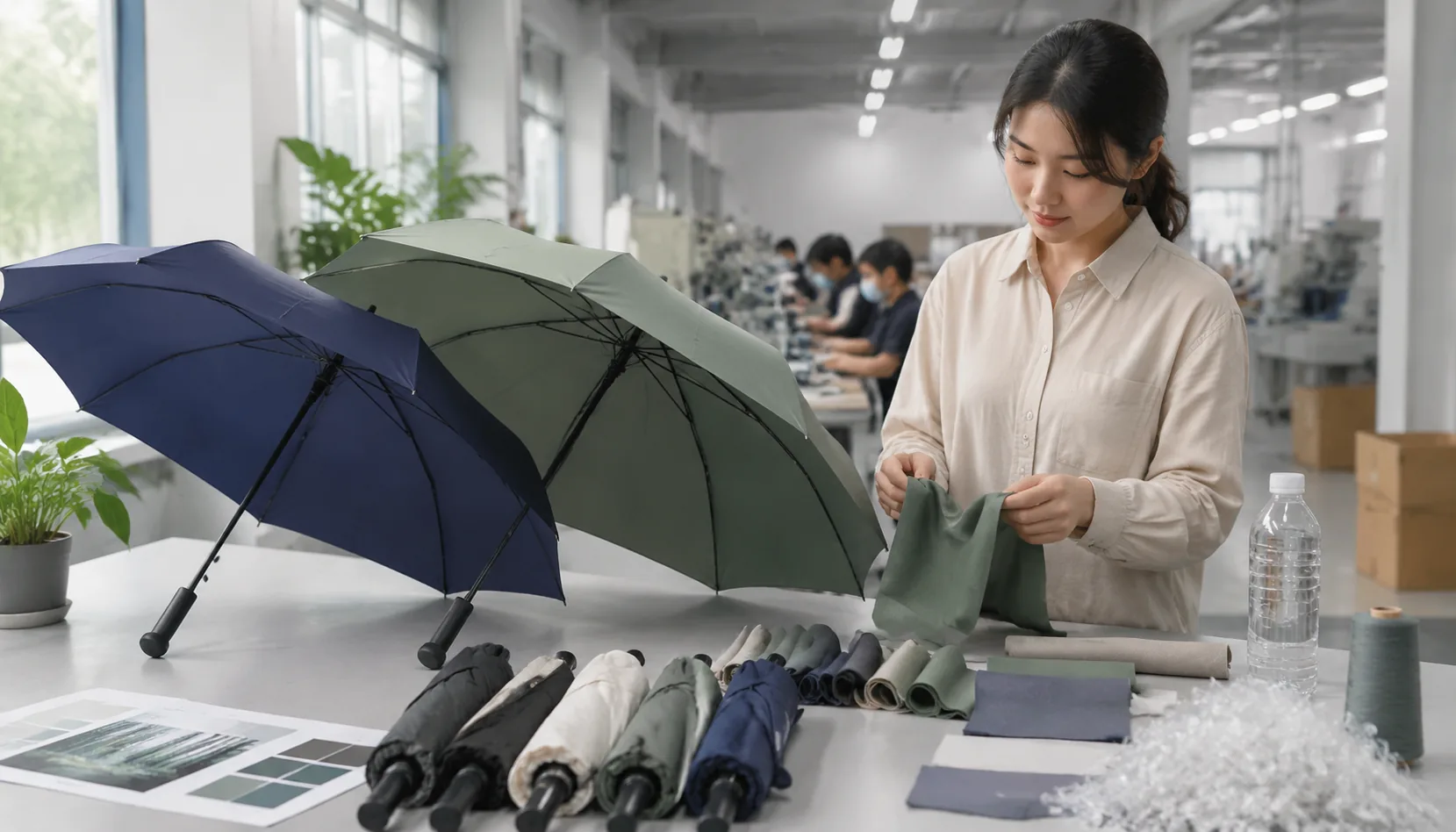
Sustainable umbrella sourcing gets risky when a supplier treats recycled fabric as a label instead of a controlled material. For RPET pongee umbrellas, buyers need to verify yarn source, 190T or 210T fabric density, GRS documents, coating consistency, print behavior, MOQ planning, and AQL 2.5 inspection before bulk cutting starts. On our Songxia production floor, most order problems show up early in fabric receipt, panel printing, or frame matching—not at final packing.
Confirm What Makes an Umbrella Truly RPET
RPET usually means the canopy fabric is recycled polyester, not that the entire umbrella is made from recycled material. The ribs are still normally fiberglass or steel, the shaft may be aluminum or steel, the runner is usually POM or nylon, and the handle can be ABS, EVA, wood, or rubberized plastic. For RPET pongee umbrellas, the buyer should first confirm the fabric specification: 190T or 210T pongee, yarn denier, recycled polyester percentage, colorfastness grade, water-repellent finish, and whether any Teflon or PU coating is added. A 23 inch 8K auto-open umbrella with 190T RPET pongee is very different from a 30 inch golf umbrella with 210T fabric, 10K fiberglass ribs, and a double-canopy vented construction. Both can be sold as recycled fabric umbrellas, but the recycled claim usually sits only on the canopy unless the PO clearly requires recycled components beyond fabric.
The cleanest proof is a GRS scope certificate from the fabric mill plus a transaction certificate tied to the yarn or fabric lot used in your order. A GRS umbrella supplier should be able to show a chain from recycled PET flakes to recycled chips, yarn, greige fabric, dyeing, finishing, and final umbrella assembly. Do not accept a generic “RPET certificate” with no company name, no validity date, no product category, or no lot reference. For sustainable promotional umbrellas, we normally ask the fabric supplier for the GRS certificate, TC number, recycled content declaration, test report for azo/formaldehyde where needed, and fabric purchase invoice before bulk cutting. If the order is 5,000 pieces of 21 inch folding umbrellas, the fabric consumption should roughly match the TC quantity; otherwise the document trail is only decoration.
Buyers should put the recycled content requirement directly into the PO and pre-production approval sheet, not leave it to sales chat screenshots. A practical line is: “Canopy fabric: 190T RPET pongee, 100% recycled polyester yarn, GRS-certified fabric, TC required before shipment.” If only 50% recycled yarn is acceptable, state that number clearly. For eco friendly umbrella OEM orders with logo printing, also check whether screen-print ink, heat-transfer film, sublimation paper, and packaging claims conflict with the sustainability message. I have seen good umbrellas fail brand audits because the hangtag said “100% recycled umbrella” while only the canopy was RPET. At AQL 2.5 inspection, the inspector cannot prove recycled content by touch; they can only verify labeling, fabric handfeel, weight, color, workmanship, and documents. The recycled claim is won or lost before production starts.
Select 190T or 210T RPET Pongee by Market Tier
Choose 190T RPET pongee when the umbrella is a campaign item and the buyer cares most about unit cost, logo visibility, and on-time distribution. In factory terms, 190T means a lighter weave with slightly more light transmission; it is not “thin junk” if the yarn, dyeing, and finishing are controlled, but it will not feel as dense in the hand as 210T. For 21" and 23" manual or auto-open umbrellas, 190T works well with 8K steel or fiberglass ribs, especially for insurance, university, charity, and event orders where the umbrella may be used a few dozen times rather than sold as a premium SKU. It accepts screen printing cleanly for 1–3 color logos, and heat transfer is fine when the artwork has gradients or small registration details. For RPET pongee umbrellas in high-volume promotions, 190T usually saves a meaningful amount without changing the basic look from five feet away.
Move to 210T RPET pongee when the product is going into retail, corporate gifting, hospitality, or a branded sustainability program where the buyer will touch the fabric before judging the price. 210T has a tighter, smoother face, better opacity in dark and mid-tone colors, and less “show-through” when panels overlap at the seams. Print sharpness is also better because the fabric surface is more stable under screen, heat-transfer, and digital print processes; fine text, QR codes, and thin brand lines hold cleaner edges. On 27" golf umbrellas, double-canopy vented windproof models, and 10K or 16K frames, I prefer 210T because the canopy looks more balanced against the stronger frame. It also carries Teflon-style water-repellent finishing and UV coatings more evenly, including UPF 50+ programs where shade performance matters.
The price gap is real but often smaller than buyers expect once freight, inspection, and packaging are included. Depending on color, coating, and order volume, 210T RPET pongee may add roughly 5–12% to the umbrella cost compared with 190T, while improving perceived value more than that on a corporate gift or retail shelf. For recycled fabric umbrellas, do not judge only by the “190T vs 210T” line on a quote; ask for GRS transaction certificate support, fabric weight, colorfastness, coating test method, and AQL 2.5 inspection criteria. Our standard practice at ZheBrella is to match 190T with sustainable promotional umbrellas where MOQ and FOB price are tight, and specify 210T for any eco friendly umbrella OEM order where the brand owner expects repeat use, sharper printing, and stronger retail presentation from a verified GRS umbrella supplier.
Match Sustainable Fabric With Durable Components
The canopy is only the visible part of the sustainability story; if the frame fails early, the umbrella is not really sustainable. For RPET pongee umbrellas, I usually pair 190T or 210T recycled pongee with fiberglass ribs when the buyer cares about wind performance and fewer warranty claims. Fiberglass bends back better than painted steel ribs, especially on 23" and 27" stick umbrellas used for retail or corporate gifts. An 8K frame is enough for most standard promotional orders, while 16K makes sense when the design needs a rounder canopy profile, heavier rain coverage, or a more premium hand feel. The cost jump is not only rib count; 16K also means more sewing points, more rib-tip reinforcement, and slower assembly. If the order is positioned as sustainable promotional umbrellas, I would rather spend budget on fiberglass ribs and a clean GRS material claim than overbuild the handle or add cosmetic parts that do not improve service life.
Shaft choice should follow the market, not a catalog photo. Steel shafts are cheaper and stronger for 23" auto-open straight umbrellas, but they add weight, which matters if the buyer is shipping DDP by air or distributing at conferences. Aluminum shafts reduce weight and look cleaner for executive giveaways, but thin-wall aluminum can dent during bulk packing if the carton spec is weak. For folding recycled fabric umbrellas, a steel-and-fiberglass mixed frame is common: steel center shaft for mechanism strength, fiberglass end ribs for wind recovery. Auto-open is reliable on stick umbrellas when the spring, runner, and notch are matched correctly; auto-open-close on compact umbrellas needs tighter inspection because the reverse spring system creates more stress during closing. Our standard practice at ZheBrella is to cycle-test mechanisms before final AQL 2.5 inspection, especially when branding is printed across multiple panels.
Windier markets need construction changes, not just a “windproof” label. A double-canopy vented build lets pressure escape through the upper canopy and works well with fiberglass ribs on 27" and 30" golf umbrellas; this is the setup I recommend for coastal U.S., U.K., and Northern European buyers. A 16K double-canopy frame feels premium but can become heavy if paired with a steel shaft, so an aluminum or fiberglass shaft may be justified when the retail target allows it. For an eco friendly umbrella OEM project, confirm whether the supplier can document GRS-certified yarn, dyeing, and fabric handling, not just provide a recycled hangtag. A serious GRS umbrella supplier should separate RPET fabric lots, keep transaction certificates traceable, and still build the frame to survive real use—ideally 50+ mph wind-tunnel testing for golf sizes and practical runner strength checks for everyday 21" and 23" models.
Plan Branding, Packaging, and Claims Carefully
Branding choices can either support the sustainability story or quietly undermine it. For RPET pongee umbrellas, we usually recommend water-based screen inks for simple logos because they reduce solvent odor and pass most promotional-product compliance reviews more smoothly than low-cost plastisol systems. For sharper gradients or photographic artwork, heat transfer is cleaner, but buyers should confirm the transfer film and adhesive are compatible with the claim they want to make. One-panel printing keeps cost controlled and avoids registration risk on 8K or 10K frames; full-panel or all-over canopy printing needs tighter fabric cutting control because 190T/210T pongee stretches slightly during sewing. On recycled fabric umbrellas, artwork should be approved on a strike-off sample, not only a digital mockup, because RPET yarn tone can shift the final Pantone color by half a shade or more.
Sleeves, hangtags, and bags need the same discipline as the canopy. If the umbrella sleeve is also RPET, label it clearly with recycled content percentage and batch traceability; if it is virgin pongee, do not let the packaging imply the whole set is recycled. FSC paper hangtags are a practical choice for retail and corporate gifting, especially when they carry QR links to GRS transaction certificates, care instructions, and material declarations. For polybags, buyers can specify recycled LDPE, biodegradable options, or paper belly bands, but each has trade-offs: recycled polybags are durable for export cartons, biodegradable bags can become brittle in hot warehouses, and paper bands expose the canopy to dust during DDP delivery. Our standard practice at ZheBrella is to lock packaging specs before pre-production samples, because changing sleeve labels or hangtags after bulk sewing delays packing by 3 to 5 days.
The biggest risk is not the printing method; it is making an “eco” claim that the paperwork cannot defend. Sustainable promotional umbrellas should not be advertised as “100% green,” “plastic-free,” or “carbon neutral” unless the buyer has certificates covering every relevant component, not only the canopy fabric. A real GRS umbrella supplier should provide scope certificate, transaction certificate, RPET yarn or fabric records, and production lot traceability; an eco friendly umbrella OEM should also separate recycled and virgin fabric during cutting to prevent mixed rolls. For RPET pongee umbrellas, the safest claim is specific and measurable: “canopy made with recycled polyester,” “FSC paper hangtag,” or “recycled-content sleeve,” depending on what is actually ordered. Procurement teams should require claim wording approval before mass production and keep all certificates with the PO file for retailer audits, customs questions, and end-client compliance checks.
Build the Order Around MOQ, Testing, and Lead Time
MOQ is the first place buyers get surprised, because RPET pongee umbrellas do not behave like ordinary stock polyester programs. For stock RPET 190T or 210T pongee colors, a realistic MOQ is usually 500–1,000 pieces per model, assuming standard 23" auto-open, 21" folding auto-open-close, or 27" golf frames are already tooled. Custom-dyed RPET fabric is different: mills normally ask for 2,000–3,000 meters per color, which often means 1,500–3,000 umbrellas depending on canopy size and cutting yield. If you are ordering sustainable promotional umbrellas for a campaign with tight dates, choose stock black, navy, forest green, beige, or gray first, then use screen print, heat transfer, or digital transfer for branding. Custom canopy dyeing only makes sense when the brand color is non-negotiable and the order has enough volume to absorb lab dips, shade-band risk, and extra fabric lead time.
Testing must be written into the purchase order, not discussed after production starts. Our standard practice at ZheBrella is AQL 2.5 for major defects, with checks on frame opening, rib alignment, runner lock, sewing tension, cap security, and carton drop condition before shipment. For recycled fabric umbrellas, ask for colorfastness to rubbing and water, because darker RPET pongee can release dye if the mill finishing is weak. Rain testing should include at least 30 minutes of spray or shower exposure, followed by inspection for seam leakage, coating failure, and handle water ingress. Print rub tests matter too: a white logo on navy RPET may look clean on the approval sample but fail after wet rubbing if the ink system is wrong. For corporate buyers requesting a GRS umbrella supplier, confirm both transaction certificate availability and whether the canopy, sleeve, and label claims are aligned.
Lead time should be counted after signed sample approval, not from deposit date. For stock-color RPET pongee umbrellas with standard fiberglass or steel 8K frames, a normal production window is 30–35 days after the pre-production sample is approved. Add 7–10 days if the order uses custom handles, matched sleeve printing, carton artwork, or multiple logo positions. Custom-dyed RPET fabric usually pushes the schedule to 40–50 days after sample approval because lab dips, bulk dyeing, fabric inspection, and shrinkage checks all happen before cutting can begin. A practical eco friendly umbrella OEM timeline is: 5–7 days for sample making, 3–5 days for buyer comments and approval, 30–50 days for bulk production, then FOB loading or DDP delivery depending on destination. Buyers who need event-date certainty should lock artwork, Pantone references, packaging, and inspection criteria before deposit, not halfway through sewing.
Frequently Asked Questions
Is RPET pongee as durable as regular polyester pongee?
Yes, when the yarn and weaving are properly specified. Buyers should compare 190T or 210T density, coating quality, and colorfastness rather than judging only by the recycled claim.
What documents should buyers request for RPET umbrellas?
Request GRS scope certificates where applicable, transaction certificates for recycled material, fabric test reports, and a signed material declaration from the factory.
What documents should a buyer request for RPET pongee umbrellas?
Ask for the supplier’s GRS scope certificate, transaction certificate when applicable, recycled fabric test report, and material composition sheet. For retail programs, buyers often also request carton marks, packing list, and AQL 2.5 inspection records before shipment.
Is 190T or 210T RPET pongee better for promotional umbrella orders?
190T RPET pongee is commonly used for cost-sensitive promotional orders, while 210T provides a denser hand feel and better perceived retail quality. Many B2B orders use 190T for giveaways and 210T for brand merchandise or distributor catalogs.
What MOQ and lead time should importers expect for custom RPET pongee umbrellas?
Typical MOQ is around 500–1,000 pieces per design, depending on frame style, fabric color, and print method. Production usually takes 30–45 days after sample approval, with additional time needed if a GRS transaction certificate is required.
Looking to Launch Your Custom Umbrella Line?
ZheBrella is a Zhejiang-based OEM/ODM umbrella manufacturer with 17 years of export experience. Free design, low MOQ from 100 pieces, windproof construction, full-color print.
Get Free Quote Now »People Also Search For
Related Articles
RPET Recycled Fabric Umbrellas: OEM Buyer Guide
Learn how to specify RPET umbrella fabric, coatings, frames, labels, MOQ, and QC requirements for sustainable retail and...
Read More »
RPET Recycled Umbrellas: Buyer Specs for Brand Orders
Specify RPET recycled umbrellas with certified pongee fabric, frame choices, coating options, MOQ, documentation, AQL 2....
Read More »
RPET Pongee Umbrellas: Buyer Guide for Eco Programs
Learn how to source RPET pongee umbrellas with verified fabric claims, durable frames, practical MOQs, and retail-ready ...
Read More »