Umbrella Handle and Grip Options for OEM Custom Orders
Choosing the right handle is not a cosmetic decision for OEM umbrellas; it affects balance, comfort, perceived value, and whether the finished product matches the frame it sits on. As an umbrella handle supplier working on factory lines every day, we see how ABS, EVA, soft-touch, wood, and molded custom shapes each solve different cost and branding targets. The best option depends on how the umbrella will be used, how it will be packaged, and what buyers need the handle to communicate at first touch.
Match the Handle Shape to the User
For commuter umbrellas, a straight handle is usually the most practical choice because it slides cleanly into a tote, backpack side pocket, or office umbrella stand. A compact 21" or 23" frame with a 9 to 11 cm grip length keeps the center of gravity low and avoids the awkward swing you get from a long hook. For bulk promo orders, a simple ABS umbrella handle is the cheapest path, but it should still have a clean mold line and enough wall thickness to survive daily bag abuse. If the buyer wants a better hand feel without moving into premium wood or rubber, a soft-touch handle on an ABS core gives a better wet-grip surface and is easier to brand with pad print or embossing than a fully textured shell.
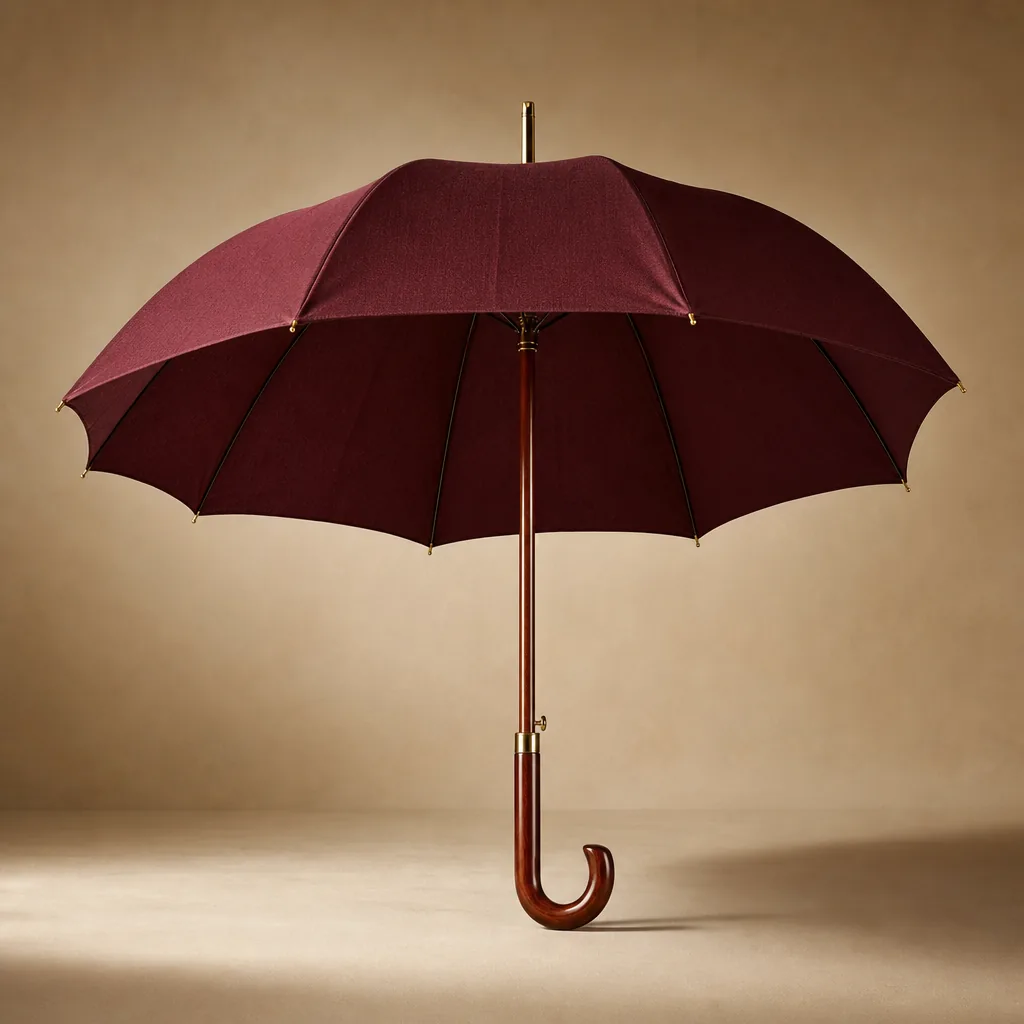
A J handle umbrella makes more sense for golf, hospitality, and older users because the hook gives a natural carry point and can hang on a chair, cart, or reception counter. The radius matters more than most buyers think: a tight hook feels compact, but a larger radius around 45 to 55 mm is easier on the wrist during longer walks and makes the umbrella less likely to dig into the forearm. An umbrella handle supplier should also pay attention to the throat thickness where the hook meets the shaft, because that junction takes the most load when the user swings the umbrella by the wrist or hangs it on a rack. For hotel and resort programs, that geometry matters as much as the canopy print.
An ergonomic umbrella grip is the right call when comfort is part of the product brief, especially for larger 27" or 30" umbrellas and auto-open-close commuter models. These handles usually use a flattened palm area, a slight finger channel, and a more pronounced rear swell so the hand does not clamp down as hard in rain or wind. Grip length should match use: short grips are fine for giveaway models, but a longer 12 to 14 cm handle improves balance on heavier golf frames and gives room for a wrist strap or custom insert. In OEM work, I treat handle shape as a storage decision as much as a comfort decision, because a bulky J hook and a narrow straight handle solve different problems. The right spec depends on how the user carries it, not just how it looks in a catalog.
Choose the Base Material and Finish
ABS is the default choice when a buyer wants a clean balance of cost, repeatability, and decoration flexibility. A molded ABS umbrella handle takes pad print well, accepts laser marking on painted or metallized surfaces, and can be finished with a soft-touch coating if the goal is a more premium feel without changing the base tooling. For an umbrella handle supplier, this is usually the most efficient route for large OEM runs because the shape is stable, the color match is predictable, and the scrap rate stays low. If the order needs an ergonomic umbrella grip, ABS also gives enough design freedom to add thumb rests, finger grooves, or a J handle umbrella profile without pushing unit cost too far. It is not the warmest material in hand, but for retail promotions and mass-market sets it delivers the best control over price and appearance.
EVA and TPR sit in the comfort-first category, but they solve different problems. EVA feels lighter and softer, so it works well when the grip needs cushioning and a slightly muted surface, while TPR gives a more rubber-like hold with better wet-hand traction and a stronger sense of control. Both can be molded into a soft-touch handle, but TPR usually holds shape better under repeated flex and higher ambient heat. Pad print works on both, though the print life is better on smoother TPR grades than on heavily textured EVA. For buyers comparing perceived value, these two materials often beat plain ABS because the hand feel is immediately obvious, even before the umbrella is opened. ZheBrella usually recommends them when the product brief emphasizes comfort, sports use, or longer carry time over the absolute lowest FOB target.
Wood and aluminum accents are used to lift perceived value, but they should be chosen for the right reason. A wooden handle, especially a J handle umbrella style, communicates a traditional or gift-grade look; it can take painted wood grain well, and darker stains hide minor machining variation better than light finishes. It is heavier, more expensive to machine, and less forgiving in humid storage than ABS or TPR, so the buyer should expect tighter QC and higher reject risk on cosmetic defects. Aluminum accents are better as trim, ferrules, or small grip inserts than as a full handle body because they are durable, clean-looking, and suitable for laser mark, but they can feel cold and slippery if overused. In practice, the strongest OEM mix is often an ABS core with aluminum accent rings or a soft-touch coating, because it gives a premium read without sacrificing cost control or production stability.
Balance the Handle with the Frame and Mechanism
Handle choice is not cosmetic; it changes how the whole umbrella sits in the hand. An auto-open button adds mass at the top of the grip area, so on a compact 21" or 23" stick umbrella the balance can feel nose-heavy if the handle is too small. Shaft diameter matters the same way: a thicker steel shaft pushes the centerline of the load down into the grip, while a slimmer fiberglass shaft feels lighter but can move more in gusts. As an umbrella handle supplier, our standard practice is to match the handle volume to the mechanism first, then worry about shape. If the opening system is auto-open or auto-open-close, the thumb needs a clean press path and the palm needs enough surface area to control the rebound without pinching.
A heavier frame usually needs a more substantial handle to keep the umbrella stable. An 8K rib set with a lightweight pongee canopy can work with a compact ABS umbrella handle, but once you move to 16K ribs, reinforced stretcher parts, or a double-canopy vented windproof build, a tiny handle starts to feel wrong in motion. The user senses this immediately when walking in wind or carrying the umbrella by the side. A soft-touch handle helps, but only if the core is thick enough to prevent flex at the neck. On larger 27" and 30" models, I prefer an ergonomic umbrella grip with more palm fill, because that extra mass counteracts the head weight and reduces wrist fatigue during long carry times.
For OEM orders, the right answer depends on the use case, not just appearance. A J handle umbrella gives better hang and leverage for retail, golf, or commuter programs, while straight handles are easier to pack and usually cheaper in mold cost and carton volume. If the frame is light and the canopy is compact, a slim ABS handle is enough; if the shaft is larger or the rib count pushes the head weight up, use a fuller grip profile so the umbrella does not feel top-heavy when opened. ZheBrella usually checks the handle-to-shaft ratio during sample approval, because a poor balance point is a common reason buyers reject a sample even when the graphics and canopy spec are correct.
Branding, Inserts, and Retail Presentation
Logo placement on the handle should be decided before tooling, not after. On an ABS umbrella handle, we normally see three workable zones: the outer stem near the neck, the flat face of a J handle umbrella, and a recessed panel on a soft-touch handle. Debossing is the cleanest choice for one-color branding when the mold already has a defined flat or slightly curved area; it survives abrasion better than pad print and does not look cheap after shipping. Print is better when the logo needs fine text, a second line, or a multi-color mark, but the usable area is smaller than buyers expect, especially on ergonomic umbrella grip shapes with narrow radii. A serious umbrella handle supplier will ask for vector artwork, Pantone references, logo size in millimeters, and a proof that shows the exact handle orientation, because a logo that looks centered in a PDF can land crooked on the finished grip.
For retail programs, the handle itself is only half the story. ZheBrella usually treats sleeves, hang tags, and insert cards as part of the same SKU decision because they change both shelf appeal and packing labor. A printed sleeve helps when the canopy color is plain and the buyer wants a cleaner front-of-house look; a hang tag is better for promotional programs where the buyer needs pricing, barcode, or compliance text visible without opening the bag. Insert cards are the right choice for premium retail because they give room for care instructions, wind rating, and brand story, while keeping the umbrella compact in the carton. If the order is headed for chain retail, we normally recommend a sleeve plus a card only when the handle finish is strong enough to justify it, because weak graphics on a soft-touch handle look worse when displayed next to better-packed competitors.
Artwork proofing is where most OEM orders go wrong. For one-color printing, we need a clean vector file, one Pantone target, and a clear note on whether the ink should sit matte or gloss; for multi-color printing, we need separate spot colors or a confirmed CMYK build, plus an overprint check so fine text does not fill in on curved plastic. Deboss artwork needs extra caution because lines that are too thin will disappear on injection-molded ABS, and the same file that works on a flat promo pen may fail on a tapered grip. The proof should show actual handle dimensions, logo scale, and placement from the top and side views, then get signed off before mass production. In practice, that proof step is what keeps a custom order from turning into a warehouse of unusable handles that no one wants to retail.
Tooling, MOQ, and Production Checks
Before mass production, freeze the handle mold, color chip, shaft fit, and pull-off strength. On an OEM run, I will not release tooling until the handle neck and shaft socket are dimensioned against the actual ferrule or tube, not a catalog drawing. That matters whether you are ordering an ABS umbrella handle, a soft-touch handle, or a J handle umbrella, because a 0.3 to 0.5 mm mismatch can turn into wobble, cracking, or glue failure after shipping. As an umbrella handle supplier, our standard practice is to lock one approved physical sample, one Pantone reference for color, and one assembly method before the line starts cutting production parts. If the buyer wants an ergonomic umbrella grip, the hand feel, coating thickness, and mold texture should also be signed off at the same time, because those details are expensive to change once the cavity is steel-cut.
Commercially, the usual MOQ depends on whether the handle is stock tooling or a new mold. For a standard ABS umbrella handle with existing tooling, 1,000 to 3,000 pieces is normal; for a private mold, 3,000 to 5,000 pieces is more realistic if the buyer wants a custom profile or logo relief. Sample lead time is typically 5 to 10 days for stock parts and 15 to 25 days for new tooling, assuming the color chip is approved quickly. Buyers should also confirm pull-off strength before bulk release, not after, because the handle-to-shaft joint is one of the first failure points in transit and field use. We test the assembled grip to a defined extraction load and check that the handle does not rotate, split, or loosen under repeated torque.
Acceptance checks should be written into the purchase order and inspected under AQL 2.5, not treated as a casual visual sort. That means checking appearance, color deviation, gate marks, sink, flash, and dimensional fit on a sampled basis, with separate attention to the grip texture and any printed or molded logo. For a soft-touch handle or ergonomic umbrella grip, we also check coating adhesion and odor, because cheap coatings can peel or feel sticky after heat exposure in cartons. The pull-off test, shaft alignment, and assembly force should be recorded on the first article and on each lot release. If the buyer wants a J handle umbrella for retail or promotion, I recommend freezing the carton pack-out and carton drop standard at the same time, since handle shape changes the way the umbrella nests and ships.
Frequently Asked Questions
Which handle type is best for promotional umbrellas?
ABS is usually the lowest-cost choice for promo runs because it supports repeatable molding and easy logo printing. EVA and TPR cost more but improve grip and can lift perceived value.
When should a buyer pay for a soft-touch handle?
Use it when the umbrella will be carried for longer periods or sold into retail where tactile feel affects conversion. It is less useful for the cheapest giveaway items because the added cost is easy to notice.
What is the usual MOQ for custom umbrella handles in OEM orders?
For standard ABS or PP handles, MOQs often start around 500 to 1,000 pieces per style. For wood handles, special molds, or multi-material grips, buyers should expect higher MOQs or a shared-tooling setup.
How much lead time should a buyer expect for new handle tooling?
Sample development usually takes 5 to 10 days once the artwork and dimensions are confirmed. New tooling and mass production commonly take 25 to 45 days, depending on handle material, finish, and order size.
Which handle material is best for low-cost promotional umbrellas versus retail umbrellas?
ABS or PP is usually the best fit for low-cost promo runs because it keeps unit cost down and supports fast production. For retail programs, wood, EVA, TPR, or soft-touch overmolded handles are more common because they improve perceived value and grip.
Looking to Launch Your Custom Umbrella Line?
ZheBrella is a Zhejiang-based OEM/ODM umbrella manufacturer with 17 years of export experience. Free design, low MOQ from 100 pieces, windproof construction, full-color print.
Get Free Quote Now »People Also Search For
Related Articles
Umbrella Handle Materials and Grip Options for OEM Buyers
Compare rubber, EVA, wood, ABS, and soft-touch handles for comfort, branding, durability, and order specs buyers should ...
Read More »
Umbrella Handle and Tip Options for Retail and Promo Buyers
Compare handle shapes, grip materials, and tip constructions so buyers can match comfort, branding, and durability to ea...
Read More »J-Handle vs EVA Grip Umbrellas for Hotels and Promo Use
Compare J-handle and EVA grip umbrella builds for hotel, retail, and promo programs, including comfort, cost, print opti...
Read More »