Umbrella Notch and Runner Tolerances That Prevent Frame Jamming
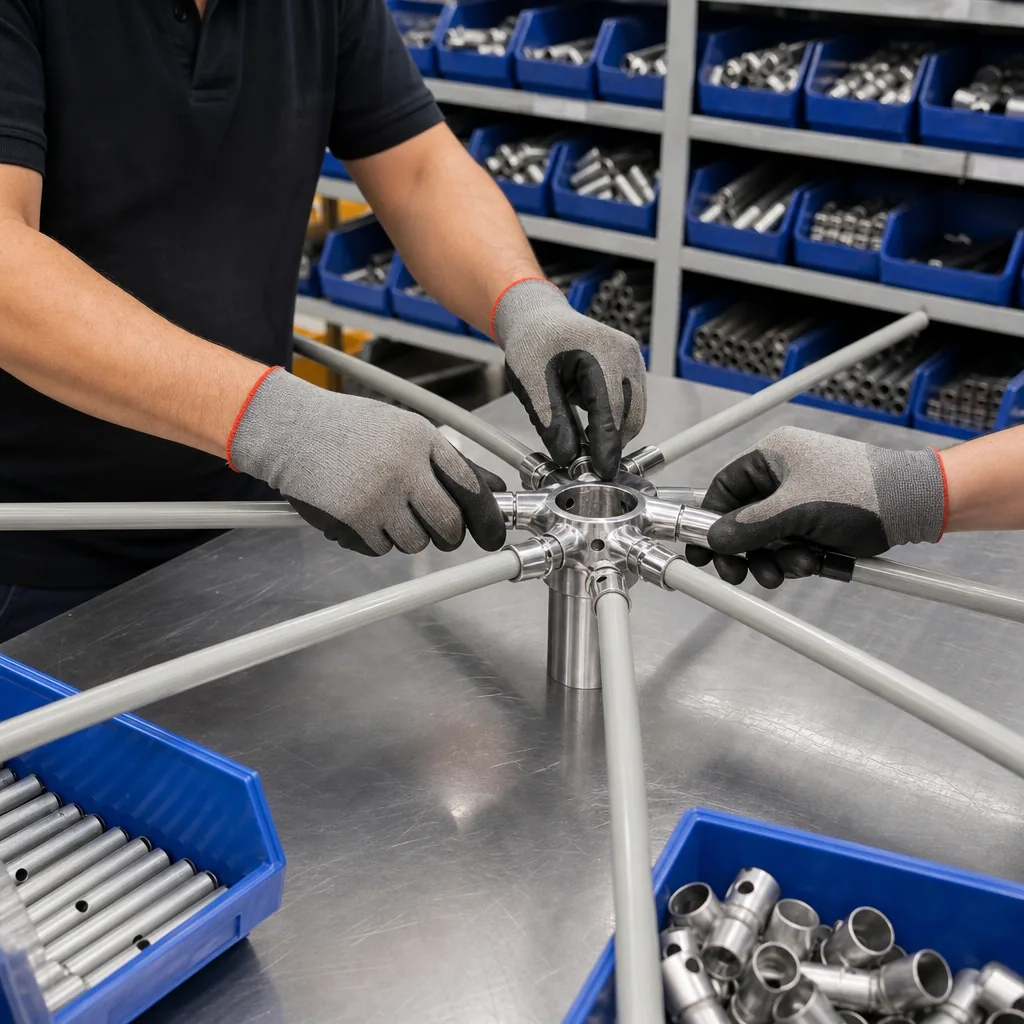
When a frame jams at mid-stroke, the root cause is often not the spring or shaft but stack-up between the notch profile, runner bore, and rib joint alignment. On our Songxia lines, we see uneven opening and repeat warranty returns when umbrella runner tolerance is set without accounting for plating buildup, burr height, and automatic opening speed. Buyers who lock these tolerances early get smoother travel, fewer hang-ups, and more stable assembly yields across production lots.
Where Frame Jamming Starts in Production
Most umbrella frame jamming starts in the tolerance stack between shaft OD, runner ID, and notch alignment, not in the canopy. A shaft that grows by 0.08-0.12 mm after nickel plating or paint can turn acceptable clearance into drag, especially on low-cost steel tubes where punched spring holes leave burrs. That makes umbrella runner tolerance a system issue, not just a runner bore dimension. Runner bore roundness, shaft straightness, rivet head clearance, and notch seat angle determine whether the runner stays concentric or cocks off-axis during travel. Once it tilts, the opening sequence goes uneven: one rib rises early, the opposite side lags, and the frame reaches only partial lock-up. For buyers, the risk is that a frame can pass subassembly checks and still fail after canopy mounting, when sewing tension adds one more variable to a marginal notch and runner assembly. The practical controls are straightforward: gauge shaft runout, deburr every punched hole, and verify runner travel before and after canopy assembly under the same inspection standard used for production lots, typically AQL 2.5.
The second source of umbrella frame jamming is notch eccentricity. If the notch sits even slightly off the shaft centerline, the error multiplies across an 8K or 10K frame and pulls the stretchers into uneven geometry on every cycle. On manual frames, that usually shows up as a sticky mid-stroke, uneven canopy opening, or a handle that needs twisting to pass one tight spot. The cause is cumulative drift: notch hole position, runner slot spacing, stretcher rivet offset, and shaft straightness all biasing the frame in the same direction. Auto open umbrella parts are less forgiving because spring force can mask poor fit at assembly but amplify it in use. A 21 in. or 23 in. auto-open frame may fire on the bench with runner drag, then fail in the field with runner rebound, incomplete top lock, or a canopy that stops short of full crown tension. Vented double-canopy styles raise the risk further because extra fabric weight demands smoother runner travel and tighter control of latch faces, notch geometry, and spring compression length.
Critical Tolerances for Notch, Runner, and Shaft Fit
Most umbrella frame jamming starts at the shaft-to-runner interface, so the writer should define umbrella runner tolerance in measurable terms, not as “good clearance.” For straight-shaft frames using steel shafts in the 6.0-7.0 mm OD range, a practical target is runner bore variation of about ±0.03-0.05 mm after forming and finishing, with sliding force checked again after paint or nickel plating adds thickness. The goal is controlled clearance: enough to slide freely after coating, but not enough for the runner to cant under spring load. Bore roundness matters as much as nominal size. Ovality from worn punches, plating nodules, or post-form distortion can let a part pass a bench check yet bind during line assembly. The writer should also cover wall thickness consistency around the runner body. If one wall runs thin, that side flexes more during opening, the runner tilts on the shaft, and the issue becomes more severe on auto open umbrella parts, where spring force exposes small geometry errors immediately. Burrs on the bore or shaft-contact surfaces should be treated as functional defects because they scrape coatings, create metal dust, and shorten cycle life.
Rivet location and burr control belong under dimensional control, not cosmetic cleanup. In a notch and runner assembly, ear-to-ear spacing drift or rivet-hole center error of 0.10-0.20 mm at the runner or notch is enough to change stretcher angles, unbalance rib travel, and twist the runner on the shaft. The usual failure pattern is uneven opening: one panel reaches full travel early while another lags, then the frame binds during closing. Punched notch slots, runner ears, and shaft holes should be deburred before assembly so sharp edges do not cut plated shafts or seed binding within a few dozen cycles. Frame layout changes the tolerance stack. Steel frames and fiberglass frames react differently to the same misalignment; steel layouts may resist deflection longer, while fiberglass can absorb error and then spring back unpredictably on close. Sensitivity rises on 16K frames versus standard 8K because doubling rib and stretcher count doubles pivot points and tightens angular spacing. In OEM umbrella engineering, 23-inch and 27-inch auto-open 16K frames therefore need tighter hole-position control, runner concentricity checks, and repeated open-close cycling before mass-production release.
Material and Surface Choices That Affect Sliding Performance
Material choice changes sliding behavior even when the nominal shaft clearance is the same. On value frames, plated steel remains the standard because stamped parts are low cost and keep their shape under spring load, especially in auto open umbrella parts. The tradeoff is finish buildup: zinc or nickel plating adds thickness that is rarely uniform inside the bore. If a notch and runner assembly is designed around only 0.10 to 0.15 mm running clearance, heavy plating at the seam or inner edge can consume most of that allowance and create localized drag. Painted steel is usually less predictable. Paint applied after forming tends to build at corners, rib-slot edges, and latch windows, so the part can leave the line tight before any cycle testing. Once paint chips in humid storage, the exposed carbon steel forms rough corrosion spots that the latch scrapes across on every open-close cycle, accelerating umbrella frame jamming. For low-cost sourcing, plated steel is usually the safer choice than painted steel, but only if the supplier controls plating thickness, deburring, and final bore condition after stamping.
Aluminum and plastic runners reduce red-rust risk, but they fail in different ways and should be specified with the full use case in mind. Aluminum can slide cleanly and resists the corrosion common on low-grade steel, yet it is not automatically smoother: soft aluminum can gall on a steel center shaft, and burrs from punched slots quickly raise friction. On higher-cycle frames, that often makes a well-finished plated steel runner more consistent than cheap cast aluminum with variable flash or porosity. Plastic runners in PP, ABS, or nylon blends offer the lowest noise and naturally low friction, and they will not seize from rust, but they can creep under load, distort in hot containers, and crack at the latch window if wall sections are too thin. In OEM umbrella engineering, anti-rust treatments such as passivation, electrophoretic coating, and light oil films improve service life, but they also alter umbrella runner tolerance. On 21 inch and 23 inch compact frames, just 15 to 25 microns of uneven buildup near the latch channel can turn a smooth sample into a runner that jams after 200 to 300 cycles. The key control is final gauging after all finishing, not raw-metal inspection alone.
Testing Methods for Smooth Opening and Lock Reliability
Validate umbrella runner tolerance with cycle data before packed-goods inspection, not with a quick hand check. Test manual and auto-open frames for 500 to 1,000 open-close cycles, and use 3,000 cycles for long-life retail programs on complete assemblies. Record peak opening force at the runner with a digital push-pull gauge on cycle 1 and the final cycle; the key pass condition is stable force over repeated use, not a single smooth opening. On 21-inch or 23-inch 8K folding frames, force drift usually traces to shaft burrs, uneven plating thickness, or an ovalized runner bore rather than a drawing error. A blue-check on shaft and runner contact surfaces shows the real friction path and helps isolate drag points faster than arguing nominal dimensions in OEM umbrella engineering. For notch and runner assembly, this is the practical standard: repeated-use validation, force measurement, and defect evidence tied to the actual contact surfaces.
Lock reliability needs its own protocol because a frame can open yet still fail in service. Verify positive engagement at the top notch and lower latch through repeated snap-open trials, then apply side-load on the ribs to simulate wind shock and vibration and confirm the runner does not rebound, half-seat, or release by accident. Common causes are misaligned notch stamping, weak spring tongues, and uneven rivet setting that twists the runner during travel. For auto open umbrella parts, pre-compress and fire the spring assembly hundreds of times before final verification, then recheck lock-up force, release force, and visible pin wear. Condition extra samples for 24 hours at about 95% RH, hold others at 45 to 50°C, and cold-check near 0 to 5°C before repeating opening-force and lock checks; borderline assemblies often show umbrella frame jamming only after this conditioning. Final acceptance should follow the agreed AQL 2.5 standard, with defects logged separately for jammed travel, incomplete lock, accidental release, and excessive opening force.
What Buyers Should Lock Before Sampling and Mass Production
Freeze the engineering package before tooling, not after the first sample. For any notch and runner assembly, buyers should require a controlled assembly drawing plus detail prints for the shaft, runner, notch, latch, and spring components; a photo sample and BOM do not control fit. The drawing set should specify shaft OD and ID, runner bore, notch slot width, rivet diameter, spring pin height, and the opening angle at full lock, with tolerance notes on every sliding and pivoting surface. The highest-risk callout is the umbrella runner tolerance between the plated shaft and the runner insert, whether nylon or metal. On 21 inch and 23 inch folding frames, nickel, paint, or black electrophoresis can reduce clearance enough to add drag, while excess clearance lets the runner tilt under load and causes umbrella frame jamming. For auto open umbrella parts, lock spring force, latch engagement depth, and coating stack-up before sampling so finish thickness is designed into the fit instead of discovered during pilot assembly.
Use staged approvals with written gates. The first article after tooling should confirm geometry and function: 8K or 10K symmetry, smooth open-close action, stretchers seated flat, and no runner hang-up after at least 200 cycles. Keep canopy approval separate from frame approval, because 190T pongee, 210T pongee, and POE can change frame loading enough to expose marginal fits. The only sample that should be inspected to AQL 2.5 is the sealed production golden sample built from mass-production components, not a hand-finished sample-room prototype. Before mass production, procurement should sign off on the tolerance table, a runner-shaft cross-section, and a defect limit sheet covering burrs, plating buildup, rivet looseness, and latch misfire so OEM umbrella engineering decisions stay traceable. If tooling changes are needed, put the commercial impact in writing: a runner bore, notch slot, or spring seat revision can force a new punch, revised die-cast insert, or shaft redraw, which may move MOQ from 500 pieces to 1,000 or 3,000 and extend sample lead time from 7-10 days to 19-30 days. Under FOB, freeze engineering changes 25-30 days before ex-factory; under DDP, add buffer for export packing, customs data, and line-haul scheduling because late fit changes can alter assembly time, final weight, and carton count.
Frequently Asked Questions
Why does an umbrella pass visual inspection but still jam after use?
Jamming often comes from tolerance stack-up, burrs, or coating buildup that are not obvious in a static visual check. Repeated opening-cycle tests and lock-force checks are needed to catch those issues.
Do 16K umbrellas need tighter runner control than 8K umbrellas?
Usually yes. With more ribs and linkage points, 16K frames can be less forgiving of small alignment errors. That makes runner fit, rivet placement, and opening-balance checks more important during sampling and mass production.
What runner-to-shaft clearance is usually targeted to reduce sticking without adding wobble?
For most steel or aluminum umbrella frames, buyers commonly ask suppliers to hold runner-to-shaft clearance in a controlled band around 0.15-0.30 mm, depending on coating thickness and shaft finish. Below that range, paint buildup and burrs can cause drag; above it, the runner may tilt and create uneven opening.
Should notch and runner tolerances be checked before or after surface finishing?
Both stages matter, but final approval should be based on post-finishing measurements because plating, e-coating, or paint can change fit by 0.03-0.08 mm on contact surfaces. A practical QC plan is first article measurement after stamping, then a second fit test after finishing and assembly.
What production test best catches frame jamming before shipment on OEM orders?
A repeated open-close cycle test is the most useful for batch control, typically 50-100 cycles per sampled frame for standard programs and higher for auto-open designs. Buyers often require jamming rate, off-track runner movement, and uneven rib deployment to be recorded by lot before packing approval.
Looking to Launch Your Custom Umbrella Line?
ZheBrella is a Zhejiang-based OEM/ODM umbrella manufacturer with 17 years of export experience. Free design, low MOQ from 100 pieces, windproof construction, full-color print.
Get Free Quote Now »People Also Search For
Related Articles
Umbrella Metal Parts Manufacturing: Stamping, Rivets, and Tolerances
Learn how stamped parts, rivet specs, and assembly tolerances affect umbrella durability, opening feel, defect rates, an...
Read More »
Umbrella Frame Assembly Tolerances That Reduce Field Failures
Learn which umbrella frame tolerances matter most in production, from rivet play to runner alignment, to cut defects, cl...
Read More »Umbrella Frame Assembly Line: Rivets, Jigs, and Tolerance Control
Learn how umbrella frames are assembled with rivets, jigs, and tolerance checks so bulk OEM orders open smoothly and pas...
Read More »