Umbrella QC Standards: AQL 2.5, Rib Tests, and Carton Checks
When an umbrella shipment misses a seam, snaps a rib, or arrives with crushed cartons, the cost shows up later in chargebacks, returns, and lost repeat orders. A disciplined umbrella QC inspection built around AQL 2.5, rib strength checks, canopy finish review, and carton integrity testing helps buyers catch those failures before they leave the factory. In production, the difference is not theory but whether the lot can survive handling, rain, and transit.
Set the Acceptance Plan Before Inspection Starts
Start every umbrella QC inspection by locking the lot definition before anyone opens a carton. A lot should be one PO line, one colorway, one mechanism, and one production window, not a mixed pile of leftovers from different shifts. For AQL 2.5, most buyers are applying a normal inspection plan with lot size tied to the shipment quantity, then pulling the sample count from the standard sampling table rather than guessing. In practice, the sample size changes fast: a 3,200-piece lot does not get the same pull as a 12,000-piece lot, and the acceptance number has to match that sample. If the lot is split across cartons, label the carton range and keep the count traceable back to the umbrella factory batch, or the results are hard to defend later.
The defect classes need to be written in plain terms that match what actually fails in umbrellas. Critical defects are broken ribs, cracked tips, canopy holes, loose ferrules, and a mechanism that will not lock or open cleanly. Major defects include missed stitches at the panel seams, uneven tension, print misalignment on logos, weak Velcro, and canopy slippage on the runner. Minor defects are usually cosmetic: light stains, off-center hangtags, small scuffs on handles, or a slightly crooked tie band. If the spec calls for 190T pongee, a double-canopy vented frame, or UPF 50+ coating, those requirements should be checked separately from appearance. That is the only way an umbrella QC inspection stays consistent across different inspectors and does not turn into opinion.
Sampling should also cover packaging, because a perfect canopy means little if the retail pack fails in transit. Check polybag size, barcode readability, hangtag content, insertion order, carton count, and whether the master carton matches the purchase order exactly. A carton drop test is worth doing on a few finished cartons, especially for export lanes with rough handling; crushed corners and popped end flaps show up fast when packing is weak. For durability, add a rib fatigue test on selected samples, then record the opening cycles, any rib deformation, and whether the canopy still tracks straight after repeated use. With AQL 2.5, the point is not to inspect everything; it is to set a measurable pass/fail line before shipment so the buyer and the factory are judging the same lot against the same standard.
Check Frame Geometry and Cycle Performance
In umbrella QC inspection, the first thing I check is geometry, not cosmetics. A frame can look clean on the bench and still be wrong if opposite ribs are not mirrored, the stretchers sit off-center, or the ferrule and runner are fighting each other. For 8K and 16K assemblies, I measure equal rib spread, verify that each joint seats fully, and confirm there is no twist in the main shaft that would cause one side of the canopy to open late. On a sample basis under AQL 2.5, we reject frames with visible wobble, uneven locking force, or any runner that binds before full travel. That kind of defect usually shows up later as canopy puckering or broken stitching, so I treat alignment as a structural issue, not a finish issue.
Cycle performance is where weak hardware stops hiding. The auto-open button must release cleanly, the spring must return with consistent force, and the runner travel has to stay smooth through repeated open-close cycles. I usually run enough cycles to expose marginal rivets, loose center joints, or a trigger that starts sticking after warm-up, because those problems get worse in real use. On 8K umbrellas, the frame can tolerate a little less load variation, but on 16K assemblies the extra ribs only help if all segments stay synchronized; one slow rib is enough to create a flat spot and shift the canopy load to the neighboring arms. A proper rib fatigue test should show no cracking, no permanent set, and no loss of latch engagement after the cycle count the customer specified.
The frame check is not complete until I look at how it survives handling, including the carton drop test. A frame that passes open-close cycling can still drift out of square if the carton is packed too loosely and the ribs take a shock load in transit. In an umbrella factory, I want the carton check to confirm the tips, tips sleeves, and shaft position are locked down so the head cannot slam sideways when the box hits the floor. That is where hidden geometry defects surface: bent stretchers, cracked rivet heads, or an auto-open button that works on the line but fails after vibration. For production release, I tie the visual geometry check, the rib fatigue test, and the carton drop test together under AQL 2.5, because one isolated pass means little if the frame cannot keep its alignment after shipping and warehouse handling.
Inspect Canopy Materials and Sewing Work
For umbrella QC inspection, the canopy check starts with the cloth itself, not the finished umbrella. On pongee 190T or 210T, I look for dye streaks, oil marks, broken filaments, pinholes, and shade variation panel to panel, because these defects show up more clearly after cutting and are harder to hide later. A clean roll can still fail if the finish is inconsistent: water repellency has to bead evenly across the panel, not just near the center, and the fabric weight should match the spec on both warp and weft. If the order claims UPF 50+, that is not a label exercise. The coating or weave density must be consistent enough to support the claim, and the canopy cannot have thin spots, abrasion at the fold lines, or print bleed that interferes with the coating layer.
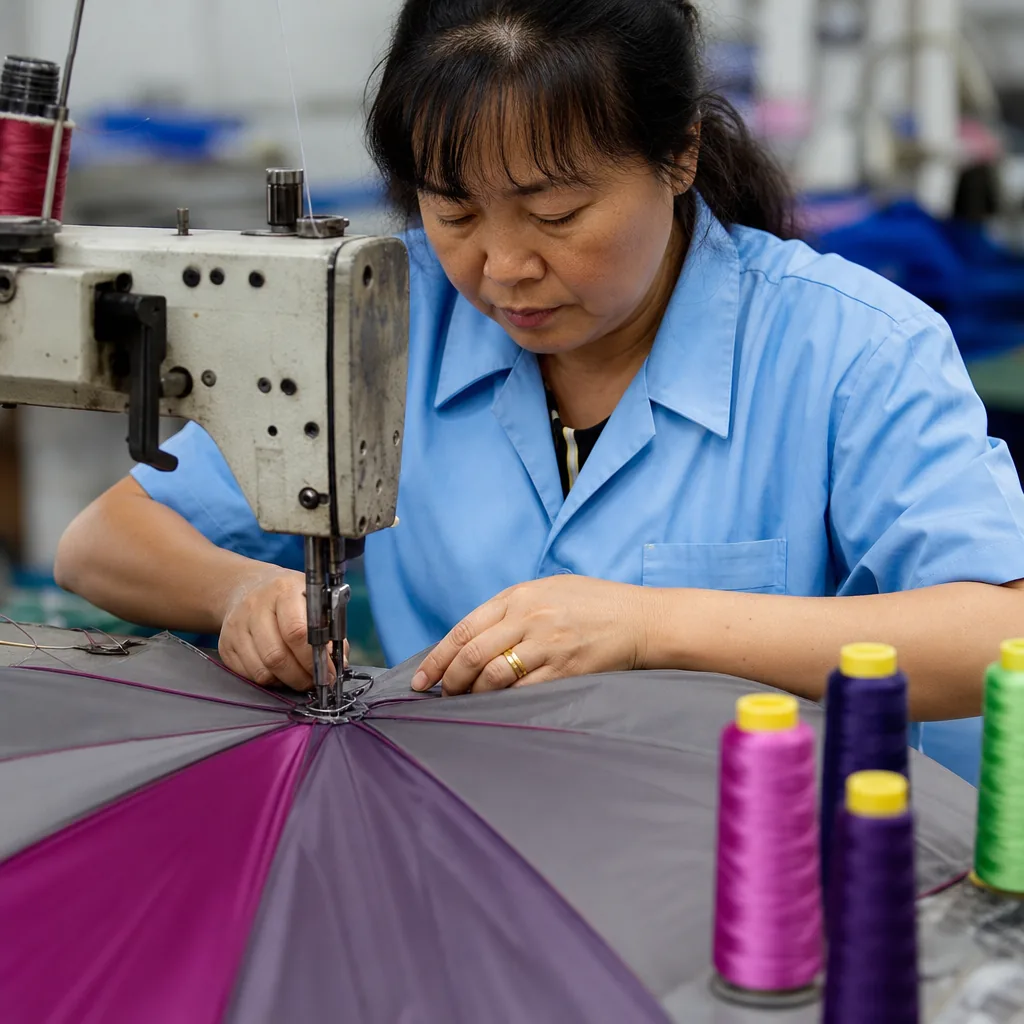
Sewing work matters just as much as the fabric. Seam puckering, skipped stitches, uneven SPI, and crooked panel alignment are all signs the operator was fighting the material or the machine tension was wrong. On a good canopy, the stitch line sits flat, the seam allowance is even, and the tip cover closes cleanly without bulk or gaps. I also check the vent area, edge binding, and any reinforced corner points, because these are where a weak umbrella factory usually cuts corners. In AQL 2.5 sampling, even a small cluster of sewing defects can push a lot out of acceptance if the same issue repeats across multiple panels, so the inspection has to catch patterns, not just isolated misses.
The final canopy review is functional, not cosmetic. Open the frame and inspect whether the fabric tracks smoothly, whether every panel tension is balanced, and whether the tip covers seat without twisting the ribs underneath. If the umbrella is sold with UPF 50+ or water-repellent claims, the canopy should be checked under light and water spray for uneven coating, especially near seams, seams crossings, and the crown where stress is highest. A bad canopy can still pass a quick visual if you do not spread it fully and handle it by hand. That is why umbrella QC inspection has to combine visual checks, tactile checks, and spec verification before moving on to rib fatigue test or carton drop test downstream.
Test Finished Goods for Leaks and Visual Defects
A finished umbrella can look acceptable on the line and still fail in customer hands, so the last umbrella QC inspection has to catch both leaks and visual defects before packing. We check the canopy under strong white light, then again with the umbrella opened and held against a dark background so pinholes, thin spots, oil stains, glue marks, and skipped stitches stand out. On pongee 190T or 210T, even a small oil stain from sewing lubricant is enough to trigger a reject if it sits in the visible panel area. Loose threads at the seams, seam puckering, and uneven panel alignment usually point to poor trimming or wrong tension during sewing, and those problems get worse after repeated opening cycles. In an umbrella factory, the rule is simple: if the canopy looks unstable when it is first opened, it will not improve in transit.
Color control matters just as much as leakage control. We compare each lot against the approved master shade under D65 light, because slight variation between dye lots is easy to miss on the sewing floor but obvious when cartons are opened by a buyer. On printed styles, we also check registration, edge sharpness, and whether the ink or transfer has broken at the folds; that is where low-grade print work starts to fail. Canopy tension gets a physical check by opening the umbrella fully, rotating it, and looking for bagging, wrinkling, or a loose crown that lets water pool instead of shedding cleanly. If the panel tension is uneven, the ribs will show it immediately, especially on 21-inch and 23-inch frames with fiberglass spokes. This is the point where umbrella QC inspection stops being visual only and becomes functional: the finished piece has to look straight, dry evenly, and hold its shape.
For release, we sample to AQL 2.5 and separate appearance defects from structural defects, because a carton full of clean-looking umbrellas can still fail if the canopy is weak or leaking. The sample set should include random units from different master cartons, then a quick shower or spray check to expose pinholes, weak seam sealing, and water ingress around the tips and runner area. If the order spec calls for it, we also confirm rib action with a light rib fatigue test on representative pieces, since a canopy that sits tight on day one may loosen after a few dozen open-close cycles. Before final pack-out, cartons get weight and count verification, label matching, and a carton drop test to make sure loose tips, bent shafts, or cracked handles do not appear after handling. That last step matters because damage often shows up after the umbrella leaves the sewing table, not before.
Verify Packing Counts and Carton Condition
Packing control starts before the carton is sealed. In an umbrella QC inspection, I verify the count against the packing list, then check whether each inner bag fits the folded umbrella without crushing the tip, handle, or canopy edges. Too tight and the bag wrinkles the retail presentation; too loose and the product shifts during transit, which usually shows up as bent tips or scuffed handles when cartons are opened at destination. Barcode accuracy matters at the same stage: the SKU on the unit label, inner bag sticker, and outer master carton must match exactly, because one wrong code can split a shipment in receiving and trigger a claim even when the goods themselves are fine. This is standard practice at ZheBrella because packing errors are cheaper to stop at the line than to fix after export.
Master carton marking needs to be legible, complete, and consistent with the order spec. I check buyer name, PO number, style code, quantity, carton dimensions, gross and net weight, and country-of-origin marking, then confirm the print does not rub off under normal handling. For export work, carton orientation arrows, batch numbers, and carton count per pallet should be clear enough for warehouse staff to trace the shipment without opening every case. The usual umbrella QC inspection point here is not just appearance; it is whether the carton layout supports correct picking and stacking. If the master carton is mislabeled, the receiving team may reject the whole lot even when the goods passed AQL 2.5 on product defects. That is a packaging failure, not a sewing failure, and it should be treated that way.
Carton strength needs a physical check, not a visual guess. A carton drop test from handling height will show weak tape seams, poor corner crush resistance, or inadequate void filling long before the freight forwarder does. For heavier orders, I also use compression checks to see whether stacked cartons deform enough to damage the umbrellas inside, especially when the shipment includes long-shaft models or mixed carton weights. This is where a separate rib fatigue test matters only indirectly: if the ribs are already borderline, repeated vibration and carton flex can turn a marginal unit into a return. A proper umbrella factory should treat packing validation as part of the same control system as product testing, not an afterthought. If the carton survives handling and the count is right, the shipment arrives usable, retail-ready, and traceable by PO without manual sorting at destination.
Frequently Asked Questions
Why use AQL 2.5 on umbrellas instead of only visual checks?
AQL 2.5 gives a defined sampling rule for major and minor defects, so shipment approval is not based on one inspector's judgment alone. It is especially useful for mixed issues like broken ribs, print defects, and carton damage.
Which defects should stop a shipment immediately?
Broken ribs, failed open-close function, major water leakage, wrong artwork, and missing pieces should trigger hold or rework. Those defects affect usability or brand presentation and should not pass as cosmetic exceptions.
What defect types are usually counted under AQL 2.5 for umbrellas?
Common major defects include broken ribs, inverted opening issues, loose handles, canopy holes, and missing parts. Minor defects usually cover cosmetic stains, uneven stitching, and small print misalignment. In a typical lot of 1,000 to 5,000 units, inspectors will sample per the agreed AQL table and record defects by severity.
How many umbrellas should be tested for rib fatigue and open-close cycles?
For a production lot, buyers often ask for a small destructive test sample plus a functional cycle check on additional units. A practical factory check is 5 to 10 pieces for manual open-close cycling and 2 to 3 pieces for rib fatigue or wind-related stress testing, depending on order size and risk level.
What carton test standards should a buyer request before shipping umbrellas?
At minimum, ask for a carton drop test from 60 to 80 cm based on parcel weight and lane risk, plus a compression check on stacked cartons. For export orders, the outer case should also be checked for edge crush, tape seal quality, and mark accuracy before palletizing.
Looking to Launch Your Custom Umbrella Line?
ZheBrella is a Zhejiang-based OEM/ODM umbrella manufacturer with 17 years of export experience. Free design, low MOQ from 100 pieces, windproof construction, full-color print.
Get Free Quote Now »People Also Search For
Related Articles

How Umbrella Factories Test Ribs, Springs, and Openers
See how factories test ribs, springs, and openers before shipment, and what buyers should ask for to reduce failures in ...
Read More »
Umbrella Frame Assembly QC: From Ribs to Final Opening
Learn how factory line QC controls rib riveting, runner fit, frame tension, and opening cycles before AQL 2.5 final insp...
Read More »Rain Test Standards for OEM Umbrellas: What Buyers Should Ask
Learn which factory rain and durability tests matter for OEM umbrellas, from water repellency and seam leakage to cycle ...
Read More »