Umbrella Runner and Notch Manufacturing: Fit, Wear, and QC
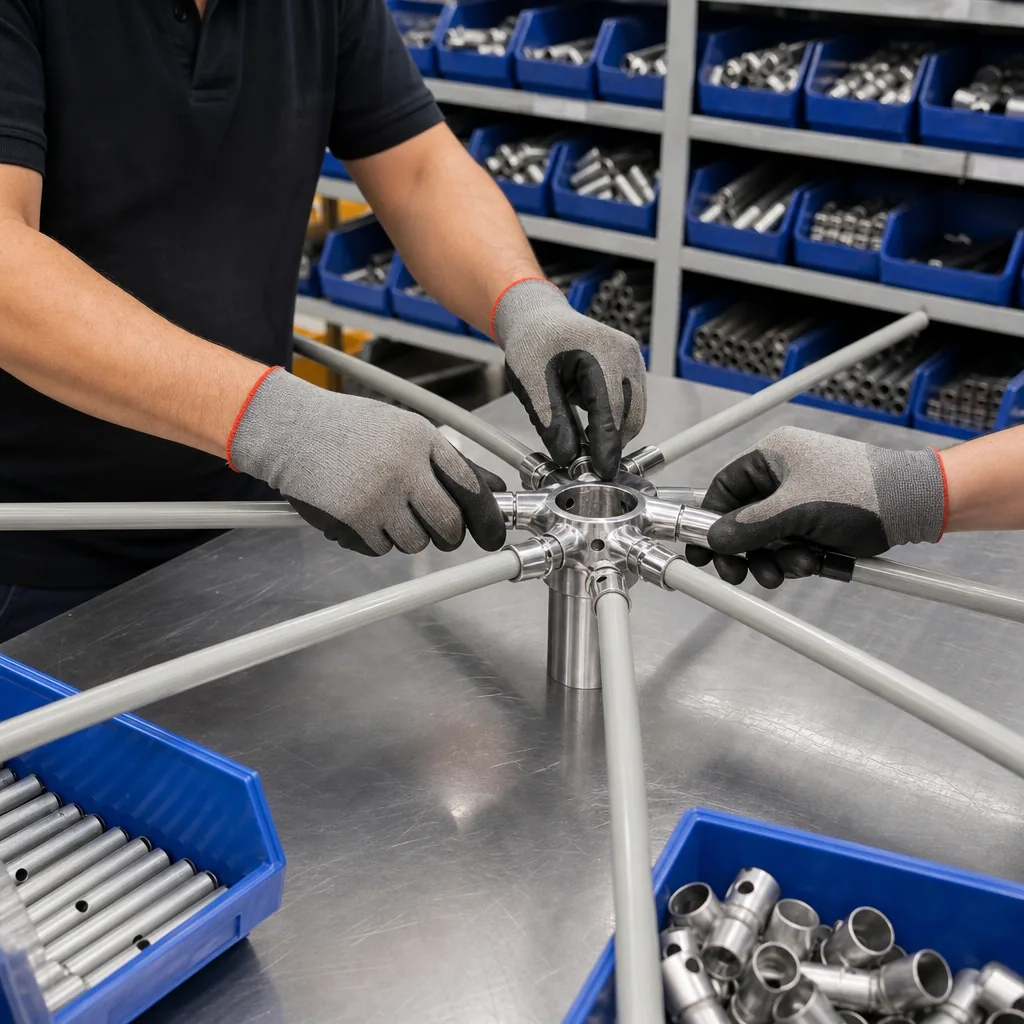
Small tolerance drift in runner and notch parts can turn a good umbrella sample into a mass-production problem: rough opening, accelerated rib wear, and lock failures after only a few cycles. On our Songxia production lines, we see that umbrella runner and notch manufacturing is less about nominal dimensions than how metal thickness, burr control, plating, and assembly fit stack up under repeated opening and closing.
How Runners and Notches Control Opening Performance
In umbrella runner and notch manufacturing, opening performance is decided by fit, not by appearance. On a manual 21-inch or 23-inch umbrella, the runner has to travel straight on the center shaft, lock cleanly, and pull each of the 8K or 10K stretchers through the same arc so the canopy reaches full spread at the same moment. On an auto-open frame, the tolerance window is tighter because spring force drives the runner upward at speed; any burr in the runner bore, shaft ovality, or poorly cut slot geometry shows up as drag, partial lock-up, or a runner that needs a second push to seat. Buyers should evaluate the full stack-up: shaft OD, runner bore ID, stretcher pin position, and top-notch angle. If that geometry drifts, slide feel turns scratchy, opening speed becomes inconsistent, and rib motion falls out of sync. The result is not just a poor user impression. It adds side load to the shaft, stretcher joints, and crown connection, which accelerates frame wear on both steel and fiberglass frame sets and shortens service life under repeated open-close cycles.
The top notch sets rib alignment at the crown, so notch stamping quality directly affects canopy shape, lock-up consistency, and long-term durability. Sharp edges in rib pockets, uneven pocket depth, or off-center pocket spacing preload ribs into a twisted position before a 190T pongee canopy is sewn, which is why one panel pulls tight while the next panel sags on a 27-inch golf umbrella or vented double-canopy frame. On steel ribs, bad notch geometry wears plating faster and increases metal-on-metal abrasion at the crown joint. On fiberglass ribs, it creates side loading that can chip the resin surface and raise wear well before the frame reaches its wind limit. Good umbrella mechanism QC starts with measurable runner tolerance and notch inspection, not hand feel alone. A practical control plan checks runner bore consistency, slot symmetry, lock-button engagement, and free shaft travel before assembly, then verifies lock-up, opening force, and rib symmetry after assembly with repeated cycling. Under AQL 2.5, reject frames with runner wobble, delayed lock-up, sticking in travel, or rib tracking marks around the notch, because those defects are early indicators of crooked opening and premature wear in customer use.
Key Dimensional Specs Buyers Should Review
The dimensions that cause most field failures are inside the frame, not in the canopy. In umbrella runner and notch manufacturing, buyers should lock six checks before production approval: runner bore ID, runner wall thickness at the slot area, rib slot width, spring hole or spring seat geometry, rivet centerline position, and notch symmetry. On a straight umbrella with a 14 mm steel shaft, a runner bore tolerance of about ±0.05 mm is a practical target for smooth travel without side play. On 12 mm and 11 mm shafts, that clearance window usually has to tighten because small ovality is easier to feel during opening and closing. Runner wall thickness at the slot matters just as much. If that section is thin, stretcher load will peen the slot edges, and frame wear shows up fast as loose travel, uneven lock-up, or a runner that cants after a few thousand cycles. Buyers should also confirm how runner tolerance changes by shaft material: aluminum shafts and compact folding runners typically allow less dimensional drift than thicker steel center poles because the mechanism has less mass and less ability to absorb misalignment.
Notch stamping deserves the same scrutiny because the notch sets every rib root angle under load. The high-risk dimensions are slot spacing, slot depth, crown concentricity, rivet or pin hole location, and left-right symmetry after forming. An 8K frame gives more room between ribs, so a minor slot error may still assemble without immediate binding; on a 16K frame, rib geometry is crowded, and even a 0.2 mm pitch error can shift adjacent ribs out of line, distort canopy panel alignment, and increase friction at the open-stop position. Spring interface tolerances also change by mechanism type. Manual frames can absorb slightly more variation, but auto-open and auto-open-close systems need tighter control where the spring, runner latch, and top notch engage, or the result is incomplete lock, rebound, or a harsh release feel. For umbrella mechanism QC, buyers should verify rivet position for spacing and perpendicularity, then confirm performance with opening-force checks, 500-1,000 cycle testing, and AQL 2.5 visual and functional inspection—especially on 21 in. folding umbrellas, 27 in. golf umbrellas, and 10K to 16K frames where crowded geometry leaves little tolerance for dimensional drift.
Material and Surface Choices That Change Service Life
Material choice at the runner and notch usually limits service life before the handle or canopy does. In umbrella runner and notch manufacturing, the cheapest stack is still an unfilled plastic runner with plated carbon-steel notches, and it is usually acceptable only for low-cycle manual 21 inch or 23 inch promotional umbrellas. The cost savings show up later as wear: the runner bore can oval after repeated open-close cycles, spring contact points polish down, and poor notch stamping with loose die clearance leaves burrs on the notch edge. Those burrs accelerate frame wear at the rib cap and stretcher joint long before 190T or 210T pongee fails. For budget programs with tight MOQ limits, reinforced PP or nylon is a safer minimum than commodity resin because runner tolerance stays more stable through hot-container shipment and winter retail storage. On auto-open or auto-open-close frames, a die-cast zinc runner or a resin runner with metal inserts usually justifies the higher unit cost. It holds latch geometry better under spring impact, especially on heavier 8K or 10K frames with fiberglass ribs or double-canopy windproof construction, which reduces partial locking and sticky release during umbrella mechanism QC. The key checkpoints are the center bore, latch window, and spring seat; drift of only a few tenths of a millimeter can create side-loading, inconsistent lockup, and premature shaft-coating wear.
Notches deserve a separate material decision because they carry concentrated rib loads and stay wet when the umbrella is closed. Stamped carbon-steel notches with nickel plating or black electrophoretic coating are common because they scale well and keep cost down, but corrosion usually starts at exposed edges where forming cracks the plating or where sharp stamped corners remain. Stainless steel, typically 201 for lower cost or 304 for better corrosion resistance, is slower to stamp and harder on tooling, but it is the better choice for coastal markets, hospitality fleets, and corporate gifts expected to last beyond one season. On 27 inch or 30 inch golf umbrellas, especially double-canopy frames rated above 50 mph for inversion resistance, weak notches often deform before fiberglass ribs fail, so forming radius and hardness matter as much as gauge. A practical middle-ground build is a reinforced resin runner paired with stainless or well-plated steel notches. Glass-filled nylon improves sliding wear, but only when the molded surface stays smooth; too much exposed glass turns the runner into an abrasive part. For umbrella mechanism QC, AQL 2.5 final inspection should include repeated actuation, lock-engagement consistency, burr checks at the notch eyelet, visible plating-break checks, and wet-cycle testing after salt-spray exposure, not just one open-close test.
Factory Controls for Smooth Assembly and Lower Rework
The cheapest rework to remove in umbrella runner and notch manufacturing is the rework that never reaches rib assembly. Control notch stamping at the press by holding punch-to-die clearance and coil hardness tightly enough to avoid the 0.10-0.15 mm burrs that cut into springs, stretchers, and top rib ends during cycling. Inspect plated steel notches by cavity, not just by batch, because one worn station in a progressive die creates a repeatable defect at the same notch position across the frame: twisted parts, cracked ears, or off-center rivet holes. Apply the same discipline to runner tolerance. On a 14 mm or 16 mm shaft, an undersized plastic runner bore often shows up first as linear scratch marks after 20-30 open-close cycles; an oversized bore creates wobble, noisy travel, and uneven rib spread. During pilot runs, track the first 100 frames by station and defect type. That early data exposes rejection patterns before a 5,000-piece lot reaches AQL 2.5 inspection, when fixes are slower and more expensive.
Deburring is a performance control, not a cosmetic step. Notch edges, spring contact points, and rivet holes need consistent deburring to prevent plating loss, pivot damage, and premature frame wear. Mold maintenance matters just as much: if the runner gate area, bore, or locking cam surface wears, opening force rises and lock engagement drifts across the lot. Log runner molds by shot count, inspect bore polish before flash appears, and service the tool before wear reaches the assembly line. Keep lubrication limited and repeatable at the shaft contact surface, spring interfaces, and key sliding points, using only enough light oil or grease to cut drag without staining hands or canopy fabric. Umbrella mechanism QC during frame assembly should use measurable checks, not feel alone: opening-force consistency with a force gauge, visible scratch marks on the shaft, lock-up position, and clean runner return after repeated cycling. On 21 inch and 23 inch compact frames, any sample that needs a sharp extra push past the lock point usually points to runner tolerance, burrs inside the runner, or misaligned notch stamping geometry.
Inspection and Approval Standards for OEM Projects
For OEM orders, the first approval gate should be a pre-production fit sample built on the exact production frame, not a CAD sign-off and not a prototype with substitute hardware. In umbrella runner and notch manufacturing, small tolerance errors stack fast across the runner bore, notch stamping width, spring-pin location, and rib eyelet alignment. A frame may open smoothly by hand in sampling but bind in production if the notch throat is just 0.2 to 0.3 mm too tight, or if runner seam flash remains after pressing. Ask for 3 to 5 first-off samples and approve them against measurable points: opening force, closing force, top-notch lock engagement, shaft straightness, and visible paint or plating rub after repeated opening. The sample must match the final mechanism type—manual, auto-open, or auto-open-close—because each one changes the load on the runner and notch. This step usually adds a few development days up front, but it is far cheaper than reworking 500 or more assembled frames after a runner tolerance problem shows up in bulk.
Require cycle testing before bulk material booking so frame wear is exposed before the order is locked. For a 21 inch or 23 inch folding frame, 500 to 1,000 open-close cycles is a practical development screen; for auto-open-close, 1,500 cycles is a more realistic threshold because impact loads are higher at the runner, shaft, and notch. Common failures are plating rub-off, burr generation, spring fatigue, loose rib caps, and poor notch stamping consistency, not canopy defects. If runners or notches are plated steel, add a 24 to 48 hour salt-spray review against the finish spec to screen for red-rust risk, especially for coastal or humid retail markets. For umbrella mechanism QC, set final inspection at AQL 2.5 and check mechanism action, cosmetic finish, critical dimensions, print alignment, carton condition, lock engagement, scraping, loose rivets, and partial-collapse risk. Expect development and production lead times to move from about 35 to 45 days up to 45 to 60 days when new molds, sample revisions, and corrosion review are included; new mold-based parts also commonly push MOQ to 3,000 to 5,000 pieces per frame. Lock the approved sample before booking FOB shipments, because any post-approval change to runner tolerance or notch dimensions can trigger full frame reinspection or leave packed stock nonconforming.
Frequently Asked Questions
Why do some umbrellas feel rough even when the fabric and ribs look fine?
The runner-to-shaft fit or notch geometry may be off, causing drag or misalignment during opening. Burrs, plating buildup, or inconsistent molded dimensions can all create a rough sliding feel.
Are reinforced plastic runners reliable enough for promotional umbrellas?
Often yes, if the frame size, spring force, and cycle target are matched correctly. Buyers should ask for opening-cycle results and compare runner wear after testing rather than judging only by material name.
What runner clearance should buyers ask suppliers to control on a straight umbrella shaft?
For most manual straight umbrellas, buyers usually ask for a runner-to-shaft sliding fit that opens smoothly without side play, commonly controlled within about 0.1-0.3 mm depending on shaft coating and material thickness. The final target should be confirmed on pre-production samples because painted steel, aluminum, and fiberglass-compatible assemblies behave differently.
How can notch stamping quality affect umbrella failure rates during use?
If the notch slot or rib seating area is stamped with burrs, uneven depth, or off-center positioning, ribs can scrape, loosen, or concentrate stress at the joint. In bulk production, this typically shows up as higher rates of broken rib connections, poor opening symmetry, or locking issues after cycle testing.
What QC test is most practical before approving mass production of runner and notch parts?
A practical B2B checkpoint is a 200-500 cycle open-close test on signed samples, combined with dimensional checks on runner bore, shaft OD, notch slot width, and latch alignment. Many buyers also require burr inspection and an opening force comparison across at least 5-10 frames from the pilot run.
Looking to Launch Your Custom Umbrella Line?
ZheBrella is a Zhejiang-based OEM/ODM umbrella manufacturer with 17 years of export experience. Free design, low MOQ from 100 pieces, windproof construction, full-color print.
Get Free Quote Now »People Also Search For
Related Articles
Umbrella Frame Tension Setup for Smooth Opening and Fit
See how frame tension, alignment, and fit tolerance affect opening feel, canopy shape, and factory reject rates in OEM u...
Read More »
Umbrella Frame Assembly Tolerances That Reduce Field Failures
Learn which umbrella frame tolerances matter most in production, from rivet play to runner alignment, to cut defects, cl...
Read More »Umbrella Frame Assembly Tolerances for OEM Production
Define rib, shaft, runner, and canopy-fit tolerances for OEM umbrellas so bulk production opens smoothly, resists wind, ...
Read More »