Umbrella Frame Tension Setup for Smooth Opening and Fit
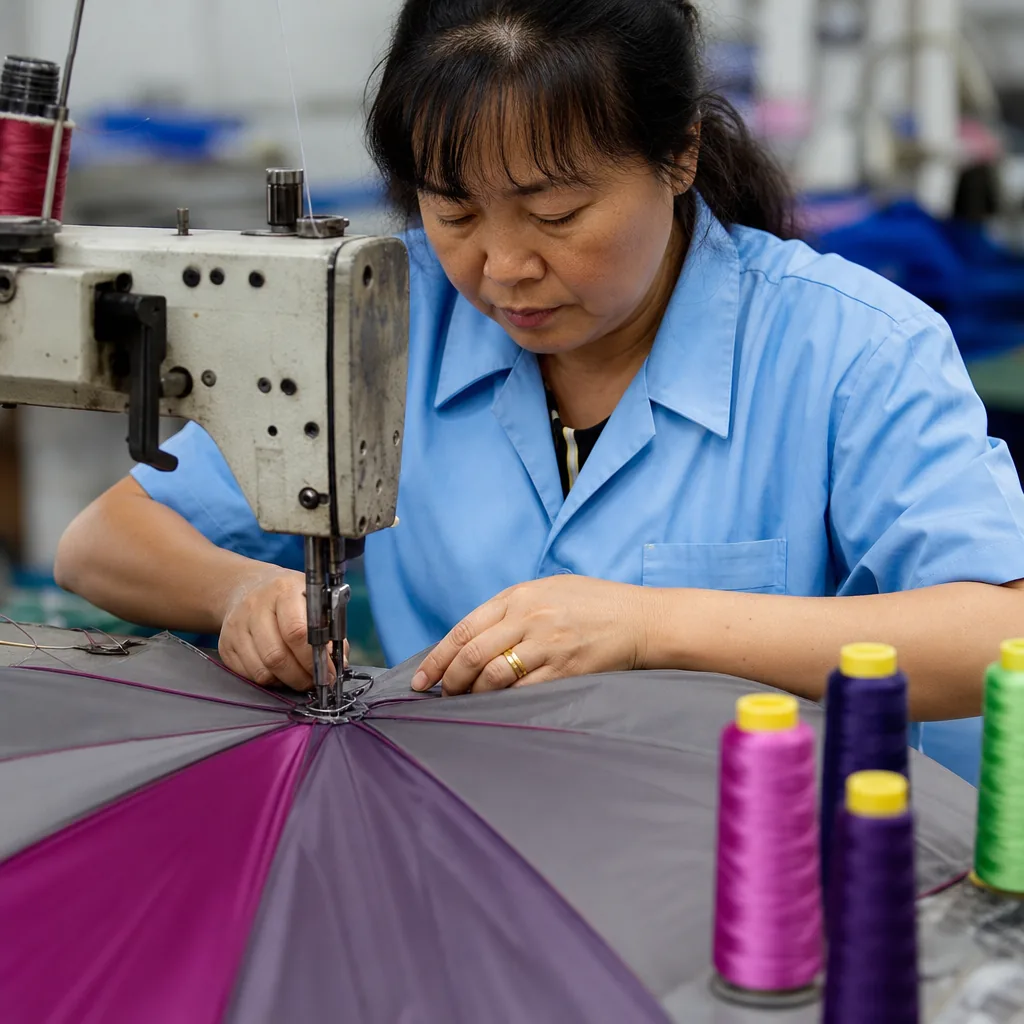
A clean opening and a true canopy rarely come from the fabric alone; they depend on how the ribs, stretcher, runner, and tension points work together inside the frame. In OEM production, even small drift in alignment or fit tolerance can make an umbrella bind, snap open unevenly, or fail inspection, so an umbrella frame tension setup has to be judged the way a factory does it: by feel, repeatability, and reject rate.
What frame tension controls in daily use
In an umbrella frame tension setup, the spring load, runner drag, and rib restraint decide how the umbrella feels in the hand before the canopy ever sees wind. If tension is right, the first push on a manual or auto-open shaft feels controlled, the runner releases cleanly, and the ribs spread to full geometry without a jump at the end. That is what buyers usually call umbrella opening smoothness, but on the factory floor it comes down to how the stretcher joints, main shaft, and runner fit tolerance are matched during assembly.
Too much tension makes the opening stroke feel stiff and fatiguing, especially on 23" and 27" sticks with steel components or tighter auto-open-close mechanisms. You see higher peak force at the button, slower snap at the spread, and more complaints about hand strain in repeat-use scenarios like retail carry umbrellas or promo giveaways. Too little tension is just as bad: the canopy starts to sag, ribs rattle in the closed position, and the umbrella does not hold its shape when the user flicks it open or collapses it after use.
The practical test is whether the frame returns to center, locks evenly, and closes without fighting the user or leaving loose fabric along the leech. Good frame alignment qc checks the rib plane, stretch length, and joint play together, because one sloppy ferrule or an overlong stretcher can make the whole canopy look crooked even if the cloth is cut correctly. On OEM umbrella mechanism tuning jobs, we normally adjust tension after the first assembly pass, then verify opening force and collapse behavior again so the final feel is consistent across cartons, not just on one sample.
Key fit points that create friction or looseness
The umbrella frame tension setup starts with the runner-to-shaft fit, because that is where most “same spec, different feel” complaints come from. If the runner bore is even slightly oversize, the canopy opens with a loose, rattly stroke; if it is too tight, the user feels drag and the stick-slip that ruins umbrella opening smoothness. In production, runner fit tolerance has to be controlled as a matched system with the shaft diameter, plating thickness, and any lubrication or anti-corrosion finish, not as three separate parts on paper. In our standard practice, that means checking the actual assembled glide force, not just measuring individual parts at incoming inspection.
Notch engagement and rib joint play decide whether the frame locks positively or feels mushy at full extension. A shallow notch, rounded pawl edge, or inconsistent punch location can let the runner sit half-captured, which shows up as different opening force from one unit to the next even when the BOM is unchanged. Rib joints with excess side play also shift load into the canopy, so one umbrella snaps open cleanly while the next hesitates and then jumps. That is why frame alignment qc has to include assembled symmetry checks, because a few tenths of a millimeter in the stretch line can change how the mechanism loads under spring preload.
Ferrule alignment is the last place people ignore and then blame the mechanism. If the ferrule sits off-axis, the lower shaft and runner no longer travel in a straight line, so the umbrella frame tension setup changes every time the canopy is opened and closed. The result is inconsistent friction, uneven rib loading, and visible skew at the top cap, especially on OEM umbrella mechanism tuning projects where one platform is cloned across 21-inch, 23-inch, and larger frames. Small tolerance shifts across shaft straightness, notch depth, and rib end geometry are enough to make two identical umbrellas feel different in hand, so the only reliable fix is to inspect the full assembled motion, not just the parts list.
How 8K, 10K, and 16K frames change setup
An umbrella frame tension setup is not the same on an 8K, 10K, or 16K frame, because the load path changes as rib count goes up. On an 8K frame, each rib carries more visible share of the opening force, so you can usually tolerate a little more variation in runner fit tolerance and canopy cut, as long as the ferrule, stretcher, and top notch are not sloppy. Once you move to 10K and especially 16K, the opening force spreads across more joints, which reduces the chance of one rib taking a hard spike load, but it also makes small dimensional errors easier to feel during opening. In practice, higher-rib-count frames demand more careful OEM umbrella mechanism tuning because the runner has to travel cleanly without binding, and the arc of the frame has to stay consistent all the way around.
The biggest difference is symmetry. With 8K, a slight mismatch in rib length or stretcher angle may show up as a minor canopy wrinkle, but on 16K that same error can compound into uneven panel tension and a crooked crown. That is why frame alignment qc gets tighter as rib count increases: the center shaft, top spring, rib set, and stretchers all need to sit within a narrow window before canopy sewing even starts. If the frame is not centered, the umbrella will still open, but umbrella opening smoothness drops fast because the runner sees uneven resistance from side to side. The more ribs you add, the less room you have for drift in weld position, rivet crush, or socket depth.
Canopy pattern accuracy becomes more important on 10K and 16K than on 8K because panel geometry must match the frame’s true span, not just the nominal size. If the panels are cut too long, the frame feels over-tensioned and the joints start working hard at full open; if they are too short, the canopy hangs loose and the umbrella looks acceptable only until the first wind load. On high-rib frames, we keep umbrella frame tension setup tied to both the metal tolerance and the fabric spread, usually checking a sample set at full-open and half-open positions before release. That is the point where a good frame feels balanced instead of stiff, and where small errors in symmetry show up immediately instead of after the customer starts using it.
Factory methods for checking opening smoothness
Cycle testing is the fastest way to catch a bad umbrella frame tension setup before it reaches packing. On the line, we open and close each sample frame repeatedly, usually 20 to 50 cycles depending on the order risk level, then watch for drag in the runner, delayed rib release, or a crooked start position. The target opening force is recorded in grams or newtons at the first pull and again after cycling, because a frame that feels acceptable on stroke one but binds on stroke ten is not stable. For OEM umbrella mechanism tuning, I want the opening curve to stay consistent, with no sudden jump at the midpoint and no rebound slam at full open.
Pull-force checks are more useful than people think because they quantify umbrella opening smoothness instead of relying on opinion. We measure the force at the handle or runner with a simple gauge, then compare it against the spec sheet for that model, size, and mechanism type; auto-open frames usually need a different range than manual frames. If the runner fit tolerance is too tight, the pull rises sharply and the shaft scratches; if it is too loose, the canopy can wobble or stop short of lock. Under AQL 2.5, any frame showing repeated hesitation, incomplete lock, visible twist, or abnormal noise during opening goes to rework, not sort-and-pass.
Manual feel inspection still matters because the hand catches issues that a gauge misses, especially in frame alignment qc. A good inspector checks for smooth entry into the lock, even rib spread, and clean release without grinding, then compares the feel against the golden sample. Our standard practice is to log the opening force target, the measured range, and the defect type on the line sheet so the sewing and assembly teams can correct the exact station causing the problem. If the defect comes from bent ribs, poor rivet setting, runner burrs, or mismatched ferrules, it is reworked before the lot can move past final inspection; under AQL 2.5, those are not cosmetic issues, they are functional failures.
What buyers should lock into the tech pack
For an umbrella frame tension setup, the tech pack has to lock the spring force range, the frame material, and the allowed play at the runner and hub, or you end up arguing over samples instead of shipping product. On steel or fiberglass frames, I expect buyers to specify the opening force window in newtons, the rib and stretcher material grade, and the runner fit tolerance in millimeters, because those three items drive umbrella opening smoothness more than the canopy fabric ever will. If the runner is loose by even a small amount, the umbrella feels cheap; if it is too tight, auto-open and manual models start to bind after a few hundred cycles.
Sample approval should not be a vague “looks good” note. Define frame alignment QC points for crown, shaft, stretcher symmetry, and lock engagement, then approve against a signed golden sample with opening force measured on the same test jig every time. For OEM umbrella mechanism tuning, we normally want the sample to pass repeated open-close cycles without sticking, overshooting, or twisting the shaft under load. Buyers should also state the acceptable wobble at the top and the amount of lateral play at the runner, because that is where fit problems show up first in production.
Tighter tolerances always cost something: they raise reject risk, slow assembly, and usually push up MOQ, unit price, and production lead time. A frame that needs very narrow spring force bands or near-zero play often requires extra sorting, more manual adjustment, and longer pre-production validation before bulk output starts. If the tech pack is loose, the factory can run faster; if it is strict, the buyer should expect more time for tooling checks, sample iterations, and a higher unit cost to hold the umbrella frame tension setup consistently across the order.
Frequently Asked Questions
What causes an umbrella to open unevenly even when the parts look correct?
Uneven opening usually comes from tolerance stack-up, not one bad part. Small differences in runner fit, rib length, or notch position can throw off the frame geometry.
Should auto-open umbrellas use the same tension spec as manual ones?
Not always. Auto-open mechanisms need enough preload for a clean release, but too much force can make the button feel heavy and reduce long-term durability.
What runner-to-shaft fit is typically acceptable for a smooth manual umbrella opening?
For most OEM manual umbrellas, buyers usually target a sliding fit that avoids sticking but limits visible wobble, often controlled within about 0.1-0.3 mm depending on shaft coating and runner material. Final acceptance should be based on opening force tests and repeated cycle checks on pre-production samples.
How does frame tension setup affect factory reject rates during mass production?
If spring force and rib alignment are inconsistent, factories usually see higher rejects from hard opening, incomplete lock-up, and uneven canopy shape. Tightening setup controls during pilot production can reduce mechanism-related rejects by several percentage points, especially on large golf and promotional umbrella programs.
When should a buyer request mechanism tuning approval in an OEM umbrella project?
It is best to lock mechanism tuning at the pre-production sample stage, before bulk assembly starts. Buyers commonly ask for approval after opening/closing cycle tests, fit checks, and canopy symmetry review, because post-production tuning is slower and may affect lead times by 7-15 days.
Looking to Launch Your Custom Umbrella Line?
ZheBrella is a Zhejiang-based OEM/ODM umbrella manufacturer with 17 years of export experience. Free design, low MOQ from 100 pieces, windproof construction, full-color print.
Get Free Quote Now »People Also Search For
Related Articles
Umbrella Frame Tension Specs for Stable Opening and Closure
Learn how frame tension, runner friction, and spring force affect smooth opening, closure, and return rates in OEM umbre...
Read More »
Umbrella Frame Torque Testing for Smooth Opening and Closure
Learn how torque, spring force, and cycle testing keep auto-open and manual umbrellas smooth, safe, and consistent in ma...
Read More »Umbrella Frame Assembly Tolerances That Reduce Field Failures
Learn which umbrella frame tolerances matter most in production, from rivet play to runner alignment, to cut defects, cl...
Read More »