Umbrella Frame Torque Testing for Smooth Opening and Closure
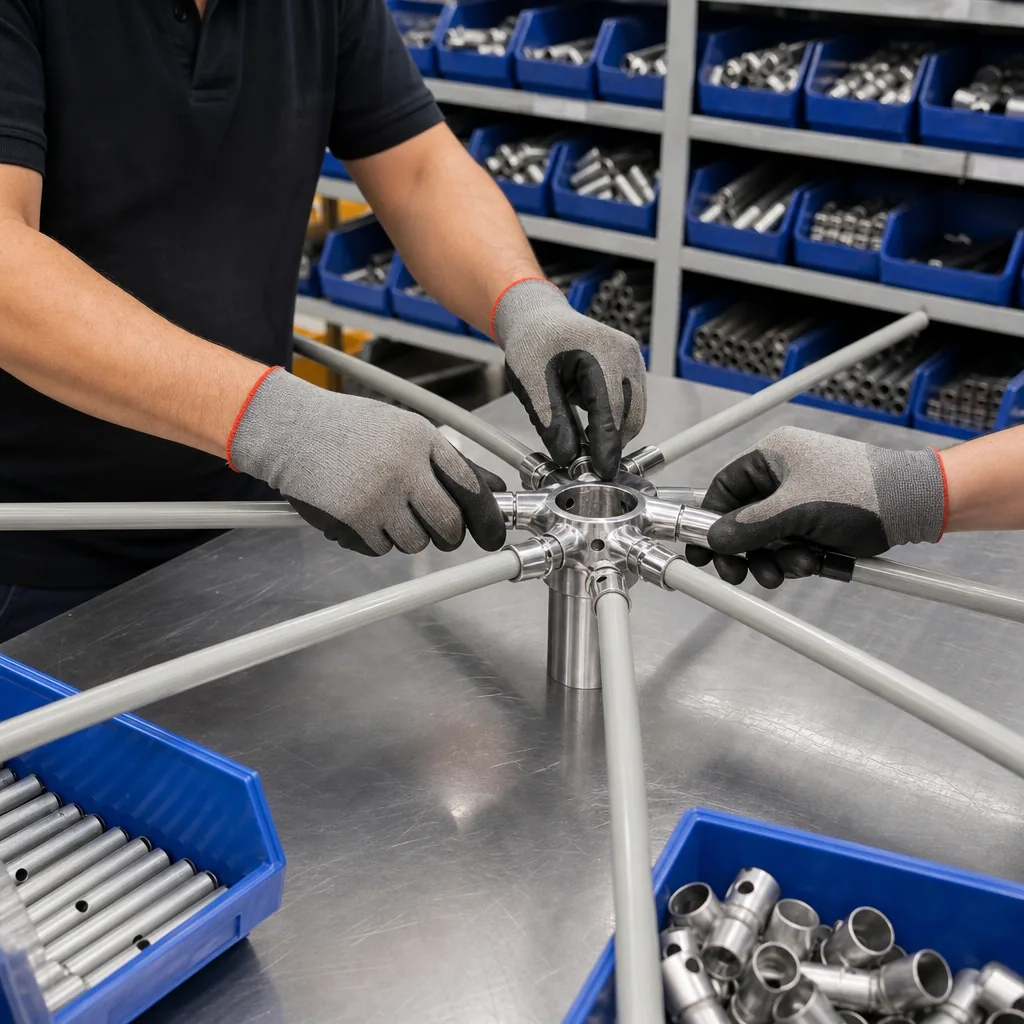
A frame that feels smooth in a sample room can bind, snap open too hard, or loosen after a few thousand cycles on the production line. Umbrella frame torque testing gives buyers a practical way to verify opening force, runner travel, spring balance, and closure feel before shipment. On our factory floor in Songxia, we use it alongside spring checks and cycle testing to catch variation that visual inspection alone will miss.
What torque testing measures in an umbrella frame
Opening torque is the force a user feels as the runner breaks free, moves along the shaft, and drives the stretchers into rib extension. Closing torque is the reverse load needed to collapse the rib assembly, control stored spring energy, and fold the canopy without a hard snap. In umbrella frame torque testing, ZheBrella measures the points that create real handling problems: runner breakaway, mid-stroke travel, top notch lock-in, button release, and final closure. A 23" straight umbrella with 8K steel ribs should open with a steady, low-friction stroke. A 30" golf umbrella with fiberglass ribs and a vented double canopy will naturally need more force because the rib arc, canopy tension, and stretcher geometry are larger. The defect signal is not absolute force alone; it is lot consistency. If five samples from the same OEM order show a 25-30% spread in opening force, the likely cause is tooling alignment, runner fit, rivet compression, or mixed shaft tolerances, not normal design variation.
OEM quality control must separate spring force from friction. In an auto-open mechanism, the spring must push the runner cleanly to the top notch, including on 190T or 210T pongee canopies with Teflon or UV coating, where fabric tension adds drag. Extra spring force does not correct a rough shaft slot, tight runner bore, plastic flash at the notch, or over-compressed rivets; it only hides the fault until the opening cycle test reaches 500, 1,000, or 3,000 cycles. The usual failures then appear as slow launch, partial lock, sticky button release, or a sharp closure load. Before gauge readings are recorded, ZheBrella checks the runner path by hand because a sound frame produces a continuous load curve, not a heavy-light-heavy stroke. Smooth operation matters on manual 21" folding umbrellas because buyers will reject two-handed opening, and it matters on auto-open and auto-open-close models because release, shaft extension, and compression loads must stay controlled enough to avoid bent ribs.
Smooth action is one of the first signs of umbrella frame durability a buyer can verify, well before wind resistance or structural testing. A gritty runner, uneven lock-in, or difficult compression is obvious on approval samples and becomes a return risk for umbrellas used repeatedly by hotel guests, event staff, or older customers. ZheBrella combines umbrella frame torque testing with visual checks on rivet seating, runner clearance, spring seat position, shaft slot finish, and top notch engagement before AQL 2.5 final inspection. Torque data does not replace rib strength checks or a wind-tunnel rating such as 50+ mph, but it catches small mechanical defects that make an otherwise acceptable OEM umbrella feel cheap or inconsistent. For importers, the commercial value is direct: cleaner pre-production samples, fewer complaints after delivery, and tighter control over frame performance across manual, auto-open, and auto-open-close builds.
Frame parts that create resistance during operation
Operating resistance comes from the full frame system, not only the visible joints. In umbrella frame torque testing, the runner travel is the first signal to check because it exposes tolerance stack-up before a full opening failure appears. A slightly oval steel shaft, a runner bore molded 0.15 mm tight, and a spring with 5-8% higher compression force can turn a normal auto-open mechanism into a harsh, sticky push. On a 23" 8K frame, that defect may pass one manual open-close check, then show plating rub, slight runner heat, and grinding after a 500-cycle opening cycle test. Fiberglass ribs bend back more cleanly under load, but their pivot holes still need consistent drilling. Steel ribs are less forgiving when a rivet angle is off because the joint binds instead of flexing.
Steel and fiberglass frames need different judgment points because they transmit resistance differently. Steel ribs and stretchers give a sharper snap-back, useful on 21" and 23" promotional umbrellas, but they also send misalignment directly into the runner, notch, and lock button. If stretcher length varies by 1 mm across an 8K frame, one rib opens early while another lags, adding side load to the runner bore. Fiberglass ribs on 27" and 30" golf umbrellas absorb more twist, especially in double-canopy vented windproof designs, but a soft fiberglass layup can mask weak spring energy until closure feels lazy. For OEM quality control, torque checks should be paired with rib symmetry checks under canopy tension; a bare frame can look balanced on the table and still require excess force once the fabric is mounted.
Tolerance stack-up causes most buyer disputes because each part can meet its drawing while the assembled umbrella fails. A canopy sewn 3 mm tight at several panel tips, a top notch pressed slightly low, molding flash inside the runner slot, and a lock button sitting 0.2 mm proud can combine into sticky opening. The reverse failure is weak snap-back: the spring free length passes inspection, but shaft friction, over-riveted stretchers, and a locking point that releases late make the umbrella open halfway and stall. Good umbrella frame torque testing separates these causes by measuring opening force before canopy mounting, after canopy mounting, and again after wet conditioning. A 190T pongee canopy with water-repellent coating adds different drag than POE, PVC, or EVA, so umbrella frame durability data should connect torque readings with AQL 2.5 inspection results and cycle-test records, not only a technician’s hand-feel judgment.
How factories run opening cycle and fatigue tests
Opening cycle testing should start on pre-production frames from actual tooling, because 20 smooth showroom samples can still develop runner drag, weak spring launch, or rivet wear after 2,000 operations. For OEM umbrellas, set the validation count by size, rib material, and mechanism risk: a proven 21-inch manual compact with steel ribs may pass at 1,000 open-close cycles, while a 23-inch auto-open mechanism or 27-inch golf frame with 8K or 10K fiberglass ribs should run to 3,000 cycles. Premium retail, corporate uniform, windproof double-canopy, or heavier 210T pongee programs should target 5,000 cycles before approval. Umbrella frame torque testing belongs beside the opening cycle test because cycle count alone misses what the buyer feels in use: sticky runner travel, harsh closing resistance, inconsistent button release, or rising force as plating, rivets, and notches wear in.
The test fixture must remove operator variation. Clamp the handle, hold the shaft vertical, and use a pneumatic or servo actuator to press the button or drive the runner at a fixed stroke and speed. For auto-open-close models, the fixture must fully release the canopy, collapse the ribs, and reset the shaft so the compression spring loads the same way on every cycle. Record opening force, closing force, runner travel, button release load, and torque change at defined checkpoints such as 0, 500, 1,000, 2,000, and 5,000 cycles. Failures should be logged by cycle number, defect code, part location, sample ID, and photo evidence, then traced to the rib lot, spring lot, plating batch, or assembly station. Common findings include burrs on the notch, ovalized rivet holes, uneven plating thickness, loose runners, and spring misfires.
Acceptance thresholds must be agreed before testing, not negotiated after a sample feels “rough.” A practical OEM quality control standard is no rib fracture, no runner lock failure, no shaft bending, no spring misfire, no canopy inversion during normal opening, and no more than a defined 15% to 20% increase from the initial force or torque reading. Cosmetic shaft rubbing may be acceptable if operation remains stable; a cracked notch, loose rivet, or button that sticks twice in 100 operations should fail the sample. If three pieces from a 20-piece validation lot show the same defect before 3,000 cycles, stop approval, correct the frame component or assembly process, and rerun umbrella frame torque testing before mass production. Final shipment inspection can then use AQL 2.5, but fatigue failures must be solved before production because AQL sampling will not catch a weak mechanism reliably.
Quality issues buyers should watch for in production
Uneven spring tension is the first defect to isolate on auto-open mechanism frames because the shaft spring, runner spring, latch, and notch must release together. A 23-inch 8K approval sample can still hesitate after 200 to 500 cycles when spring wire hardness varies or plating tightens the runner ID. “Opens normally by hand” is not an inspection standard. Umbrella frame torque testing should log opening force, lock engagement, and closing resistance on inline samples, not just the golden sample. Low tension leaves the canopy half-raised before the notch locks; excess tension makes the frame snap open and overloads rivets, plastic runners, and button assemblies. Buyers see both failures as delayed opening, partial lock, harsh button feel, and early returns.
Bent ribs and loose rivets often hide beneath clean 190T or 210T pongee sewing, so inspectors should test the frame before packaging. Steel ribs can bend during tipping, canopy sewing, or carton compression; fiberglass ribs recover better, but their joint points still fail when rivet pressure is too light or uneven. On 10K and 16K frames, one loose rivet creates side play, distorts the canopy arc, and shifts wind load to adjacent ribs. The umbrella may pass a visual check, then fatigue after a few rainy commutes or fail in a 50+ mph wind-tunnel test. For OEM quality control, open the umbrella, shake it, press each rib joint, check lateral movement, and apply AQL 2.5 sampling. Treat loose joints as structural defects, not cosmetic issues.
Misaligned notches, rough runner slots, and poorly deburred shaft holes are small tooling errors that create expensive field failures. A notch only 0.5 mm off-center can make the runner lock only when the user twists the handle, which customers report as “stuck” or “won’t click.” On manual frames, this raises closure resistance; on auto-open-close compact umbrellas, it can damage the reverse spring system and shorten cycle life. Umbrella frame torque testing exposes friction changes after coating, electroplating, and handle assembly, when visual inspection is too late. ZheBrella compares pre-production frames with inline samples after 50, 100, and 300 opening cycle test intervals, then separates failures by spring, rivet, notch, and runner cause. For FOB or DDP orders, require these records before shipment because frame rework after canopy sewing adds delay and lot variation.
Specifying durability requirements in bulk orders
Put durability requirements in the tech pack before PP sample approval, with a separate line item for each frame variant: 21 inch compact, 23 inch straight, 27 inch market, or 30 inch golf; 8K, 10K, or 16K rib count; fiberglass or steel ribs; steel or aluminum shaft; runner type; and manual, auto-open, or auto-open-close construction. For umbrella frame torque testing, state the test stage clearly because a bare frame, a sewn 190T or 210T pongee canopy, and a packed finished umbrella can show different opening torque, closing torque, and runner sliding force. Use the approved golden sample as the control, then define pass/fail criteria: torque and sliding force must stay within the approved tolerance after transport simulation and the agreed opening cycle test. List functional failures as jamming, delayed release, rib inversion damage, cracked notch, bent stretcher, failed button return, or abnormal sound. Low-cost promotional orders often use 300 to 500 open-close cycles; retail programs should require 1,000+ cycles when umbrella frame durability affects warranty risk or shelf acceptance.
Write inspection rules to AQL 2.5 for major defects, and classify defects before mass production. A stiff runner that still opens can be minor; a failed auto-open mechanism, detached spring, broken rib joint, or frame that cannot close cleanly should be major or critical depending on the channel and warranty exposure. For OEM quality control, require incoming frame inspection, in-line checks during rib and stretcher assembly, and final random inspection after canopy attachment. Keep three reference samples available on the line: the approved PP umbrella, one frame-only sample, and one packed finished umbrella. Add the spare-part policy to the PO, not only to emails. For custom plastic handles, branded buttons, special fiberglass ribs, or nonstandard runners, require the supplier to reserve 1% to 2% extra critical parts for rework and after-sales claims. Without that clause, replacement parts can become slow or expensive if the frame vendor changes tooling, spring tension, or material batches.
Match the testing scope to MOQ, sample timing, and trade terms. A 500-piece MOQ rush order may only support basic torque checks, a 100-cycle function check, and AQL 2.5 final inspection. A 10,000-piece retail order should include pre-production torque data, opening cycle test records, carton drop testing, and batch-level frame traceability. Build the schedule around testing, not only sewing: allow 3 to 5 days for frame-only checks and another 5 to 7 days after canopy assembly, especially for double-canopy windproof umbrellas where fabric tension affects closure. Under FOB terms, the buyer usually carries more destination-side claim risk, so extended umbrella frame torque testing should appear as a development charge or be included in the unit price. Under DDP terms, the supplier absorbs more logistics and claim exposure, so tighter pass/fail limits and stronger spare-part coverage should be priced before production starts. Weak test language can reduce the quote but increase the risk of gritty, uneven frames at delivery.
Frequently Asked Questions
How many opening cycles should a buyer request for a custom umbrella model?
For most OEM programs, 1,000 cycles is a useful baseline for validation, while higher-end or promotional programs may need more. The right number depends on expected user frequency and whether the model uses an auto-open mechanism.
Why does an umbrella feel smooth in samples but stiff in bulk production?
Small sample runs often receive tighter manual adjustment than mass production. In volume, slight variation in rivet fit, spring force, or rib alignment can raise friction and change the opening feel.
What torque range is acceptable for smooth umbrella opening and closing?
The acceptable range depends on the frame size, shaft material, and mechanism type, but factories usually define upper and lower limits during pre-production approval. For OEM orders, torque and closing force should be recorded from golden samples and checked again during inline and final inspection.
How many opening and closing cycles should an auto-open umbrella pass before shipment?
Many B2B buyers require 500 to 1,000 open-close cycles for standard promotional umbrellas and higher cycle counts for retail or premium models. The test should confirm that the spring, runner, ribs, and button mechanism still operate smoothly without jamming or unsafe release.
Can torque testing catch problems before mass production starts?
Yes. Torque testing during pilot production can identify tight shafts, weak springs, rough runner movement, or inconsistent rivet assembly before full production. This helps the factory adjust tooling, lubrication, spring force, or assembly pressure before large-volume QC failures occur.
Looking to Launch Your Custom Umbrella Line?
ZheBrella is a Zhejiang-based OEM/ODM umbrella manufacturer with 17 years of export experience. Free design, low MOQ from 100 pieces, windproof construction, full-color print.
Get Free Quote Now »People Also Search For
Related Articles
Umbrella Opening Cycle Tests for Durable OEM Mechanisms
See how factories test manual and auto-open umbrellas for cycle life, spring stability, and field reliability before bul...
Read More »
Umbrella Frame Tension Specs for Stable Opening and Closure
Learn how frame tension, runner friction, and spring force affect smooth opening, closure, and return rates in OEM umbre...
Read More »Umbrella Fatigue Testing Protocols for OEM Durability Approval
Learn which fatigue tests matter for umbrella OEM orders, from opening cycles to rib-joint wear, with pass criteria buye...
Read More »