Umbrella Runner Assembly Quality for Auto-Open Orders
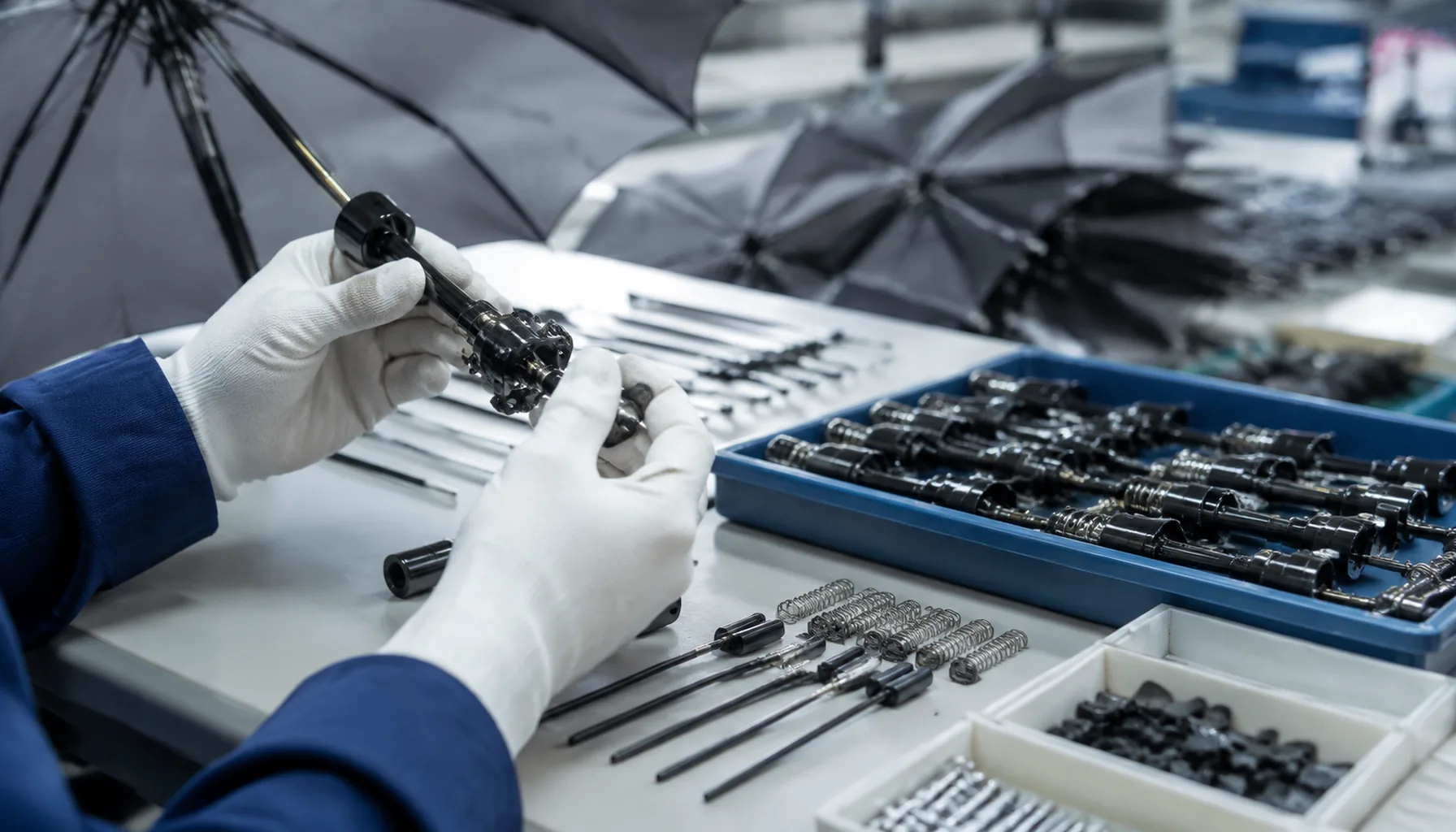
Auto-open failures usually start at the runner: a slightly tight bore, weak spring seating, rough ribs, or too much plating friction can turn a good-looking sample into a bulk complaint. On our Songxia assembly floor, umbrella runner assembly quality is checked from molded part shrinkage and spring fit through hand-feel, opening speed, and repeated cycle testing, so buyers can lock the PP sample with confidence and keep shipment performance consistent.
Runner Function in Manual and Auto-Open Frames
The runner is the moving hub that decides whether a frame feels controlled or cheap. On a manual 23" straight umbrella, the user pushes the runner up the shaft until the runner notch engages the top spring or locking bead; the stretchers then hold the 8K or 10K ribs at the designed canopy angle. If the runner bore is too tight, it scratches the plated steel shaft and stalls before lock-up. If it is too loose, the canopy shakes, especially on 27" and 30" golf frames. For umbrella runner assembly quality, we check sliding resistance, lock engagement depth, and release button clearance before the canopy is sewn on, because fabric tension can hide a weak runner for a few cycles and then expose it after packing compression.
In auto-open umbrella production, the runner does more than slide; it transfers stored spring force into rib movement. When the button is pressed, the shaft spring drives the runner upward, the stretchers push the main ribs open, and the runner must stop cleanly at the crown-side lock without bouncing back. This is where umbrella mechanism QC gets practical: we test spring preload, runner travel length, button release timing, and rivet tightness on the stretcher joints. A common failure in low-cost promotional orders is mismatched spring force: too weak and a 190T pongee canopy opens halfway; too strong and plastic runners crack around the stretcher pins. Our standard practice at ZheBrella is to cycle-test sampled auto-open frames before printing, because a logoed canopy cannot rescue a rough mechanism.
Auto-open-close compact frames add another job: the runner must open under spring force, then disengage and drive downward during closure while the shaft stores energy for the next reset. That is why runner spring testing is stricter on 21" 3-fold and 23" 3-fold designs than on simple manual sticks. The runner must pass the lower lock during closing without catching the ribs, and the user should be able to compress the telescopic shaft without grinding or sudden kickback. For an OEM umbrella factory, this is not a catalog detail; it affects AQL 2.5 inspection results, return rates, and whether a 50+ mph windproof claim survives real use. Good umbrella runner assembly quality shows up as consistent button feel, full canopy spread, clean release, and no white stress marks around the runner after repeated cycles.
Materials and Molding Factors That Matter
Runner material is the first place I look when an auto-open complaint comes back, because the runner takes the shock load every time the spring releases. ABS is easy to mold and cheap, but I only trust it on light 21" promotional umbrellas with thin steel ribs. Nylon has better toughness and survives repeated impact better, though it can absorb moisture and shift dimensions if the resin is not dried properly before injection. POM gives the cleanest sliding feel on steel shafts and holds bore accuracy well, but it is less forgiving if the notch design has sharp corners. For heavier OEM umbrella factory programs, glass-fiber-reinforced nylon or reinforced plastic runners are safer, especially on 23" and 27" auto-open umbrellas where the runner must lock without cracking around the rib seats. Good umbrella runner assembly quality starts with choosing the resin for the load, not just matching the buyer’s target price.
Molding defects look small on the table but become failures after 500 open-close cycles. Mold flash inside the bore creates drag on the shaft, so the umbrella may open halfway or feel gritty. Shrinkage around the bore can make the runner too tight on powder-coated steel shafts, while an oversized bore allows wobble and poor notch engagement. I want the bore diameter checked with plug gauges, not only calipers, because roundness matters when the runner travels at speed. The notch fit is just as important: if the catch window is shallow, the umbrella can false-lock; if it is too deep or has a sharp edge, the runner may chip after impact. In auto-open umbrella production, our standard practice is to pair dimensional inspection with runner spring testing, including repeated firing on actual shafts from the same lot, because a perfect-looking runner can still fail when matched with the wrong shaft coating or spring force.
Load requirements change quickly with frame design. A 21" 8K steel-rib umbrella has a very different runner load than a 30" golf umbrella with 16K fiberglass ribs and a stronger center spring. Steel ribs transfer a sharper impact into the runner when the canopy snaps open, while fiberglass ribs flex and absorb some force but add torsion at the rib-seat points. A 16K layout doubles the number of rib connections compared with 8K, so the runner crown must have more consistent notch spacing and better weld-line strength after molding. For umbrella mechanism QC, I check runner travel, lock height, spring release force, rib-seat cracking, and post-cycle looseness together instead of treating them as separate issues. This is where umbrella runner assembly quality becomes measurable: if the runner slides cleanly, locks positively, and shows no whitening or cracks after cycle testing, the auto-open mechanism has a much better chance of passing AQL 2.5 final inspection without field returns.
Assembly Controls for Smooth Movement
Smooth auto-open action starts with the runner, not the push button. For auto-open umbrella production, we check spring seating before the frame ever reaches canopy sewing: the compression spring must sit flat against the runner cup and upper notch, with no tilted coil, crushed end, or loose rattle when the shaft is tapped. On 23" and 27" straight umbrellas, a mis-seated spring can still pass a casual open test but will scrape the plated shaft after 200-300 cycles. Our standard practice at ZheBrella is to sample runner spring testing during rib assembly and again after final canopy attachment, because fabric tension changes the load. For reliable umbrella runner assembly quality, the runner should travel from closed lock to open latch without a hard spot, grinding sound, or sudden jump. Steel shafts need particular attention at the slot edges; fiberglass frames hide less friction, but poor runner molding still shows up as slow opening.
Latch engagement is checked by both feel and measurement. The runner pawl must fully catch the shaft notch, and the button should release it cleanly without requiring a second press or thumb pressure above normal retail use. In umbrella mechanism QC, I do not accept a frame that opens only when held perfectly vertical; customers open umbrellas at bus stops, in wind, and with one hand. We test button response after handle fitting because glue squeeze-out, misaligned handle pins, or tight decorative rings can reduce travel by 0.5-1.0 mm. Burr removal is mandatory on the shaft slot, runner bridge, stretcher rivets, and any stamped steel parts touching the runner path. For 8K and 10K frames, one rough rivet head may only feel like minor drag; on 16K promotional models, the same defect multiplies friction enough to slow or stop auto-open movement.
Lubrication must be controlled, not used to hide poor assembly. A light silicone-based wipe on the runner contact zone is acceptable; visible oil droplets, grease streaks, or lubricant migrating onto 190T/210T pongee are not. Oil on coated fabric can weaken screen print adhesion, stain light-colored canopies, and interfere with Teflon or UV UPF 50+ treatments. Plated shafts are handled with gloves or clean cotton pads after polishing, because fingerprints and sweat marks can corrode under salt-spray storage or during 30-45 day ocean freight. Final checks include opening the umbrella at least three times after canopy tying to confirm no rib tip, seam allowance, vent layer, label, or sleeve cord snags the runner. For an OEM umbrella factory shipping under AQL 2.5, these controls are cheap compared with a stuck-runner claim on 5,000 auto-open units.
Durability Tests Before Final Inspection
The runner is where auto-open failures usually start, so durability testing has to happen before final cosmetic inspection, not after cartons are packed. For auto-open umbrella production, I want repeated open-close cycle tests on pre-shipment samples and in-line random pieces: 300 cycles for standard promotional 21" and 23" compact models, and 500 cycles for heavier 27" or 30" golf umbrellas with fiberglass ribs and stronger shaft springs. The test is simple but strict: press the button, confirm full canopy deployment, close to the lock position, and check that the runner does not scrape, tilt, jam, or lose spring return. Good umbrella runner assembly quality means the runner slides cleanly on the shaft, the notch locks without chatter, and the button does not feel soft after cycling. If a batch uses 8K steel ribs with 190T pongee, the load is moderate; if it uses 10K fiberglass ribs, double-canopy venting, or 210T coated fabric, the runner and spring need more attention because opening resistance is higher.
Drop checks catch weak runner locks faster than a desk inspection ever will. I normally test closed umbrellas dropped from 80-100 cm onto a rubber mat and also open umbrellas tipped onto the canopy edge, because courier handling and event-site staff are not gentle. After each drop, the runner must still lock, the auto-open button must not self-release, and the cap, shaft, and rib tips must stay aligned. Button force checks should be measured with a push-pull gauge, not by someone saying it “feels okay.” For most auto-open stick and folding umbrellas, a 12-22 N button force is comfortable; below that, accidental opening risk rises, and above that, users complain. Runner spring testing should include spring rebound, rust spots, deformation, and noise, especially for nickel-plated steel springs stored through humid Zhejiang summer weeks. Our standard practice at ZheBrella is to separate mechanical defects from appearance defects because a tiny print smudge is not equal to a runner that fails after 40 opens.
Lock-hold testing is the last gate before AQL sampling because it simulates the umbrella sitting open in wind or being carried through a crowd. For a compact auto-open model, the locked runner should hold under steady downward pull without slipping; for 27" and 30" promotional golf umbrellas, I prefer testing under stronger shaft and rib load, especially when the order specifies windproof fiberglass ribs or double-canopy construction rated around 50+ mph. In umbrella mechanism QC, any runner slip, button sticking, partial opening, or spring ejection should be treated as a major defect. Final bulk inspection should follow AQL 2.5 for major defects, with tightened sampling if the PO is for a time-sensitive promotion, sports event, airline gift, or retail launch. An OEM umbrella factory should not gamble with delivery windows: if the first random sample shows mechanism instability, stop packing, isolate the affected assembly line, and recheck the runner riveting, spring length, shaft groove depth, and button housing before FOB or DDP shipment booking.
RFQ Details Buyers Should Confirm
The RFQ should lock the runner specification before anyone quotes tooling or assembly time, because umbrella runner assembly quality changes fast when buyers leave it as “standard.” State whether the runner is ABS, nylon, zinc alloy, or plated steel, and confirm the shaft diameter it must slide on, usually 8 mm, 10 mm, 12 mm, or 14 mm depending on 21", 23", 27", or 30" frames. For auto-open umbrella production, also specify manual, auto-open, or auto-open-close mechanism, because the runner groove, notch depth, spring seat, and latch angle are not interchangeable. If the frame is 8K fiberglass, 10K steel, or 16K windproof double-canopy, say so in the RFQ; rib count changes runner load and the force needed for smooth release. I also ask buyers to define canopy fabric and coating, such as 190T pongee with Teflon or 210T pongee with UPF 50+, because heavier fabric increases opening resistance during final assembly.
Cycle-test targets need to be written as a number, not a slogan. For promotional orders, 500 open-close cycles may be acceptable; for retail auto-open umbrellas, I prefer 1,000 to 3,000 cycles, with runner spring testing done before canopy sewing hides early mechanism faults. Good umbrella mechanism QC checks runner travel, button release force, spring rebound, shaft burrs, rivet looseness, and whether the runner catches at the upper notch after humidity exposure. If the buyer wants windproof performance, state the rating, for example surviving 50+ mph in a wind tunnel for a double-canopy vented design, and confirm whether failed inversion recovery counts as a defect under AQL 2.5. PP samples must come from production tooling, not hand-adjusted sample-room parts, because a runner that feels perfect after filing is useless when 20,000 units go through mass assembly at normal line speed.
Commercial terms belong in the same RFQ because they affect how the OEM umbrella factory plans parts and inspection. State MOQ by color and logo, expected lead time in days, and whether spare runners, springs, push buttons, and repair shafts should be packed as after-sales parts at 0.5%, 1%, or a fixed carton quantity. For custom logo orders using screen print, heat transfer, or sublimation, confirm whether the PP sample must include final artwork and packaging before approval. FOB Ningbo or Shanghai is different from DDP Los Angeles or Hamburg; DDP needs carton dimensions, HS code review, duty handling, and realistic transit time built into the schedule. Our standard practice at ZheBrella is to freeze the approved PP sample, runner material, shaft diameter, spring force range, and inspection checklist before bulk runner assembly starts, then inspect incoming runners and finished umbrellas under AQL 2.5 before shipment.
Frequently Asked Questions
Why do auto-open umbrellas sometimes stick during bulk production?
Common causes include runner bore variation, shaft plating thickness, mold flash, weak spring seating, or excess friction after assembly. These issues should be caught with first-piece checks and cycle testing.
Is the runner material important for promotional umbrella orders?
Yes. Low-cost plastics can reduce price but may wear faster at the lock and sliding surfaces. For larger OEM orders, specify the resin type and require PP sample testing before approving mass production.
What runner assembly tests should be approved before starting bulk auto-open umbrella production?
For PP approval, buyers should confirm runner sliding force, spring fit, button release response, and full open/close cycling. A practical standard is 100-300 cycles on PP samples before bulk cutting, with no runner jamming, spring dislocation, or delayed opening.
Which runner defects most often cause auto-open umbrellas to fail in shipment?
Common defects include oversized or undersized runner holes, molding flash inside the runner, weak spring seating, rough shaft plating, and excessive friction between the runner and shaft. These issues can cause slow opening, incomplete canopy deployment, or runner lock failure.
Can runner spring tension be adjusted for different umbrella sizes in OEM orders?
Yes. Spring length, wire diameter, and compression force should be matched to the frame size, shaft diameter, rib material, and canopy weight. For example, a 23-inch 8-rib auto-open umbrella usually needs a different spring setting than a compact 3-fold model.
Looking to Launch Your Custom Umbrella Line?
ZheBrella is a Zhejiang-based OEM/ODM umbrella manufacturer with 17 years of export experience. Free design, low MOQ from 100 pieces, windproof construction, full-color print.
Get Free Quote Now »People Also Search For
Related Articles
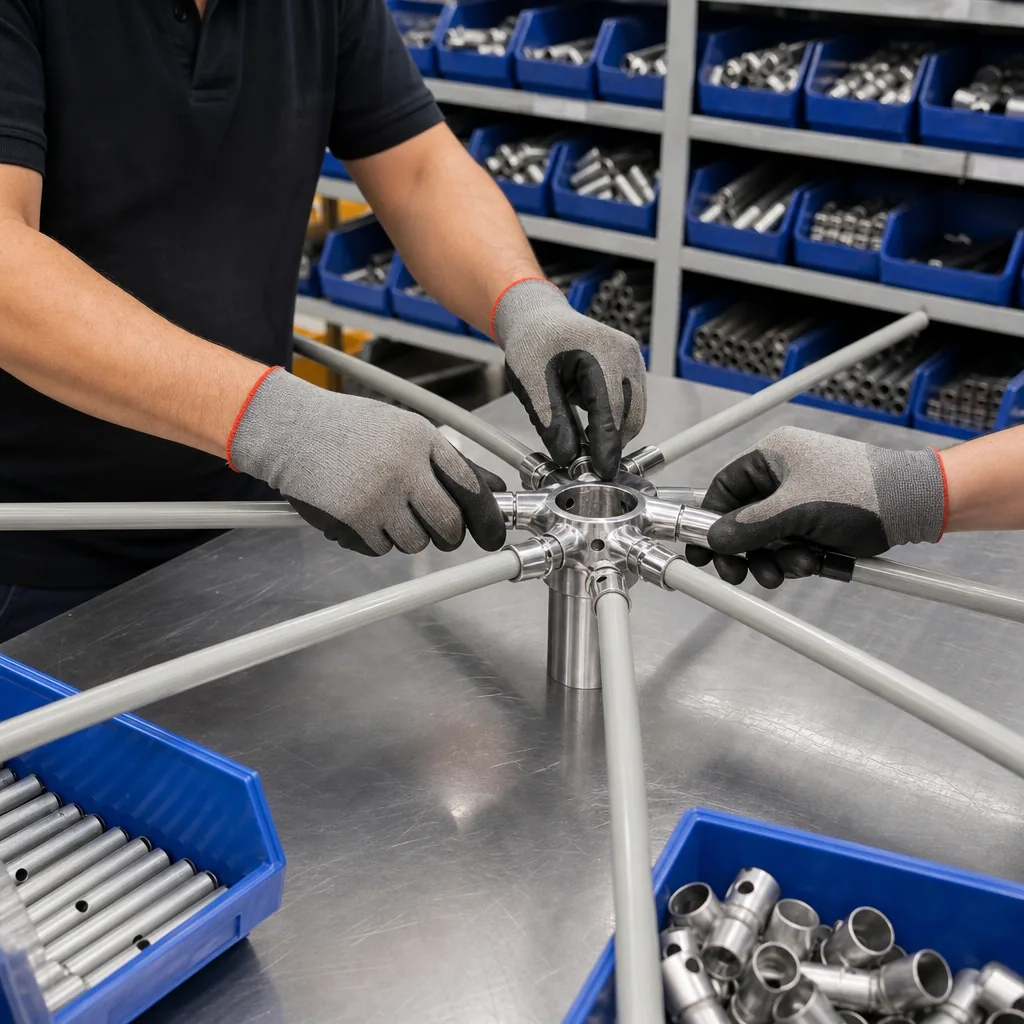
Umbrella Opening Cycle Tests for Durable OEM Mechanisms
See how factories test manual and auto-open umbrellas for cycle life, spring stability, and field reliability before bul...
Read More »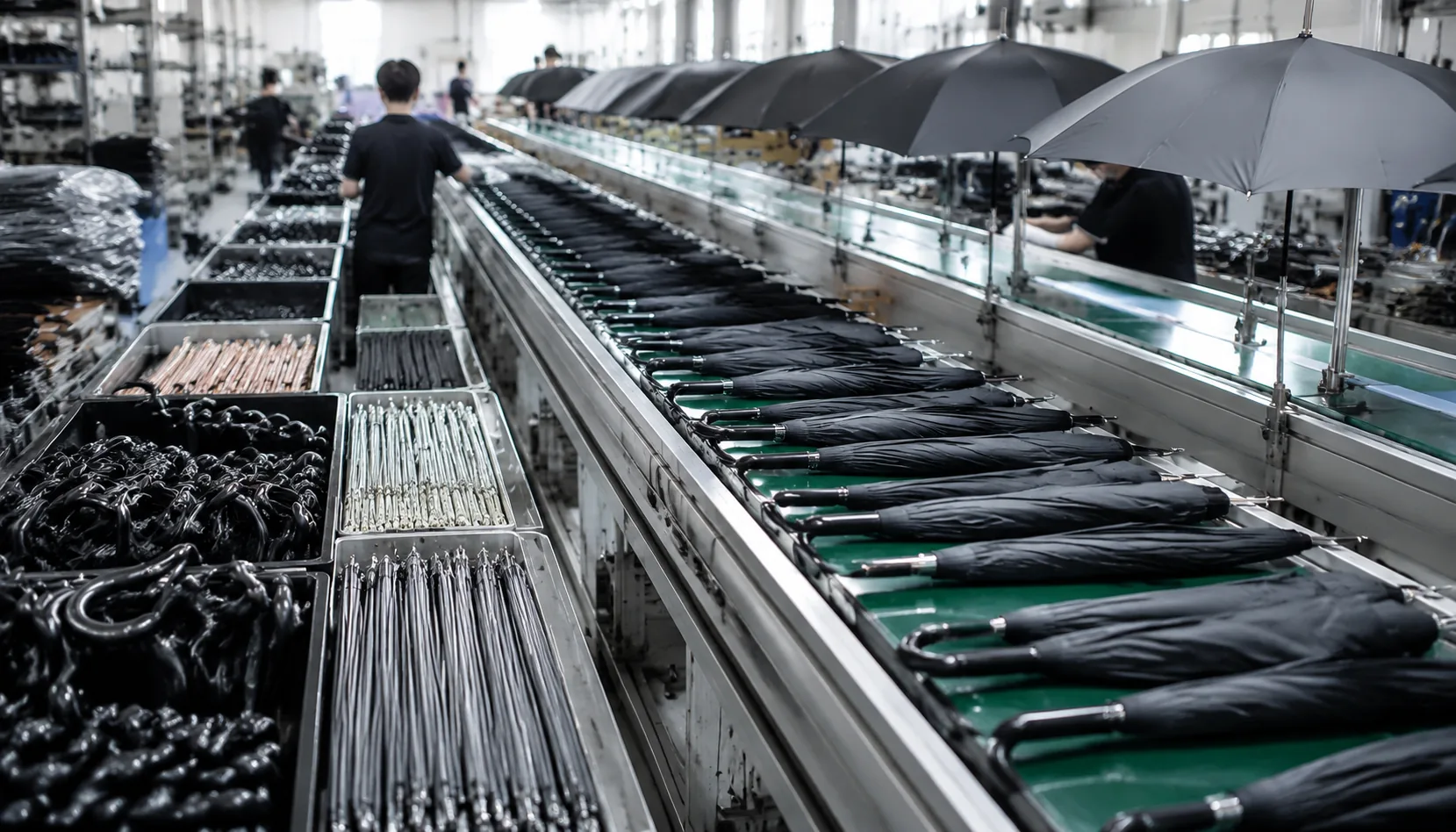
Umbrella Final Assembly Line Controls for Bulk OEM Orders
Improve bulk umbrella order consistency with final assembly controls for frame fit, auto-open function, canopy tension, ...
Read More »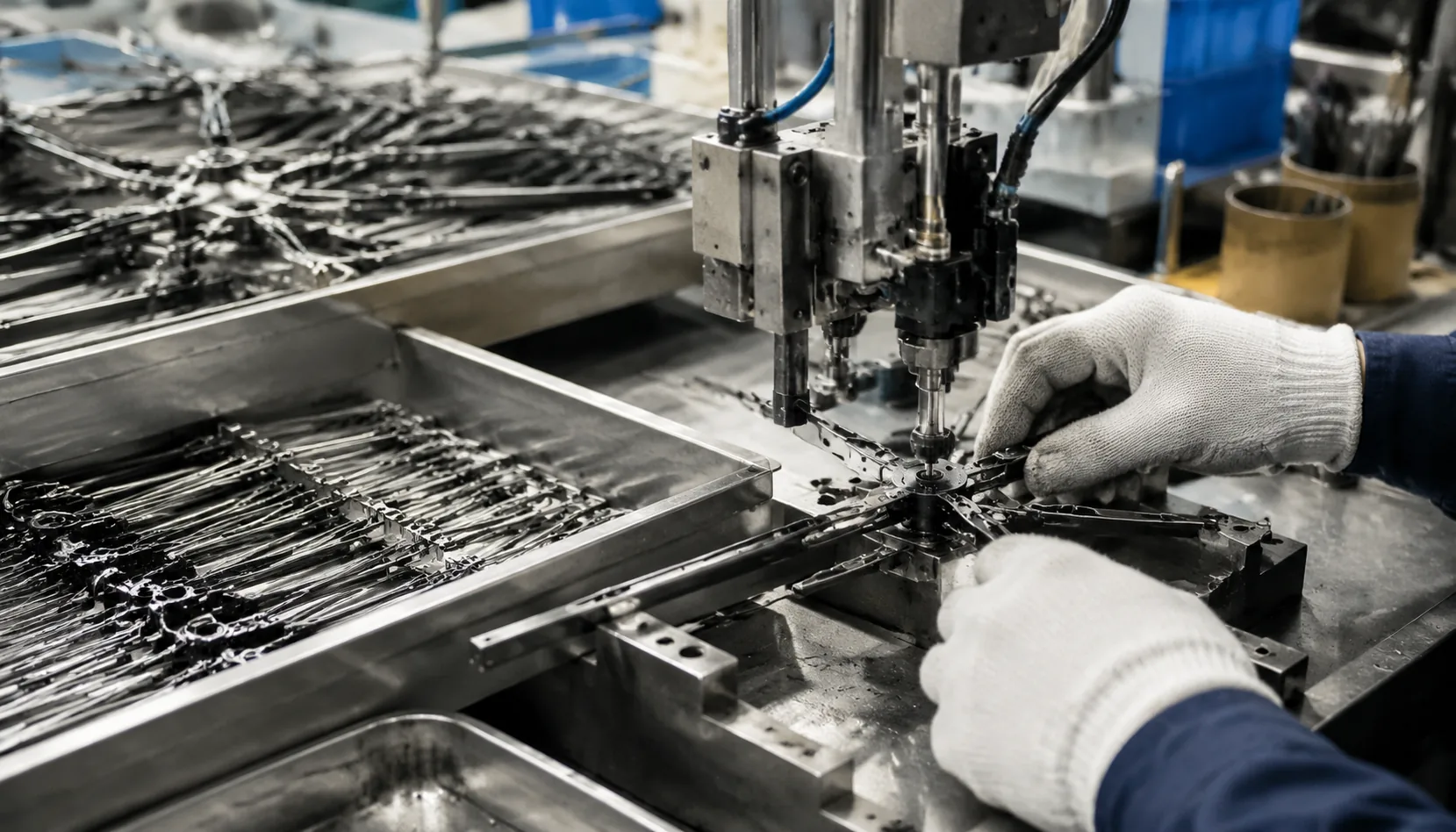
Umbrella Frame Riveting Process Control for Bulk Orders
See how rivet size, hole alignment, and pull-force checks improve umbrella frame durability across fiberglass, steel, 8K...
Read More »