Umbrella Final Assembly Line Controls for Bulk OEM Orders
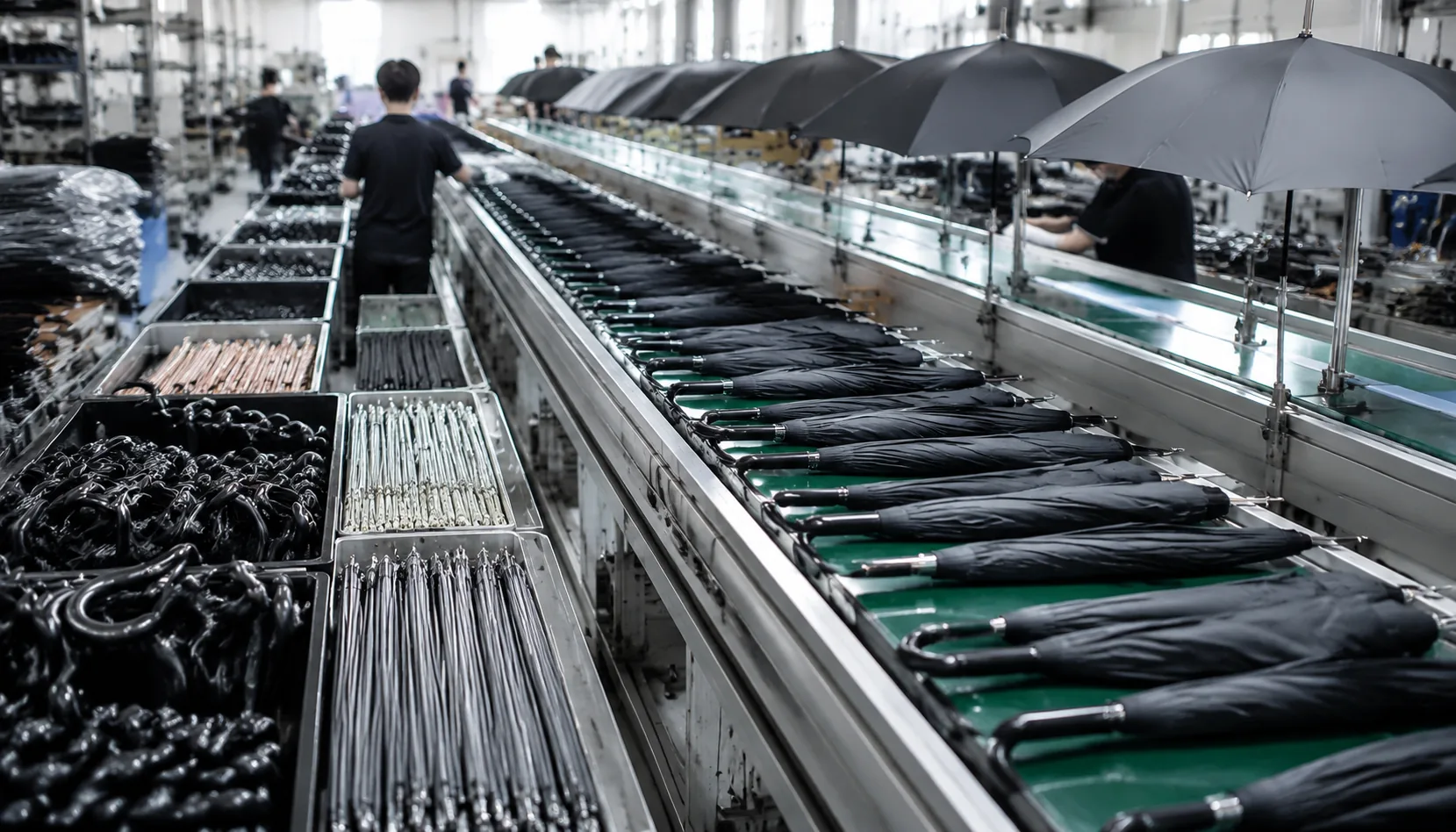
Bulk OEM umbrella orders usually fail in the last 20 meters of production, not at fabric cutting or frame making: a runner skips a rib check, an auto-open spring feels weak, or cartons are packed before moisture and tension settle. On our Songxia assembly floor, umbrella final assembly controls mean locking frame fit, canopy pull, switch function, labeling, and AQL 2.5 inspection into one repeatable gate before shipment.
What Happens in Final Assembly
Final assembly is where an umbrella stops being a pile of correct parts and becomes a shippable product, so the flow has to be locked down before bulk production starts. On a normal OEM umbrella assembly line, we stage inspected frames by size and mechanism first: 21" folding, 23" straight, 27" golf, or 30" large canopy units do not share the same jigs or carton plans. Steel shaft frames get checked for plating scratches and rivet tightness; fiberglass ribs are flexed to catch cracked tips or weak joints. The sewn canopy, usually 190T or 210T pongee, POE, PVC, or EVA depending on the order, is matched to the frame lot, then mounted by aligning the top notch, runner, rib pockets, and seam direction. Good umbrella final assembly controls start here, because a canopy rotated one rib off will pass a quick glance but fail when opened under tension.
After canopy mounting, workers fix the rib tips, sew or cap the top, and attach the handle according to the bill of materials. Manual umbrellas need smooth runner travel and clean latch engagement; auto-open models need spring force checked before handle tightening; auto-open-close folding umbrellas require more careful sequencing because the internal spring, button, runner, and shaft lock must work together without binding. On 8K and 10K promotional umbrellas, the most common failures are loose tips, uneven canopy tension, and crooked logos after mounting. On 16K windproof or double-canopy vented models, we slow the line because more ribs mean more chances for skipped tip stitching and asymmetric tension. Our standard practice at ZheBrella is to inspect mechanism function immediately after handle attachment, not after packing, because rework is faster before labels and sleeves are applied.
The last part of the umbrella factory process control is functional checking, labeling, sleeve insertion, inner-box packing, and master-carton sealing. Every unit is opened and closed at least once; auto-open-close models are cycled more carefully to confirm shaft reset and button response. For umbrella production inspection, inline QC checks canopy cleanliness, print position, UPF 50+ or Teflon hangtag accuracy if specified, barcode placement, polybag warning text, and carton marks against the approved sample. Bulk umbrella order quality depends on separating defects by type: cosmetic marks may follow AQL 2.5 sampling, but unsafe sharp tips, failed locks, broken ribs, or wrong branding are treated as critical. Before FOB or DDP shipment, packed cartons are weighed, drop-tested when required, and matched against the packing list so a 5,000-piece order does not leave with mixed colors, wrong handles, or cartons that collapse in export handling.
Critical Fit and Function Checkpoints
The first fit check on an OEM umbrella assembly line is canopy geometry, not the logo or the carton. On a 23" straight umbrella, I want even canopy tension across all 8K panels after the cap, tip cups, and tie stitches are fixed; loose fabric at one panel usually means the seam was not centered over the rib before sewing, while drum-tight fabric near the edge means the cut tolerance or rib length is fighting the frame. For 190T or 210T pongee, our normal allowance is small, but PVC, POE, and EVA can creep after storage, so the inspector should open the umbrella for 30 seconds before judging wrinkles. Rib-to-seam alignment should stay within about 3 mm at the tip and mid-seam on standard 8K/10K frames; on 16K fashion umbrellas the tolerance must be tighter because one crooked rib is more visible. These umbrella final assembly controls catch the defects buyers usually see first: twisted panels, uneven scallops, and ribs sitting under printed artwork instead of seams.
Ferrule tightness, handle bonding, runner travel, and spring response need separate checks because a good-looking umbrella can still fail in the first rain. The ferrule should seat square on the shaft with no wobble under hand torque; for metal shafts we usually use crimping or thread-locking adhesive, while fiberglass shafts need controlled adhesive coverage so the ferrule does not split the tube. Handles should pass a pull and twist check after curing, especially for EVA foam, rubberized PP, and wooden handles where glue absorption varies by batch. Runner travel must be smooth from closed position to full lock, with no scraping on the shaft and no half-lock feeling at the notch. For auto-open models, I like sampling opening speed by batch: most 23" auto-open umbrellas should deploy cleanly in roughly 0.3–0.6 seconds, without canopy hesitation or violent rebound. Auto-open-close folding umbrellas need extra cycling because weak springs often appear only after 20–30 operations, not on the first press.
Fiberglass and steel ribs behave differently at final inspection, so the same test cannot be applied blindly. Steel ribs show permanent bending if the canopy is over-tensioned or the stretcher rivet is tight; fiberglass ribs may look fine but store torsion and snap back unevenly, creating a lopsided canopy under wind. For windproof double-canopy models, the top and lower canopy vents must align with the rib layout and leave consistent exhaust gaps, otherwise the umbrella will invert earlier even if the frame is rated for 50+ mph in a wind tunnel. At ZheBrella, umbrella production inspection for bulk umbrella order quality normally combines 100% function checks at assembly with AQL 2.5 final inspection, because umbrella factory process control is strongest when defects are caught before packing. The practical rule is simple: every umbrella should open fully, lock positively, vent evenly, close without fabric pinching, and stand straight when viewed from ferrule to handle.
Line Balancing for Stable Output
Stable output on an OEM umbrella assembly line starts with takt time, not with pushing operators to work faster. For a 23 inch auto-open straight umbrella, we normally split work into handle fixing, runner and spring check, rib-tip alignment, canopy attachment, top cap tightening, hangtag/polybag packing, and two inspection points. A balanced line might run 18 to 24 operators with shared fixtures for shaft straightness, cap torque, and open-close cycling, producing 2,000 to 3,500 pieces per shift depending on 8K versus 10K frames and manual versus auto mechanisms. Good umbrella final assembly controls keep the slowest station visible: if canopy sewing has a 1.5 mm panel mismatch or the frame shop sends tight runners, final assembly backs up immediately and operators start skipping small checks.
Fixtures are the quiet part of umbrella factory process control. A cheap handle-press jig that drifts 2 mm will create crooked logos, loose ferrules, or cracked plastic grips across hundreds of pieces before anyone notices. For bulk umbrella order quality, we lock sample-approved settings at the start of each SKU: handle insertion depth, top notch engagement, cap torque, sleeve size, barcode position, and carton quantity. Inspection stations should not sit only at the end of packing. A practical setup uses in-line checks after frame opening, after canopy tie-down, and before polybagging, with inspectors pulling samples under AQL 2.5 rules plus 100% function checks for auto-open-close models. Our standard practice at ZheBrella is to hold first-piece approval for each colorway before releasing cartons to the finished-goods area.
MOQ and lead time pressure are where defect risk rises fast. A 5,000 piece MOQ in one SKU is easier to control than 5,000 pieces split into ten colors, three logo positions, and mixed 21 inch, 23 inch, and 27 inch sizes. Every changeover means new canopy bundles, different ribs or tips, different sleeves, and often a different packing method for FOB or DDP shipment labels. Urgent 10 to 15 day lead times make it tempting to switch the line four or five times per day, but that is exactly when wrong-color panels, missed UV coating labels, loose straps, and mixed cartons appear. Strong umbrella final assembly controls limit daily SKU changes, stage materials by work order, and require a short restart inspection before full-speed production resumes.
In-Process Defects to Catch Early
The defects worth catching early are the ones that become expensive after packing: loose tips, twisted ribs, slow auto-open mechanisms, wrinkled pongee, scratched handles, incorrect labels, and carton mix-ups. On an OEM umbrella assembly line, each must have a fixed prevention point, not just a final inspection note. Loose tips should be checked immediately after tip riveting or gluing, with pull checks on every bundle and spot checks recorded by operator number. Twisted ribs show up when the runner is cycled before canopy closing; if the umbrella is only checked after sleeve insertion, the line has already wasted sewing, labeling, and packing labor. Slow auto-open or auto-open-close action should be tested after frame-to-canopy attachment, using three open/close cycles to catch weak springs, burrs in the shaft, or runner friction before handles are fitted.
Wrinkled 190T or 210T pongee is usually not a fabric problem; it is often caused by uneven panel tension, wrong notch alignment, or careless tie stitching near the rib end. Good umbrella production inspection catches this before steaming or folding hides the issue temporarily. Scratched plastic, EVA, wooden, or rubber-coated handles need a separate control point at handle assembly, because damage often comes from dirty fixtures, metal bins, or workers twisting the handle against the shaft without a sleeve protector. Our standard practice at ZheBrella is to separate handle stock by finish type and require visual checks under normal packing-room light, not only under the brighter QC table, because retail buyers see the umbrella in ordinary lighting. This is where umbrella final assembly controls protect bulk umbrella order quality better than a final AQL 2.5 inspection alone.
Incorrect labels and carton mix-ups are boring defects, but they create the worst buyer complaints because the umbrella may be structurally correct and still fail the order. Hangtags, woven labels, barcode stickers, care labels, and PO-specific inserts should be verified at the first-piece approval stage, then rechecked whenever the line changes color, size, canopy logo, or handle model. For mixed cartons, the packing leader should use a physical golden sample and a carton map showing SKU, color ratio, inner polybag count, and master carton quantity, especially for 21-inch folding umbrellas packed alongside 23-inch or 27-inch stick umbrellas. A clean umbrella factory process control system connects every defect to a line station: frame cycling, canopy tension check, handle protection, label verification, and carton scan. Without those checkpoints, final QC becomes a sorting operation instead of a prevention system.
Pre-Shipment QC and Packing Release
Pre-shipment QC has to happen after the umbrellas are fully packed but before the forwarder locks the container plan; doing it too early is how bad mixed-carton mistakes escape. For bulk OEM orders, I prefer final AQL 2.5 inspection on finished cartons using ANSI/ASQ Z1.4 sampling, with critical defects set to zero tolerance. Inspectors should pull random cartons across the full lot, not just the first pallet near the door. Open checks cover rib alignment, runner lock, auto-open or auto-open-close function, canopy tension, sewing skips, cap and ferrule fit, handle logo position, and obvious printing defects. For a 23-inch 8K folding umbrella in 190T pongee, the inspector should compare the actual article against the buyer-approved golden sample: fabric hand feel, color, shaft finish, sleeve label, hangtag, and packed weight. This is where umbrella final assembly controls prove whether the OEM umbrella assembly line stayed consistent after the first approved samples.
Pack-out review is not cosmetic; it prevents retail chargebacks and warehouse rejection. Carton markings, inner box count, polybag warning text, desiccant placement, barcode readability, and SKU separation must match the buyer’s packing instruction exactly. If the order has mixed colors, carton-level color ratio should be checked against the packing list, because one wrong ratio can hold an entire shipment at a distributor’s DC. Barcode checks should include both scanner verification and human-readable code confirmation, especially when UPC, EAN, Amazon FNSKU, or retailer-specific labels are involved. For export cartons, we normally review 5-ply carton strength, gross/net weight, carton dimensions, tape sealing, and pallet pattern if requested. A carton drop test or at least a pack-out compression review is sensible for heavy 27-inch golf umbrellas, 16K windproof models, or POE/PVC bubble umbrellas where tips and ribs can punch through weak packaging.
QC timing should be tied to the shipping plan, not treated as an afterthought. For FOB Ningbo or Shanghai, final umbrella production inspection should be scheduled 2 to 3 days before warehouse cutoff, leaving time to replace failed pieces, reprint labels, or repack cartons without missing CY closing. For DDP orders, I want QC finished before the truck appointment is confirmed, because air/rail/sea DDP routes often have tighter pickup windows and less flexibility once customs documents are generated. If a lot fails AQL 2.5, the factory needs a documented sorting plan, re-inspection scope, and revised booking date agreed by the merchandiser and buyer. At ZheBrella, umbrella final assembly controls are released only after QC signs the golden sample comparison sheet, barcode scan record, carton count, and packing photos, because bulk umbrella order quality is measured at the buyer’s receiving dock, not at the sewing table.
Frequently Asked Questions
When should final assembly inspection happen for a bulk umbrella order?
Factories should inspect during assembly, not only after packing. A final AQL 2.5 inspection is typically done when production is complete and at least 80% of goods are packed.
Why do mixed umbrella SKUs increase assembly risk?
Different rib counts, handles, fabrics, and auto-open mechanisms require different fixtures and checks. Without clear line segregation, factories can mix parts, labels, or cartons across SKUs.
What should be checked in the final assembly stage for bulk umbrella orders?
A final assembly check usually covers frame alignment, rib and shaft fit, open/close function, canopy tension, stitching, and packing count. For OEM bulk orders, many factories also add a 100% visual check for surface defects and label placement before carton sealing.
How is AQL 2.5 typically applied to umbrella shipments?
AQL 2.5 is commonly used for major and minor defect sampling at shipment inspection, with sample size based on lot quantity. Buyers usually define which issues are major, such as failed opening, broken ribs, or wrong branding, before production starts.
What is a practical way to reduce defects on an umbrella assembly line?
Set in-line checkpoints for frame fit, auto-open spring performance, and canopy symmetry, then do a final packing audit before carton closure. Factories often use go/no-go gauges and function tests on a fixed percentage of each batch, plus 100% checks for critical appearance issues.
Looking to Launch Your Custom Umbrella Line?
ZheBrella is a Zhejiang-based OEM/ODM umbrella manufacturer with 17 years of export experience. Free design, low MOQ from 100 pieces, windproof construction, full-color print.
Get Free Quote Now »People Also Search For
Related Articles
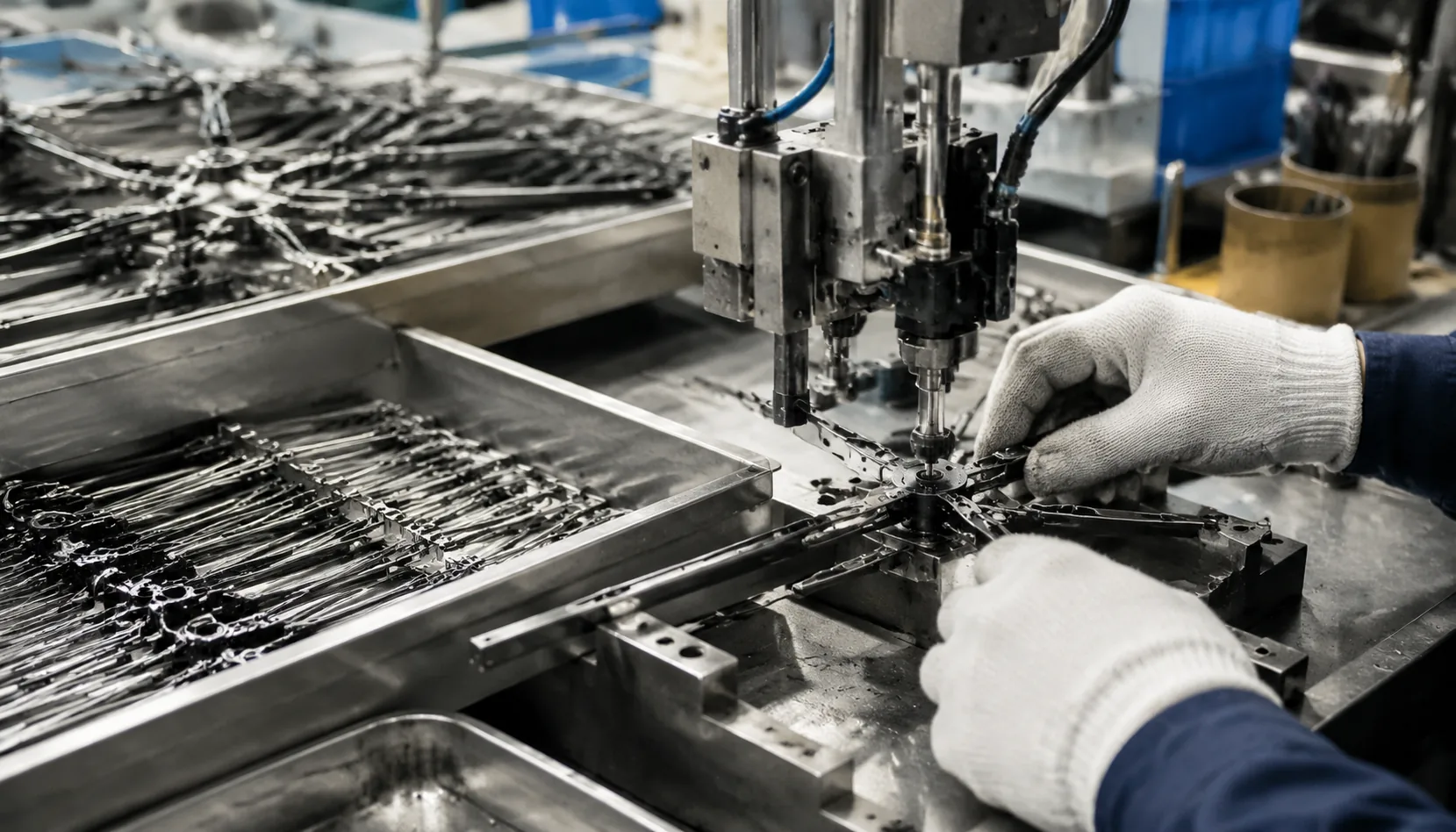
Umbrella Frame Riveting Process Control for Bulk Orders
See how rivet size, hole alignment, and pull-force checks improve umbrella frame durability across fiberglass, steel, 8K...
Read More »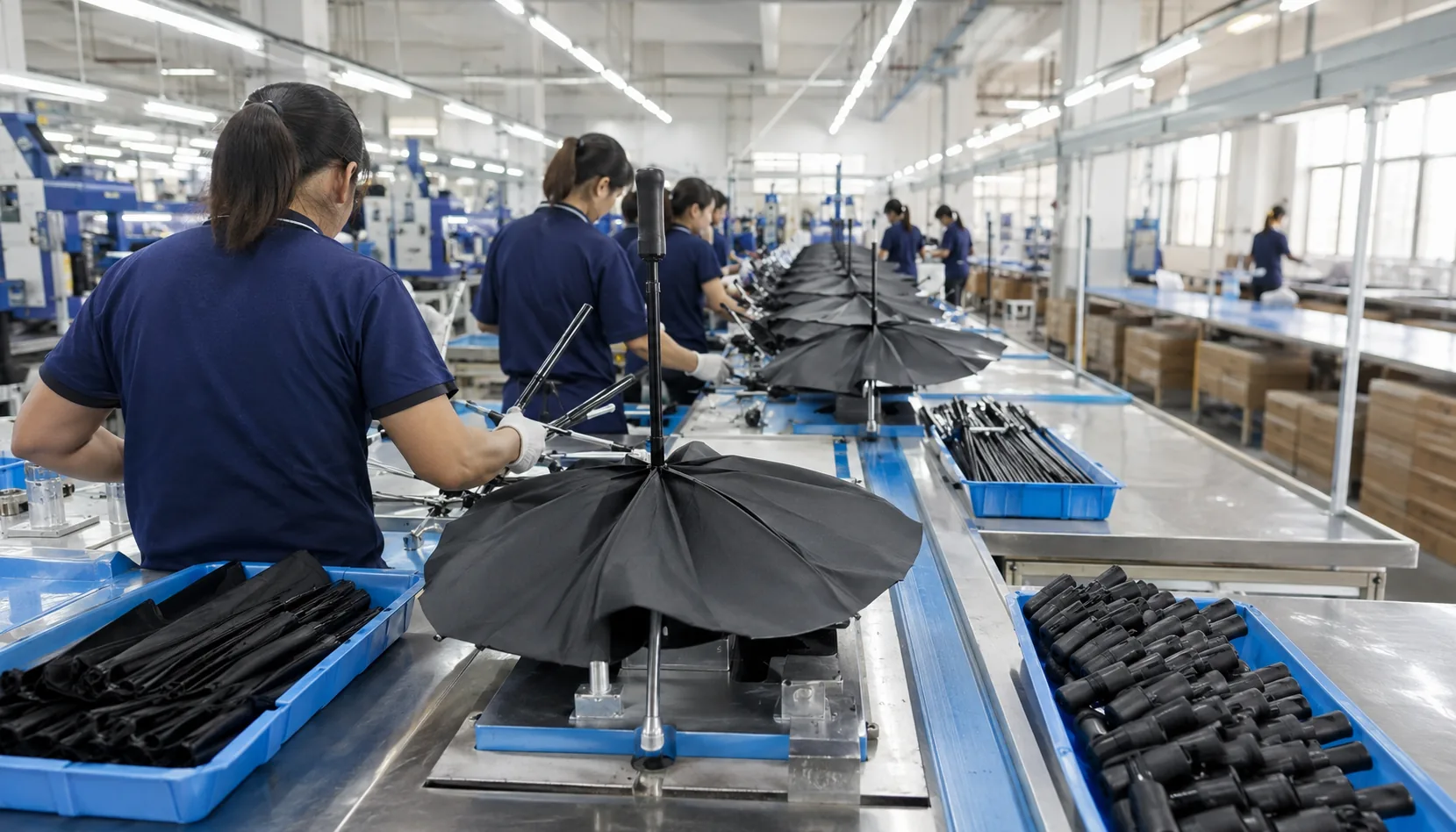
Umbrella Final Assembly Line Balancing for OEM Production
Plan umbrella assembly cells with takt time, inline QC gates, and pack-out checks to stabilize output, lead times, and A...
Read More »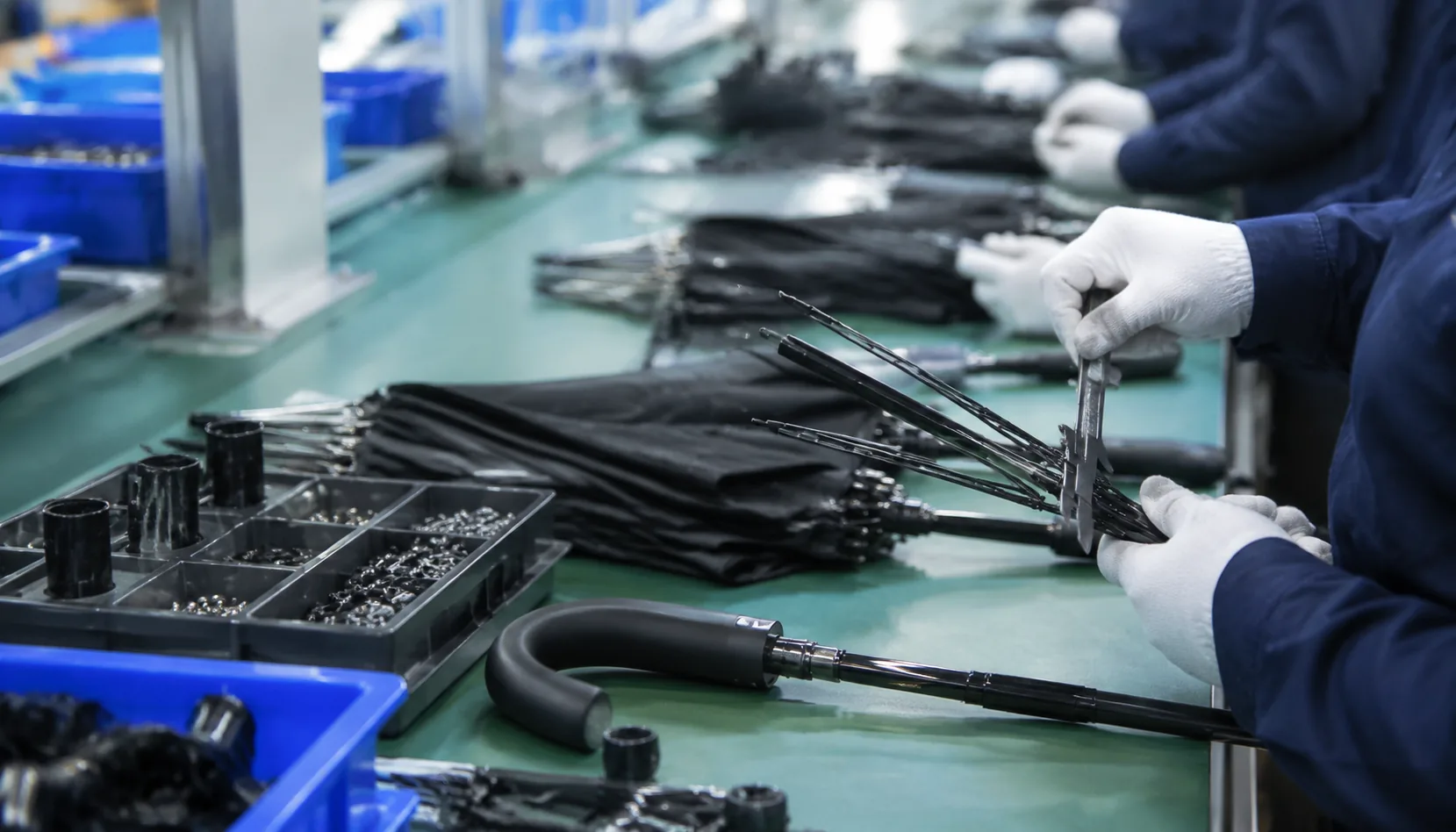
Inline Umbrella Assembly QC Gates Before Final Inspection
Map practical in-line QC gates for frames, canopies, auto-open mechanisms, and export packing so defects are caught befo...
Read More »