Variable-Data Umbrella Printing for Personalized Campaigns
When a campaign needs every umbrella to carry a different name, QR code, branch number, or serial, the risk is not the printing itself but the data control behind it. On our Songxia factory floor, personalized umbrella printing works only when artwork, spreadsheet logic, panel positioning, print method, and inspection checkpoints are locked before fabric cutting and canopy assembly begin.
What Variable-Data Branding Can Include
Variable-data branding means the umbrella artwork has fixed elements plus changing fields printed from a database, not a new full layout for every piece. In real buyer programs, that usually means employee names on one panel, event zone colors for crowd control, table or booth numbers for conferences, serialized gift numbers for VIP kits, or distributor campaign codes tied to regional sales teams. Printed QR code umbrellas are also common for tourism boards, university admissions, product launches, and retail loyalty campaigns, but the code must be sized correctly; I do not like going below 25 mm square on 190T or 210T pongee because fabric texture, water-repellent coating, and panel curvature reduce scan tolerance. For personalized umbrella printing, the safest placement is usually one lower panel area away from seams, rib tips, and heavy folds.
Some artwork should not move, even when the variable data changes. The main logo size, Pantone color, print method, and panel location should stay fixed so the whole production run still looks like one campaign. If promotional umbrella logos shift from panel to panel, the buyer sees it as poor quality even when the data is technically correct. Our standard practice at ZheBrella is to lock the master logo, define a maximum text box for names or codes, and test the longest expected entry before mass production. A name like “Li Chen” and a name like “Alexandria Montgomery-Santos” behave very differently on a 21-inch compact umbrella panel. For custom name umbrellas, we normally recommend a simple sans-serif font, minimum 18–22 pt equivalent after scaling, and one-color printing unless the budget supports digital heat transfer or sublimation.
The production file must separate fixed artwork from variable fields before sampling. For screen printing, variable data is inefficient unless quantities are small or the changing element is applied later by heat transfer label. For larger variable data umbrellas, digital transfer, UV flatbed on cut panels, or sublimation on white polyester gives better control, especially when QR codes, serial numbers, or multi-color campaign tags are involved. Buyers should provide the data sheet in clean CSV or Excel format with one row per umbrella and columns for name, code, zone, URL, and any distributor reference. We check spelling and sequence only against the supplied file, so approval responsibility must be clear. A good pre-production sample should include the longest name, the shortest name, one QR code, and one serialized code to confirm scan rate, alignment, and readability after folding.
Best Print Methods for Changing Artwork
For changing artwork, digital printing is usually the cleanest route when every canopy needs a different name, QR code, serial number, store location, or campaign message. On 190T and 210T pongee, direct digital output can hold small details better than screen printing because there is no separate mesh screen for each variation. That matters for variable data umbrellas where one panel may carry a customer name and the next panel carries a unique landing-page code. The weak point is not only the printer resolution; it is ink behavior on water-repellent fabric. Pongee with a strong Teflon-type finish can reduce ink bite, so we often test pretreatment, drying temperature, and rub resistance before approving bulk production. For personalized umbrella printing, I do not accept a QR code proof only on paper. It must be printed on the actual canopy fabric, opened on a frame, and scanned under normal indoor and outdoor light.
Heat transfer is more stable than direct digital printing when the artwork changes but the buyer still wants strong color density on dark navy, black, red, or forest green canopies. It works well for custom name umbrellas, short-run event gifts, and regional campaign versions because each transfer sheet can carry different data while using the same umbrella body. The tradeoff is hand feel and edge behavior. A thick transfer film on 210T pongee may sit slightly above the fabric, and fine QR corners can soften if pressure, dwell time, or platen temperature is wrong. Coated UPF 50+ fabrics need extra care because high heat can affect the coating or leave a press mark, especially on silver-coated sun umbrellas. Our standard practice at ZheBrella is to run wash, fold, tape, and scan tests before mass production, not after 3,000 pieces are already packed.
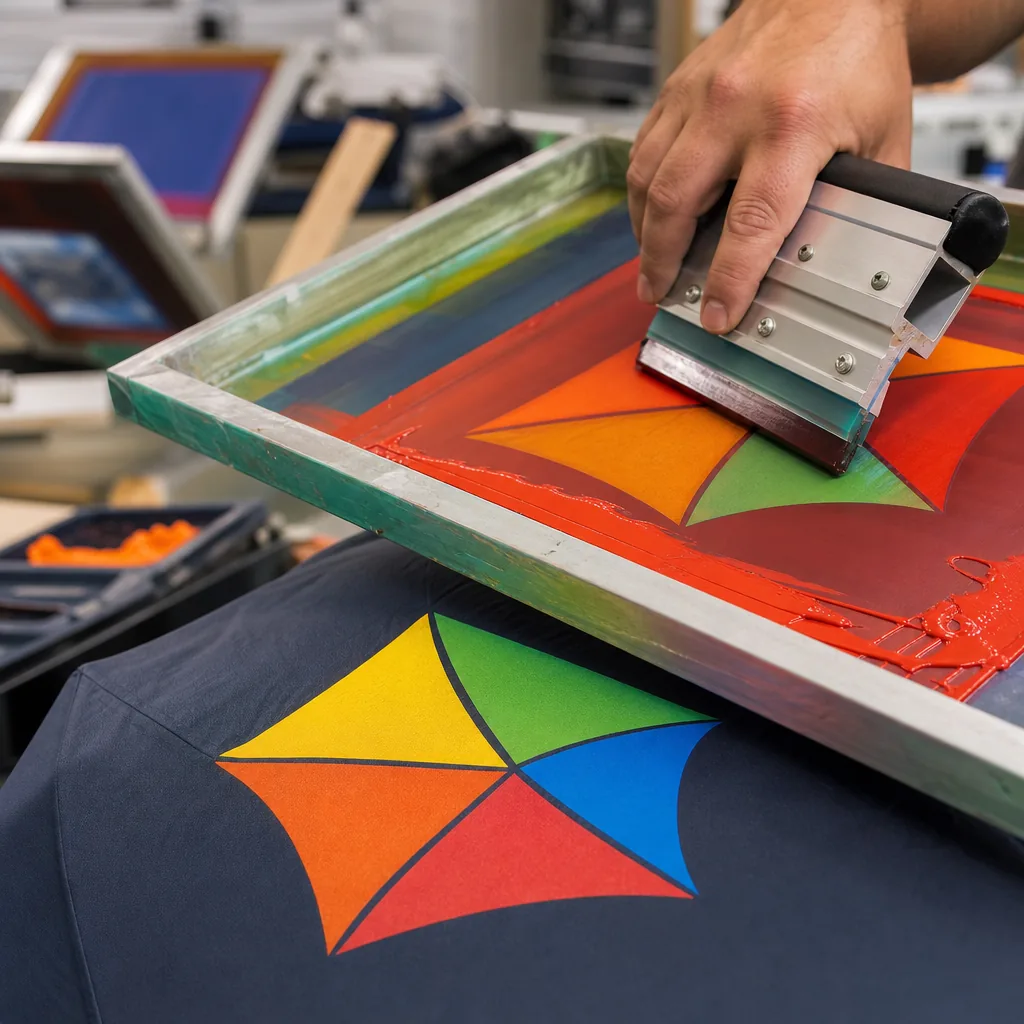
Screen printing is still the right method for fixed promotional umbrella logos, especially when the same one- or two-color mark repeats across 500, 1,000, or 5,000 umbrellas. It gives good opacity, low unit cost, and dependable registration on simple brand panels, but it is the wrong tool for true variable data because every changed name or QR code needs new output and setup. Edge sharpness also depends heavily on fabric and color. A white logo on black 190T pongee may need an underbase; a small black QR code on a dark royal canopy may fail because the contrast is too low. For printed QR code umbrellas, I recommend a quiet zone of at least 4 modules, high-contrast ink, and a minimum finished code size around 25 to 30 mm for short URLs. If the campaign requires both a fixed logo and unique codes, combine screen printing for the logo with digital or transfer printing for the variable panel.
Artwork and Data File Requirements
Clean artwork is the first control point for personalized umbrella printing, because canopy panels stretch, curve, and move during sewing. For promotional umbrella logos, send vector files in AI, EPS, or PDF with fonts outlined and Pantone Solid Coated references called out; JPEG logos pulled from a website usually fail once enlarged to a 23" or 27" canopy. If the job includes heat transfer or screen printing, keep thin strokes above 0.3 mm and avoid small reversed text under 6 pt. For sublimation on white 190T or 210T pongee, CMYK raster elements should be 150–300 dpi at actual print size. Our standard practice at ZheBrella is to place logo art on the exact umbrella panel template, not a flat square mockup, because rib spacing, seam allowance, and top notch position affect what the customer actually sees when the umbrella is open.
Variable data umbrellas need a clean data file, not a folder of random names and images. Use CSV or XLSX with one row per umbrella and separate columns for name, number, QR URL, panel position, canopy color, handle color, and carton mark if needed. For custom name umbrellas, confirm capitalization rules, special characters, and maximum character count before printing; long European names can exceed the visual safe area on 21" folding umbrellas. Printed QR code umbrellas need stricter artwork discipline: I recommend a finished QR size of at least 25 mm x 25 mm for close scanning, 35–40 mm if the code sits on an outer panel likely to wrinkle, with a quiet zone equal to four QR modules on all sides. Use high-contrast black-on-white whenever possible; metallic ink, dark pongee, PVC glare, and seam placement all reduce scan reliability.
Proof naming rules prevent expensive sorting errors during mass production. Each proof should match the data row ID, for example UMB-2025-001_JaneSmith_QR-A_panel3.pdf, and the same ID should appear on the spreadsheet, digital proof, production traveler, and inner carton label. For variable runs, approve both a master layout proof and several live-data proofs from the actual CSV, including the longest name, shortest name, accented characters, and one QR code from each destination type. Before bulk printing, order a pre-production sample or at minimum a strike-off on the real canopy material, not paper. A strike-off confirms ink density, registration, QR scan distance, and coating compatibility with Teflon or UV UPF 50+ finishes. For orders above 500–1,000 pieces, that small delay is cheaper than rejecting goods under AQL 2.5 because 8K or 10K panels were printed with mismatched names.
Production Planning, MOQ, and Lead Times
Variable data changes the production plan even when the umbrella itself is a normal stock platform. An 8K auto-open with a steel shaft, a 16K windproof model with fiberglass ribs, or a 23" pongee 190T straight umbrella may all run on familiar frame lines, but the canopy printing control becomes much tighter. With personalized umbrella printing, the risk is not the rib assembly; it is matching the correct name, QR code, branch address, or campaign ID to the correct canopy panel and carton. For promotional umbrella logos, we can gang-print the same artwork across hundreds of panels. For variable data umbrellas, each print position needs a controlled data file, usually CSV or Excel, tied to an artwork template with locked font size, QR quiet zone, and color profile. Our standard practice at ZheBrella is to freeze the master layout before bulk production and run a 5 to 20 piece pilot check, especially for printed QR code umbrellas where scan distance and contrast matter more than visual beauty.
MOQ depends on how much variation the buyer wants, not only on the umbrella model. For standard screen printing, 500 pieces per design is usually efficient because screens, ink mixing, and line cleaning take time. For heat-transfer or digital sublimation on polyester pongee 190T/210T, variable data can start lower, often 100 to 300 pieces, but the unit cost rises if every umbrella is unique. Custom name umbrellas are usually sorted by data sequence before sewing or after canopy inspection, depending on whether the name appears on one panel or multiple panels. We separate batches by SKU, handle color, rib type, and data group, then apply carton marks that match the buyer’s distribution list. If a campaign has 2,000 units across 80 store locations, the production order should not be written as one bulk SKU; it should be planned as 80 sub-batches with overrun rules, replacement rules, and AQL 2.5 inspection sampling clearly defined.
Lead time needs extra days for data checking, even when frames are ready in the warehouse. A normal 23" auto-open umbrella with one logo panel may ship in 25 to 35 days after artwork approval. Variable-data orders usually need 3 to 7 additional days for file cleaning, proof generation, barcode or QR scan testing, and buyer approval of the data merge. If the order uses double-canopy vented windproof construction, UV UPF 50+ coating, Teflon water repellent treatment, or 27"/30" golf frames, add time for fabric sourcing and canopy sewing capacity. FOB Ningbo or Shanghai is simpler when cartons ship to one consignee. DDP campaigns require earlier packing-list control because each carton may need a different Amazon FBA label, retail DC label, or event-location address. The biggest mistake buyers make is sending revised name lists after printing starts; that can stop the line faster than a shortage of fiberglass ribs.
Quality Control for Personalized Umbrellas
Quality control for personalized umbrella printing starts before the first canopy is sewn. For variable data umbrellas, every record should be locked against an approved data file: name, barcode, QR URL, logo position, canopy color, and carton destination. On the line, operators should scan the barcode or QR code from the printed panel and match it to the work order before assembly, not after packing. Printed QR code umbrellas need a real phone scan test under normal indoor light and again after the canopy is tensioned on the frame, because distortion across 8K or 10K panels can affect readability. For custom name umbrellas, spelling verification should be done against the buyer’s source spreadsheet, not retyped into a factory form. One wrong letter on 500 staff gifts is not a minor defect; it usually means reprinting the full panel.
Print durability must be checked separately from data accuracy. For pongee 190T or 210T canopies, we use cross-hatch tape tests, wet rub tests, and folding abrasion checks around rib contact points, especially for heat-transfer and digital prints. Sublimation on white polyester usually bonds well, but dark promotional umbrella logos printed by screen or transfer need closer adhesion review after Teflon coating or water-repellent finishing. PVC, POE, and EVA umbrellas require different ink systems, and a pass on polyester does not mean the same artwork will survive on transparent plastic. A practical QC plan should include first-piece approval, mid-line inspection, and final inspection under AQL 2.5, with critical defects including unreadable QR codes, mismatched names, wrong panel sequence, missing logos, and visible print cracking after open-close testing.
Carton-level sorting is where many personalized campaigns fail, even when the printing is perfect. Writers should specify that packing lists must show carton number, recipient group, SKU, canopy color, name range, and quantity, with the same identifier printed on the master carton label. For event drops, retail allocations, or employee gifting, mixed cartons create expensive distribution errors after FOB or DDP shipment. Our standard practice at ZheBrella is to add scan-confirmation at packing: umbrella hangtag or sleeve barcode matched to the carton label before sealing. Buyers should also request a final digital packing list in Excel or CSV, plus photos of representative cartons, inner bundles, and labels. This is especially important when personalized umbrella printing includes hundreds of names, branch codes, or regional promotional umbrella logos, because warehouse teams need to dispatch by carton without opening and manually checking every umbrella.
Frequently Asked Questions
Can every umbrella in one order have a different name or QR code?
Yes, if the artwork is prepared as structured variable data and the print method supports it. Digital printing or heat transfer is usually more practical than screen printing for this type of order.
Do QR codes work reliably on umbrella canopies?
They can work well if printed large enough, with high contrast and a clear quiet zone. Curved canopy surfaces and dark 190T/210T pongee should be tested with a strike-off before mass production.
Can one umbrella order include unique names, QR codes, and serial numbers at the same time?
Yes. Most factories can combine a fixed base design with 1-3 variable elements per unit, such as a name on one panel, a QR code on another, and a sequential serial inside the strap or on the sleeve. Buyers usually submit the variable data in CSV or Excel format mapped to exact print positions before proofing.
What print method works best for variable-data umbrellas in bulk?
For repeated artwork with only one logo, screen printing is usually the most cost-efficient. For variable names, unique QR codes, or short-run mixed artwork, digital printing is typically the better fit because it avoids making separate screens for each version, though lead times and unit cost can increase depending on quantity.
How should QR codes be checked before mass production on umbrellas?
Ask for a scan test on pre-production samples using both iPhone and Android devices under indoor and outdoor lighting. For reliable readability, buyers typically keep strong contrast, avoid placing codes across seams, and confirm a minimum printed size based on the canopy curvature and fabric texture.
Looking to Launch Your Custom Umbrella Line?
ZheBrella is a Zhejiang-based OEM/ODM umbrella manufacturer with 17 years of export experience. Free design, low MOQ from 100 pieces, windproof construction, full-color print.
Get Free Quote Now »People Also Search For
Related Articles
QR Code Printing on Umbrellas for Trackable Campaigns
Plan scannable QR code umbrellas with the right print size, contrast, panel placement, coating tests, and approval proce...
Read More »
QR Code Printing on Promotional Umbrellas for Campaigns
Plan scannable QR code umbrella printing with the right panel size, contrast, fabric, testing, MOQ, and delivery terms f...
Read More »
Variable Data Printing for Event Umbrella Campaigns
Use QR codes, serial numbers, venue names, or sponsor variants on event umbrellas while controlling scan quality, MOQ, l...
Read More »