QR Code Printing on Promotional Umbrellas for Campaigns
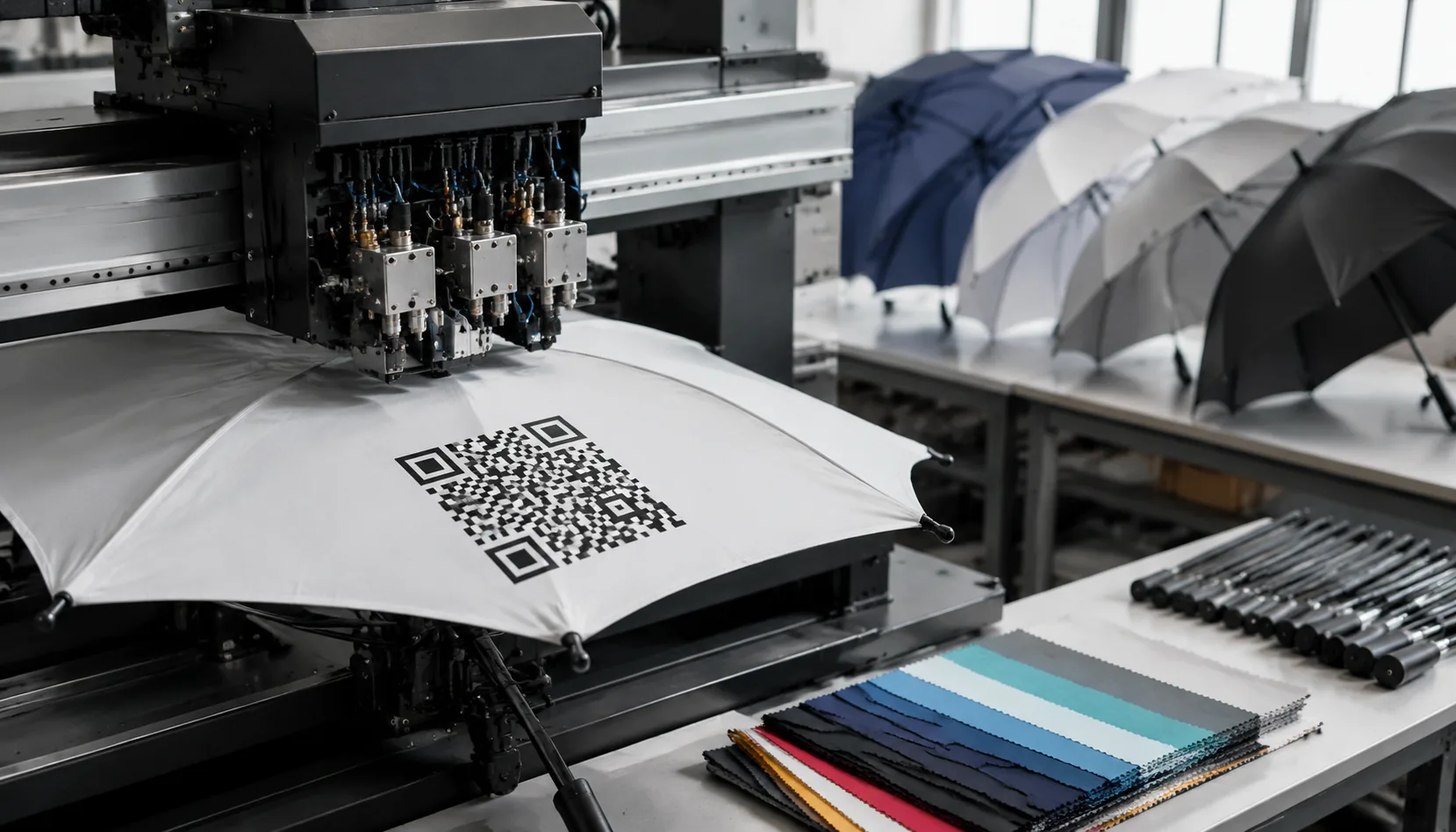
A campaign umbrella only works if people can scan it quickly in the rain, under glare, and while the fabric is moving. On our Songxia production floor, QR code umbrella printing starts with panel layout, ink contrast, fabric coating, and repeated scan checks before bulk sewing—not after cartons are packed. For buyers planning event giveaways, the risk is not just a blurred code; it is missing the activation window because sampling, MOQ, and delivery terms were not locked early.
Scannability Starts With Size, Contrast, and Placement
Scannability starts with physical size, not artwork cleverness. For QR code umbrella printing, I do not approve anything below 45 x 45 mm on a normal 23" or 27" panel, and 60 x 60 mm is safer for event crowds where people scan from 3 to 6 feet away. The code also needs a true quiet zone: at least 4 modules of blank space around the matrix, not a thin cosmetic border squeezed between slogans. If the QR is printed by screen printing, we normally keep module detail simple and avoid micro-codes because ink gain on 190T or 210T pongee can close small white gaps. Heat transfer gives sharper edges, but the transfer film must sit flat and bond evenly or glare and edge lift will hurt scans after folding.
Dark-on-light contrast is non-negotiable. Black, navy, or dark green QR codes on white, silver, pale yellow, or light gray canopy panels scan reliably; pale gold on beige may look premium in a mockup but fails under rain glare and shade. I also avoid reversing the code unless the buyer has tested it on multiple phone models, because some scanners struggle with light modules on dark backgrounds. Teflon water-repellent coating, PU backing, and UV UPF 50+ finishes can change surface reflectivity, so sample testing matters before bulk production. For promotional umbrella branding, the QR should not compete with large gradients, photo backgrounds, or busy sponsor blocks. Keep the logo separate or place a small logo in the QR center only if the code has enough error correction and has passed real scan checks.
Placement decides whether scannable umbrella logos work in the field. A flat outer panel, centered between two ribs, scans better than any position crossing a seam, sitting near a rib tip, or wrapping over the crown curve. On 8K and 10K umbrellas, I prefer the upper-middle area of one canopy panel, about 120 to 180 mm below the top seam on a 23" stick umbrella, because the fabric tension is stable when open and the user’s hand does not block it. Near-edge placement looks visible from a distance, but wind movement and panel sag distort the square. For event umbrella printing and branded campaign umbrellas, we usually print one large QR on one or two panels, then keep the remaining panels for the campaign name, sponsor marks, or short URL backup. Every pre-production sample should be scanned open, half-wet, and under indoor light before approving mass production.
Choosing Fabric and Print Method for Clean QR Edges
Digital printing and heat transfer solve different problems. Direct digital printing is useful for event umbrella printing with full-color graphics, short runs, or variable campaign artwork, but black QR modules can look slightly soft on coated pongee unless the machine profile is tuned and the fabric is pretreated. I use it when the QR code is secondary and the main job is photographic promotional umbrella branding. Heat transfer gives the sharpest black edges for small QR codes and color logos because the film defines the boundary, making it a strong option for 50–300 piece orders, rush events, and branded campaign umbrellas that need crisp sponsor marks. The tradeoff is hand feel: a large transfer patch can feel stiff and may show fold lines after repeated auto-open-close cycling. On POE, PVC, or EVA clear umbrellas, heat transfer and UV digital printing need separate adhesion testing because coatings that work on 210T pongee often peel on plastic canopy materials.
Frame Specs That Affect Code Visibility
Rib count changes QR readability more than most buyers expect because it controls how flat each printed panel stays under tension. An 8K umbrella gives wider triangular panels, so a 70–90 mm QR mark has more uninterrupted fabric around it and fewer seam shadows crossing the quiet zone. That is usually the safest build for QR code umbrella printing on 23" and 27" straight umbrellas, especially when the code sits on one alternate panel rather than near the crown. A 16K frame looks premium and rounder, but each panel is narrower and more curved; the code may bend across two fabric planes if the artwork is oversized. For scannable umbrella logos, I keep the code at least 25 mm away from stitched ribs and use a white or light solid backing patch behind the matrix, not just negative space in a busy campaign graphic.
Fiberglass ribs usually improve scan reliability in real use because they flex and recover without permanently warping the canopy. On a 190T or 210T pongee canopy, fiberglass creates more even panel tension after repeated opening, so the printed squares stay closer to their original geometry. Steel ribs are cheaper and strong in compression, but once a rib takes a bend during freight, event handling, or a 40–50 mph gust, the panel can develop a diagonal wrinkle that cuts through the QR quiet zone. That wrinkle may not fail AQL 2.5 visual inspection, but it can make event umbrella printing scan poorly under phone autofocus. For branded campaign umbrellas with codes, I prefer fiberglass ribs with steel shaft on 23" auto-open models, or full fiberglass on 27" golf umbrellas where the canopy span magnifies distortion.
Double-canopy windproof structures add another variable: the vent seam and overlapping top layer can interrupt both printing position and lighting. A vented 8K or 10K golf umbrella survives gusts better because air escapes instead of inverting the frame, but the QR should never be placed across the vent overlap or near the floating upper canopy edge. In production, our standard practice at ZheBrella is to lock the print template after measuring the open-frame canopy, not the loose fabric panel, because double-canopy sewing changes curvature by several millimeters. For promotional umbrella branding, I specify high-contrast black-on-white heat transfer or screen print, 300 dpi source artwork, matte finish, and a minimum 4:1 contrast ratio after water-repellent coating. Teflon treatment is fine if cured properly, but glossy PVC or POE panels can reflect sunlight and reduce scan speed unless the code is enlarged to 100–120 mm.
Sampling, AQL, and Scan Testing Before Mass Production
Pre-production samples are not optional for QR code umbrella printing because a code that looks sharp on a PDF can fail once it is stretched over curved 190T or 210T pongee panels. I would tell the writer to specify at least one printed canopy sample before bulk cutting, using the final artwork size, final ink system, and final umbrella construction, not a substitute fabric swatch. For straight umbrellas, test on the actual 23", 27", or 30" panel geometry; for compact 21" folding umbrellas, check the code across the tighter canopy arc. Screen printing, heat transfer, and sublimation each spread color differently, so the quiet zone around the QR code should stay clean, usually no less than 4 mm after printing. If the buyer wants scannable umbrella logos beside a slogan, the code should sit on a flatter visual area, not too close to rib seams, tips, or the ferrule line.
Phone scan testing should be written as a measurable approval step, not a casual “looks OK” check. Our standard practice at ZheBrella is to scan each sample with both iPhone and Android cameras at 1–2 meters under warehouse light, outdoor shade, and direct daylight glare, because campaign users will not stand still under perfect studio lighting. The writer should mention testing the umbrella both fully open and held at a natural walking angle, since glossy POE/PVC can reflect more than matte pongee, and dark navy or red can reduce contrast if the QR code is printed in brand colors instead of black on white. For promotional umbrella branding, I prefer a minimum printed QR size of 80–100 mm for close-range event use and larger for golf umbrellas, especially when the scan target includes a logo embedded inside the code.
AQL 2.5 inspection should cover the print as a functional component, not just decoration. Inspection points for branded campaign umbrellas should include missing dots, ink bleeding, heat-transfer edge lift, sublimation blur, pinholes, scratches through the code, wrong URL destination, skewed placement, upside-down panels, and alignment drift against the approved sample. For event umbrella printing, set a tolerance such as ±3 mm for QR position relative to the panel centerline and reject any unit that fails scanning at 1 meter after normal opening and closing. Logo color checks also belong in the same control plan: compare Pantone or CMYK targets under D65 light, confirm the sponsor logo is not contaminated by the QR black, and verify that coated fabrics with Teflon, UV, or water-repellent finishing still hold clean edges after curing. A good final inspection pulls samples across cartons, not only from the top layer.
MOQ, Lead Time, and Shipping Terms for Campaign Deadlines
For campaign work, MOQ is not just a price lever; it decides whether the factory can control color, print registration, and QR scan reliability without wasting your launch window. For QR code umbrella printing, I normally separate orders into three bands: 300–500 pieces for repeatable stock models, 800–1,000 pieces when you need custom canopy colors or mixed panel printing, and 2,000+ pieces for retail-style branded campaign umbrellas with custom handles, sleeves, cartons, or rib color matching. A pre-production sample usually takes 5–7 days after artwork approval if it is screen print or heat transfer on 190T/210T pongee, and 7–10 days for sublimation or full-panel graphics. Do not approve samples by photo only when the QR code is functional; scan it under indoor light, outdoor glare, and at a realistic 3–6 foot distance. For scannable umbrella logos, we keep the code at least 30–35 mm wide on compact umbrellas and larger on 23" or 27" golf models, with quiet-zone spacing protected from seam lines.
Mass production timing depends more on material allocation and print method than on the umbrella frame itself. A standard 21" auto-open compact or 23" straight umbrella using stock black steel shaft, fiberglass ribs, and 190T pongee can usually ship in 18–25 days after sample approval for 500–3,000 pieces. If the order uses double-canopy vented windproof construction, 8K or 10K fiberglass ribs, UPF 50+ coating, Teflon water repellent finish, or POE/PVC/EVA transparent panels, plan for 25–35 days. Event umbrella printing with multiple sponsor logos takes longer because every panel must be checked for position, ink density, and distortion after sewing. Our standard practice at ZheBrella is to run QR scan checks during in-line inspection and again at final AQL 2.5, because a beautiful canopy is useless if the campaign landing page cannot be reached. Lock final artwork, Pantone colors, URL destination, and carton marks before deposit; late URL changes often mean reprinting, not a quick edit.
For fixed event dates, choose FOB when your company already has a forwarder, can manage vessel bookings, and has enough buffer for customs and inland delivery. FOB Ningbo or Shanghai usually gives better freight control on larger quantities, especially 2,000+ umbrellas packed in export cartons, but ocean shipping can add 18–35 days depending on destination port and congestion. Choose DDP when the delivery date is non-negotiable, the buyer has no import team, or the umbrellas must arrive directly at a hotel, stadium, warehouse, or conference venue. DDP costs more, but it puts freight, customs clearance, duties, and final-mile trucking into one accountable timeline. For promotional umbrella branding tied to a launch date, I advise counting backward from the event: 7–10 days for sampling, 20–35 days for production, 5–7 days for final inspection and export paperwork, then the real transit time. If the campaign is inside 30 days, reduce customization, use air freight selectively, and avoid full-surface sublimation unless the artwork is already tested.
Frequently Asked Questions
What is the safest QR code position on an umbrella?
A single outer canopy panel, centered away from ribs and seams, is usually safest. Keep enough quiet zone around the code and test scanning on the actual fabric sample.
Can QR codes be printed in brand colors instead of black?
Yes, but contrast matters more than brand preference. Dark colors on white or light pongee usually scan better than low-contrast tone-on-tone combinations.
What QR code size works best on a promotional umbrella panel?
For reliable scanning, a QR code should usually be at least 12–15 cm wide on one panel, with a quiet zone around the code. Larger sizes, such as 18–20 cm, are recommended for outdoor events where people scan from farther away.
Which umbrella fabric and print method are best for scannable QR codes?
Pongee or polyester with a smooth weave works better than textured fabrics. Screen printing is suitable for simple high-contrast codes, while digital printing is better when the panel includes gradients, campaign graphics, or multi-color artwork.
Can factories test QR code scanning before mass production?
Yes. A pre-production sample can be scanned under indoor light, daylight, and angled viewing conditions before bulk production. For OEM orders, buyers should approve the physical sample or photo/video scan test before confirming mass printing.
Looking to Launch Your Custom Umbrella Line?
ZheBrella is a Zhejiang-based OEM/ODM umbrella manufacturer with 17 years of export experience. Free design, low MOQ from 100 pieces, windproof construction, full-color print.
Get Free Quote Now »People Also Search For
Related Articles
QR Code Printing on Branded Umbrellas for Campaign Tracking
Design scannable QR codes on branded umbrellas with the right size, contrast, placement, fabric choice, and QC checks fo...
Read More »
QR Code Printing on Umbrellas for Campaign Tracking
Use QR code umbrella printing with readable sizing, durable placement, and QC checks so event and retail campaigns can d...
Read More »
Reflective Umbrella Logos for Safety Brand Campaigns
Specify reflective logo films, panel locations, and AQL checks for promotional umbrellas used in night events, campuses,...
Read More »