QR Code Printing on Umbrellas for Campaign Tracking
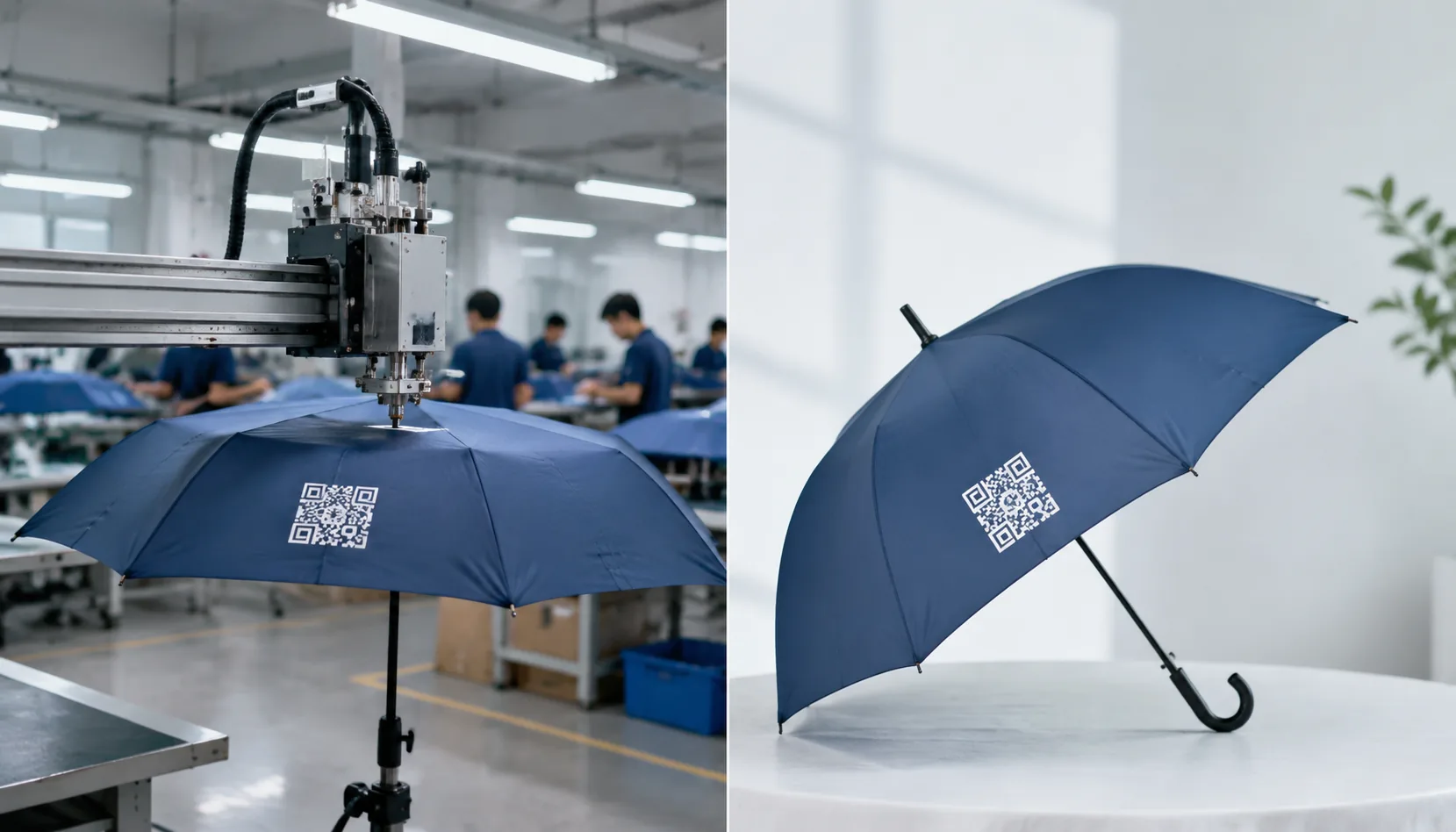
For campaign buyers, a QR code on an umbrella only works if people can scan it after shipping, rain, folding, and real outdoor use. On our Songxia factory floor, QR code umbrella printing means controlling panel tension, print position, ink adhesion, and code size before bulk production, not just adding artwork to a template. The difference shows up at events and retail shelves, where readable codes turn giveaways into measurable traffic instead of missed scans.
When QR Codes Make Sense on Branded Umbrellas
QR code umbrella printing makes sense when the umbrella stays in the user’s hand long enough for a scan to feel useful, not forced. Good applications include event registration at outdoor conferences, loyalty signups outside retail stores, hotel concierge or shuttle-service pages, product warranty registration, and social media landing pages tied to a seasonal campaign. For event marketing umbrellas, I prefer putting the QR on one dedicated canopy panel rather than across a seam, because stitching distortion and rib tension can break small modules. On 190T or 210T pongee, a heat-transfer QR with a matte finish usually scans more reliably than heavy screen ink, especially on dark navy or black panels where contrast must be controlled.
The QR should support the brand message, not replace the main logo. A scannable umbrella logo sounds attractive, but in production I would separate the two unless the artwork is very simple: keep the brand mark large on the front-facing panel and place the QR on a side or rear panel with a short call-to-action such as “Scan for VIP access” or “Register warranty.” For branded campaign umbrellas, the minimum practical QR size is usually 35–45 mm square on folding umbrellas and 50–70 mm on 23" or 27" stick umbrellas, assuming clean artwork, high contrast, and no metallic ink. Always test scans after printing, not just from the digital proof.
Trackable promotional umbrellas work best when the landing page is campaign-specific, mobile-fast, and built with UTM parameters or unique QR batches by city, hotel, distributor, or event date. A hotel may use the code for room service, local maps, or umbrella return instructions; a retailer may send customers to warranty registration or a loyalty offer; a sports event may drive traffic to a sponsor’s Instagram or ticket page. Our standard practice at ZheBrella is to print a pre-production sample, scan it under indoor light and daylight at multiple angles, then include QR readability in the inspection checklist alongside canopy alignment, rib function, color matching, and AQL 2.5 visual checks. A beautiful umbrella that cannot scan is just bad campaign accounting.
Readable Size, Contrast, and Placement Standards
Readable QR codes start with physical size, not artwork resolution. For canopy printing, I will not approve anything under 45 x 45 mm for close-range scanning, and 60–80 mm is safer on event marketing umbrellas where people scan from 2–4 feet away. Keep a true quiet zone around all four sides: minimum 4 QR modules, but in production I prefer 6–8 mm of blank fabric because ink gain on 190T/210T pongee can soften the outer squares. A scannable umbrella logo should use dark code on a light field, ideally black, navy, or deep green on white, silver, or pale yellow. Reverse QR codes can work on screen print, but they fail faster under rain glare, canopy wrinkles, and low light. For QR code umbrella printing, always test the final vector at 100% size after converting spot colors, not just the PDF proof on a monitor.
Placement is where many branded campaign umbrellas lose scan performance. Do not center a QR over rib seams, panel joins, heat-transfer edges, or the high-curvature outside 30–50 mm near the canopy hem; the code distorts when the 8K or 16K frame opens and pulls the fabric into a shallow cone. The best canopy location is usually the lower third of one clean panel, 80–120 mm above the edge on a 23" stick umbrella or 27" golf umbrella, with the code facing outward when carried. On double-canopy vented windproof models, avoid the vent overlap because the upper layer moves in wind and can cast shadows. Our standard practice at ZheBrella is to print a sample, open it on the actual frame, and scan from iPhone and Android at 1, 2, and 3 meters before bulk cutting.
When scanning distance matters more than visual branding, the canopy is not always the best carrier. A strap label can hold a 25–35 mm QR, but it is for hand-held scanning only; it disappears when the umbrella is open and the strap wraps around wet fabric. A sleeve gives flatter geometry and can carry a 50–70 mm code with better contrast, making it useful for retail pickup, hotel programs, or sponsor redemption campaigns. Hangtags are the most reliable for trackable promotional umbrellas because coated paper or PET cards keep edges sharp, support variable QR codes, and avoid fabric texture entirely. For QR code umbrella printing tied to analytics, I often recommend a large brand mark on the canopy plus a matched QR on the sleeve or hangtag, so the umbrella still photographs well while the campaign link actually scans.
Print Method and Fabric Considerations
Screen printing is still the safest choice when the QR code is a simple black mark on a light canopy panel. A properly exposed screen, tight mesh, and controlled squeegee pressure give a dense black block with sharp edges, which matters because scanners read contrast first. For QR code umbrella printing, I normally keep the code on a white or very light rectangular patch rather than placing it directly over busy artwork. On 190T pongee, the fabric weave is fine enough for most promotional codes, but small modules can soften if the ink is too thin or the operator floods the screen too aggressively. On 210T pongee, the tighter weave gives better edge control, especially for codes around 40–60 mm wide. If the umbrella uses Teflon-style water-repellent finishing, the panel should be tested before bulk printing because some inks sit on the coating instead of biting properly, causing poor wash and rub resistance after folding.
Digital printing is better when the code is part of full-color artwork, such as event marketing umbrellas with gradients, sponsor blocks, or a campaign landing-page graphic built around the scannable umbrella logo. Heat transfer and sublimation can reproduce fine details that screen printing cannot separate economically, but they are not automatic wins. Sublimation works best on white polyester pongee before heavy waterproof finishing, while heat transfer can sit on top of coated 190T or 210T fabric but may feel slightly stiffer when folded. For branded campaign umbrellas, I ask buyers to supply the QR code as vector artwork or at least 600 dpi at final size, with a quiet zone around all four sides. Do not let a designer place raindrop textures, shadows, or dark brand colors behind the code unless a real printed sample has already been scanned under daylight, indoor LED light, and a phone camera at arm’s length.
The most common failure is not the code file; it is ink spread changing the module size after printing and drying. A QR code that looks clean on a PDF can become unreadable when black modules gain 0.2–0.4 mm on woven pongee, especially after waterproof coating, panel tension, or heat press pressure. For trackable promotional umbrellas, I prefer codes no smaller than 50 mm for hand-held use and larger on golf umbrellas, with error correction set high if the design includes a logo in the center. Our standard practice at ZheBrella is to print one pre-production canopy panel, scan it on both iPhone and Android devices, then fold and rub the panel before approving mass production. This is more reliable than approving only a strike-off swatch, because rib tension and canopy curvature can distort the printed square once the umbrella is assembled.
Testing QR Codes Before Mass Production
QR code umbrella printing should be approved like a functional component, not decorative artwork. I would tell the writer to specify vector artwork as the starting point: AI, EPS, PDF, or SVG with the QR generated at final size, not a 300 dpi JPG pulled from a presentation deck. For most branded campaign umbrellas, the printed code should be at least 35–45 mm square on a canopy panel, with a quiet zone equal to four QR modules around all sides. Avoid placing the code across a seam, rib line, vent overlap, or heavy canopy curve. On 190T or 210T pongee, screen printing gives strong opacity, but fine modules can fill in if the mesh count, ink viscosity, or squeegee pressure is wrong. For POE or PVC clear umbrellas, ink adhesion and reflection matter more than fabric absorption, so the test sample must use the actual production material and coating, not a substitute panel.
Before bulk printing, require a pre-production sample and scan it with multiple phones, not only the designer’s latest iPhone under office lights. Our standard practice at ZheBrella is to test with at least one iPhone, one Samsung or other Android flagship, and one lower-end Android model because camera focus and QR decoding tolerance vary. The scannable umbrella logo should be checked from normal user distances: 12 inches, 24 inches, and arm’s length when the umbrella is open. Test both straight-on and angled scans because customers rarely hold event marketing umbrellas perfectly flat. If the campaign URL uses UTM parameters, redirects, or a landing-page tracker, verify that every scan records correctly in analytics before sample sign-off. A code that opens the page but drops tracking data is not a trackable promotional umbrella; it is just printed decoration.
Wet-canopy testing is where weak QR work usually fails. Spray the open umbrella until water beads on the Teflon-coated pongee or runs across the POE surface, then scan again under indoor LED lighting, outdoor shade, direct sun, and evening low light. Glossy heat-transfer film can glare under trade-show spotlights, while black ink on dark navy canopy fabric may pass indoors but fail outdoors when reflections reduce contrast. The writer should also mention folding and rubbing checks: open-close the sample 20–30 times, then inspect whether the QR modules crack, smear, or distort along crease lines. Mass production should not start until the buyer approves a physical pre-production sample, including final canopy color, print method, QR size, scan distance, URL behavior, and wet-scan performance. That approval should be documented before cutting bulk fabric or exposing screens for the full order.
Production Specs, Lead Time, and Quality Control
For campaign work, the practical MOQ depends less on the umbrella body and more on how many unique QR destinations you need. For one shared code, 300–500 pcs is workable on standard 21" auto-open folding umbrellas or 23" straight stick umbrellas; for serialized or city-specific codes, I prefer 1,000 pcs and up because plate setup, artwork control, and packing segregation become real production time. QR code umbrella printing should be specified with the code size, scan distance, and contrast before sampling. A 35–45 mm code can scan well on a folding umbrella panel if the surrounding artwork is quiet, while 50–60 mm is safer on stick umbrellas used as branded campaign umbrellas at outdoor events. For fabric, 190T pongee is acceptable for short activations, but 210T pongee with a water-repellent coating gives a smoother print face and less distortion after sewing.
Auto-open folding umbrellas are easier for street teams, giveaways, and commuter campaigns, usually in 21" or 23" arc sizes with steel shafts and either steel or fiberglass ribs. Steel ribs lower cost, but after watching event crews toss cartons, open samples repeatedly, and use umbrellas in gusty plazas, I push fiberglass ribs for anything positioned as trackable promotional umbrellas. A 23" stick umbrella with 8K fiberglass ribs and a 14 mm metal shaft is more durable than a cheap compact frame, and a double-canopy vented build is worth considering when the event is exposed to wind. For the scannable umbrella logo, avoid printing across seam lines or near the rib tip area; panel tension can warp the modules and reduce scan reliability. Our standard practice at ZheBrella is to test scans from 0.5 m, 1 m, and 1.5 m under indoor light and daylight before approving bulk.
Lead time is normally 7–10 days for a digital proof and pre-production sample, then 25–35 days for bulk after sample approval on standard event marketing umbrellas. Add 5–8 days if you need custom panel matching, woven labels, individual QR variable data, or retail-style packaging with barcode stickers. Quality control should call out AQL 2.5 for major defects, with QR clarity listed as a functional checkpoint, not only a cosmetic print issue. Inspectors should verify code contrast, edge sharpness, correct landing URL, panel placement tolerance, and scan success after opening the umbrella fully. When a campaign launch date is fixed, build the logistics backward: FOB Ningbo or Shanghai works when the buyer controls freight, but DDP should be planned earlier because customs, duties, truck delivery appointments, and Amazon or warehouse labeling can add 12–25 days depending on destination.
Frequently Asked Questions
What is the safest place to print a QR code on an umbrella?
A flat area near the center of one canopy panel is usually safest, as long as it stays away from rib seams and heavy curvature. For close-range scanning, a sleeve, strap label, or hangtag can be more reliable.
Can QR codes be printed in brand colors instead of black?
Yes, but contrast must remain high and the background should be clean. The factory should test-scan the exact printed sample, not only the digital artwork.
What is the recommended QR code size for umbrella printing?
For handheld umbrellas, a QR code should usually be at least 2.5 to 3 inches wide on the canopy panel. Larger golf or event umbrellas can use 4 to 6 inch codes for easier scanning from a short distance.
Where should a QR code be placed on an umbrella for reliable scanning?
The best placement is on a single flat canopy panel, away from seams, folds, and high-curvature areas. For campaign use, many buyers print the QR code on 2 opposite panels so it remains visible when the umbrella is open.
Can each umbrella batch use a different QR code for tracking?
Yes, batch-level QR codes can be printed for different events, cities, stores, or distributors. For OEM orders, buyers typically provide final QR artwork before sampling, and production lead time is usually 25 to 45 days after sample approval.
Looking to Launch Your Custom Umbrella Line?
ZheBrella is a Zhejiang-based OEM/ODM umbrella manufacturer with 17 years of export experience. Free design, low MOQ from 100 pieces, windproof construction, full-color print.
Get Free Quote Now »People Also Search For
Related Articles
QR Code Printing on Branded Umbrellas for Campaign Tracking
Design scannable QR codes on branded umbrellas with the right size, contrast, placement, fabric choice, and QC checks fo...
Read More »
QR Code Printing on Branded Umbrellas for Event Tracking
Create scannable QR code umbrellas with the right logo size, contrast, print method, fabric choice, proofing steps, and ...
Read More »
QR Code Printing on Promotional Umbrellas for Campaigns
Plan scannable QR code umbrella printing with the right panel size, contrast, fabric, testing, MOQ, and delivery terms f...
Read More »