Branded Umbrella Color Blocking for Stronger Shelf Impact
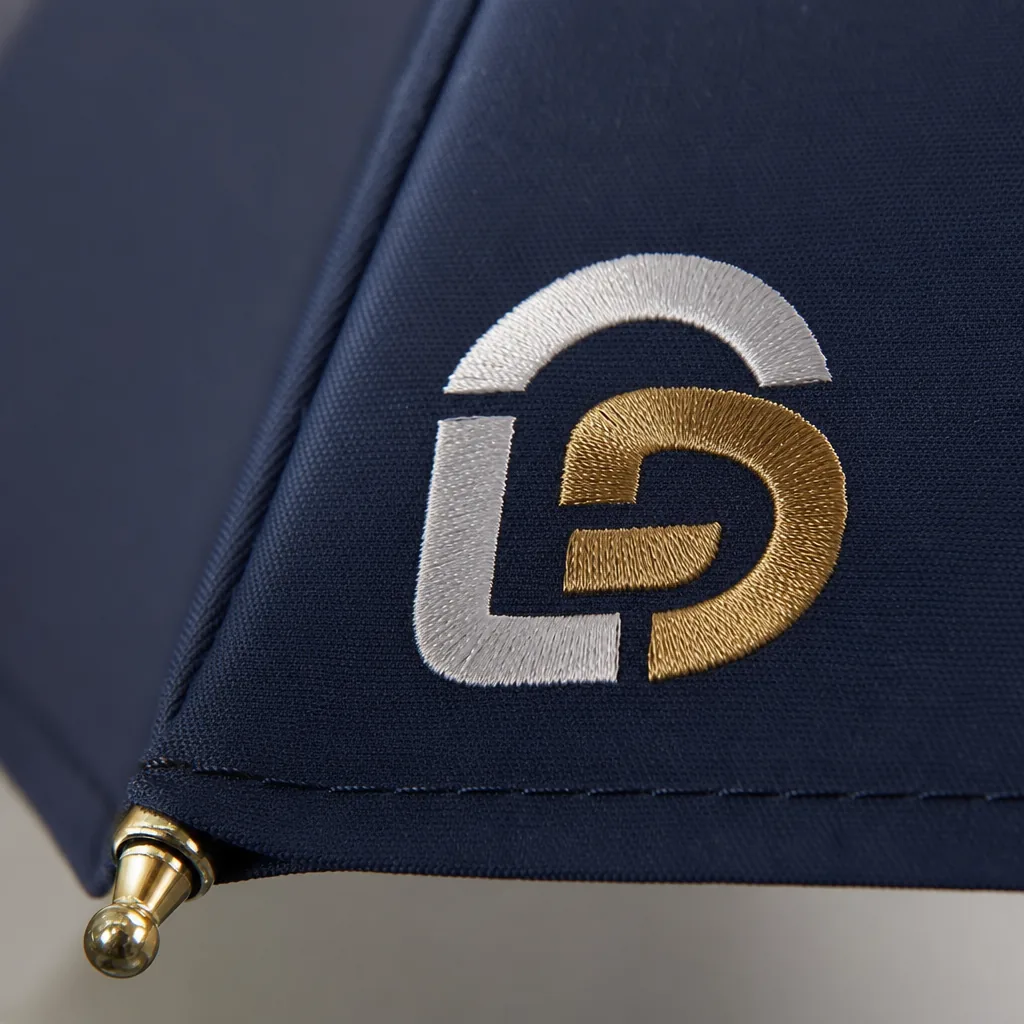
When buyers ask for stronger shelf impact, the first issue on the factory floor is how panel contrast, trim color, and fabric dye lot control affect logo readability once the canopy is cut and sewn. In color block branded umbrellas, a layout that looks balanced on screen can shift after panel joining, edge binding, and wet-test inspection, so production decisions have to protect both visual punch and run-to-run consistency.
What Color Blocking Means in Umbrella Development
Color blocking starts with the frame, not the artwork. On an 8K or 10K umbrella, each gore is assigned before cutting so every color break lands on a rib line, not across a seam. The standard layouts are simple but behave differently at retail. Alternating panels switch color every other gore for a balanced two-tone canopy that stays legible from roughly 10 to 20 feet. Quarter-block layouts group two adjacent panels or build one four-panel zone, giving the umbrella a clear front-facing side for shelf display, event visibility, and product photography. A solid canopy with contrast trim keeps the main fabric in one color while edge binding, the runner, shaft accents, or the handle carries the second tone. For color block branded umbrellas, that panel architecture usually matters more than the logo at first glance: buyers notice contrast, silhouette, and panel rhythm before they read print. On a 23-inch auto-open umbrella in 190T pongee, a controlled two-color canopy often produces stronger shelf impact than a busy full-canopy print on the same frame.
The manufacturing case is equally practical. Alternating branded umbrella panel colors are usually the lowest-risk option because the canopy can be cut from standard dyed fabric lots, which reduces print setup, avoids alignment problems across seams, and keeps color control tighter than a large multi-panel graphic. Quarter-block layouts add little sewing complexity but create a stronger hero face for retail umbrella branding without committing to full-canopy printing. Material choice also changes the result: on clear POE or EVA domes, opaque contrast wedges or printed trim strips can deliver the effect, while on 190T or 210T pongee the panel split typically looks cleaner and more premium. For events and distributor programs, promotional umbrella color blocking usually lowers setup cost versus sublimation or multi-position screen printing. At MOQs around 500 to 1,000 pieces, mixing stock colors is often faster than developing custom printed yardage, with lead times commonly staying in the 25- to 35-day range. On 21-inch folding umbrellas, a solid canopy with contrast trim remains the safest choice because extra panel changes can look crowded once the canopy is collapsed and wrapped.
Choosing Fabrics and Colors That Reproduce Consistently
Fabric choice sets the ceiling for consistent reproduction. For volume programs, 190T pongee is still the cost-control spec, especially on 21-inch and 23-inch folding umbrellas where lower fabric weight helps keep FOB pricing tighter and works cleanly with screen printing or heat transfer. The tradeoff is visible on the open canopy: 190T typically delivers slightly lower color saturation, more seam-line show-through, and a softer drape that can blur the edge between adjacent branded umbrella panel colors. When the design depends on hard separation between black, navy, and red, 210T pongee is usually the safer call for color block branded umbrellas. Its tighter weave improves opacity, holds dark tones with better depth, and keeps a firmer canopy profile through cutting and sewing, which helps reduce wavy panel edges on finished 8K or 10K frames. It also changes retail perception. Buyers generally read 210T as the more premium fabric because it has a fuller hand feel and a cleaner surface, but that upgrade only makes sense if the added fabric cost still supports your margin target.
Color consistency is not just a Pantone issue; it depends on fabric lot, coating, and approval method. White panels are the highest-risk element in promotional umbrella color blocking because optical brighteners, back-coating, and mixed fabric lots can shift one panel cooler or grayer than the next under retail LED lighting. Darker shades usually reproduce more consistently, but they can bury fine logo detail unless ink opacity is adjusted and strike-offs are approved on the actual pongee, not a paper swatch. UV-coated UPF 50+ canopies need extra scrutiny because the coating can mute brightness and reduce perceived contrast, especially when yellow, orange, or sky blue sits beside white or deep black. A Teflon or UV finish can also change surface reflectivity, so the same ink formula may read flatter on coated fabric than on uncoated cloth. For retail umbrella branding, lock the fabric spec, print method, and Pantone target before bulk cutting, then approve a sewn sample under both daylight and store LEDs. That is the practical control point for orders from 1,000 to 10,000 units, where panel variation becomes a returns risk, not a minor design defect.
How Panel Count and Frame Materials Affect the Look
Choose panel count based on how far the design needs to read. For color block branded umbrellas, an 8K canopy gives eight wider wedges, so each branded umbrella panel color holds more visual weight and a 1-color or 2-color logo usually stays legible from roughly 20 to 30 feet on a 23-inch canopy in 190T or 210T pongee. That makes 8K the lower-risk spec for retail umbrella branding, shelf display, and sidewalk racks where fast recognition matters more than detail. The wider wedges also reduce seam interruptions, which leaves more usable print area and lowers the chance that a logo lands across a stitch line. A 16K canopy creates a tighter, more frequent color rhythm: stronger for promotional umbrella color blocking with alternating shades such as black/red or navy/white, but less effective for billboard-style branding because each wedge narrows and the same artwork either scales down or crosses more seams. On clear POE or EVA canopies, those extra seams can add style value. On opaque pongee, they increase the production risk of visible misregistration, uneven tape alignment, and weaker color transitions unless artwork is approved both flat and fully opened under rib tension.
Frame material should match the price point, wind target, and brand position. Fiberglass ribs and stretchers are the stronger choice when color block branded umbrellas need lighter carry weight, better flex recovery, and credible windproof positioning. On a 23-inch or 27-inch vented double-canopy, a properly specified fiberglass frame can support 50+ mph wind testing, provided the runner, ferrule, and rib joints are built to the same standard. Steel ribs lower FOB cost and give a firmer hand feel, but they add weight and are more likely to stay bent after inversion, which raises warranty risk on frequent-use programs. That makes steel a practical fit for opening-price promotional umbrellas where budget is the first filter and an 8K layout with simple panel contrast is enough. For 16K fashion or gift programs, fiberglass usually supports the premium story better because the finer rib structure benefits from lower weight and better recovery after gusts. The difference is even more noticeable on auto-open-close models, where excess steel weight makes closing force feel harsher and less refined.
Coordinating Trim, Strap, and Edge Details Without Overdesign
On color block branded umbrellas, the highest-return upgrade is usually trim, not another printed panel. Buyers get more perceived value from the parts a customer touches first: the closure strap, 2-3 mm edge piping, ferrule, tip caps, and handle ring. The rule is simple: repeat one existing accent color and stop there. On a 23-inch auto-open golf umbrella with navy-and-white panel blocking, keep the strap stitching, piping, and rubberized handle insert in the same navy so the design reads deliberate at retail. Once a third or fourth accent color reaches the piping, webbing, and molded tips, the umbrella starts to look crowded, especially on 8K and 10K frames where the wedges already create strong visual segmentation. For most retail umbrella branding programs, match trim either to the darkest canopy panel or to the logo color, not both. That reduces approval rounds, contains part-count complexity, and lowers the risk of visible shade mismatch between 190T or 210T pongee and molded ABS, PP, or TPR components.
The closure strap is usually the most efficient branding surface because it stays visible when the umbrella is folded, hung, or packed in a master carton. In promotional umbrella color blocking, a woven strap with a heat-transfer logo or a matching hook-and-loop tab often delivers more shelf impact than adding another canopy print. On contrast panel umbrellas, molded tip caps and top caps can echo the same accent, but hard parts show batch variation faster than fabric, so every added color raises QC exposure and reject risk. If the handle is soft-touch black ABS with a colored push button, a bright ferrule often adds cost without improving the design. Auto-open models and double-canopy windproof styles offer extra branded touchpoints, but they need the same discipline. On 21-inch tri-fold auto-open-close umbrellas, the button surround, wrist strap, and handle end cap can carry the accent without taking more canopy space. On double-canopy styles, use the undercanopy, vent binding, or spreader-cover patches for contrast while keeping the top view commercial. If the frame is fiberglass and wind-rated above 50 mph, the technical story is already strong; trim should support it. For mass production, inspect trim alignment and color consistency to AQL 2.5, because mismatched straps and sloppy piping joins hurt shelf impact faster than a slightly off-center canopy print.
Production Controls, Lead Times, and Order Planning
For color block branded umbrellas, the highest production risk is panel control before sewing, not logo printing. Lock every canopy against the PO at pre-production with three approvals: a digital panel map that fixes panel direction and color sequence, a physical cut-panel assembly reference that shows the exact wedge order, and one finished sample signed to the approved colorway. On 8K and 10K frames, mark each wedge by fabric lot, Pantone target, and sewing position so panel 1 cannot be swapped with panel 5 when contrast seams meet at the ferrule. Buyers should approve branded umbrella panel colors on the actual canopy substrate, not only on flat artwork, because 190T pongee, 210T pongee, and POE reflect color differently under retail lighting. Keep a sealed assembly board on the sewing line showing rib number, alternating panel order, logo orientation, strap position, and handle facing. That single reference limits carton-to-carton mix-ups when multiple colorways run in the same window and protects retail umbrella branding across the shipment.
AQL 2.5 is the right inspection standard for promotional umbrella color blocking because panel symmetry and shade consistency are obvious at shelf distance. Check shade variation by fabric lot, panel sequence accuracy, stitching at tip pockets, logo distance from the seam edge, and whether contrast panels pull off-center after the canopy is tensioned over the frame. For contrast panel umbrellas, a wrong-color wedge, a reversed printed panel, or an obvious dye-lot jump should be classified as a major defect, not a minor cosmetic issue. Final random inspection should also cover open-close cycling by mechanism type, top-notching, rib tension, canopy drape, finished diameter, assortment ratio by carton, and any required windproof or corrosion checks for fiberglass-rib or vented models. MOQ climbs fast once you move from a single body color to true multi-color canopy assembly: a basic 8K umbrella may start at 500 pieces, but two- to four-color canopies are usually more workable at 1,000 to 3,000 pieces per colorway. After final sample approval, typical FOB lead time is 30 to 45 days for standard builds and 45 to 60 days for multiple colorways or retail packaging; DDP usually adds 10 to 25 days based on destination and shipping mode.
Frequently Asked Questions
Does adding multiple canopy colors increase umbrella lead time?
Usually yes, because multi-color canopy cutting and panel assembly add coordination compared with a solid-color build. Buyers should expect this to affect sampling and bulk timelines, especially on large orders.
Is fiberglass or steel better for color-blocked promotional umbrellas?
Fiberglass is often preferred for better flex and wind resistance, particularly on event or commuter umbrellas. Steel can reduce cost, but it is heavier and may be less suitable for premium or high-wind positioning.
How many canopy colors can I combine before production complexity starts affecting lead time?
Most OEM umbrella programs stay efficient at 2 to 4 canopy colors per style. Once you move to 5 or more panel colors, cutting, panel sorting, and QC usually add 3 to 7 days depending on order volume and whether matching trim colors are required.
Does color blocking change logo print placement or print method options?
Yes. High-contrast panel splits can limit usable print area near seams, so logos are usually kept 10 to 15 mm away from stitch lines. For clean branding, buyers often choose 1-panel or 2-panel screen printing, while heat transfer is used when the artwork has finer detail or multiple colors.
How do buyers control color consistency across repeat umbrella orders?
The standard approach is to approve Pantone references, fabric swatches, and a sealed pre-production sample before bulk production. For repeat runs, mills can usually keep commercial shade tolerance within an agreed range, but exact matches depend on fabric type, coating, and minimum dye lot quantity.
Looking to Launch Your Custom Umbrella Line?
ZheBrella is a Zhejiang-based OEM/ODM umbrella manufacturer with 17 years of export experience. Free design, low MOQ from 100 pieces, windproof construction, full-color print.
Get Free Quote Now »People Also Search For
Related Articles
Custom Umbrella Color Blocking for Stronger Brand Recognition
Learn how to use panel blocking, trim choices, and stock color programs to boost brand recognition while controlling MOQ...
Read More »
Umbrella Trim Color Decisions for Stronger Brand Recognition
Learn how trim colors, piping, and frame accents shape brand recognition, while balancing MOQ, material choices, and pro...
Read More »
Using Contrast Panels and Trim Colors to Strengthen Umbrella Branding
Show buyers how contrast panels, trim colors, and accent details can make umbrella logos read faster while keeping premi...
Read More »