Branded Umbrella Insert Cards for Retail and Gift Programs
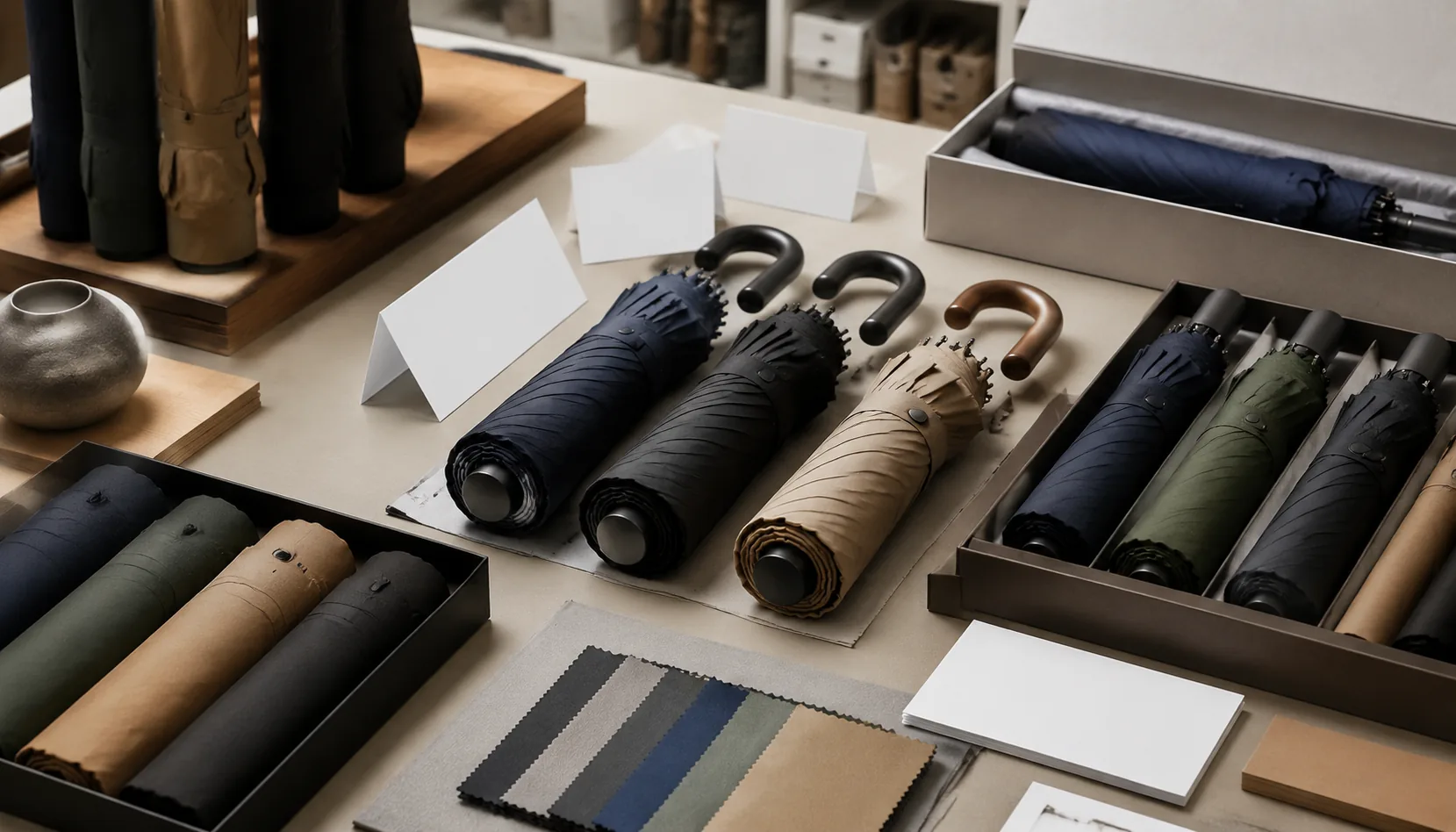
Retail buyers want the umbrella to sell the moment the carton opens, but adding value cannot slow assembly, alter rib construction, or create approval issues at packing. On our Songxia production floor, branded umbrella insert cards are treated like a controlled component: size, coating, copy, barcode space, and folding method all have to match the canopy style, sleeve, and carton workflow. Done right, the card explains UPF 50+ fabric, windproof frame details, care points, and gift messaging without touching the umbrella build.
Define the Insert Card’s Branding Job
The insert card should do one job first: reduce buyer uncertainty at the moment they open the sleeve, gift box, or retail peg pack. For basic promotional umbrellas, umbrella care cards are enough: dry the canopy open, do not force an auto-open-close shaft by hand, rinse saltwater from fiberglass ribs, and avoid storing a wet 190T pongee canopy inside a PVC sleeve. For retail umbrella inserts, I prefer a feature-led card when the product has real specs worth explaining, such as 8K fiberglass ribs, a double-canopy vent, Teflon water-repellent finish, UPF 50+ coating, or a windproof frame tested to 50+ mph. Warranty terms belong on the same card only if they are short and enforceable: coverage period, what counts as a manufacturing defect, and what is excluded, such as storm damage, bent steel ribs from inversion abuse, or broken tips from airline baggage handling.
Branded umbrella insert cards also work well when the umbrella is part of a campaign or gift program, but the copy must stay practical. Corporate gift insert cards can explain why a 23 inch auto-open stick umbrella was selected for sales teams, or why a 21 inch compact auto-open-close model fits commuter use. Sustainability notes should be specific, not decorative: recycled 210T pongee percentage, rPET certification, FSC paper sleeve, water-based ink, or reduced-plastic private label umbrella packaging. If the umbrella carries a retail barcode, hangtag, and care label already, the insert card should not repeat all three. Use it for the message the customer cannot see from the outside: frame construction, coating performance, return channel, campaign QR code, or a short brand story tied to the design printed by screen, heat-transfer, or sublimation.
Card size is a production detail, not an afterthought, because a wrinkled insert makes the whole umbrella feel cheap. For folded compact umbrellas, we usually keep cards around 85 x 120 mm or smaller so they sit flat against a 21 inch three-fold canopy without catching in the POE or fabric sleeve. For straight umbrellas in long sleeves, 90 x 160 mm works, but the corners should be rounded if the sleeve is thin PVC or EVA. Gift boxes allow larger formats, commonly A6 or 100 x 180 mm, but the card must clear the handle, runner, and tip cup so it does not bow during carton compression. For branded umbrella insert cards in private label umbrella packaging, our standard practice at ZheBrella is to check the insert during pre-production packing trials, then include placement in the AQL 2.5 inspection checklist before FOB or DDP shipment.
Match Claims to the Umbrella Specification
The safest insert-card copy is built from the product spec sheet, not from the sales team’s best adjective. If the canopy is 190T pongee, say “190T pongee canopy”; if the buyer paid for 210T pongee with Teflon water-repellent finish, say that instead. UPF 50+ belongs on branded umbrella insert cards only when the fabric or coating has been tested to that level, because UV claims can create real compliance problems in retail channels. The same rule applies to “windproof.” A double-canopy vented golf umbrella with fiberglass ribs and a reinforced shaft can honestly carry stronger wind-resistance language than a basic 8K steel-frame stick umbrella. For retail umbrella inserts, I prefer copy such as “vented double canopy helps reduce inversion” over vague promises like “storm proof,” unless there is a documented wind-tunnel result, such as surviving 50+ mph in a controlled test.
Mechanism details also need to match the build. A 23" auto-open umbrella, a 21" auto-open-close folding umbrella, and a 30" manual golf umbrella should not share the same corporate gift insert cards just because they use the same logo artwork. Rib count matters too: an 8K compact frame is normal for daily carry, while 16K construction gives a heavier, rounder canopy profile and better load distribution if the ribs are fiberglass or properly heat-treated steel. Umbrella care cards should reinforce the real construction: dry open after use, do not force the runner if ribs are tangled, and rinse salt or sand from beach umbrellas before storage. Our standard practice at ZheBrella is to lock insert-card wording after pre-production sample approval, so private label umbrella packaging does not claim fiberglass ribs, UPF 50+, or auto-open performance on a shipment that was later cost-adjusted to different materials.
Choose Paper, Finish, and Print Method
Paper choice should match the umbrella’s price point, not just the artwork file. For most retail umbrella inserts, 250–300 gsm coated art card is the safest option: it prints clean CMYK images, holds small care icons, and stays flat inside a 21", 23", or 27" umbrella sleeve without adding much freight weight. I use 350 gsm when the insert doubles as a warranty card or hang-tag style piece for premium 16K fiberglass models, because the heavier board feels intentional when the customer handles it. Recycled kraft fits outdoor, campus, and eco-positioned programs, but buyers should accept that white ink and fine gray text will not look as sharp as on coated stock. For private label umbrella packaging, the insert should feel like part of the same system as the belly band, sleeve label, and carton mark, not a loose afterthought.
Finish is where many brands overspend. Matte lamination gives branded umbrella insert cards a soft retail feel and protects dark backgrounds from scuffing during packing, especially when cards are inserted by hand beside wet-look POE, PVC, or EVA umbrellas. Spot UV works better as a controlled accent on a logo, QR code frame, or product name; if you flood too much of the card, fingerprints show and the piece starts to look like cheap cosmetics packaging. Foil stamping is useful for executive gifts, hotel VIP sets, and corporate gift insert cards, but it needs simple shapes and enough margin because foil can shift 0.3–0.5 mm in mass production. Umbrella care cards usually do not need foil; clear folding, drying, and storage instructions matter more than decoration.
Color control should be handled before paper is ordered, because a Pantone number on coated card will not visually match the same number printed on 190T or 210T pongee. Our standard practice at ZheBrella is to check Pantone references against three surfaces: the canopy fabric, the insert card, and the outer packaging or sleeve. If the umbrella canopy is screen printed, the ink sits differently than heat-transfer or sublimation, so the buyer should approve a physical swatch or pre-production sample rather than relying on a PDF proof. For branded umbrella insert cards with strict corporate colors, specify Pantone Solid Coated for coated board and request a delta E tolerance only if the program volume justifies lab control. On kraft paper, do not chase perfect color; adjust the design toward black, white, and one strong brand color.
Place Inserts Without Slowing Packing
The fastest placement is usually inside the umbrella sleeve, but only when the sleeve is not already tight. A 23" auto-open with 190T pongee canopy and 8K steel ribs normally has enough sleeve clearance for a 90 x 55 mm care card, while a compact 21" auto-open-close in a narrow sleeve can jam if the card is too stiff. For branded umbrella insert cards, we test the loaded sleeve during pre-production: the operator must insert the umbrella in one motion, without folding the card or scraping a heat-transfer logo. If the umbrella has a belly band, placing retail umbrella inserts under the band is cleaner for store presentation, but the band tension must be controlled so it does not mark UV-coated or Teflon-treated fabric. I do not recommend loose cards floating inside a sleeve; they shift during carton vibration and create inconsistent unboxing.
Rigid boxes give the most controlled result for private label umbrella packaging, especially for executive gifts, golf umbrellas, and 27" or 30" models with wood or EVA handles. In that format, the insert should sit on top of the tissue wrap or in a shallow die-cut pocket, not under the umbrella shaft where it can crease. For corporate gift insert cards, ribbon attachment works well when the umbrella is presented open-handle-first, but the ribbon knot must be outside the canopy folds and away from the runner, otherwise it can catch during final open-close testing. Our standard practice at ZheBrella is to define insert placement in the packing SOP with a photo, card orientation, and acceptable skew tolerance, usually within 5 mm for boxed goods and visibly centered for ribboned gifts.
Insert placement affects inspection more than buyers expect because AQL 2.5 is not only checking the umbrella; it checks the shipped retail unit. During final inspection, missing umbrella care cards, wrong-language cards, reversed cards, damaged corners, or carton count mismatches are treated as packaging defects. If one export carton is specified as 24 pieces, the inspector expects 24 umbrellas and 24 inserts, not 23 cards plus one spare loose in the carton. The packing line needs a simple count control: cards issued by bundle quantity, operator places one card per unit, checker confirms placement before sleeve sealing or box closing, and carton sealing only happens after inner count verification. This matters for DDP and retail programs because a mispacked insert is often discovered at the distribution center, not at the factory gate, and rework after FOB shipment is far more expensive than slowing the line by two seconds for a placement check.
Approve Samples Before Bulk Production
Sample approval should start with a digital proof, not a printed card, because most mistakes are layout mistakes: wrong Pantone callout, QR code too small, warranty text cut off by the fold, or logo placed where the hang tag string hides it. For branded umbrella insert cards, we normally check card size, fold direction, bleed, safe area, barcode position, and carton-marking consistency against the umbrella spec sheet. A 23" auto-open golf umbrella in 190T pongee may use a larger sleeve and insert than a 21" folding auto-open-close model, so artwork cannot be approved in isolation. Digital proof approval usually takes 24–48 hours if the buyer has final files ready in AI, PDF, or high-resolution PNG. At this stage, corporate gift insert cards and umbrella care cards should also confirm claims like UPF 50+, Teflon coating, fiberglass ribs, or windproof double-canopy construction, because those words must match the approved umbrella build.
After the digital proof, request one printed card and one fully packed umbrella sample. The printed card confirms paper stock, matte or gloss lamination, color density, crease quality, and whether small type remains readable after folding. The packed sample confirms the real customer experience: canopy folded, strap closed, sleeve fitted, insert positioned, barcode scannable, and warning labels visible. Retail umbrella inserts often fail here because the card looks fine on a desk but bends inside a tight PVC sleeve or blocks the product view in clear POE packaging. For private label umbrella packaging, we check insert cards together with hang tags, polybags, master carton labels, and any retail-ready inner box. This sample round normally adds 3–7 days before bulk production, depending on printing method and whether the umbrella itself is a standard 8K steel-frame model or a custom 10K/16K fiberglass frame requiring separate sample assembly.
The final pre-production sample should be approved only after the card, umbrella, sleeve, and export labels are all from the intended production materials. This is where MOQ alignment matters: insert card MOQ is usually tied to the umbrella order quantity, often 500–1,000 pieces for standard printed cards, but specialty paper, spot UV, foil, or individual QR serialization can push the practical MOQ higher. If the umbrella order is 1,200 pieces but the card printer’s economical run is 2,000, confirm whether the extra cards are stored, shipped, or discarded. For FOB shipments, the approved insert content should match commercial invoice descriptions, carton marks, HS code support, and any retailer routing label requirements. For DDP, the documentation burden is heavier: country-of-origin marking, compliance wording, Amazon or big-box barcode rules, and customs-facing product descriptions must be locked before mass packing. Our standard practice at ZheBrella is to keep the signed sample, AQL 2.5 inspection checklist, and packing photos together so production cannot substitute a cheaper card stock later.
Frequently Asked Questions
Can insert cards be customized by region or retailer?
Yes. Buyers can run the same umbrella with different insert cards for languages, warranty terms, UPC notes, or retailer campaigns, as long as carton markings and packing lists stay aligned.
Do insert cards affect umbrella MOQ?
Usually they follow the umbrella MOQ, but specialty paper, foil, or spot UV may have a separate print MOQ. Confirm this before approving a small trial order.
What information should be printed on branded umbrella insert cards for retail approval?
Most retail buyers expect care instructions, material or feature claims such as UPF 50+ or windproof ribs, country of origin, barcode or SKU area, warning text if required, and brand contact details. For chain retailers, leave space for price stickers or compliance labels if they are applied after import.
Can insert cards be added without changing the umbrella design or tooling?
Yes. Insert cards are a packaging component, so they can usually be added to existing OEM umbrella orders without changing the frame, canopy, handle, or mold. Buyers typically only need to confirm card size, paper weight, artwork, and packing position before production.
What MOQ and lead time are typical for custom umbrella insert cards?
For OEM umbrella orders, custom insert cards are commonly produced with the umbrella MOQ, often starting around 500–1,000 pieces depending on the style. Artwork approval usually takes 1–3 days, and card printing can run in parallel with umbrella production to avoid extending the main lead time.
Looking to Launch Your Custom Umbrella Line?
ZheBrella is a Zhejiang-based OEM/ODM umbrella manufacturer with 17 years of export experience. Free design, low MOQ from 100 pieces, windproof construction, full-color print.
Get Free Quote Now »People Also Search For
Related Articles

Umbrella Insert Cards for Branded Gifting and Aftercare
Use insert cards to explain features, care, warranty, and brand story while improving the gift feel of 190T, 210T, windp...
Read More »
Custom Umbrella Insert Cards for Brand Storytelling
Use umbrella insert cards to explain brand value, care steps, UPF 50+ claims, and warranty details while improving gifti...
Read More »
Umbrella Insert Cards for Private-Label Brand Storytelling
Use insert cards to explain fabric, frame, care, warranty, and brand values while improving perceived value in private-l...
Read More »