Colorfast Umbrella Printing Standards for Outdoor Promotions
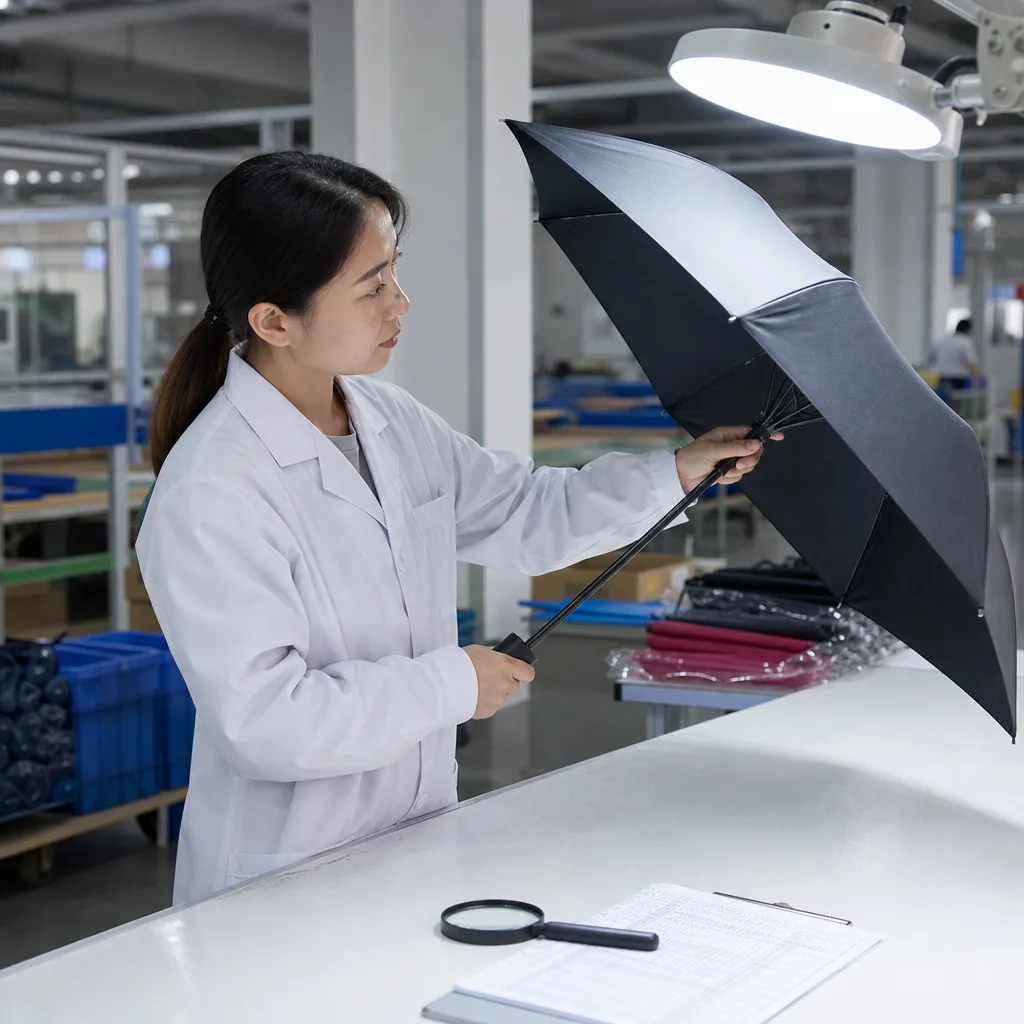
For outdoor promotions, the complaint usually arrives months after shipment: a logo has faded, a dark panel has bled onto a light print, or wet fabric has transferred dye onto a customer’s hands. On our Songxia production floor, colorfast printed umbrellas are controlled long before final inspection—starting with polyester lot selection, ink compatibility, curing temperature, rub testing, UV checks, and AQL criteria that buyers must lock into the PO.
Why Colorfastness Matters for Promotional Umbrellas
Colorfastness is not a cosmetic detail; it is the difference between a campaign asset and a claim waiting to happen. Outdoor promotional umbrellas sit in UV, rainwater, sweat, sunscreen, and repeated folding pressure, so weak dyes show up fast as fading, crocking, dye migration, or logo cracking. On 190T and 210T pongee, we normally worry about sublimation bleed on dark panels, poor pigment bonding on low-grade coatings, and heat-transfer films that fracture along rib fold lines after 200 to 500 open-close cycles. POE, PVC, and EVA clear canopies have a different problem: ink adhesion and plasticizer migration, especially when stacked warm in cartons for 20 to 35 days during sea freight. If a logo rubs onto a user’s hand or a white shirt, the buyer does not ask whether the issue was fabric, ink, curing, or packing temperature. They see a failed brand impression.
Fading risk is highest on umbrellas used for outdoor campaigns longer than a weekend: golf events, university admissions, beverage launches, hotel pools, auto dealerships, and street teams. A red or navy logo that drops one grade after UV exposure looks cheap even if the umbrella frame is solid, and that damages repeat orders more than a broken tip. For colorfast printed umbrellas, our standard practice is to match print method to canopy and use: screen printing for strong spot colors, heat transfer for detailed logos on 190T pongee, and sublimation only where the fabric and coating system can tolerate the process without migration. Umbrella print durability should be checked after water spray, dry rub, wet rub, and folding abrasion, not only by looking at a fresh sample under office lights. A supplier who approves color from a PDF and skips physical strike-offs is gambling with the distributor’s account.
The commercial pain comes after delivery, when a distributor has 5,000 outdoor promotional umbrellas already handed out and the end client sends photos of ghosted logos, pink dye bleeding into white panels, or cracked transfers at the crown seam. At that point, branded umbrella quality control becomes evidence: approved PPS samples, Pantone records, print curing logs, carton photos, AQL 2.5 inspection reports, and umbrella logo testing results for rub and adhesion. Claims are harder to defend if the purchase order only says “logo print” with no colorfastness grade, no fabric spec, and no test method. I prefer putting minimum standards in the quote: 190T pongee with Teflon or equivalent water-repellent finish, UV coating where needed, colorfastness to rubbing Grade 4 dry and Grade 3-4 wet, and cross-hatch or tape adhesion checks for transfer prints. That wording prevents arguments later and forces the factory to build the umbrella for the campaign conditions, not just for the sample photo.
Match Printing Method to Fabric and Artwork
Printing method should be chosen after the fabric, coating, and artwork are fixed, not after the buyer has approved a pretty mockup. On 190T pongee and standard polyester, screen printing is still the workhorse for simple 1- to 3-color logos because the ink sits cleanly on the weave and gives good edge definition at normal viewing distance. For 210T pongee, the tighter weave accepts finer detail, but it also exposes poor curing faster; if the ink film is too thick, folding stress around the rib tips will crack it within a few open-close cycles. For outdoor promotional umbrellas with large white logos on navy, black, or burgundy panels, I normally ask for a wet-rub and fold-rub test before bulk printing. Dark canopies need stronger opacity, which means more ink deposit, longer flash time, and higher risk of hand-feel stiffness. That is where many colorfast printed umbrellas fail in real use, not in the artwork file.
Heat transfer is better when the logo has gradients, small text, or multiple spot colors that would make screen setup expensive, but it is not a free pass on umbrella print durability. Transfer film bonds differently to 190T pongee, 210T pongee, PVC-coated polyester, and UV-coated fabric; too much press temperature can damage water-repellent treatment, while too little pressure leaves edges that lift after rain and folding. We usually test transfers at 140-160°C depending on film type, dwell time, and coating sensitivity, then run tape peel, wet rub, and 24-hour conditioning checks. Metallic inks and foil transfers look sharp for event work, but they are the first place I look for cracking because metallic particles reduce flexibility. For branded umbrella quality control, the inspection should include the logo area after the umbrella has been opened, closed, tied, and packed, not just a flat panel review on the sewing table.
Sublimation is the cleanest option for full-panel artwork, photo patterns, gradients, and edge-to-edge branding, but only on suitable polyester-based fabrics before heavy coating. It dyes the fiber instead of building a surface ink layer, so the hand feel stays soft and fold resistance is usually better than thick screen ink or transfer film. The limit is color control: sublimation cannot print true white, and colors shift on off-white, silver-coated, or UPF 50+ treated fabrics. If the project needs colorfast printed umbrellas with Pantone-sensitive logos, umbrella logo testing should include a printed strike-off under daylight D65, wet-rub testing, and accelerated UV exposure, especially for beach, golf, and café umbrellas that sit in sun for weeks. Large solid logos are also risky because any panel tension, seam distortion, or coating variation becomes visible after canopy sewing. Our standard practice at ZheBrella is to approve fabric, coating, print method, and artwork size together before cutting bulk panels, then check production under AQL 2.5 with specific print-defect criteria.
Define Practical Colorfastness Test Requirements
Practical colorfastness requirements should start with the failure modes buyers actually see after an event season: ink transfer onto hands, logo cracking on fold lines, and shade drift after sun exposure. For colorfast printed umbrellas, I would specify dry rub and wet rub checks on the printed logo plus adjacent canopy fabric, not just the center of a clean panel. A simple factory-floor method is 10 back-and-forth rub cycles with white cotton cloth under consistent hand pressure, first dry and then dampened with clean water. Acceptance should be “no obvious transfer” on the cloth and no visible smearing, edge bleeding, or tackiness on the print. For higher-value outdoor promotional umbrellas using 190T or 210T pongee with screen print, heat transfer, or sublimation, set a tighter visual standard: only very slight staining on the rub cloth, no readable reverse logo, and no change that is noticeable at 1 meter under daylight.
Water exposure and folding abrasion matter more than many lab-style specs because umbrellas are repeatedly opened, soaked, collapsed, and strapped while the printed panels are still wet. Writers should tell buyers to request a water spray or soak check for 15–30 minutes, followed by opening, closing, and strap-fastening cycles while the canopy is damp. The acceptance target is no logo peeling, no blistering, no adhesive edge lift on heat-transfer films, and no ink bleed into nearby white or light-color panels. Folding abrasion should focus on the natural crease lines between 8K or 10K ribs, because that is where prints fail first on compact 21" and standard 23" models. Our standard practice at ZheBrella is to inspect the logo after repeated folding and hand pressing, then compare it against an approved pre-production sample before bulk packing under AQL 2.5.
UV exposure checks should be defined with measurable tolerance, not vague promises like “sun resistant.” For umbrella print durability, a practical requirement is accelerated UV exposure or outdoor daylight exposure with before-and-after color readings on the logo and base fabric. A Delta E shift of 3.0 or less is a good target for retail and branded umbrella quality control, while Delta E 4.0–5.0 may be acceptable for short-term event giveaways if the buyer approves it in writing. The test should also include visual checks for chalking, yellowing, cracking, and loss of gloss, especially on dark logos printed over white pongee or on POE/PVC transparent canopies. For umbrella logo testing, keep one signed golden sample, one UV-exposed sample, and one folded-abrasion sample so procurement, factory QC, and the client judge the same standard instead of arguing from photos after shipment.
Control Production Variables on the Factory Floor
Colorfast printed umbrellas are won or lost before the first full production run, because ink viscosity, mesh count, squeegee pressure, curing temperature, and fabric surface all interact. For 190T or 210T pongee, we normally pretreat dark panels with a light corona or wiping step when the coating is heavy, especially on Teflon-finished or UV UPF 50+ fabric where ink can sit on the surface instead of anchoring. Screen inks are mixed by weight, not by eye, with Pantone targets checked under D65 light; heat-transfer films need the correct adhesive layer for polyester, not generic garment film. Sublimation is different again: the panel must be white or very light, and the press cycle usually sits around 190–205°C for 35–55 seconds depending on paper, ink load, and fabric shrinkage. If the operator changes dwell time by 10 seconds to “speed up,” umbrella print durability drops fast after rain and sun exposure.
Curing discipline is the part buyers rarely see, but it is where many outdoor promotional umbrellas fail. Screen-printed pongee panels need controlled flash drying before stacking, otherwise wet backs transfer faint ghost marks onto the next panel. Heat-transfer logos must cool flat before folding; if workers peel too hot or throw panels into a bin, the edge lift shows up after the first open-close cycle. For PVC, POE, or EVA canopies, low-temperature ink systems are required because aggressive heat can warp the panel or distort the seam allowance. Our standard practice at ZheBrella is to issue operator setup sheets for each SKU: fabric roll number, ink batch, logo position, curing window, press pressure, drying rack time, and first-piece approval photo. Those sheets matter when a 5,000-piece FOB order runs across two shifts, because branded umbrella quality control cannot depend on one senior operator remembering the settings.
Print positioning must be engineered around the frame, not just centered on a flat triangle in Illustrator. Auto-open frames put stronger snap tension into the canopy, so a logo printed too close to the rib pocket can wrinkle or skew when the runner locks. An 8K umbrella gives wider printable panels and easier registration, while 16K rib structures break the canopy into narrower segments where curved text and large logos need more compensation. Double-canopy vented windproof umbrellas are even trickier: the lower and upper panels overlap, and a mark that looks centered on the cutting table may be partly hidden when air vents open in a 50+ mph wind-tunnel test. For colorfast printed umbrellas, umbrella logo testing should include dry rub, wet rub, tape pull, cross-hatch adhesion where suitable, and an open-frame inspection on manual, auto-open, and auto-open-close samples before bulk cutting. AQL 2.5 final inspection catches defects, but factory-floor controls prevent them.
Inspect Bulk Orders Before FOB or DDP Shipment
Bulk inspection has to happen before the goods leave the factory gate, not after the forwarder has loaded them. For colorfast printed umbrellas, our standard checkpoint is AQL 2.5 for major defects, with a tighter internal screen on the logo panels because one shifted print can ruin a whole promotional campaign. Inspectors should verify logo position against the approved artwork and strike-off, usually with a tolerance of ±3 mm on folding umbrellas and ±5 mm on 27" or 30" golf umbrellas. Color consistency should be checked under a D65 light box or consistent daylight, not under yellow sewing-floor lamps. On 190T and 210T pongee, the same Pantone ink can look different after Teflon, PU, or UV UPF 50+ coating, so bulk panels need to be compared against the signed PPS sample, not just the digital proof.
Ink adhesion is where many outdoor promotional umbrellas fail in real use. For screen print, heat-transfer, and sublimation panels, inspectors should run a dry rub and wet rub check, then apply clear tape over the logo and pull at 180 degrees to catch weak curing or poor film bonding. Umbrella print durability also depends on the canopy fabric: sublimation performs well on white polyester pongee, while dark 210T pongee usually needs screen print or heat transfer with proper underbase. During branded umbrella quality control, I also require checks for pinholes, oil marks from frame riveting, chalk stains from cutting tables, and water spots from rushed packing. A clean logo on a dirty canopy is still a reject for retail or event distribution.
Do not inspect only open umbrellas; packed sleeves tell you whether the print will survive shipment compression. Open samples confirm rib alignment, canopy tension, 8K or 10K frame symmetry, shaft straightness, tips, ferrules, and manual, auto-open, or auto-open-close mechanism function. Packed samples reveal another problem: ink transfer from one umbrella to the sleeve, hangtag, strap, or neighboring canopy after carton pressure and summer container heat. For umbrella logo testing, I like to leave several printed umbrellas compressed in sleeves for 24 hours, then check for ghosting, blocking, and tacky ink. Before FOB Ningbo or Shanghai, or DDP shipment to the buyer’s warehouse, carton marks, polybag warnings, sleeve fit, barcode labels, and final quantity count should match the PO exactly. That last hour of inspection prevents weeks of claims paperwork.
Frequently Asked Questions
Which umbrella fabric gives the best print durability?
190T and 210T pongee are common choices for durable promotional printing because they have a smoother hand feel and better perceived quality than basic polyester. The final result still depends on ink, curing, and coating compatibility.
Can UV-coated umbrellas still be printed clearly?
Yes, but UPF 50+ coatings can affect ink adhesion and heat-transfer behavior. Always approve a printed sample and run rub or folding tests before bulk production.
What colorfastness tests should be included in a printed umbrella QC plan?
For outdoor promotional umbrellas, buyers should specify dry and wet rub tests, water spotting checks, and UV exposure evaluation. A common target is Grade 4 or higher for rubbing and no visible logo bleeding after wet testing.
How should curing be controlled for umbrella logo printing?
Screen-printed or heat-transfer logos should follow the ink supplier’s curing temperature and dwell time, typically verified during pre-production sampling. Poor curing can cause tackiness, cracking, or dye transfer when panels are folded.
What AQL criteria are practical for colorfast printed umbrellas?
Many importers use AQL 2.5 for major defects and AQL 4.0 for minor defects. Major defects should include visible fading, ink peeling, dye migration, misaligned logos, or color transfer onto adjacent panels.
Looking to Launch Your Custom Umbrella Line?
ZheBrella is a Zhejiang-based OEM/ODM umbrella manufacturer with 17 years of export experience. Free design, low MOQ from 100 pieces, windproof construction, full-color print.
Get Free Quote Now »People Also Search For
Related Articles
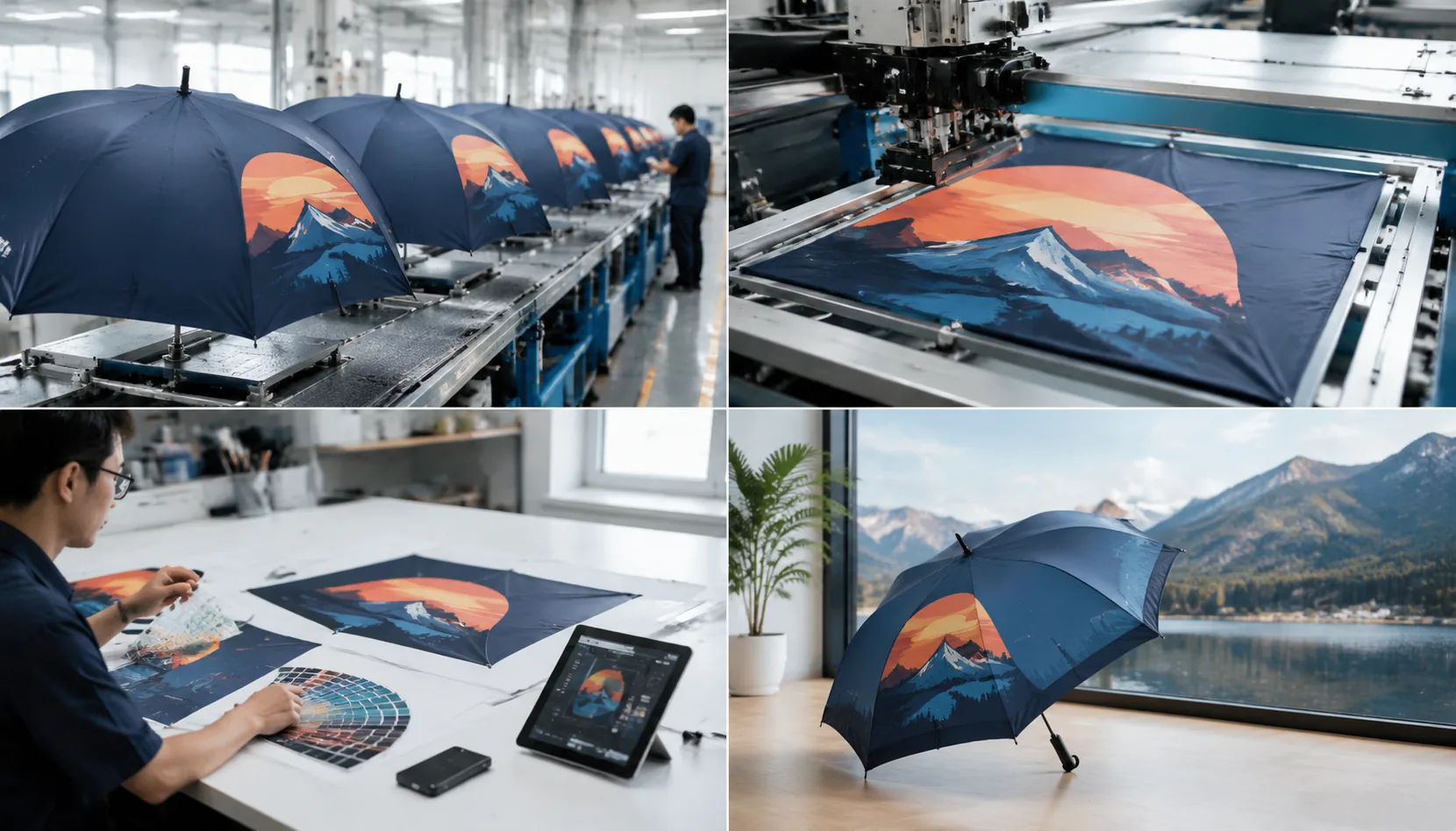
Colorfast Umbrella Printing Specs for Outdoor Brand Use
Specify fade-resistant umbrella prints with fabric, ink, coating, and AQL checks suited for outdoor campaigns, retail, a...
Read More »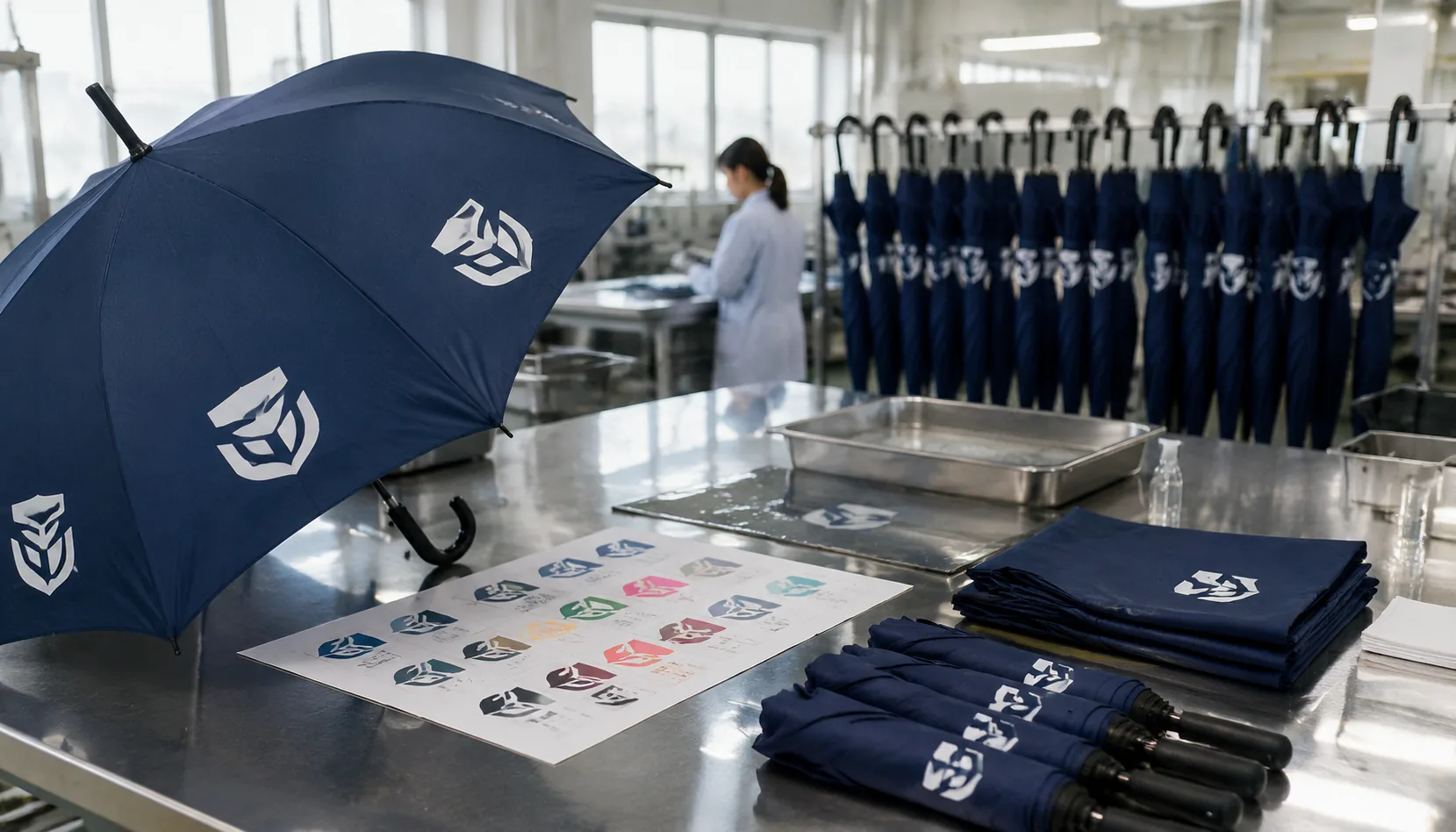
Colorfast Logo Printing Tests for Branded Rain Umbrellas
Define rub, rain, UV, and adhesion checks so printed umbrella logos survive wet use, sun exposure, packing friction, and...
Read More »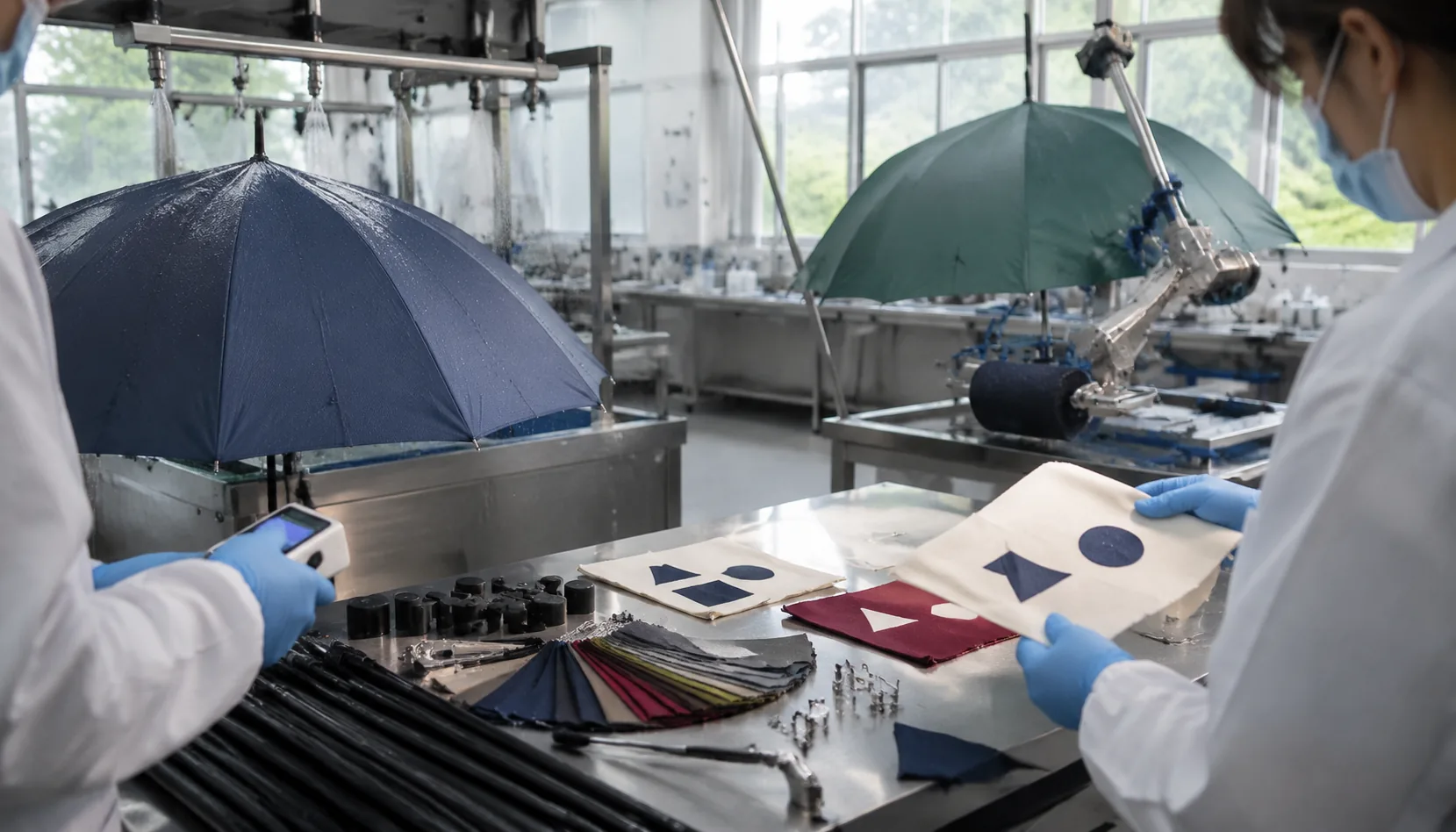
Logo Durability Testing for Branded Umbrella Programs
Plan branded umbrella orders with logo durability checks, AQL 2.5 inspection points, fabric tests, and approval steps be...
Read More »