Logo Durability Testing for Branded Umbrella Programs
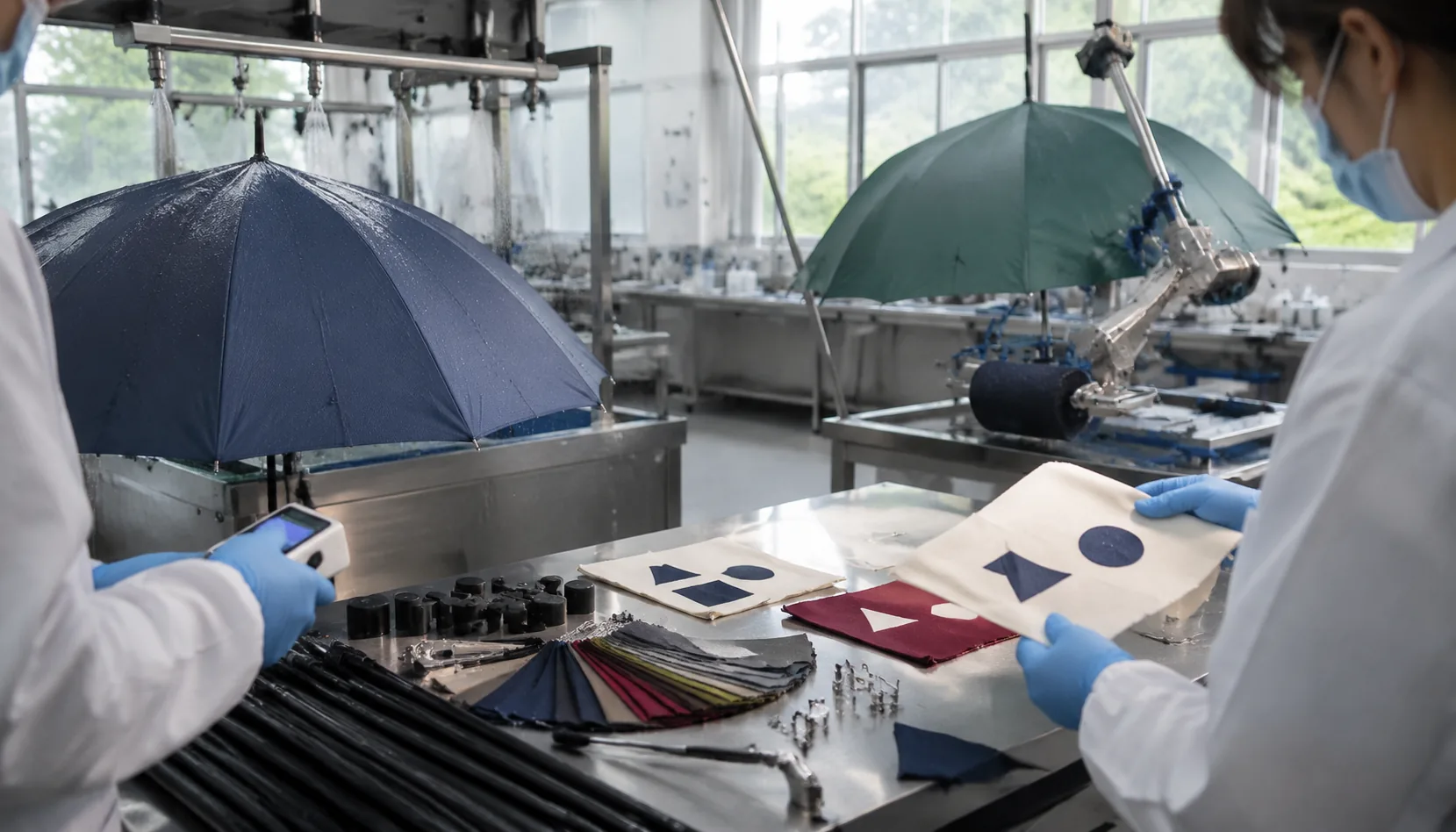
A logo that looks sharp on a pre-production sample can still crack, bleed, or rub off after folding, rain exposure, and carton compression in a real shipment. On our Songxia factory floor, branded umbrella logo durability is checked alongside fabric coating, panel tension, ink curing, and AQL 2.5 inspection points before bulk cutting starts. For buyers managing retail or promotional programs, the risk is not just a rejected lot—it is a brand mark failing in the customer’s hand.
Logo Wear Risks Buyers Should Specify Up Front
Logo wear usually starts before the umbrella ever reaches rain. A folded canopy puts printed panels under pressure from rib tips, seam allowances, and neighboring fabric layers; if the logo sits across a fold line, every open-close cycle works like a light crease test. Wet handling makes it worse because 190T pongee relaxes slightly when damp, and stacked wet umbrellas can transfer ink if curing or adhesion is weak. For screen printing, buyers should specify ink type, curing temperature, and whether a cross-hatch tape test plus wet/dry rub test logo printing check is required. For heat-transfer logos, ask about film thickness, edge lift after folding, and whether the adhesive survives repeated flexing. In our factory practice at ZheBrella, we treat rib-contact areas as high-risk zones and avoid placing fine logo details directly over the main fold line on 21", 23", and 27" models.
UV exposure is the second silent killer, especially for outdoor campaigns where umbrellas sit open for hours. Standard promotional inks may look sharp at shipment but fade or chalk after strong sun, while sublimation on polyester generally handles wash and flex better but depends on fabric color and artwork density. A Teflon-coated 210T pongee canopy can improve water repellency, but the coating also changes ink anchoring, so umbrella print testing should be done on the actual production fabric, not a substitute swatch. UPF 50+ coatings and silver UV backings add another variable because heat-transfer films can wrinkle or show a border if the lamination temperature is pushed too high. For branded umbrella logo durability, I prefer buyers define minimum results: no visible cracking after 200 open-close cycles, no color transfer after 20 wet rubs, and no major fading after a defined UV exposure period.
Promotional event umbrellas and retail programs should not use the same durability standard. For a giveaway at a two-day golf outing, the logo mainly needs to survive packing, distribution, rain handling, and a few uses without smearing or peeling. For retail, corporate stores, or loyalty merchandise, the umbrella may be opened 100-300 times, stored in cars, dried half-folded, and judged by consumers who expect the mark to age with the canopy. That is where promotional umbrella quality control should move beyond a quick visual check and include AQL umbrella inspection with defined logo defects: misregistration over 2 mm, pinholes, ink bleeding, edge lift, cracking on folds, and transfer marks on adjacent panels. Buyers should put these criteria in the PO before sampling, because once bulk printing starts, changing from standard ink to higher-elasticity ink or from transfer to sublimation can affect MOQ, unit cost, and lead time by 3-7 days.
How Fabric and Frame Choices Affect Logo Durability
Logo life starts with the cloth, not the ink. On 190T pongee, the weave is slightly more open and the hand feel is softer, so plastisol, water-based screen ink, and heat-transfer film can sink or bridge differently depending on coating weight. It is workable for promotional umbrellas, but we tighten umbrella print testing on dark colors because ink edges can look fuzzy after wet-rub and fold-cycle checks. 210T pongee gives a denser face and cleaner logo boundary, especially for fine type under 6 mm height or multi-color registration. For branded umbrella logo durability, I prefer 210T when the buyer wants a logo on two or more panels, a retail hangtag claim, or repeat outdoor use beyond a single event season.
Coated fabrics change the test plan. A UPF 50+ canopy often uses silver, black, or UV-blocking coatings on the underside, while the logo sits on the outer face; that coating still affects heat stability, needle tension, folding memory, and how the panel behaves in curing. Too much heat on a transfer can distort 190T panels or leave a pressure shadow on coated cloth, so we check peel strength after 24 hours, not only right off the press. For promotional umbrella quality control, a proper rub test logo printing sequence should include dry rub, wet rub, tape pull, water spray, and 500 to 1,000 open-close cycles before shipment. In AQL umbrella inspection, we normally classify logo cracking, major color loss, and transfer lifting as major defects under AQL 2.5.
Frame choice matters because the logo is not living on a flat banner; it is stretched over a moving rib system. Fiberglass ribs flex and recover under wind load, spreading stress more gently across the canopy, which helps printed panels survive gusts on 23 inch and 27 inch models. Steel ribs are cheaper and stiff, but under a 40 to 50 mph wind event they push harder at rib tips, stretchers, and crown seams, creating pressure points where ink can crease. An 8K layout has wider printed panel spans, so the logo may flex more in the middle of the panel. A 16K layout creates a rounder canopy but doubles the rib lines, meaning more chances for rib pressure points to contact printed artwork during folding, carton compression, and repeated auto-open use.
Practical Print Tests Before Mass Production
The fastest way to prevent logo failures is to abuse the pre-production sample before approving bulk fabric cutting. For umbrella print testing, I ask for dry rub and wet rub on the actual logo area, not a blank corner: 20 back-and-forth strokes with white cotton cloth, first dry and then damp, checking for color transfer, edge feathering, and ink lift. For a rub test logo printing check, screen print should not powder off, heat transfer should not crack at the film edge, and sublimation on 190T or 210T pongee should not show ghosting after rubbing. I also use 3M-style tape adhesion: press tape firmly over the print, peel at roughly 180 degrees, and reject if letters, fine lines, or Pantone-matched blocks come away. This is where branded umbrella logo durability is won or lost, because a logo that looks clean on day one can fail after two rainy events if ink, coating, and fabric were not matched correctly.
Fold crease review matters because umbrellas are not flat banners; the logo is repeatedly bent around ribs, seams, and tie-wrap pressure points. We open the sample fully, mark where the canopy naturally folds, then close it tightly for 24 hours and inspect the printed area under daylight and a 6500K light box. Cracking along creases is common on thick heat-transfer film, especially over double-canopy vented windproof models where fabric layers shift during closing. For water spray, I run a practical rain simulation on the printed panel for 10 to 15 minutes, then close the umbrella while damp and reopen it after drying. On Teflon-coated pongee or UV-coated UPF 50+ fabric, ink adhesion must be verified because coatings can block proper bonding if the print process is not adjusted. Our standard practice at ZheBrella is to require pre-production samples using final fabric, final ink chemistry, final coating, and the actual manual, auto-open, or auto-open-close mechanism specified in the order.
Sample-size logic should be strict but not theatrical. For a new logo, new fabric, or new print method, test at least 3 to 5 pre-production umbrellas per colorway; one sample is for destructive rub and tape checks, one for water spray and drying, and the rest for open-close cycling and fold review. I like 100 open-close cycles for manual and auto-open models, and 150 cycles for auto-open-close shafts because the closing force twists the canopy more aggressively. During promotional umbrella quality control, these tests feed into the later AQL umbrella inspection plan: bulk inspection can use AQL 2.5 for major defects, but it cannot rescue a weak pre-production print decision. If the order is 5,000 pieces with 8K fiberglass ribs and 23-inch 190T pongee, the approved sample must use that exact construction, not a convenient stock umbrella. Branded umbrella logo durability depends on the full system: fabric tension, rib count, seam placement, ink cure, coating, and repeated mechanical movement.
AQL 2.5 Inspection Points for Printed Umbrellas
AQL 2.5 is the practical baseline for printed umbrella shipments, but the inspection sheet must define print defects tighter than a generic umbrella checklist. For logo position, I normally set tolerance at ±5 mm from the approved artwork mark on a 21" or 23" folding canopy, and ±8 mm on 27" to 30" golf umbrellas because panel stretch and sewing tension are larger. Color variation should be checked against a Pantone target or signed pre-production sample under D65 light; a visible Delta E shift, especially on navy, red, orange, and fluorescent inks, should be treated as a major defect if the brand color is part of the buyer’s identity. Missing ink, broken strokes, and pinholes are judged by viewing distance: a 1 mm pinhole inside a 150 mm event logo may be minor, but missing ink through a letter, QR code, sponsor name, or trademark line is major because it changes recognition. This is where branded umbrella logo durability starts before any aging test: the print must first be complete, centered, and visually acceptable.
Registration and cleanliness are where many promotional orders fail AQL umbrella inspection. For one-color screen printing on 190T or 210T pongee, registration is usually simple, but two- to four-color logos need a clear limit, such as misregistration not exceeding 1 mm for fine text and 2 mm for large graphic blocks. Heat-transfer logos can shift during pressing if the canopy panel is not held flat, and sublimation can bleed along stitching lines when the artwork is too close to seams. Smudges, ghosting, ink drag, scorch marks from transfer paper, and adhesive residue are major defects when visible on the open canopy at arm’s length. Canopy contamination also needs separation: loose thread or dust that wipes off is minor, but oil marks from frame assembly, dirty handprints near the logo, or ink transfer onto the reverse panel are major. In our standard practice at ZheBrella, umbrella print testing includes open-canopy visual inspection, panel-by-panel logo comparison, and a basic rub test logo printing check before final carton sealing.
Critical defects are not just “ugly” defects; they are defects that create safety risk, legal exposure, or make the branded order commercially unusable. A sharp rib tip, broken runner, exposed metal burr, or auto-open mechanism that fires unpredictably is critical even if the logo is perfect. For branded printing, a wrong logo, wrong sponsor name, unauthorized trademark, unreadable compliance mark, or colorway assigned to the wrong client can also be treated as critical because the goods cannot be distributed. Major defects include off-center logos beyond tolerance, obvious color mismatch, missing ink in brand text, heavy smudging, poor registration, transfer peeling after a dry rub test, or contamination that remains after wiping. Minor defects are small cosmetic issues that do not affect brand recognition: a tiny isolated ink dot outside the artwork, slight edge feathering on a large solid logo, or a barely visible pinhole in a non-critical graphic area. Good promotional umbrella quality control separates these levels clearly, so branded umbrella logo durability is measured against the real risk to the buyer, not just a factory’s convenience.
Approval Workflow for Repeat Branding Programs
Approval for repeat branding programs should lock the logo process before anyone cuts bulk fabric. I like a written artwork proof first: Pantone references, logo size in millimeters, panel position, print method, and canopy material all confirmed on one sheet. A 23-inch 8K steel-frame promo umbrella with 190T pongee behaves differently from a 30-inch golf umbrella with 210T pongee and fiberglass ribs, especially when the logo crosses a seam or lands near the panel curve. For branded umbrella logo durability, the proof should also name the test standard: dry rub, wet rub, tape adhesion, water spray, and folding abrasion after 20 to 30 open-close cycles. If the buyer only approves a PDF mockup, promotional umbrella quality control is weak from the start because screen print ink thickness, heat-transfer edge lift, and sublimation color drift cannot be judged on a monitor.
Print strike-offs normally take 3 to 7 days after vector artwork and Pantone targets are confirmed. A proper strike-off is not a beauty sample; it is a small production trial using the actual canopy fabric, coating, ink, mesh count, curing temperature, and operator method planned for bulk. For umbrella print testing, we check color under D65 light, measure logo placement tolerance, then run a rub test logo printing check before the buyer signs off. On darker pongee, white underbase opacity is the usual failure point; on Teflon-coated or high-density water-repellent fabric, adhesion is the risk. Once the strike-off is approved, we keep one signed golden sample in the QC room and one with the line supervisor. Our standard practice at ZheBrella is to photograph both with a ruler and Pantone card so repeat orders do not drift six months later when fabric lots change.
Bulk production usually runs 25 to 45 days depending on MOQ, rib count, handle type, printing coverage, and season; May to August capacity in Shangyu is tighter because export orders and domestic rainy-season demand overlap. During production, buyers should receive photos at fabric cutting, logo printing, sewing, frame assembly, and packing, not just a finished carton shot. Final AQL umbrella inspection should include AQL 2.5 for major defects, carton drop checks where required, logo position measurement, color comparison against the golden sample, and functional testing for manual, auto-open, or auto-open-close mechanisms. For branded umbrella logo durability, the inspection report should attach rub-test results, photos of tested panels, defect counts, carton markings, and PO traceability. This approval workflow costs a few extra days, but it prevents the expensive failure: 5,000 umbrellas arriving with a logo that looks fine in the carton and starts peeling after the first wet commute.
Frequently Asked Questions
Can ZheBrella test logo durability on both screen print and digital print samples?
Yes. Testing should use the same pongee fabric, coating, ink system, and curing process planned for bulk production so results reflect the real order.
What defect rate is acceptable for printed logo issues?
Many B2B buyers use AQL 2.5 for major visual defects, but premium retail programs may set tighter limits for logo placement, color consistency, and ink coverage.
What logo durability tests should be approved before mass production?
For branded umbrella orders, buyers should approve dry and wet rub tests, tape adhesion checks, folding abrasion checks, and colorfastness review on the actual canopy fabric. Testing should be done on a pre-production sample using the final logo size, ink, print position, and fabric color.
How is AQL 2.5 used during umbrella logo inspection?
AQL 2.5 is typically applied to major defects such as logo peeling, misplacement, heavy color variation, ink bleeding, or unreadable artwork. Minor issues like slight positioning tolerance may use a looser level, but the inspection standard should be confirmed before production starts.
What logo placement tolerance is reasonable for bulk promotional umbrellas?
For most panel prints, a tolerance of about ±3 mm to ±5 mm is common, depending on logo size, panel shape, and printing method. Larger golf umbrellas or all-over prints may need a separate approved positioning guide to avoid disputes during final inspection.
Looking to Launch Your Custom Umbrella Line?
ZheBrella is a Zhejiang-based OEM/ODM umbrella manufacturer with 17 years of export experience. Free design, low MOQ from 100 pieces, windproof construction, full-color print.
Get Free Quote Now »People Also Search For
Related Articles
Print Durability Testing for Branded Umbrella Programs
Compare rub, adhesion, rain, UV, and folding tests for umbrella prints, with practical specs for 190T/210T pongee and AQ...
Read More »
Logo Durability Testing for Branded Umbrella Orders
Build a logo durability test plan for branded umbrella orders, covering adhesion, rub, water, folding, AQL 2.5 checks, a...
Read More »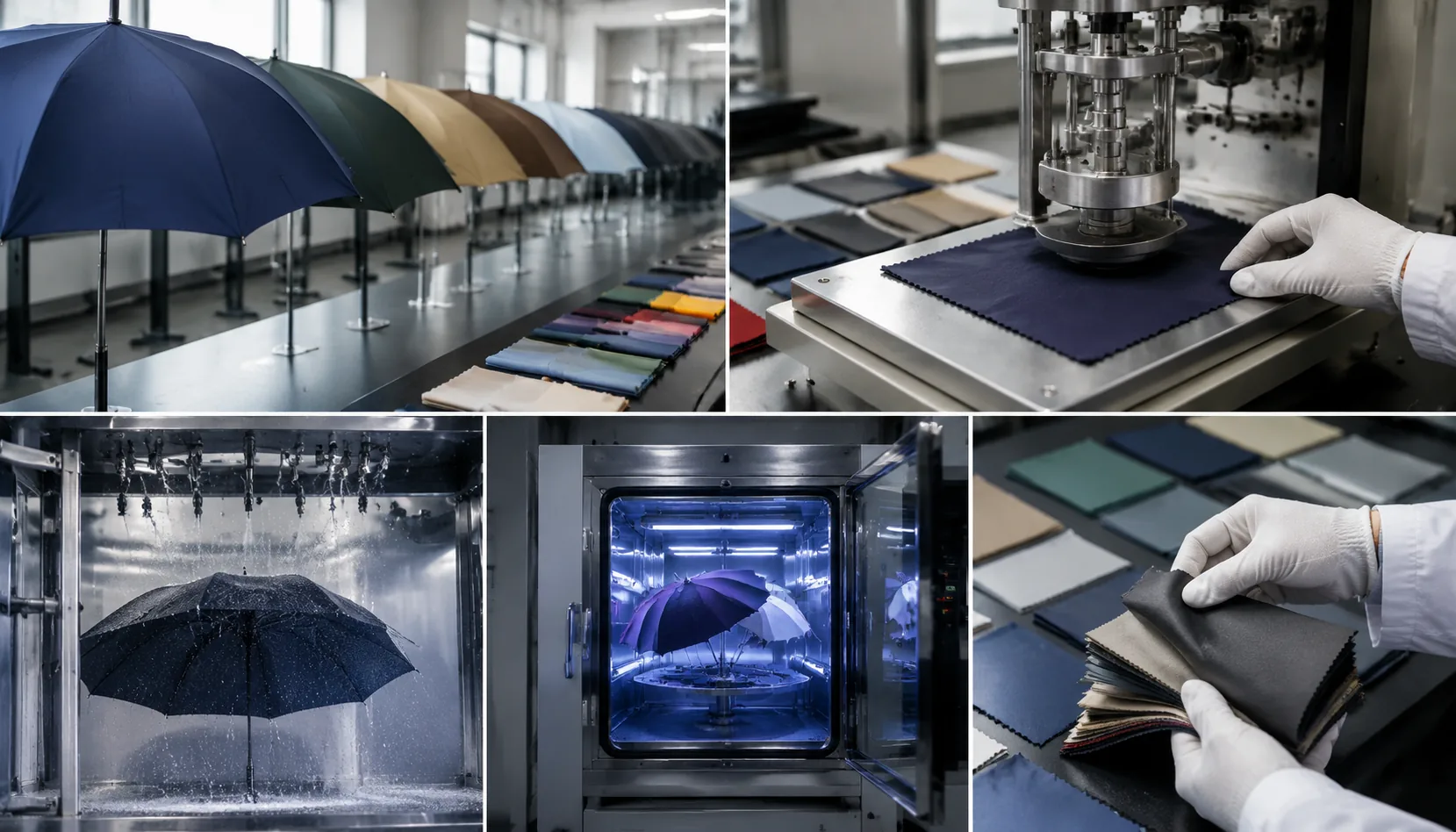
Logo Print Durability Tests for Branded Umbrella Orders
Learn which rub, tape, fold, and wet tests help buyers confirm umbrella logo durability before bulk production and final...
Read More »