AQL 2.5 Umbrella Quality Control for OEM and ODM Orders
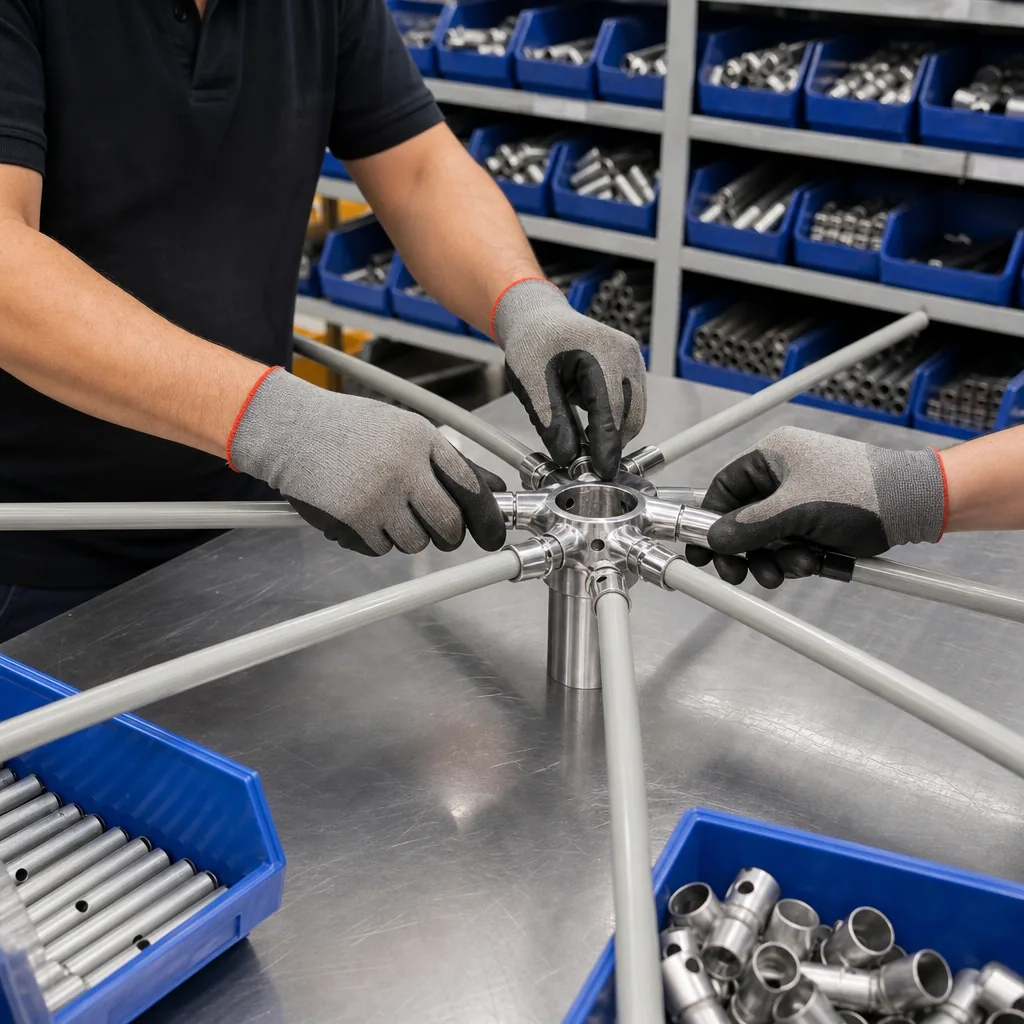
For OEM and ODM umbrella programs, the hardest part is not getting a sample approved, but keeping every shipment consistent when fabric, frames, and print all vary by order. Effective umbrella quality control depends on clear AQL 2.5 rules, plus the pull tests, opening-cycle checks, and fabric verification that catch weak parts before cartons leave the factory floor.
Incoming Material Inspection
Incoming material inspection is where umbrella quality control starts, and it is the only place to catch problems cheaply. For pongee 190T or 210T canopy fabric, we check weave density, yarn slubs, pinholes, oil stains, shade-to-shade color variation, and width tolerance before cutting. A 190T cloth that looks fine on a roll can still fail once it is tensioned on the frame if the weave is loose or the dye lot drifts. For fiberglass ribs, we inspect fiber layup consistency, edge splintering, bent wire inserts, and the straightness of rib tips and stretcher arms. Steel shafts need a separate check for wall thickness, concentricity, burrs, and surface rust. Plating on shafts, runners, and ferrules must be uniform, because thin chrome or nickel plating flakes early and creates corrosion complaints after a few shipping cycles.
In an OEM umbrella inspection, the incoming lot is also sorted by finish and fit, not just by appearance. We reject parts with rust spots, sharp burrs, cracked plastic tips, off-center holes, and any hardware that binds when assembled by hand. Color variation matters more than most buyers expect: if the canopy lot, handle lot, and trim color do not match under daylight and shop LEDs, the order can look inconsistent even when every part is technically usable. The factory QC checklist should record supplier lot numbers, measurement results, and photo evidence before production starts, then link those records to the final AQL 2.5 inspection. That is the practical way to keep umbrella testing standards consistent across repeated OEM runs, especially when a customer reorders the same style in a different season or from a different fabric batch.
In-Line Checks During Sewing and Assembly
The first real umbrella quality control gate is not final inspection; it is sewing. On the line, we check seam allowance at 6 to 8 mm, panel symmetry within 2 to 3 mm across opposite gores, and stitch density where the fabric curves hardest near the tips and crown. If the needle starts skipping on 190T pongee or 210T pongee, the defect usually shows up as a weak seam long before the canopy reaches assembly. A good factory QC checklist catches that immediately, because once the panels are joined, a distorted seam line will pull the whole canopy off center and no amount of trimming later will fix it. In OEM umbrella inspection, this is where we reject loose threads, uneven hem folds, and panels that do not match the cutting pattern before they consume hardware and labor.
Assembly checks are just as mechanical. Tip insertion must seat fully without splitting the fabric or punching too large a hole, and the rib ends need to lock cleanly into the tips without forcing the canopy into a twisted shape. Runner fit matters more than most buyers think: if the runner has excess play, the umbrella will rattle and misdeploy; if it is too tight, the frame binds and the fabric gets dragged during opening. For auto-open models, spring consistency is part of the umbrella testing standards, because weak springs create partial opens and inconsistent rebound after repeated cycles. On the floor, we cycle random pieces by hand and listen for the same click, the same travel, and the same stop point every time. That is where we catch loose ribs, bent stretchers, and frame geometry problems before they become shipment claims.
The practical goal is to stop alignment errors while they are still cheap. If the canopy sits off one rib by even a few millimeters, the panel tension shifts and the umbrella will look crooked from above, especially on 8K and 10K frames with large 23-inch or 27-inch panels. ZheBrella’s standard practice is to combine inline sewing checks with assembly-point verification, then escalate any recurring defect into AQL 2.5 inspection only after the process is stable. That matters because AQL 2.5 is not a substitute for line control; it is the backstop. The factories that do this well do not wait for final packing to find stitch skips, loose ribs, or bad canopy alignment. They correct the operator, the jig, or the frame batch the same shift, which is the only way to keep OEM umbrella inspection from turning into rework and delayed lead times.
AQL 2.5 Sampling and Defect Classification
An AQL 2.5 inspection starts with a real random pull from the finished lot, not a handpicked stack from the packing table. For umbrella quality control, that means sampling cartons across the full order, then opening units from different cartons, colors, sizes, and production days so one good shift does not hide a bad one. The sample size comes from the lot size and the agreed inspection level, usually based on ANSI/ASQ Z1.4 or ISO 2859-1 style tables, and the inspector records defects against the agreed AQL 2.5 limit before the lot is released. In practice, the factory QC checklist should also confirm model, panel count, canopy material such as 190T pongee or POE, handle type, and mechanism type, because a clean-looking umbrella can still be wrong on spec.
Defects are usually split into critical, major, and minor because not every flaw has the same business impact. Critical defects are the ones that make the umbrella unsafe or unusable: a broken rib that exposes sharp metal, an auto-open failure, a shaft that will not lock, a canopy tearing at the seam on first opening, or a print using the wrong brand logo on a regulated order. Major defects reduce function or value enough that the unit should normally fail OEM umbrella inspection: print misregistration outside the buyer's tolerance, broken stitches along a panel or binding, missing spring parts, loose ferrules, or water leakage from a seam that should have been sealed. Minor defects are cosmetic issues such as light scuffs, small thread tails, or slight shade variation that does not change performance.
Buyers should define acceptance limits before production, not after the shipment lands. For example, print misregistration can be set at 2 mm to 3 mm for a logo on one panel, with tighter limits for multi-color registration or retail packaging; broken stitches can be zero tolerance on load-bearing seams and one or two isolated non-structural loose stitches allowed per sample if they do not open under pull; and function failures should normally be zero tolerance for critical mechanisms such as open, close, and lock. The point of AQL 2.5 inspection is not to argue over every mark, but to tie each defect type to a clear rule in the purchase order and factory QC checklist so the inspector, buyer, and production team are using the same standard.
Functional Tests for Strength and Safety
For umbrella quality control, the functional tests start with opening-cycle counts and stop relying on appearance alone. A normal OEM umbrella inspection will usually run repeated open-close cycles on random samples to catch loose rivets, weak springs, and handle play before shipment. For manual models, we check whether the runner locks cleanly and whether the shaft binds after 20 to 50 cycles; for auto-open and auto-open-close units, the button action has to stay consistent without misfire or partial release. The factory QC checklist should also record canopy symmetry after cycling, because a frame that looks fine on the bench can twist once the ferrule, stretcher, and rib joints heat up during repeated use. In our standard practice at ZheBrella, cycle testing is matched to the order type, with stricter pull and release checks for retail-pack and gift-box programs than for basic promotional stock.
Wind resistance checks are where standard models and reinforced constructions diverge. A regular 21" or 23" promotional umbrella may only need a basic shake or fan test, while a double-canopy vented windproof model should be pushed in a stronger airflow to verify that the vent opens and relieves pressure instead of inverting the frame. Fiberglass-reinforced ribs and tips are tested differently from steel because the failure mode is usually flex fatigue, not straight breakage, so the inspector watches for permanent set, joint cracking, and seam tearing at the crown. For umbrella testing standards, we also compare canopy tension after the wind test and confirm that pongee 190T or 210T fabric has not slipped at the tips or stretched around the stitching holes. This is the practical part of umbrella quality control that separates a low-cost promo piece from a usable consumer product.
Button endurance and tip safety inspection close out the functional test. The button on an auto-open or auto-open-close umbrella should survive repeated presses without sticking, double-triggering, or losing spring force, and the closure latch should still hold after transport vibration and sample cycling. Tip safety inspection is not cosmetic: we check exposed metal burrs, cracked plastic caps, sharp wire ends, and any gap that could snag a finger or puncture the canopy during folding. On fiberglass-heavy frames, inspectors pay extra attention to splintering at the rib ends and the tips because broken glass fiber is a real handling hazard, especially on children’s or hotel-use umbrellas. Under AQL 2.5 inspection, the pass/fail decision should tie back to the actual defect class, not a general visual score, so the buyer gets a clear record of what failed, why it failed, and whether the shipment needs rework or sorting before release.
Pre-Shipment Reports and Corrective Actions
A real pre-shipment report for umbrella quality control should tell you exactly what was sampled, what failed, and what was done about it. For an AQL 2.5 inspection, that means the report needs lot size, sample size, inspection date, SKU breakdown, carton count, and a defect summary split into critical, major, and minor items. The useful part is not the pass/fail stamp; it is the evidence: close-up photos of broken tips, uneven canopy stitching, crooked runners, ink transfer defects, missing ferrules, and any steel or fiberglass rib damage. A factory QC checklist should also record measurements that matter on umbrellas, such as open diameter, shaft length, canopy panel alignment, and whether the mechanism cycles cleanly through manual, auto-open, or auto-open-close operation without jamming.
Carton checks belong in the same report because a good umbrella can still arrive wrong if the pack-out is careless. The buyer should see carton dimension verification, gross and net weight, inner pack condition, barcode or carton mark accuracy, polybag presence, hangtag or insert confirmation, and drop-test or compression damage if that was part of the umbrella testing standards. For OEM umbrella inspection, I also want a clear note on mixed lots: if one color, size, or handle type is packed into the wrong carton, that is not a cosmetic issue, it is a fulfillment defect. The report should state whether defects were isolated to production, packing, or final loading, because that tells you whether the problem is a sewing issue, an assembly issue, or a warehouse issue.
A buyer should require a 100 percent recheck when the report shows a pattern defect, not just random noise. If the same seam split, canopy hole, auto-open failure, or loose rivet appears across multiple cartons, the lot should be reworked before release because the sampling result is only the warning sign. Repair is acceptable when the defect is confined to retrievable items such as loose thread ends, missing labels, minor print touch-up, or a single broken tie strap that can be replaced without affecting function. Replacement is the right call when there is structural failure, water-leak issues on a coated canopy, or repeated frame collapse on opening and closing. In practice, umbrella quality control should not green-light a shipment until the corrective action note shows what was fixed, how many pieces were rechecked, and who signed off the final release.
A good corrective action record also states whether the factory quarantined the lot, reworked the affected cartons, and rechecked after repair under the same AQL 2.5 inspection method. If the defect rate is close to or above the agreed limit, I would not accept a partial spot check; the buyer should demand either 100 percent reinspection or full replacement of the affected batch, especially on promotional orders where a failed umbrella hurts the brand more than the unit cost suggests. The report should close with release status, remaining risk, and any holdback quantity if the buyer wants a reserve for claims. That is the difference between a paper report and a usable factory QC checklist: one records problems, the other prevents them from shipping.
Frequently Asked Questions
Is AQL 2.5 strict enough for retail umbrellas?
For many B2B programs, AQL 2.5 is a practical baseline, especially when the umbrella is not a safety-critical product. Retail brands may still tighten limits on print quality, function failures, or carton damage depending on channel requirements.
What tests matter most for an auto-open umbrella?
The button mechanism, spring rebound, and repeated open-close cycling matter most. Buyers should also verify that the runner locks cleanly and that the canopy stays centered after multiple cycles.
Which umbrella defects are usually treated as major under AQL 2.5?
Broken ribs, failed opening mechanisms, canopy tears, seam splitting, and handle separation are typically classified as major defects because they affect function or safety. For branded OEM orders, crooked printing or mismatched canopy panels may also be treated as major if the buyer's spec sheet says so.
How many opening cycles should a factory test for OEM umbrellas?
For standard manual umbrellas, buyers often ask for 5,000 to 10,000 open-close cycles. Auto-open models are commonly tested at 3,000 to 5,000 cycles, but the final number should match the target price point and the purchase order.
What fabric checks matter most before shipment?
The key checks are color consistency, coating uniformity, water repellency, panel alignment, and seam integrity. If the order includes printed canopies, factories should also confirm print registration and shade consistency across all panels before packing.
Looking to Launch Your Custom Umbrella Line?
ZheBrella is a Zhejiang-based OEM/ODM umbrella manufacturer with 17 years of export experience. Free design, low MOQ from 100 pieces, windproof construction, full-color print.
Get Free Quote Now »People Also Search For
Related Articles
Umbrella AQL 2.5 Inspection Checklist for OEM Buyers
Learn how to audit umbrella orders with AQL 2.5, defect classes, sample sizes, and functional checks before shipment to ...
Read More »Umbrella Assembly Line QC Gates for OEM Manufacturing
Map the key QC gates in umbrella assembly, from frame prep to final packing, to cut defects, speed approvals, and protec...
Read More »Umbrella Factory Incoming QC for Fabric, Frames, and Parts
Build an incoming QC plan for pongee fabric, ribs, shafts, handles, and cartons before mass production to reduce defects...
Read More »