Logo Durability Testing for Branded Umbrella Orders
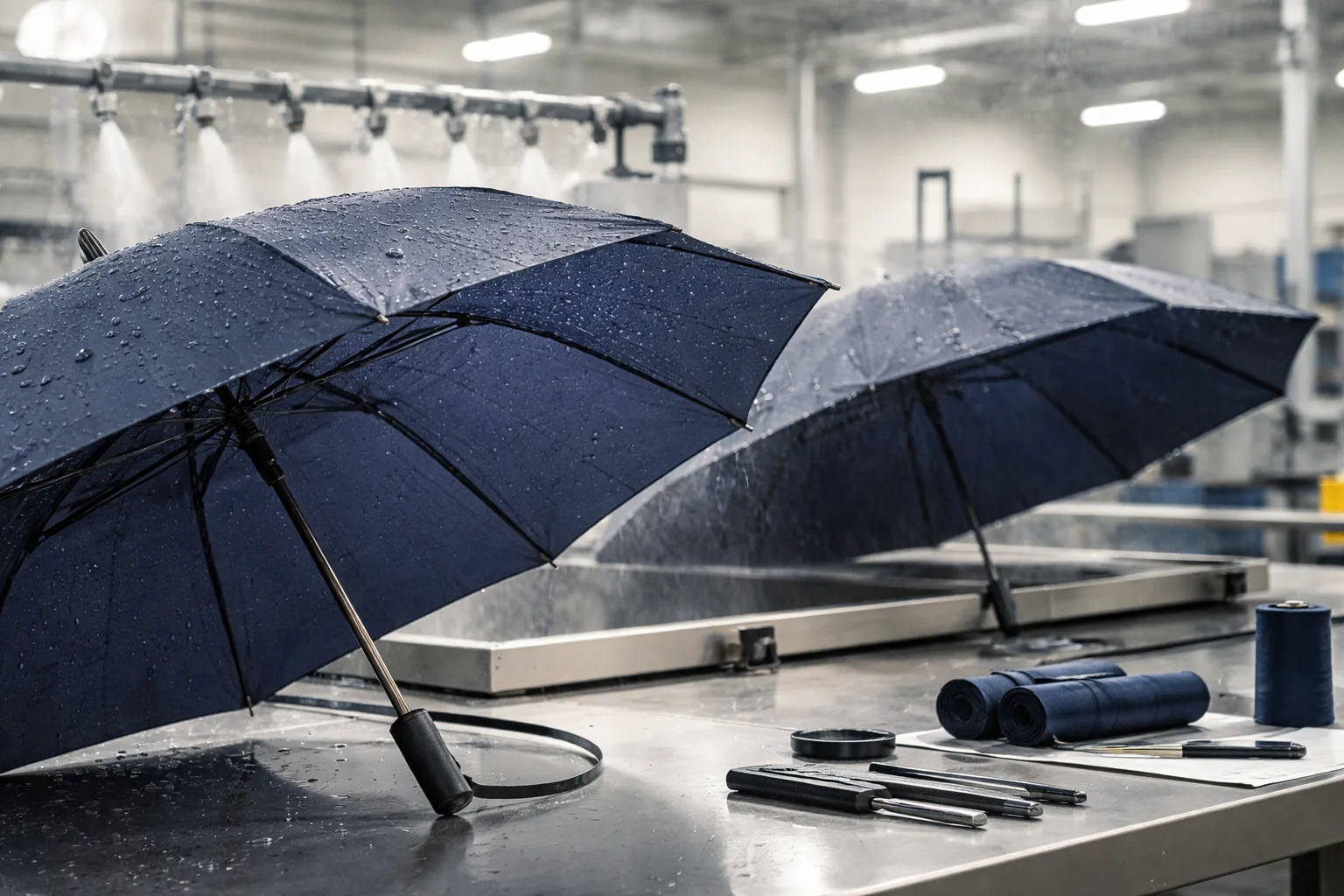
When a branded umbrella order fails in the market, the issue is often not the canopy or frame but a logo that cracks, bleeds, or rubs off after real handling. On our Songxia production floor, logo durability testing starts before bulk printing, with ink adhesion, wet rub, folding stress, water exposure, and AQL 2.5 inspection tied to clear buyer approval samples. That discipline protects both your brand artwork and the shipment schedule.
Set Durability Standards Before Artwork Approval
Logo durability testing has to start with the use case, not the artwork file. A giveaway umbrella for a trade show only needs the logo to survive handling, folding, and a short promotional life, while a retail SKU or hotel amenity umbrella may need to look acceptable after months of sun, rain, and repeated opening. Corporate gifts sit in the middle: buyers usually want the branding to stay clean through daily commuting, not just through unboxing. If you do not define that lifespan up front, the factory will test to the wrong target and you will end up approving a print that passes visually but fails in the field. That is why we separate logo durability testing by channel before sampling begins. A simple one-color screen print on a 190T polyester canopy is a very different risk profile from a full-color sublimation graphic on pongee or a soft-touch heat-transfer mark on POE film.
Decoration method and substrate drive how deep the umbrella print adhesion test needs to go. Screen print can crack if the ink film is too heavy or the fabric is too slick; sublimation can look sharp but only works on coated polyester and still needs wash, fold, and abrasion checks; heat transfer can peel at the edges if the press window is wrong. The canopy matters just as much: 190T and 210T pongee handle ink differently from POE, PVC, or EVA, and a vented double-canopy style puts more flex on the logo area than a flat standard canopy. On lower-cost promo programs, a quick rub-and-fold test may be enough. On higher-ticket retail or hotel programs, I would push for a longer abrasion cycle, wet rub, and sun exposure check before artwork approval.
Good branded umbrella quality control ties the logo standard to the commercial target. If the target price is low, the buyer should accept simpler decoration and a shorter verified lifespan; if the piece is meant to sit in a hotel room or carry a premium corporate logo, the testing should be stricter even if the order quantity is small. Our standard practice is to lock the durability expectation in the artwork sign-off, then confirm it again during sampling and pre-shipment checking, because umbrella logo printing QC is cheaper before mass production than after cartons are packed. For production lots, AQL 2.5 inspection should include not only count and placement, but visible defects like edge lift, color shift, cracking, and mis-registration. That keeps the decoration spec aligned with the buyer’s channel instead of treating every umbrella like the same product.
Run Adhesion, Rub, and Folding Checks
Logo durability testing has to start before bulk packing, not after the cartons are sealed. For screen print on 190T or 210T pongee, we run a tape pull after the ink is fully cured: 3M 600 or equivalent tape pressed firmly over the logo for 60 seconds, then pulled back at roughly 180 degrees. A clean pass means no visible ink lift at the edges or inside fine lettering. Digital print needs the same pull check, but we pay closer attention to CMYK-heavy areas because dark navy, black, and red blocks show adhesion loss faster on PU, Teflon, or UV-coated fabric. For heat transfer logos, the weak point is usually the film edge, especially when the transfer temperature was too low or pressure was uneven on a curved umbrella panel.
Rub testing catches problems that a tape pull can miss. Our standard practice at ZheBrella is 20 dry rubs and 10 wet rubs with white cotton cloth on approved pre-production samples, then spot checks during branded umbrella quality control. A good screen print should not powder, smear, or leave obvious pigment on the cloth. Heat transfer should not become sticky, cloudy, or wrinkled after wet rubbing. On coated pongee, especially 210T with water-repellent treatment, poor surface preparation can leave silicone residue that blocks ink bonding. That is why umbrella print adhesion test results must be tied back to fabric lot, coating type, ink batch, curing temperature, and dwell time, not just the printing operator’s judgment.
The folding check is where many umbrella logo printing QC failures appear. We open and close the umbrella 25 to 50 cycles, then inspect logo areas that cross rib channels, fold valleys, and panel seams. Ink cracking along fold lines is common when a large solid logo is printed too close to the rib, or when heat transfer film is too thick for compact 21" and 23" models. For larger 27" and 30" golf umbrellas, the risk is different: panel tension during opening can stretch the print near the outer arc. During AQL 2.5 inspection, inspectors should classify peeling, cracking, color transfer, and misregistration separately, because each defect points to a different root cause in curing, fabric coating, transfer pressure, or canopy sewing tension.
Test Against Rain, Sun, and Handling Conditions
A logo that looks sharp at packing can still fail after three rain cycles if the ink film was under-cured or the canopy finish was not matched to the printing method. For logo durability testing, we normally start with a water exposure check: open the umbrella, spray or shower the printed panels for 10-15 minutes, then let it dry fully at room temperature instead of wiping it aggressively. After drying, the inspector checks for edge lifting, whitening, tackiness, dye bleeding, and transfer onto adjacent panels. This matters most on 190T and 210T pongee with water-repellent or Teflon coating, because the same coating that sheds rain can reduce ink bite if pretreatment and curing are weak. A basic umbrella print adhesion test should also include a dry rub and wet rub on the logo area, especially around seam lines where fabric tension changes during opening and closing.
Sun exposure is a separate failure mode from rain. On UPF 50+ canopies, buyers often focus on the UV rating of the fabric but forget that the printed logo must survive light, heat, and coating interaction. We check colorfastness by comparing the printed sample against an approved pre-production sample after controlled UV exposure or outdoor aging, then record shade shift, cracking, and gloss change. Dark inks can heat up faster under sunlight, which can soften some transfer films or make plastisol-like layers feel sticky. Metallic inks need extra checks because aluminum or pearl pigments sit differently in the binder and can lose brightness after rubbing or folding. Large solid logos are also risky: a 20 cm white block on navy pongee has more ink load, more curing demand, and more chance of micro-cracking when the canopy flexes on 8K or 10K frames.
Storage in sleeves is where many branded umbrella quality control problems show up late. A printed panel may pass open-air drying, then block or imprint after 24-48 hours inside a tight matching sleeve, especially in humid cartons before FOB shipment. Our standard umbrella logo printing QC includes closing the umbrella after full cure, inserting it into the sleeve, storing it under light pressure, and reopening it to check whether ink transfers to another panel or the sleeve lining. For production lots, this should be tied to AQL 2.5 inspection with clear defect definitions: minor shade variation, major logo peeling, critical ink transfer that stains other goods. ZheBrella usually recommends extra sleeve-storage checks for dark navy, black, red, and metallic logos, plus any large solid heat-transfer artwork used for promotional campaigns where the umbrella may sit packed for months before distribution.
Connect Print QC With Umbrella Construction
Print durability is not only an ink problem; the frame decides how much the logo is stretched, folded, and rubbed during use. Steel ribs make a 23" or 27" umbrella feel solid, but the added weight increases canopy sag when the umbrella is wet, especially with 190T pongee or heavier 210T fabric. That sag can create micro-movement between panels and ribs, so a screen-printed logo near a rib line may see more abrasion during repeated opening and closing. Fiberglass ribs cost more, but they flex back instead of permanently bending, which keeps panel tension more stable after wind loading. In branded umbrella quality control, I want the umbrella print adhesion test done after open-close cycling, not only on flat fabric before assembly, because the real failure often appears where the logo crosses a tension line.
Double-canopy windproof umbrellas need separate logo durability testing because the vent layer changes airflow and panel pull. A vented 8K frame has fewer, wider panels, so logo placement is easier and large artwork can sit cleanly between seams, but each seam takes higher load when the canopy inverts and recovers. A 16K frame spreads stress across more ribs and gives a rounder canopy, but the narrower panels make alignment harder; a misplaced heat-transfer logo can creep into stitch allowance or distort across two panels. For umbrella logo printing QC, we check registration against rib position, seam allowance, and tip-to-tip symmetry before bulk packing. During AQL 2.5 inspection, adhesion, cracking, color rub, and logo skew should be recorded together with frame defects, because print complaints often start with construction choices rather than the printing table alone.
Use AQL Inspection and Approval Samples
Approval samples are the cheapest insurance in a branded umbrella order because they freeze the print target before bulk fabric is cut. For most logo durability testing, I want three references on file: the customer’s artwork proof, a golden sample signed off by the buyer, and a pre-production sample made with the same canopy fabric, ink, curing temperature, and print position planned for mass production. On a 23" 8K auto-open umbrella in 190T pongee, that means checking logo registration against panel seams, tip orientation, handle alignment, and whether the print stays inside the agreed tolerance, usually ±2 mm for placement and Delta E 2–3 for color when the buyer provides Pantone or LAB values. For screen printing, we rub the logo after curing to catch weak ink film; for heat transfer, we bend the panel over a rib curve to look for edge lifting or cracking. If the sample passes, production has a physical standard, not just a PDF.
The pre-production sample also exposes MOQ and lead-time problems before they become shipment delays. A one-color logo on stock 190T pongee may only need 3–5 days for sampling and 15–25 days for bulk after deposit, while custom-dyed 210T pongee, sublimation panels, or a UV UPF 50+ coated canopy can add 7–15 days because fabric has to be dyed, coated, relaxed, cut, and tested before sewing. Low MOQ orders are more sensitive because the print setup loss is proportionally higher; one bad screen, wrong transfer film, or color mismatch can consume 30–80 panels before anyone notices. Our standard practice at ZheBrella is to treat the pre-production sample as a mini bulk run: same operator, same mesh count or transfer press setting, same drying rack time, and the same umbrella print adhesion test used later during branded umbrella quality control.
Final bulk control should not rely on the factory saying the order looks good; it should be written into an AQL 2.5 inspection plan with specific umbrella logo printing QC checkpoints. Inspectors pull cartons randomly and check logo registration, smudges, pinholes, ink bleeding, transfer film outline, cracking after open-close cycling, and color tolerance against the golden sample under consistent light. They should also open the umbrella fully, shake it, close it, and inspect printed panels over rib contact points because that is where weak adhesion often fails first. For FOB orders, failed inspection usually means the vessel cutoff is missed unless rework is finished within 2–4 days; for DDP shipments, the timing is tighter because trucking, export declaration, sea or air booking, duty handling, and final delivery windows are already linked. Proper logo durability testing before packing keeps the buyer from discovering print failure only after promotional events or retail allocation.
Frequently Asked Questions
What logo defects should be counted during AQL 2.5 inspection?
Common defects include cracking, peeling, smudging, poor registration, wrong color, visible pinholes, and logos printed too close to ribs or seams. Buyers should define major and minor defects before inspection.
Can durability testing be done before placing the full bulk order?
Yes. A pre-production sample can be tested for adhesion, rub, water exposure, and folding before mass production starts, though this may add several days to the lead time.
What rub test level is typically used for printed umbrella logos?
For branded umbrella orders, buyers often specify a dry rub test plus a wet rub test to check ink transfer and surface wear. A practical spec is 20-50 double rubs for sample approval, but the final target should match the print method and coating used on the canopy.
How is AQL 2.5 applied to umbrella logo quality control?
AQL 2.5 is commonly used for cosmetic and branding defects on finished umbrellas, including misprints, missing logos, color variation, and ink smudging. The exact sample size and acceptance number depend on the shipment quantity and the inspection standard your buyer selects.
Should logo durability be tested before or after folding?
Both. Test adhesion and rub resistance on the opened canopy first, then repeat folding-cycle checks to confirm the print does not crack at panel seams or crease lines after repeated opening and closing.
Looking to Launch Your Custom Umbrella Line?
ZheBrella is a Zhejiang-based OEM/ODM umbrella manufacturer with 17 years of export experience. Free design, low MOQ from 100 pieces, windproof construction, full-color print.
Get Free Quote Now »People Also Search For
Related Articles
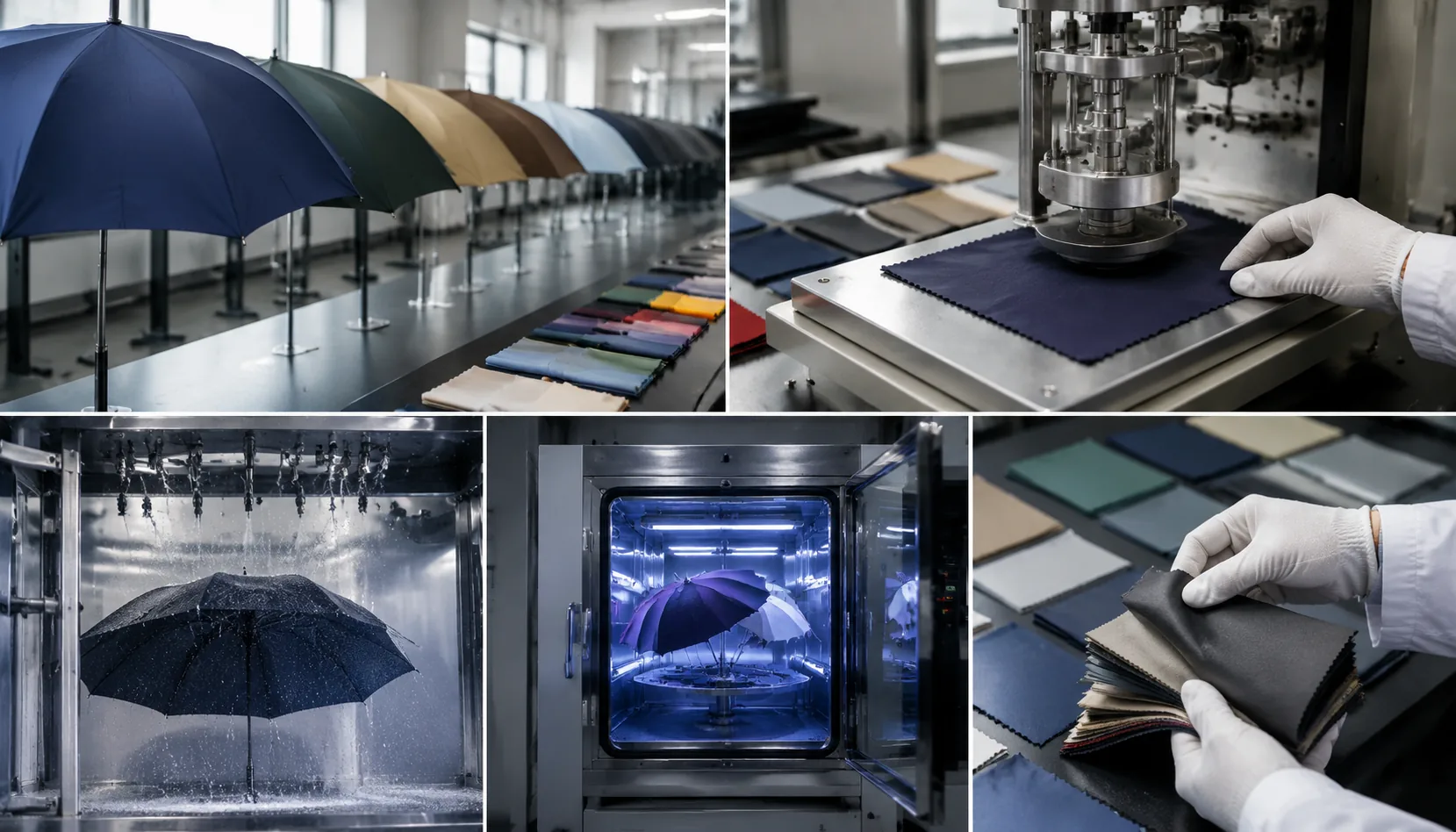
Logo Print Durability Tests for Branded Umbrella Orders
Learn which rub, tape, fold, and wet tests help buyers confirm umbrella logo durability before bulk production and final...
Read More »
Print Durability Testing for Branded Umbrella Programs
Compare rub, adhesion, rain, UV, and folding tests for umbrella prints, with practical specs for 190T/210T pongee and AQ...
Read More »
Logo Durability Testing for Branded Umbrella Programs
Plan branded umbrella orders with logo durability checks, AQL 2.5 inspection points, fabric tests, and approval steps be...
Read More »