Logo Print Durability Tests for Branded Umbrella Orders
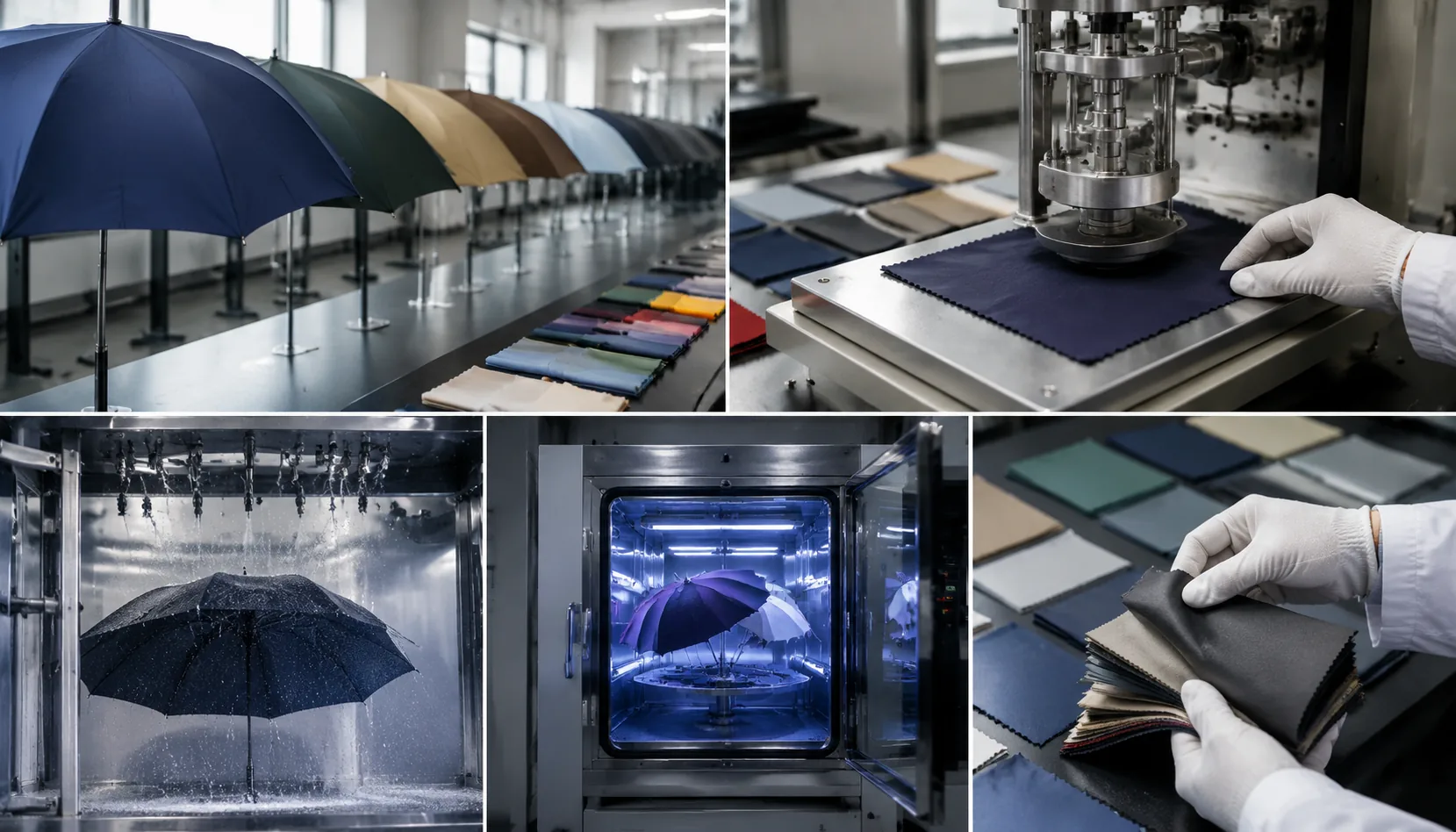
A printed logo can look perfect on a strike-off and still fail after rubbing against a sleeve, sticking to packaging tape, or flexing across a folded panel. For buyers placing branded umbrella orders, umbrella logo durability testing is the practical checkpoint between artwork approval and bulk production. On our Songxia factory floor, we use simple rub, tape, fold, and wet checks to catch weak ink adhesion before it becomes a carton-wide AQL problem.
Why Logo Durability Fails in Real Use
Logo failure usually starts after the umbrella is closed wet, not while it is open in the rain. When 190T or 210T pongee is folded with moisture trapped between panels, the printed ink or heat-transfer film sits under pressure for hours, sometimes days if the user leaves it in a sleeve. That is where weak branded umbrella printing shows up: softening at the ink edge, transfer film lifting at sharp corners, or color rubbing onto the opposite panel. A proper print adhesion test must simulate this wet-fold condition, because a dry rub test alone will pass many logos that fail in actual use. Panel folds are the first danger zone because the canopy is creased along the same lines every time. If the logo crosses a fold, especially with thick plastisol, silicone, or low-temperature transfer film, the stress concentrates at the bend and creates micro-cracks before the buyer sees visible peeling.
Rib contact is the second common failure point, and it gets worse as rib count increases. On an 8K umbrella, each panel has wider fabric span, so the logo may sit away from the frame if positioned correctly. On a 16K umbrella, there are more contact lines and more stitching channels, so a large logo has a higher chance of touching fiberglass or steel ribs during closure. Near seams, the canopy is not flat; thread bulk, seam allowance, and tension from the tips create raised areas that scrape the print during folding. I do not like placing fine text or metallic transfer logos within 25–35 mm of a seam or rib line unless the artwork is small and the ink system has already passed umbrella logo durability testing. Dark canopies also hide early scuffing less effectively when white or silver logos are printed on top.
Auto-open and auto-open-close frames add another stress that many buyers underestimate. A manual 23" umbrella is usually closed slower, but a 21" compact auto-open-close snaps the canopy tight and then collapses it with uneven panel compression. Repeated cycling can drag the printed area across rib joints, runner contact points, and the inside sleeve mouth, especially when the user twists the canopy to fit it back into a narrow pouch. Sleeve abrasion is not cosmetic only; PVC, EVA, or rough woven sleeves can polish, scratch, or lift transfer edges after 50–100 insertions. In custom umbrella quality control, our standard practice at ZheBrella is to combine wet-fold storage, tape pull, dry/wet rub, and cycle testing before AQL 2.5 inspection, because final random inspection catches visible defects but cannot prove long-term logo adhesion by itself.
Core Tests to Request Before Bulk Approval
The first tests I ask for before bulk approval are dry rub, wet rub, and 3M tape adhesion, because they catch most failures in branded umbrella printing before the fabric ever reaches sewing. For dry rub, use a white cotton cloth and 20 back-and-forth strokes over the printed logo; visible color transfer is a warning sign, especially on dark navy, red, and black inks. Wet rub should use the same motion after soaking the cloth in clean water, then check both the cloth and the logo edge for bleeding or softening. For the print adhesion test, press 3M 600 or equivalent tape firmly over the logo, wait 60 seconds, then pull back at roughly 180 degrees. Any ink lift, pinhole peeling, or edge flaking means the ink system, curing temperature, or pretreatment is not stable enough for bulk.
Crease testing matters more on umbrellas than on most promotional textiles because the canopy is folded under rib tension every time the product is packed. I prefer testing on actual pongee 190T or 210T panels, not flat lab swatches, because real canopy fabric has coating, bias stretch, stitching tension, and panel curvature that change ink behavior. Fold the printed area along a normal canopy crease, compress it for 12 to 24 hours inside the sleeve, then open and close the umbrella at least 20 cycles. Screen print may crack if the ink layer is too thick; heat-transfer logos may show edge lifting; sublimation usually survives folding well but can look dull if the artwork was profiled poorly. This is a practical part of umbrella logo durability testing, not a cosmetic afterthought.
Water exposure and sleeve abrasion should be checked together because many logo failures happen during wet repacking, not during display on a sample table. Open the umbrella, spray or shower the logo area for 10 to 15 minutes, shake it, then insert it into the sleeve while damp and remove it 10 times. Check for smearing, whitening, tackiness, and rubbing at the fold tips where the sleeve mouth scrapes the canopy. For custom umbrella quality control, our standard practice at ZheBrella is to record these tests in the pre-production sample report and keep the approved sample beside the line during production. During AQL 2.5 inspection, the inspector should compare random bulk pieces against that approved sample for logo position, color, adhesion, and abrasion marks, not just count broken frames or missed stitches.
How Fabric, Ink, and Coating Affect Adhesion
Adhesion starts with the canopy surface, not the logo artwork. On standard 190T or 210T polyester pongee, screen print usually gives the strongest bond because the ink sits into the weave and can be heat-cured around 140-160°C depending on pigment system. Heat transfer is cleaner for gradients and small sponsor marks, but it relies on film adhesive grabbing the fabric face; if the pongee has a heavy water-repellent finish, the edge can lift after folding cycles. Digital print behaves differently: sublimation is excellent on white polyester because the dye migrates into the fiber, while UV or direct digital ink remains more surface-level and needs careful curing. For branded umbrella printing, I push buyers to match the process to the fabric color, logo complexity, and expected use, not just the cheapest print quote.
UPF 50+ and waterproof coatings are where many logo failures begin. Silver-coated, black-coated, Teflon-treated, PVC-laminated, POE, and EVA canopies all resist water, but they also resist ink wetting. A print adhesion test on these materials often shows poor cross-hatch results unless the ink system is adjusted or a primer is used. Teflon-type finishes are especially tricky because the same low-surface-energy chemistry that makes rain bead off also prevents plastisol or solvent ink from biting. PVC and POE clear umbrellas usually need flexible inks, because a rigid ink layer cracks when the canopy is opened, folded, and packed. Our standard practice at ZheBrella is to test the actual production fabric roll, not a showroom swatch, because coating weight can vary enough between lots to change adhesion results.
Good umbrella logo durability testing should include more than rubbing the print with a thumb. For custom umbrella quality control, I like a sequence of cross-hatch tape pull, wet rub, dry rub, fold-line abrasion, and 24-hour curing verification before bulk packing. Heat transfers should be checked at the corners and along rib contact points, especially on 23-inch and 27-inch auto-open models where canopy tension is higher. Screen print should be inspected for pinholes, under-cure, and ink bridging near sewn seams. Digital and sublimation prints need colorfastness checks after simulated rain exposure, because bright reds and deep blacks reveal weak curing quickly. During AQL 2.5 inspection, adhesion defects should be treated as functional defects, not cosmetic issues, because a peeling corporate logo turns a promotional umbrella into a complaint shipment.
Setting Acceptable Defect Limits for Inspection
Acceptable limits for logo defects must be written before bulk printing starts, not argued over during final inspection. For umbrella logo durability testing, I separate cosmetic variation from functional brand failure. A hairline ink edge variation under 0.5 mm may be acceptable on 190T pongee because the weave has texture, but visible cracking across letters, peeling at folded canopy creases, or missing ink larger than 1 mm on the main logo should be classified as major. Color loss after a standard rub check should be judged against an approved pre-production sample, not a PDF artwork file. For branded umbrella printing, I also define viewing distance: most retail and corporate buyers inspect logo panels at 50 cm under normal light, while photo-shoot or luxury packaging orders may require 30 cm checks and stricter shade matching.
For AQL 2.5 inspection, major logo defects should include peeling after tape pull, obvious cracking after opening and closing cycles, misregistration that shifts text or icon layers more than 1 mm, and color deviation beyond the signed color chip or Pantone tolerance. Minor defects can include tiny ink specks outside the logo area, slight screen pressure marks, or registration drift under 0.5 mm where the brand mark remains clean and readable. My usual recommendation is AQL 2.5 for major defects and AQL 4.0 for minor cosmetic marks on promotional orders, but no critical defects allowed. A logo printed upside down, wrong color, wrong position, or on the wrong panel is not a minor issue; it is a shipment-blocking defect because the umbrella cannot represent the brand correctly.
Premium retail and executive gift orders need tighter internal control than the final AQL table suggests. At ZheBrella, our standard practice is to run first-piece approval, in-line checks every 50 to 100 panels, and a print adhesion test before sewing, because failed ink is much cheaper to catch on flat cut fabric than on finished 23 inch or 27 inch umbrellas. Heat-transfer logos on pongee, sublimation on white polyester, and screen print on PVC or POE all fail differently, so the pass/fail sheet should name the process and substrate. Good custom umbrella quality control should include dry rub, wet rub, tape pull, fold-line flexing, and comparison after 24 hours of curing. For corporate gift orders, I prefer internal rejection once major logo defects exceed 1.0% in process, even if final AQL 2.5 might technically pass.
How to Build Durability Into the Order Timeline
Build the durability gate before the factory cuts bulk fabric, not after 20,000 panels are already printed. For branded umbrella printing, I want a pre-production sample using the actual canopy material, ink system, logo size, and coating stack: 190T or 210T pongee with Teflon water repellent behaves differently from POE, PVC, or EVA, and UV UPF 50+ coatings can change ink bite. A proper print adhesion test at this stage includes cross-hatch tape pull, wet rub, dry rub, folded-panel abrasion, and a 24-hour water soak on dark and light fabric. Allow 5–7 days for sample testing because the print needs curing time before abuse testing; rushing heat-transfer or screen ink after 12 hours gives false confidence. For umbrella logo durability testing, this is also when we check whether the logo cracks near seam allowance, rib contact points, or the crown where fabric is under tension.
The first-article stage should happen after sample approval but before full-speed production. In our standard practice at ZheBrella, the first 20–50 finished umbrellas are pulled from the actual line: same operators, same jigs, same dryer temperature, same frame assembly. This matters because a loose 23-inch auto-open canopy or a 30-inch golf umbrella with 8K fiberglass ribs stretches the printed panels differently than flat sample cloth. We inspect logo position against the panel template, run open-close cycles, check rubbing against tips and stretchers, and repeat tape adhesion on finished goods. If the order uses a double-canopy vented windproof design rated for 50+ mph, the vent overlap must be checked because printed logos near the vent edge can scuff during packing and wind movement. First-article approval usually adds 1–2 working days, but it prevents a much larger delay from reprinting bulk panels.
Mid-production testing is the safety net for custom umbrella quality control, especially on orders above MOQ where printing may run across several shifts or ink batches. I recommend pulling samples at 30–50% completion and recording results inside the AQL 2.5 inspection file, not treating logo checks as a casual visual note. Standard bulk lead time after approval is often 25–35 days for common 21-inch or 23-inch folding umbrellas, and 35–50 days for 27-inch or 30-inch golf umbrellas with custom frames, but this assumes testing gates are built into the calendar. MOQ also affects scheduling: 500 pieces may run in one print batch, while 5,000–20,000 pieces need staged fabric cutting, curing, sewing, and packing. FOB terms usually end at Ningbo or Shanghai port timing, while DDP requires extra buffer for carton labeling, customs data, duties, and last-mile delivery windows, so approve print durability before logistics dates are locked.
Frequently Asked Questions
Should every logo method pass the same durability test?
No. Screen print, transfer, and digital print should be judged against the fabric, coating, and intended use. A UPF 50+ coated canopy may need different adhesion checks than standard 190T pongee.
Can durability testing be done after bulk production starts?
It can, but it is safer to run rub, tape, and folding tests on the pre-production sample. Mid-production checks then confirm the approved ink, curing, and fabric batch are being followed.
Which logo durability tests should be done before approving a pre-production umbrella sample?
For branded umbrella orders, buyers should request dry rub, wet rub, 3M tape adhesion, repeated fold/unfold, and water spray tests on the printed panel. These tests are usually done on the same fabric, ink, and logo size intended for bulk production.
How many printed umbrellas should be checked during final AQL inspection?
For most export orders using AQL 2.5, inspectors randomly check samples based on the order quantity and inspection level, then verify print position, color, adhesion, smudging, cracking, and logo consistency. Critical logo defects should be classified clearly in the inspection checklist before production starts.
Can logo durability requirements be added to the purchase order?
Yes. The PO should specify the printing method, Pantone color, approved sample reference, adhesion test standard, acceptable logo tolerance, and whether wet rub or fold testing is required before shipment.
Looking to Launch Your Custom Umbrella Line?
ZheBrella is a Zhejiang-based OEM/ODM umbrella manufacturer with 17 years of export experience. Free design, low MOQ from 100 pieces, windproof construction, full-color print.
Get Free Quote Now »People Also Search For
Related Articles
Logo Durability Testing for Branded Umbrella Orders
Build a logo durability test plan for branded umbrella orders, covering adhesion, rub, water, folding, AQL 2.5 checks, a...
Read More »
Print Durability Testing for Branded Umbrella Programs
Compare rub, adhesion, rain, UV, and folding tests for umbrella prints, with practical specs for 190T/210T pongee and AQ...
Read More »
Colorfast Logo Printing Tests for Branded Rain Umbrellas
Define rub, rain, UV, and adhesion checks so printed umbrella logos survive wet use, sun exposure, packing friction, and...
Read More »