Contrast Piping and Trim on Umbrellas for Brand Identity
Buyers often approve a striking trim color on screen, then run into bleeding, puckering, or shade drift once the umbrella moves into cutting and sewing. On our Songxia lines, umbrella contrast piping only works when the fabric, cord, and binding tape are matched to canopy thickness, stitch density, and batch dye tolerances, especially when you need consistent brand color across repeat orders.
How Trim Details Strengthen Brand Recognition
Trim is usually recognized before a logo. On an 8K or 16K canopy, a narrow band of umbrella contrast piping creates a continuous outline that reads from about 20 to 30 feet, even when branding is limited to one printed panel. It also gives cleaner color separation on 190T or 210T pongee, especially on dark-to-light panel layouts where standard seam stitching can lose definition after repeated folding. For corporate identity, the lowest-risk specification is usually a black or navy canopy with a Pantone-matched edge in red, orange, or white, then the same accent repeated on the closing strap or handle insert. That keeps the silhouette consistent across 21-inch folding styles, 23-inch straight umbrellas, and 27-inch golf frames without reworking the artwork for each size. For buyers managing multiple SKUs, that matters: branded umbrella trim can carry the brand system even when print area, frame shape, or canopy size changes.
Binding and custom umbrella edge trim work best where the eye already travels: the outer perimeter, vent openings on double-canopy windproof umbrellas, and the closure strap. In retail collections, those retail umbrella design details often deliver better shelf impact than full-canopy sublimation because they sharpen the profile and avoid an overprinted look. Trim is even more useful on POE, EVA, or PVC dome umbrellas, where transparent canopies limit logo visibility; colored hem binding with matching tip caps gives the product a clearer, more premium outline. For events and promotional umbrella branding, fluorescent or reflective trim improves visibility in moving crowds, hotel arrivals, golf tournaments, and race-day staging. The main production risk is trim quality. Low-grade binding can pucker on auto-open-close frames or bleed onto light-colored pongee after wet packing, so buyers should require opening-cycle checks and colorfastness testing before bulk approval, especially on MOQ orders from 500 to 5,000 pieces.
Which Umbrella Styles and Fabrics Accept Trim Best
Straight and golf umbrellas take umbrella contrast piping more reliably than compacts because the canopy edge stays under more even tension. That shows up most clearly on 23", 27", and 30" straight or golf frames, where full-length ribs and no 3-fold packing reduce edge distortion after sewing and packing. On a standard 8K straight umbrella, the trim reads as a defined outer ring, useful when a buyer wants to separate a dark canopy from a lighter logo print without changing panel color. Golf and double-canopy windproof styles give you two practical trim positions: the outside hem and the vent opening between the upper and lower canopies. The vent edge usually delivers stronger visibility for promotional umbrella branding because the accent line remains visible when the umbrella is open and moving. Compacts can still use branded umbrella trim, especially on 21" auto-open-close frames, but the fold geometry is less forgiving. On 3-fold styles, thick corded piping is higher risk because carton compression can leave crease memory; lighter binding and a tighter stitch line are the safer construction.
Fabric and rib count determine whether custom umbrella edge trim looks crisp or creates production risk. Pongee 190T folds more easily on compact umbrellas and handles narrow trim with less bulk at the tips, which helps on 21" folding frames. Its drawback is that it shows stitch tension earlier if the piping cord is too firm or if the binding tape shrinks after wet testing. Pongee 210T has better opacity and a fuller hand, so the trim line usually runs straighter on larger 23", 27", and 30" straight or golf umbrellas; high-contrast colors like white, red, or reflex-silver on black also read cleaner. The trade-off is seam buildup where rib pockets, closing tape, and trim intersect, so sewing order matters to preserve smooth closing. Rib count changes the visual effect as much as fabric: 8K frames create wider panels and bolder retail umbrella design details visible from distance, while 16K frames create a finer, dressier perimeter but tighter labor tolerances. If your target is AQL 2.5 edge appearance, 8K is the lower-risk choice for bold corporate programs; 16K usually means slower sewing and slightly higher unit cost in exchange for a more refined edge.
Color Control, Material Choice, and Durability
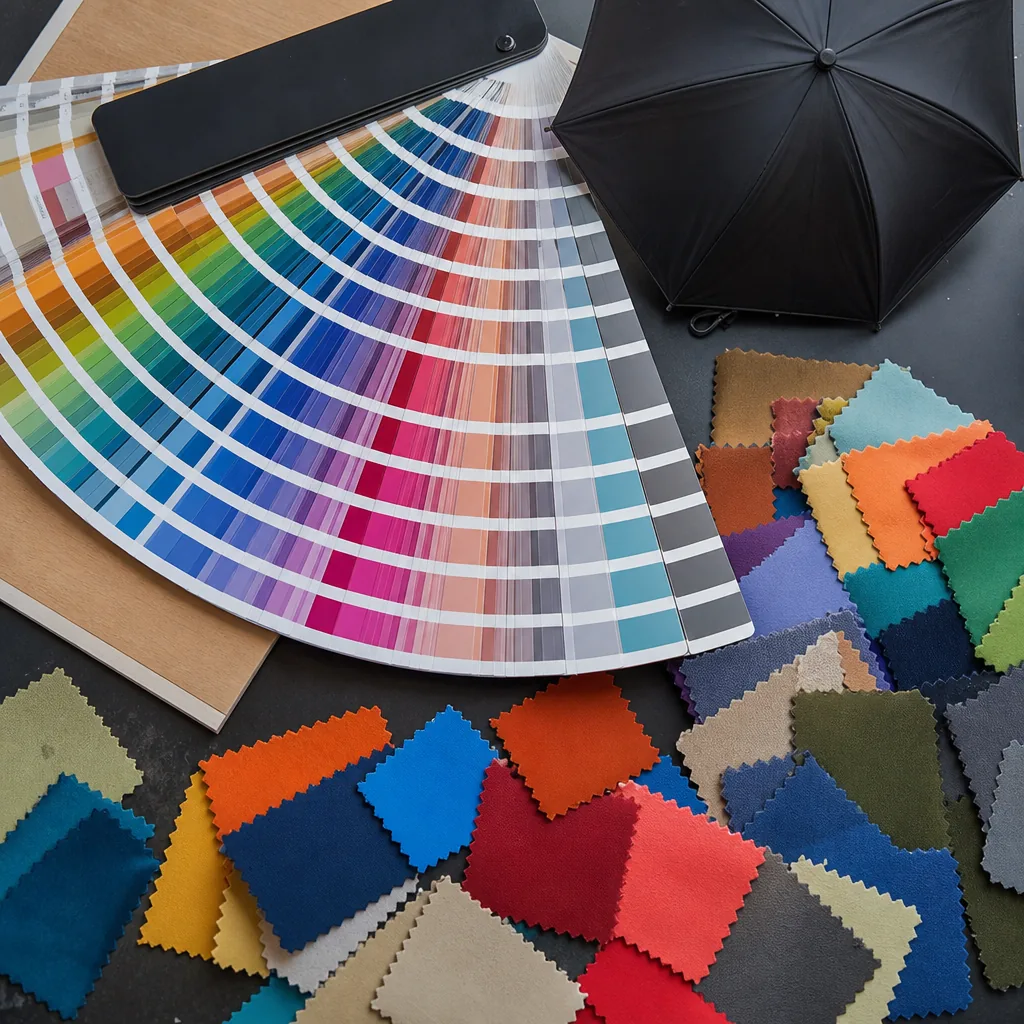
Color approvals slow down when buyers expect one Pantone to look identical on every component. A canopy may be 190T or 210T pongee, while the tie strap, sleeve, handle accent, and branded umbrella trim use different substrates such as woven polyester, nylon tape, or molded ABS. The same PMS teal can read darker, grayer, or glossier from one surface to the next because weave, yarn luster, and dye uptake are not the same. Black trim on a white canopy is low risk; matching a retail color across canopy print, custom umbrella edge trim, and strap is where rework starts. The practical control is simple: approve a physical PMS reference, then request a lab dip on the actual trim material, not only the canopy fabric. Review that match under both D65 light and store lighting before bulk production. That extra approval step shortens lead-time risk and keeps promotional umbrella branding consistent across the parts customers see first.
Material choice should follow the umbrella’s use case, not just the artwork. For umbrella contrast piping, common options are folded polyester piping, nylon tape, reflective trim, and PU-coated decorative binding. Polyester is usually the safest choice on 21 inch and 23 inch folding umbrellas in 190T or 210T pongee because it sews cleanly, holds color well, and avoids the cracking often seen in low-grade PVC trim after repeated open-close cycles. Clear POE or EVA canopies need tighter sewing control: woven binding gives a cleaner contrast line, but stitch marks, puckering, and color migration show faster on transparent material. Width matters too. A 4 to 6 mm trim reads clearly on a 27 inch golf umbrella, while compact telescopic models need a narrower edge to avoid bulk at the seam.
Durability has to be checked as part of the full umbrella system. A trim that survives on a manual-open steel frame can fail early on an auto-open-close frame cycled 5,000 to 8,000 times, because each deployment loads the seam and binding harder. Fiberglass ribs flex better than steel ribs under gust load, but that extra movement also puts more repeated stress on the seam that captures the trim. On vented double-canopy windproof umbrellas tested above 50 mph, weak thread tension or brittle binding usually frays before the canopy fabric fails. Buyers should ask suppliers to inspect trim seam security during cycle testing and again at final inspection to AQL 2.5, with special attention at notch points and tip pockets. If the trim ages faster than the frame or canopy, the product looks worn long before the mechanics are finished.
Cost Impact, MOQ, and Sampling Workflow
Umbrella contrast piping raises cost because it changes a fast canopy-sewing job into a slow perimeter operation. A standard 21" or 23" promotional umbrella in 190T pongee is usually sewn in a fixed sequence—panel joins, top patch, strap closure—using repeatable guides. Add piping or folded edge tape, and the operator must feed trim evenly around the full edge, hold canopy tension, and keep the topstitch line clean through every seam transition. Labor also scales with geometry: a 10K or 16K frame has more seam interruptions and a longer edge than an 8K frame, so sewing time rises with both rib count and canopy size. Material cost is only part of the increase. Stock black or white branded umbrella trim is typically easy to source, but reflective tape, PU-coated trim, or Pantone-matched custom umbrella edge trim may need to be slit, folded, or woven to order. Trim mills usually quote by total length and color lot, not by finished umbrella count, which is why trim MOQs often exceed the umbrella body MOQ.
Unit price usually moves for three clear reasons: added trim material, slower sewing speed, and tighter inspection. A 5 mm to 8 mm trim with exact color matching costs more than stock tape before labor is added, and coated fabrics such as 210T pongee with Teflon or UV treatment are less forgiving under the presser foot, increasing puckering risk and rework if the line lacks experience. In practical buying terms, stock-trim programs may hold at 500 to 1,000 pieces per colorway, while custom trim often pushes MOQ to roughly 1,200 to 3,000 pieces, depending on umbrella size, frame format, and trim-mill minimums. For sample approval, focus on the failure points that will repeat in bulk: stitch neatness on the face and inside return, trim width consistency from panel to panel, seam-join cleanliness, flat edge appearance when the canopy is fully opened, and true color match against the actual canopy fabric rather than Pantone alone. Before releasing mass production, approve a sealed pre-production sample with the exact frame, fabric, trim width, and print position, then lock written tolerances, pack-out, carton quantity, and AQL 2.5 inspection terms.
Factory QC and Shipment Planning
Most defects in umbrella contrast piping start at sewing, so QC has to begin on the line rather than at packing. Check alignment first: the piping seam should follow the canopy panel seam and land cleanly at the tip, because a 3-5 mm drift between adjacent gores is obvious when the umbrella opens. Stitch density also needs a set standard. For 190T or 210T pongee, 8-10 stitches per inch is a practical control point; lower density can let the trim wander or pucker, while excessive density can perforate the fabric and distort curved custom umbrella edge trim. Where the design uses contrast tape or reflective piping, measure reveal width around the full canopy so branded umbrella trim looks even from gore to gore instead of heavy on one panel and thin on the next. If the trim supports retail umbrella design details or print registration, confirm that the trim path stays consistent relative to the artwork, not just the seam line.
Loose-thread control should be a defined inspection step, not a last-minute cleanup. After sewing, require 100% visual thread trimming, then inspect each canopy under opening tension to catch skipped stitches, exposed piping cord, needle damage, and color transfer from dark trim onto light canopy fabric. Final inspection should run to AQL 2.5 and cover canopy symmetry, tip security, runner travel, open-close function, print placement, and whether promotional umbrella branding follows the trim path cleanly. On auto-open-close frames, add random cycle testing to check whether umbrella contrast piping snags near the strap or ferrule during closing. For international branded trim programs, packaging and shipping terms affect damage risk and landed cost. Individual polybags reduce abrasion; paper collars or canopy wraps help prevent edge creasing during long container transit. Cartons should match umbrella size and frame type, since 21 inch folding umbrellas and 27 inch golf umbrellas compress differently. FOB Ningbo fits buyers managing consolidation, while DDP suits customers who want a single landed cost. As a planning baseline, allow 35-45 days for repeat orders and 45-60 days when new color matching, packaging mockups, or carton-label approvals are still open.
Frequently Asked Questions
Does contrast piping work on both promotional and premium umbrellas?
Yes. It can upgrade basic promotional models and also complement premium specs like double-canopy construction, fiberglass ribs, and UPF 50+ canopies, depending on the target price point.
Is trim color matching easier than canopy color matching?
Not necessarily. Trim materials can take dye differently than canopy fabric, so visual matching must be approved on physical samples rather than artwork alone.
Can contrast piping be matched to a specific Pantone color across the canopy, sleeve, and handle details?
Usually yes, but exact consistency depends on the material. Polyester canopy fabric can be Pantone-matched more closely than molded plastic parts, and buyers should approve a physical color swatch before mass production, especially when combining fabric trim with rubber or plastic components.
What MOQ is typical if we want a standard umbrella model with added contrast edge trim but no new frame mold?
For many OEM programs, MOQ is commonly around 500 to 1,000 pieces per colorway when using an existing frame and standard trim construction. If you request custom-woven trim, special reflective piping, or multiple low-volume color combinations, the MOQ may increase.
Are there design limits on where trim can be added without affecting umbrella opening or waterproof performance?
Yes. Trim is most commonly added along canopy panel seams, edge binding, or closure straps; bulky trims near runner movement, rib joints, or top notch areas can interfere with opening and closing. Heavy stitched trim can also create needle holes, so factories often recommend sealed stitching areas or limited placement on water-sensitive styles.
Looking to Launch Your Custom Umbrella Line?
ZheBrella is a Zhejiang-based OEM/ODM umbrella manufacturer with 17 years of export experience. Free design, low MOQ from 100 pieces, windproof construction, full-color print.
Get Free Quote Now »People Also Search For
Related Articles
Umbrella Trim Color Decisions for Stronger Brand Recognition
Learn how trim colors, piping, and frame accents shape brand recognition, while balancing MOQ, material choices, and pro...
Read More »Umbrella Trim Color Customization for Stronger Brand Recall
Learn which trim elements can be color-matched, what minimums apply, and how to use accents to improve brand recall with...
Read More »Color-Blocking Strategies for Brand-Driven Umbrella Design
Show how color-blocked umbrella layouts strengthen brand recognition while staying production-friendly, with fabric, pri...
Read More »