Custom Umbrellas for Cruise Lines and Port Excursions
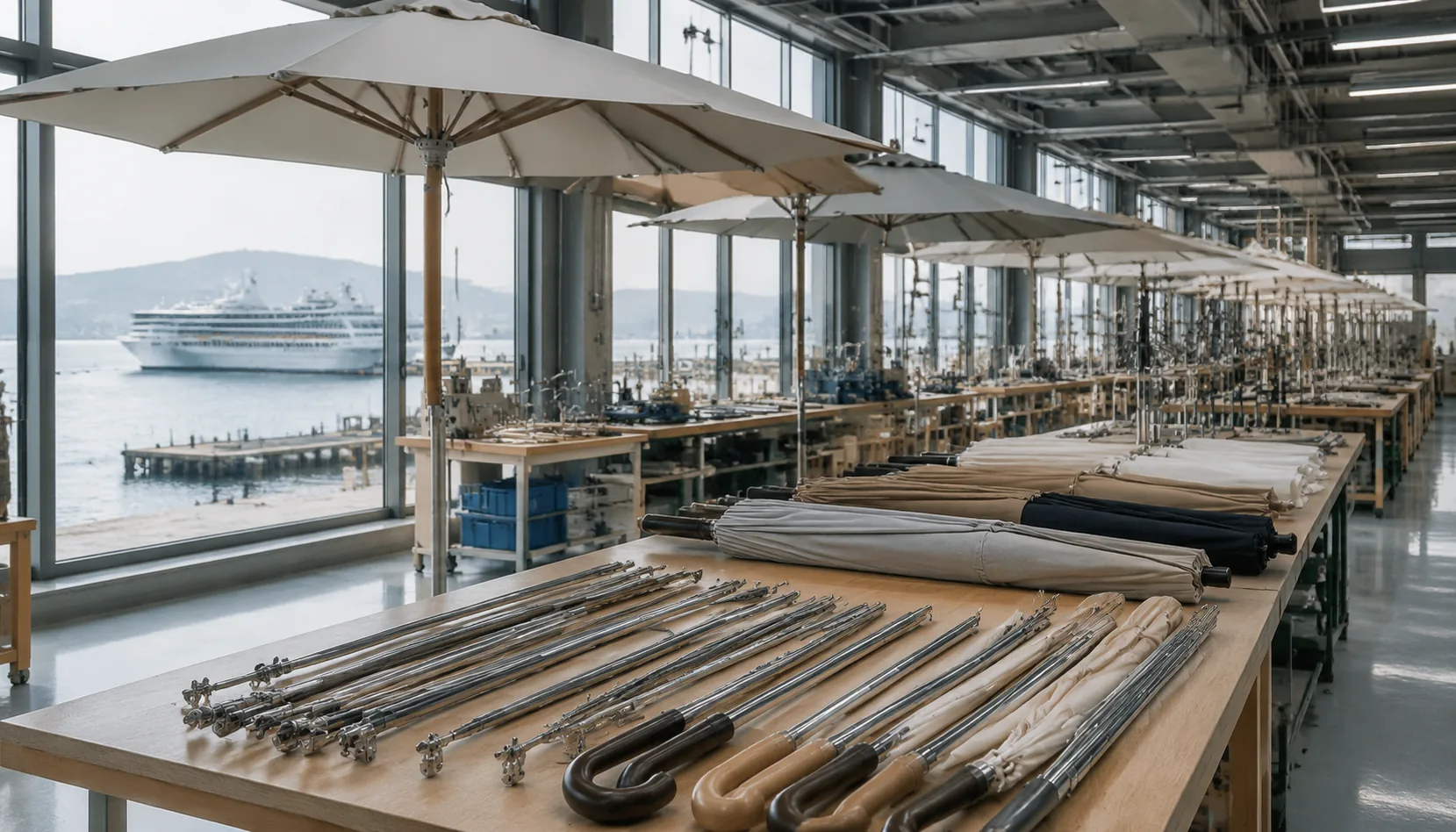
Cruise buyers do not just need a logo on fabric; they need umbrellas that survive salt air, tight cabin storage, tender transfers, and sudden port rain without creating service complaints. When we build custom umbrellas for cruise lines, we look first at compact frame strength, 190T or 210T pongee hand-feel, UPF 50+ coating consistency, carton sizing for port delivery, and AQL checks that catch weak ribs or print defects before loading.
Where Umbrellas Fit in Cruise Operations
Cruise umbrellas are not one product; they are three different inventories with different failure costs. For shore teams, port excursion umbrellas need to open fast, survive repeated handouts, and come back wet without bleeding dye onto bus seats. I usually specify a 23" or 27" auto-open stick umbrella with fiberglass ribs, 190T or 210T pongee, a straight EVA handle, and a dark canopy that hides scuffs from gangway bins. For escorting guests from terminal to coach during rainy port calls, 8K fiberglass is usually enough; for windy islands or exposed piers, a vented double-canopy 10K frame is safer. If the umbrella collapses in a 35 mph squall, the problem is not just a broken rib, it is a delayed excursion departure and an angry passenger line.
Guest gifts and VIP welcome kits are judged more by feel than by lifetime duty cycle. Branded cruise umbrellas for suites, loyalty tiers, or inaugural sailings can use 21" or 23" compact auto-open-close frames, 210T pongee, Teflon water-repellent coating, and a rubberized handle that fits into luggage without feeling cheap. Logo placement should be restrained: one panel screen print for classic hospitality, heat-transfer for detailed ship artwork, or full sublimation only when the design justifies the cost and longer sampling time. For custom umbrellas for cruise lines, I would avoid low-grade steel ribs on compact gifts because salt air and wet storage expose weak plating quickly. AQL 2.5 inspection should include open-close cycle checks, seam leakage review, logo rub testing, and carton drop checks because these items often travel through multiple warehouses before embarkation.
Onboard retail is a different calculation: the umbrella must sell at a margin, look good on a wall hook, and fit barcode, hangtag, and concessionaire requirements. A 21" compact manual umbrella can work as an entry-price souvenir, while a 23" auto-open-close with UV UPF 50+ coating can sit as a better travel SKU for Caribbean, Mediterranean, or Alaska itineraries. Operational stock should be simpler: bulk travel umbrellas in black, navy, or cruise-brand colors, packed 24 or 36 pieces per carton, with spare units staged at guest services, gangways, tenders, and excursion desks. Passenger rain umbrellas for loan programs need ID marking on the sleeve, not just the canopy, because sleeves disappear first. Typical production lead time is 25–35 days after artwork approval, with FOB Ningbo or Shanghai and DDP options for U.S. or EU cruise procurement teams when the order schedule is tied to a ship deployment date.
Compact vs Full-Size Models for Passenger Programs
For cabin placement and excursion-bus handout, a 3-fold auto-open umbrella is usually the right tool, not a miniature golf umbrella pretending to be compact. A 21" or 23" folding model with an 8K steel-and-fiberglass frame, 190T or 210T pongee canopy, and a closed length around 11–12 inches fits inside a stateroom drawer, seat-back pocket, welcome tote, or bus storage bin without creating housekeeping problems. I prefer auto-open over manual for passenger rain umbrellas because guests may be carrying shore cards, phones, or shopping bags when rain starts at the pier. Auto-open-close is convenient but adds cost and more spring load, so for bulk travel umbrellas used across mixed-age passengers, we test the button pressure and shaft lock carefully. A straight plastic handle saves space, but a matte rubberized ergonomic handle gives better grip when hands are wet or sunscreen-covered. For branded cruise umbrellas, the sleeve matters: a loose pongee sleeve with a wide mouth and drain gap is faster for passengers than a tight fashion sleeve nobody can repack.
For crew-led groups, especially walking tours where the guide needs visibility, a 54–60 inch full-size golf umbrella has a completely different job. A 27" or 30" stick umbrella with 8K or 10K fiberglass ribs, a fiberglass shaft, and a vented double canopy can keep two guests or a guide plus equipment dry, and it is much easier to spot in a crowd than a compact model. If the program involves windy ports, I would not specify cheap steel ribs; a fiberglass frame with a double-canopy vent can survive 50+ mph wind-tunnel testing when the runner, tips, and rib joints are not underbuilt. EVA or rubber-coated straight handles work well for guides because they can hold the umbrella for 30–60 minutes without the palm fatigue caused by narrow J handles. For port excursion umbrellas, sleeve design should use a shoulder strap or long carry sleeve, because guides need hands free for radios, clipboards, scanners, or first-aid kits.
Storage limits decide the mix more than buyers expect. Cabins do not tolerate bulky wet items: even a 54" golf umbrella can block closet floors, drip near carpet edges, and create return headaches for housekeeping, while 3-fold models can be issued one per cabin with a hang loop or sleeve tag for easy inventory. Tour vehicles are also tight. A 45-seat coach may handle a carton of 100 compact umbrellas, but 60" golf umbrellas need tall bins, rear luggage hold space, or a dedicated rack at the gangway. For custom umbrellas for cruise lines, our standard practice at ZheBrella is to separate passenger and crew specs: compact 21"/23" auto-open units for cabins and buses, larger 27"/30" vented umbrellas for guides, both checked under AQL 2.5 for open-close function, rib alignment, print position, and sleeve fit. Typical MOQ starts around 500–1,000 pieces per design, with 25–35 days production after artwork approval and FOB Ningbo or DDP delivery depending on the sailing schedule.
Marine-Adjacent Materials and Weather Performance
Salt air punishes umbrellas faster than normal city rain, so the frame choice matters more for cruise programs than many buyers expect. Steel ribs can be strong on paper, but once the plating is scratched at the rivet, runner, or rib tip, corrosion starts and the umbrella begins to stain the canopy or seize at the joints. Fiberglass ribs and fiberglass shafts avoid that problem because they do not rust, and they flex instead of taking a permanent bend when a gust hits the pier. For custom umbrellas for cruise lines, I usually avoid steel-heavy builds unless the umbrella is a short-life giveaway with a very tight budget. A practical spec is an 8K or 10K fiberglass frame for walking tours, with reinforced tips and a manual or auto-open runner tested for smooth operation after salt-mist exposure.
Canopy fabric should match the selling channel, not just the artwork. For value port excursion umbrellas handed out by tour operators, 190T pongee is the right baseline because it prints cleanly, dries faster than cheap polyester, and keeps the landed cost under control for bulk travel umbrellas. For onboard retail, loyalty gifts, or suite-level branded cruise umbrellas, 210T pongee feels denser in the hand and gives better color depth under screen print or heat transfer. I would not use PVC for a standard passenger rain umbrella unless transparency is part of the design; PVC and POE dome umbrellas are useful for visibility in crowded terminals, but they are less compact and need careful packing to avoid creasing.
Sunny ports change the performance requirement. In the Caribbean, Mediterranean, and Southeast Asia, the same umbrella may be used more for shade than rain, so a UPF 50+ coating is not cosmetic; it is a real comfort feature during shore excursions, tender queues, and open-air sightseeing. Silver, black, or specialized UV coatings can be applied under 190T or 210T pongee, but buyers should approve strike-offs because coatings can slightly change fabric hand feel and print brightness. Our standard practice at ZheBrella is to pair UPF 50+ canopies with fiberglass frames and run AQL 2.5 checks on opening force, rib alignment, seam leakage, and print placement before export. For coastal use, that combination gives better field performance than a cheaper steel-frame umbrella with a nice logo but weak corrosion resistance.
Branding for Retail, Guest Experience, and Wayfinding
Branding starts with panel control, not just a logo slapped on one wedge. For cruise retail, I usually recommend 23" auto-open straight umbrellas or 21" compact auto-open-close models with 190T or 210T pongee because the fabric prints cleanly and packs well in cabin luggage. Screen printing is still the most economical choice for one- or two-color ship logos, while heat transfer handles gradients, mascots, and port artwork better. For branded cruise umbrellas sold in onboard shops, the most overlooked detail is matching the canopy Pantone to the handle, sleeve, hangtag, and barcode label; passengers notice when the umbrella feels like real merchandise instead of a leftover promo item.
For excursions, color is operational. A cruise line running six bus groups in Ketchikan or three walking tours in Dubrovnik can use red, blue, yellow, and green canopy panels to make guides visible at 30-50 meters without shouting over crowds. Port excursion umbrellas should have printing on alternating panels so the logo is visible whether the guide is walking toward or away from passengers. I would avoid very dark canopies for tour leaders in heavy rain because they disappear against buses and terminal buildings; high-contrast white logos on bright pongee or POE work better. Custom umbrellas for cruise lines can also use numbered sleeve labels or woven tags to separate shore-excursion inventory from retail stock.
Open piers punish weak frames, especially when passengers are boarding tenders or waiting beside exposed gangways. For passenger rain umbrellas used in coastal wind, a double-canopy vented design with fiberglass ribs is safer than a cheap 8K steel frame; we normally test windproof models around 50+ mph before suggesting them for pier use. Co-branding with ports, duty-free shops, or excursion partners can be handled with a cruise logo on one panel and partner marks on two opposite panels, keeping the layout balanced. For bulk travel umbrellas, confirm MOQ, carton size, AQL 2.5 inspection level, and FOB or DDP delivery early, because onboard shop packaging and mixed-color tour assortments affect lead time by several days.
Lead Times, Inspection, and Port Logistics
Lead time is controlled less by sewing speed and more by fabric booking, frame availability, and logo approval. For custom umbrellas for cruise lines, I normally separate MOQ by model: 500–1,000 pcs for 21" folding auto-open passenger rain umbrellas, 1,000 pcs for 23" straight umbrellas with steel shaft and fiberglass ribs, and 2,000 pcs+ for POE/PVC clear dome styles because mold-cut panels and binding setup waste more material. Premium 27" or 30" golf umbrellas with 8K/10K fiberglass frames, double-canopy vents, and 190T/210T pongee usually start at 500 pcs per color, but mixed-color programs work better at 1,200 pcs+ because dye-lot control becomes easier.
A pre-production sample should be approved before fabric cutting, not after the line is already loaded. For branded cruise umbrellas, we check Pantone match under D65 light, logo position on each panel, print adhesion after wet rub, opening force, runner lock, tip alignment, and canopy tension. Screen printing is stable for one- or two-color logos; heat transfer is cleaner for gradients; sublimation is best for full-panel artwork but needs white polyester. Our standard practice at ZheBrella is PP sample approval in 5–10 days, then 30–45 days bulk production depending on frame type, printing method, and whether UPF 50+ or Teflon water-repellent coating is specified.
Inspection should be written into the PO, not negotiated after cartons are sealed. For port excursion umbrellas and bulk travel umbrellas, AQL 2.5 for major defects and AQL 4.0 for minor defects is a practical baseline; critical defects such as sharp burrs, broken stretchers, unsafe tips, or failed auto-open-close mechanisms are zero tolerance. FOB Ningbo or Shanghai makes sense when the cruise line has a nominated forwarder or regional consolidator. DDP is better when goods must land at a cruise warehouse, port agent, or Miami/Barcelona/Singapore distribution point with duty, trucking, and appointment delivery handled in one quote. For custom umbrellas for cruise lines, carton marks should include vessel program, port season, SKU, color, and PO number so warehouse teams do not split rain kits across sailings.
Frequently Asked Questions
Are folding umbrellas better than golf umbrellas for cruise lines?
Folding umbrellas are better for passenger gifts, cabin placement, and excursion bags. Golf umbrellas work better for crew escorts, gangway coverage, and premium retail where larger branding space matters.
What fabric should cruise retail umbrellas use?
210T pongee gives a smoother hand feel and more premium appearance for retail. 190T pongee is suitable for high-volume passenger giveaways when budget and carton efficiency are priorities.
What umbrella specs work best for cruise guests and shore excursions?
Most buyers choose 3-fold compact frames with 190T or 210T pongee fabric because they pack small and dry quickly. For sunny itineraries, UPF 50+ can be added, and many programs keep finished open diameter around 38 to 43 inches for adult use without adding too much weight.
Can you ship umbrellas directly to a cruise port or excursion warehouse?
Yes, but port delivery usually needs tighter scheduling, clear consignee details, and pre-shipment carton labeling. Buyers typically plan 2 to 4 weeks of buffer time for local port handling, customs clearance, and final-mile delivery coordination.
What quality checks should a distributor request for bulk umbrella orders?
AQL inspection is common, with buyers often specifying a general inspection level and checking canopy alignment, printing quality, opening/closing function, and water-repellent performance. For branded cruise programs, it’s also smart to confirm handle finish and color consistency before bulk release.
Looking to Launch Your Custom Umbrella Line?
ZheBrella is a Zhejiang-based OEM/ODM umbrella manufacturer with 17 years of export experience. Free design, low MOQ from 100 pieces, windproof construction, full-color print.
Get Free Quote Now »People Also Search For
Related Articles
Custom Umbrellas for Cruise Lines, Marinas, and Excursions
Source umbrellas for cruise retail, marina guests, and shore excursions with marine-ready specs, branding choices, MOQ p...
Read More »
Custom Umbrellas for Cruise Lines and Ferry Operators
Source marine passenger umbrellas with windproof builds, corrosion-aware materials, and FOB/DDP planning for cruise, fer...
Read More »
Branded Umbrellas for Cruise Lines and Ferry Operators
Source marine-ready umbrellas for shore excursions, terminals, and onboard retail with windproof frames, 210T pongee, AQ...
Read More »