Custom Umbrellas for Insurance Adjusters and Claims Teams
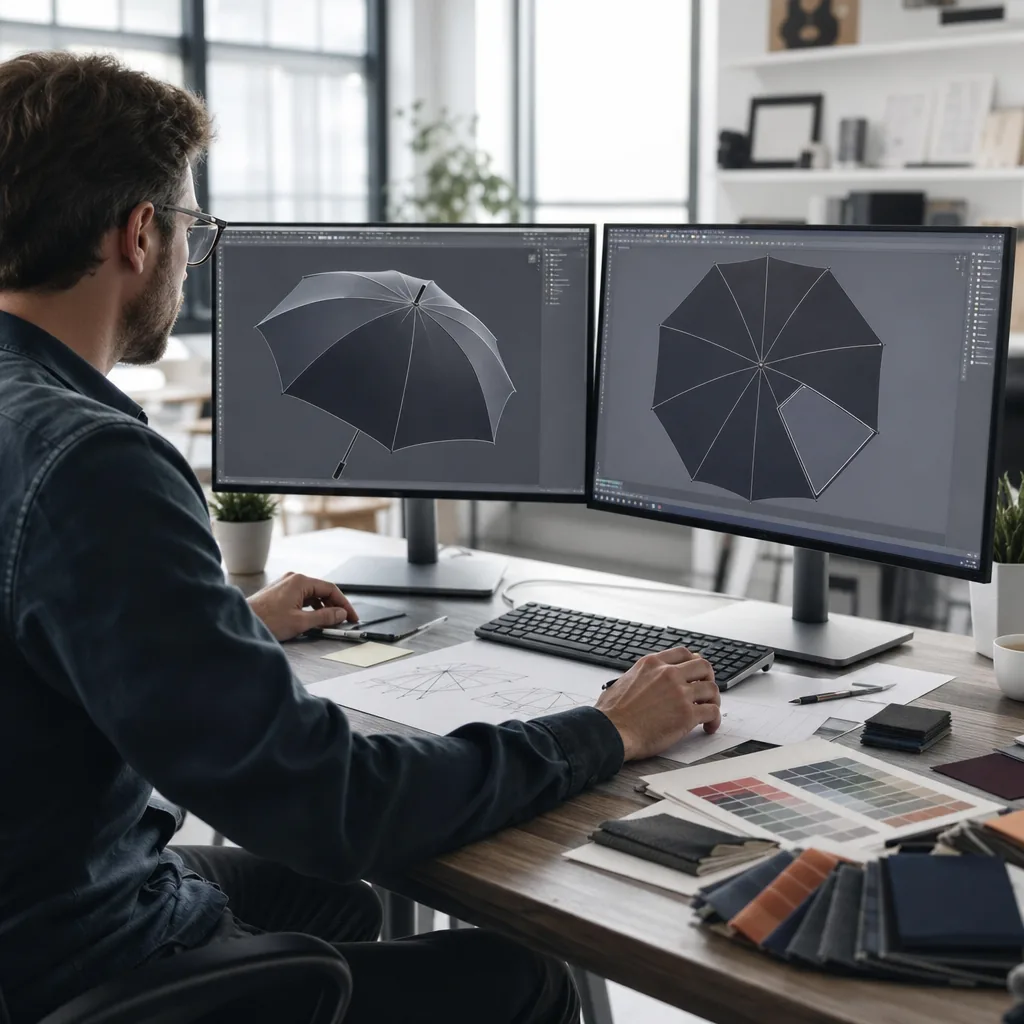
When storm response teams are standing in wind, rain, and roadside traffic, a promo-grade umbrella that fails on the second deployment becomes an operations problem, not a branding detail. Buyers sourcing custom umbrellas for insurance adjusters need to weigh frame strength, opening reliability, canopy coverage, and repeat-order consistency the same way we do on the factory floor, where rib fatigue, shaft wobble, and fabric tension show up long before a shipment leaves Songxia.
Why Insurance Field Teams Need a Different Umbrella Spec
Insurance field teams destroy umbrellas faster than office buyers expect because the job is not commuting. A giveaway-grade 21-inch frame may be fine for parking-lot use, but it tends to fail when an adjuster is climbing in and out of a truck 15 to 30 times a day for property inspections, roadside assessments, CAT response, and client visits. For custom umbrellas for insurance adjusters, the baseline spec is larger coverage and faster deployment: a 23-inch or 27-inch canopy protects shoulders, tablets, clipboards, and claim files better than a 21-inch frame, and auto-open work umbrellas let the user deploy one-handed while holding a ladder rail, camera case, or moisture meter. That matters on wet roofs, highway shoulders, and apartment complexes, where stopping to fight a manual runner wastes time and adds risk. The mechanism also has to tolerate field abuse. A dependable auto-open system that keeps working through dust, grit, and repeated wet-close cycles is a better buying priority than the lowest unit price.
Durability is where cheap umbrellas fail first. Thin steel ribs paired with oversized canopies invert easily around damaged roofs, open lots, and roadside claim scenes, so fiberglass rib umbrellas are the practical upgrade. In an 8K or 10K frame, fiberglass ribs and a fiberglass shaft flex under load and recover shape better than electroplated steel, which directly improves service life. Match that frame with 190T or 210T pongee for faster drying, cleaner logo print, and better wear when the canopy is opened wet, closed dirty, and dropped back into a vehicle. If your teams work in routine wind exposure, a vented double-canopy build tested to 50+ mph usually justifies the higher cost. Claims team umbrellas also need to look credible on client visits, so darker canopies such as navy, black, or charcoal with a restrained logo are standard, along with a molded ABS handle and wrist strap instead of a hook handle that snags on seats and tool bags. Treat these as field adjuster rain gear, not promo swag: ask for AQL 2.5 inspection, opening-cycle checks, MOQ in the 300 to 500 piece range, and 25 to 35 days production after sample approval.
Best Frame, Canopy, and Opening Specs for Field Work
Frame spec determines service life more than logo treatment. For custom umbrellas for insurance adjusters, fiberglass rib umbrellas are the better default for repeat field use because the ribs flex under gusts and recover their shape; lower-cost full steel frames are more likely to leave crews with bent ribs or twisted stretchers after repeated use around trucks, curbside inspections, and job sites. A practical base spec is a 23-inch or 27-inch straight umbrella with an 8K frame, fiberglass ribs, and a steel shaft. That combination keeps unit cost, weight, and daily durability in balance better than all-steel economy frames. For storm claims, roadside work, or exposed roof inspections, move to a vented double-canopy frame with factory wind testing around 50 mph. The point is not feature inflation; it is reducing the chance of inversion and field failure during an active inspection.
Opening method and storage format should match how adjusters actually work. Auto-open is the right mechanism for claims team umbrellas because most users are stepping out of a vehicle with a phone, tablet, camera, or clipboard already in hand. Manual open is cheaper, but the repeated two-handed action slows deployment across multiple stops. Auto-open-close compacts help when storage space is tight, yet the extra mechanism usually gives up canopy tension and long-term durability versus a straight auto-open stick. Choose the format by vehicle storage: a 21-inch or 23-inch compact fits more easily in a door pocket or center console, while a 27-inch or 30-inch straight-handle model gives better shoulder coverage for documents, equipment, and entry and exit around SUVs and pickups. For field adjuster rain gear programs, 190T pongee is the standard fabric because it controls cost, prints cleanly, and dries faster than cheap polyester; 210T pongee is the better upgrade when buyers want a heavier hand, sharper logo print, and stronger perceived quality. Add a black UV coating, Teflon water-repellent finish, or a UPF 50+ canopy when the umbrella will see extended outdoor exposure rather than occasional rain use.
Choosing Windproof and Visibility Features by Region
Match the umbrella spec to the territory first, because field failures usually start at the ribs, stretchers, or runner assembly long before the canopy fabric wears out. For custom umbrellas for insurance adjusters working coastal storm belts, mountain corridors, or open commercial sites, the baseline should be a double-canopy vented frame with fiberglass ribs, a reinforced shaft, and an auto-open mechanism built for repeated daily cycles. A 23-inch or 27-inch canopy in 190T or 210T pongee gives enough coverage for tablets, clipboards, and camera gear without becoming difficult to control in gusts. In Gulf Coast routes or windy Midwestern claims zones, specify windproof structure first and ask for field-ready frames tested to 50+ mph conditions. In calmer urban territories, a simpler straight umbrella can be enough if frame consistency and runner quality are still controlled. Leave handle styling and printed decoration until after the structural spec is locked; for working fleets, replacement rate, deployment speed, and service life affect total cost more than cosmetic upgrades.
Canopy size should follow the inspection task. For ladder-adjacent roof checks, parking lot walk-throughs, and perimeter photo work, a 21-inch or 23-inch frame is easier to manage one-handed. For longer stationary inspections, catastrophe staging, or shared coverage with a policyholder, a 27-inch or 30-inch straight umbrella gives better shoulder and equipment protection, which is why claims team umbrellas usually outperform compact folding units in daily field use. Add reflective piping, high-visibility edge tape, or bright canopy panels for roadside vehicle claims, dawn or dusk visits, and winter work near traffic or heavy equipment; field adjuster rain gear needs to improve conspicuity as well as weather protection. An 8K fiberglass frame is sufficient for most daily use when rib stock is consistent and the canopy is not oversized, especially on a vented 23-inch or 27-inch model. Premium 16K designs can look denser and more upscale, but they are often more about image than field performance: extra ribs add joints, weight, and assembly complexity, and a poorly engineered 16K frame can underperform a well-built 8K. For fleet orders, specify fiberglass rib umbrellas with AQL 2.5 inspection, and reserve 16K styles for presentation-driven programs.
How Procurement Teams Standardize SKUs Across Branches
National insurers and TPAs usually control cost better with three standardized SKUs instead of letting branches buy different frames, sizes, and canopy colors. For custom umbrellas for insurance adjusters, the core SKU is typically a 23-inch or 27-inch auto-open straight umbrella with 8K fiberglass ribs, a black steel shaft, and a 190T or 210T pongee canopy. That build holds up better to daily trunk use than low-cost all-steel frames, especially when adjusters open and close the umbrella 6 to 10 times per day during roof inspections, roadside assessments, and property walk-throughs. The second SKU is an executive 30-inch golf-style umbrella with a wood or matte-finish handle, tighter canopy sewing tolerance, and cleaner panel alignment for broker meetings, carrier visits, and larger insured accounts. The third is a CAT-response model: usually a 27-inch or 30-inch vented double-canopy frame built with fiberglass rib umbrellas, reflective trim, and a high-visibility sleeve, with wind resistance suited to 50+ mph gusts. That three-tier setup gives procurement a clear durability ladder without carrying a dozen overlapping specs.
The program only works if procurement holds the line on MOQ and logo rules. The most efficient structure is one shared frame and one shared canopy color across branches, with only approved artwork changing by entity or region; once teams add 21-inch foldables, extra handle molds, or multiple canopy colors, small orders get slower and unit cost rises. A practical MOQ is usually 300 to 500 pieces per SKU per color. For branch branding, screen printing is the better fit for simple 1-color or 2-color marks at moderate volume, while heat transfer gives more flexibility for smaller regional identifiers. Keep the rules fixed: corporate logo on one panel, branch or TPA identifier on the closing strap or opposite panel, and no unapproved color substitutions. Replenishment should track storm seasons and claims spikes, not just annual budget cycles. Most buyers place preseason orders 60 to 90 days before hurricane, hail, or severe-weather peaks to cover artwork approval, fabric booking, production, AQL 2.5 inspection, export booking, and inland distribution. Core claims team umbrellas can be forecast from headcount and branch demand, while CAT stock should be buffered separately and reordered when inventory drops below about 35% of peak-season demand, especially when field adjuster rain gear needs fast DDP replenishment instead of slower FOB planning.
Quality Assurance, Lead Times, and Landed Cost Basics
Approve custom umbrellas for insurance adjusters against field-use standards, not appearance alone. For auto-open work umbrellas, require open-close cycle checks on production samples from the actual run: 500 to 1,000 cycles on the spring, runner, and latch, with any hesitation, incomplete lock at the notch, or inconsistent release treated as a reject. Put frame construction in the PO as well. Fiberglass rib umbrellas are the safer choice for repeated vehicle-to-site use because fiberglass will flex back after gust loading, while low-grade electroplated steel ribs are more likely to take a permanent bend. For print approval, do not sign off on a simple visual match. Lock the logo position from the panel seams, confirm the Pantone reference before sampling, and approve one print standard for each canopy color. That is especially important on 190T and 210T pongee, where screen print and heat transfer show different edge sharpness and ink penetration, and small variation is obvious on white or other light panels.
Write final QC and packing terms before deposit so disputes stay objective. AQL 2.5 final inspection should prioritize defects that trigger receiving claims or branch complaints: broken tips, skewed canopy panels, scratched handles, loose top caps, dirty white panels, and mispacked color or branch assortments. For claims team umbrellas entering warehouse stock, export carton specs are part of quality control, not an afterthought. Use a 5-ply corrugated master carton and require carton dimensions, gross and net weight, PO number, style code, color code, quantity, and destination label on two sides; inner packs of 10 or 12 usually make branch allocation easier than opening 36- or 48-piece masters. Lead times are straightforward when the frame and handle are standard: 5 to 7 days for a digital mockup, 7 to 12 days for a physical sample, and another 7 to 10 days if you need a new handle badge mold or a custom 23-inch or 27-inch frame. Bulk production typically runs 25 to 35 days after sample approval and deposit for 1,000 to 5,000 pieces, stretching toward 40 days in peak rain season. FOB Ningbo or Shanghai usually works best if you ship to one DC or already use a U.S. forwarder; DDP is usually the better fit when custom umbrellas for insurance adjusters need to land at multiple branch addresses with duties and last-mile delivery included.
Frequently Asked Questions
Is auto-open or auto open-close better for claims adjuster umbrellas?
Auto-open is usually the better fit because it deploys quickly with fewer moving parts to fail in heavy field use. Auto open-close can be useful for compact executive models, but it is typically less preferred for rugged operational programs.
Do adjuster teams need double-canopy umbrellas?
Not always, but they are valuable in coastal, storm-prone, or open-site environments where gusts are common. For routine urban inspections, a single-canopy fiberglass-frame umbrella may be enough at a lower cost.
What umbrella specifications hold up best for insurance adjusters working around vehicles and properties?
For daily field use, buyers typically choose 23 to 27 inch auto-open umbrellas with fiberglass ribs and a reinforced shaft. That size gives enough coverage for clipboards, tablets, and inspection photos without becoming awkward in tight residential or auto lot spaces.
How should claims teams plan reorders before storm season or catastrophe deployments?
A practical approach is to split purchasing into a base annual order plus a reserve buffer of 10% to 20% for surge events. For OEM programs, repeat orders usually move faster than first runs because artwork, Pantone matching, and packaging specs are already approved.
Which QC checkpoints matter most when buying umbrellas for multi-region field operations?
B2B buyers usually ask suppliers to verify auto-open function, rib tension consistency, canopy stitching, and carton drop resistance before shipment. For regional deployments, it also helps to confirm labeling by branch, carton counts, and AQL inspection terms so distribution errors do not delay field rollout.
Looking to Launch Your Custom Umbrella Line?
ZheBrella is a Zhejiang-based OEM/ODM umbrella manufacturer with 17 years of export experience. Free design, low MOQ from 100 pieces, windproof construction, full-color print.
Get Free Quote Now »People Also Search For
Related Articles
Custom Umbrellas for Insurance Adjusters and Claim Teams
Source durable umbrellas for adjusters and field claim teams with fast-open specs, weather-ready fabrics, QC standards, ...
Read More »Umbrella Programs for Insurance Adjusters and Claim Teams
Build durable umbrella programs for adjusters and field claim teams with practical specs, branding rules, MOQs, QC stand...
Read More »
Umbrella Programs for Insurance Adjusters and Claims Teams
Build umbrella programs for insurance adjusters with field-ready specs, sun and rain protection, branding options, and d...
Read More »