Designing Umbrellas for Manufacturability in OEM Production
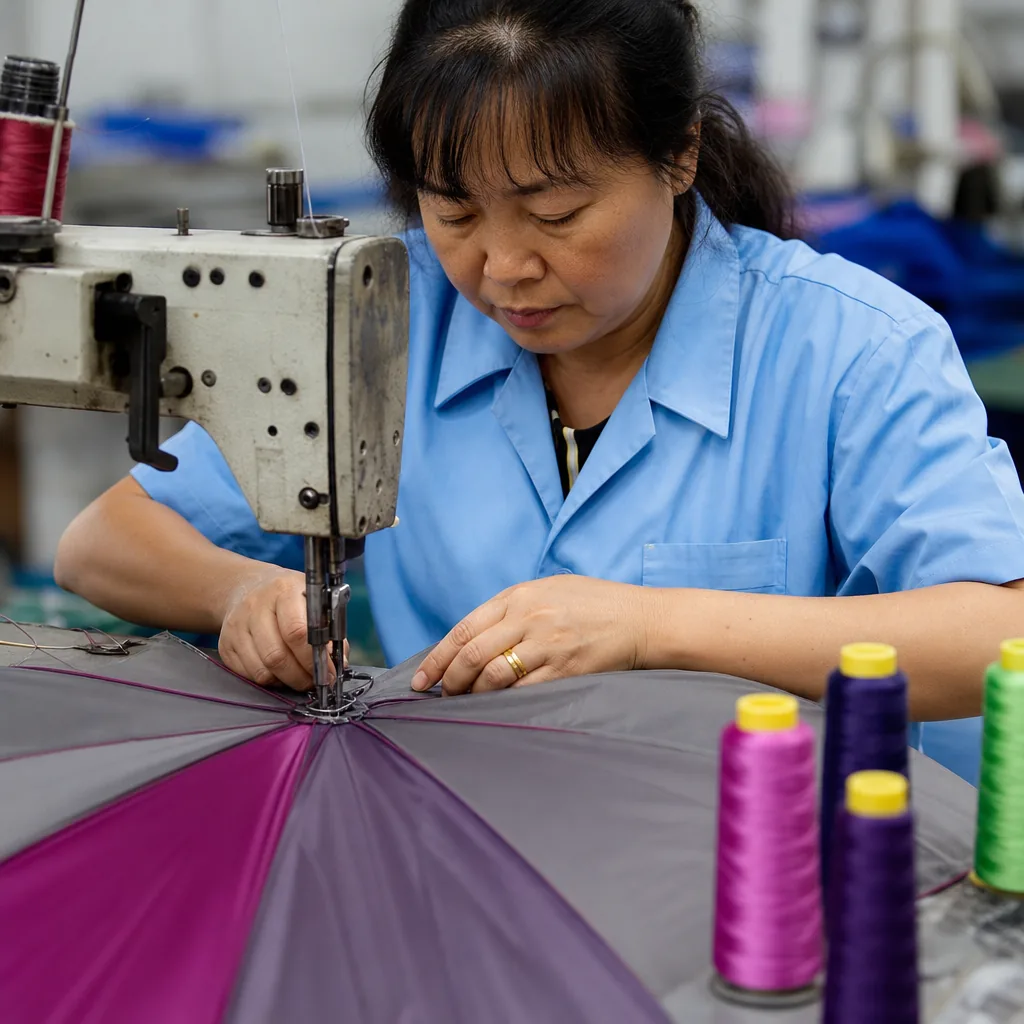
OEM buyers often discover too late that a clean-looking umbrella concept is hard to build at scale: ribs bind, panels drift, seam allowances vary, and the bill of materials keeps changing after tooling starts. Effective umbrella design for manufacturability starts on the factory floor, where frame tolerances, fabric behavior, and assembly sequence are matched before samples become expensive problems.
Start With Proven Platform Choices
The lowest-risk umbrella design for manufacturability starts with a proven platform, not a custom sketch. For OEM umbrella product development, that usually means an 8K straight umbrella for promotions, a 3-fold auto-open model for daily carry, or a double-canopy golf style when wind resistance matters. Standard rib counts, shaft diameters, ferrules, and runner geometry let the factory use existing tooling, gauges, and repair records instead of building new tolerances around trial fits, broken samples, or spring-rate problems. Buyers usually get faster sampling, fewer revision rounds, and lower upfront engineering cost when they stay inside a validated frame family.
Common sizes matter as much as the opening system. A 21" or 23" straight umbrella usually fits standard pongee 190T or 210T panels, while 27" and 30" golf frames align with established canopy layouts and cut patterns. That keeps umbrella cost engineering tied to stock parts such as standard tips, conventional open springs, and fiberglass or steel ribs that already fit factory jigs. If you start with an unusual arc, shaft length, or rib layout, you add labor before print development begins and raise the risk of a longer approval cycle. Buyers should lock the size and frame first, then adjust canopy material, coating, or handle spec around that platform.
Tested opening systems should come before cosmetic features because they drive failure rate, packing size, and user experience. Manual, auto-open, and auto-open-close mechanisms each have different tolerance stacks, but the failure points are predictable when the shaft, runner, and rib geometry stay within proven combinations. That is what improves umbrella production efficiency: fewer sample rounds, fewer reworks at AQL 2.5, and a cleaner path to bulk production under the agreed MOQ and lead time. Buyers can still change canopy color, print, Teflon coating, UPF 50+ treatment, or handle style later; the first decision should be the platform that already works at scale, with FOB or DDP terms set after the sample is locked.
Choose Materials the Factory Can Source Repeatedly
For umbrella design for manufacturability, the first test is whether the factory can source the same materials every month without changing fit, weight, or cycle time. Fiberglass ribs are usually the safer default for OEM umbrella product development because they flex back instead of taking a permanent set, add less weight, and avoid the corrosion and straightness variation common with thin steel. Steel still has a place in low-cost straight umbrellas where stiffness matters more than wind recovery, but once the spec moves to a lighter frame or a vented canopy, fiberglass usually gives better umbrella production efficiency. Lock the rib count early, because 8K, 10K, and 16K frames need matched ferrules, tips, hubs, and springs. A handle spec should be just as stable: PP and ABS are the easiest to source at volume, EVA and TPR overmolds improve grip but add tooling and cycle-time risk, and wood sits in a higher-end lane with more moisture-control and color-variation issues.
For the canopy, pongee 190T is the standard choice because it cuts, sews, and prints with predictable results at scale. Pongee 210T gives a denser hand feel and a slightly heavier cloth, but it raises fabric cost and should be used only when the target price can absorb it. POE and PVC belong mainly on clear or specialty umbrellas because they shift the process away from standard sewing toward welding or other specialty handling, which increases scrap risk compared with pongee. Keep fabric width, coating weight, panel count, and seam construction fixed before sampling; if those variables change later, cutting yield, seam settings, and labor minutes all move with them. That is the core of umbrella design for manufacturability: hold the material stack stable enough that the factory can quote, sample, and scale without reworking the BOM every round.
Premium specs should be treated as added process steps, not as label changes. UPF 50+ coatings and Teflon water-repellent finishes add application passes, cure control, and test requirements, so they must be built into lead time, inspection points, and unit cost before approval. They also increase risk during incoming inspection and final QC because coated fabric can fail differently from plain dyed pongee 190T or 210T. In practical terms, moving from standard fabric and basic PP or ABS handles to coated 210T with UPF 50+ protection changes the BOM, the sampling plan, and the production schedule. The right decision is not whether the spec looks better on paper, but whether the factory can repeat it at the intended MOQ, AQL 2.5 target, and delivery window without slowing production or raising defect rates.
Avoid Design Features That Create Assembly Failures
The fastest way to lose money in OEM umbrella product development is to treat the canopy and frame as separate parts. A pattern cut too tight will pull ribs off center as soon as sewing starts, especially on 21" and 23" stick umbrellas, where there is little room to absorb distortion. If rib arc, stretcher length, runner travel, and panel angle are not matched in the first sample, the result is skewed frames, uneven tip projection, and rework at closing and opening stations. That is the real test of umbrella design for manufacturability: the structure has to survive assembly, not just look correct in CAD. For buyers, the risk shows up as higher labor, slower line speed, and unstable output before mass production starts.
Heavy trims create the same problem in a different way. Thick jacquard edging, oversized logo patches, metal beads, and long tassels add weight at the canopy edge, which changes how the frame hangs and can push rib tips out of position during sewing and final inspection. Those details affect umbrella cost engineering because they increase operator handling time, defect rate, and packing loss. A manufacturable umbrella design keeps load centered, leaves enough seam allowance for tension control, and avoids features that force repeated manual correction. If the goal is umbrella production efficiency, the design must be easy to sew, easy to close, and easy to pack without twisting the frame or creasing the canopy.
Tolerance risk rises again with 16K designs and custom hardware. More ribs mean more joints, more alignment points, and more opportunities for small errors to stack up if tooling is not mature. When ferrules, stretcher eyelets, runners, and shaft fittings are not tooled cleanly, a 16K frame can open unevenly, sit twisted at rest, or drift out of symmetry from one sample to the next. Auto-open and auto-open-close layouts are even less forgiving because spring force and latch timing leave little room for poor geometry. In practice, mature tooling matters more than clever styling: once the frame, hardware, and pattern are locked correctly, the line stops absorbing avoidable adjustments and the umbrella becomes repeatable enough for real OEM production.
Engineer the Spec Pack for Bulk Repeatability
A production-ready spec pack removes guesswork before sampling starts. In umbrella design for manufacturability, lock the open diameter, closed length, panel count, rib count, shaft material, frame finish, canopy fabric code, handle style, and print method in one revision-controlled file. A workable OEM example is a 23-inch automatic-open umbrella with 8K fiberglass ribs, a steel shaft, matte black powder-coated frame, and a pongee 190T canopy. Print placement should be dimensioned by panel number and X/Y location, not described as “logo on canopy.” The pack also needs the mechanism called out as manual, auto-open, or auto-open-close, because each version changes the runner, spring, button, and packed height. If the drawing only says “navy umbrella with logo,” the factory will fill in seam allowance, tip style, and handle stack-up, and those assumptions usually turn into sample delays and unstable mass production.
Test requirements belong in the same document, not in a follow-up email. For OEM umbrella product development, specify whether the canopy needs a water-repellent or Teflon coating, UPF 50+ UV protection, and a wind target such as 50+ mph for vented or double-canopy styles. Add measurable checks for seam strength, tip pull-out resistance, opening-cycle count, color fastness, and corrosion resistance on plated parts. The quality plan should name checkpoints at incoming material, first article, in-process assembly, and final packing, with AQL 2.5 as the shipment standard for critical and major defects. That level of detail improves umbrella cost engineering and umbrella production efficiency because it cuts rework, line stoppages, and carton-to-carton variation.
Packing and labeling need the same control as the frame spec. A manufacturable umbrella design should define folded length, polybag or sleeve requirement, carton count, inner box style, barcode placement, master carton marks, and whether hanging tags or insert cards are required, since each choice affects labor time and carton fit. The spec should also name the accepted fabric options, such as pongee 190T, 210T, POE, PVC, or EVA, plus the print process for each zone, whether screen print, heat transfer, or sublimation. The most reliable runs start with a dimensioned drawing, approved color chips, a sealed sample, and a written inspection sheet tied to the same revision. That gives the factory a buildable target and gives QC a clear standard for passing final goods at AQL 2.5 without arguing over what the sample was meant to mean.
Balance Cost, MOQ, and Lead Time Early
The lowest unit price on an umbrella quote often conceals the highest launch cost once mold charges, sampling, and procurement delays are factored in. For umbrella design for manufacturability, start by identifying which parts exist in the factory’s parts library and which require new tooling. A custom runner, ferrule, or handle can add mold charges, stretch PP sample timing by weeks, and tie up engineering capacity. Standardizing on common 21" or 23" frames, a consistent fiberglass rib set (e.g., 8K or 10K), and stocked pongee 190T or 210T typically shortens sampling by 5–10 days. It also lowers MOQ pressure because the buyer pulls from routine inventory instead of placing a special fabric or hardware lot with slower replenishment and higher scrap risk.
In OEM umbrella product development, material availability, MOQ, and lead time must be treated as one decision. A nonstandard POE canopy, an 8K rib count, and a custom EVA grip in the same order create more sourcing steps, approval points, and delay risk. The factory must coordinate canopy fabric, frame parts, print files, carton specs, and assembly sequence—one late item can push the entire schedule. Lock the mechanism first, then confirm rib length and canopy fabric, then choose decoration (screen print, heat transfer, or sublimation). This sequence improves umbrella production efficiency by avoiding one-off parts in the sample room and enabling batch material buys, AQL 2.5 quality control, and predictable lead times (typically 30–45 days for standard builds).
A manufacturable umbrella design also stabilizes FOB or DDP planning. Standardized parts make carton counts, gross weight, and pack-out easier to forecast, so freight quotes shift less when handle shape, canopy size, or vented double-canopy construction changes late in development. That stability reduces total landed cost volatility, critical when ocean freight, inland trucking, and accessory sourcing move on different timelines. Practical savings come from running existing cutting tables, sewing templates, and rib-assembly jigs with minimal changeover—not from chasing pennies off fabric. For umbrella cost engineering, the best result is a simpler bill of materials that keeps mold charges down, shortens sampling, and delivers a clearer FOB or DDP estimate before production starts.
Frequently Asked Questions
Is it better to use standard umbrella components or fully custom parts for a new OEM launch?
For first runs, standard components usually reduce tooling cost, shorten sampling, and improve assembly consistency. Custom parts make sense when the branding or function justifies higher MOQ and longer validation time.
Can a factory make a 16K umbrella as easily as an 8K model?
No. A 16K umbrella involves more ribs, more sewing alignment points, and tighter frame-canopy matching, so it generally carries higher labor content and a greater risk of tolerance-related defects.
Which umbrella design choices usually increase tooling risk in OEM production?
New rib geometry, nonstandard runner shapes, custom handle molds, and unusual shaft diameters often require new tooling or fixture changes. As an example assumption to verify in the supplier quote, a new plastic handle mold may add a separate tooling charge and extend sampling by 10-20 business days depending on mold complexity and supplier capacity.
How can a buyer reduce unit cost without weakening the umbrella structure?
Start with proven frame sizes, standard rib counts, existing handle molds, and fabric widths that minimize cutting waste. For example, confirm whether the factory already runs 21-inch, 23-inch, or 27-inch frame programs, then compare BOM changes line by line before approving a custom component.
What should be checked before approving a manufacturable umbrella sample?
Check rib alignment, runner movement, canopy tension, seam placement, print registration, wind resistance target, and packed-carton dimensions. For bulk orders, ask the supplier to state the inspection standard, AQL level, sample size, and the exact tests included before production begins.
Looking to Launch Your Custom Umbrella Line?
ZheBrella is a Zhejiang-based OEM/ODM umbrella manufacturer with 17 years of export experience. Free design, low MOQ from 100 pieces, windproof construction, full-color print.
Get Free Quote Now »People Also Search For
Related Articles
ODM Umbrella Tooling and Molds: Cost, Ownership, and DFM Rules
Plan ODM umbrella tooling with clearer mold scope, DFM checkpoints, and ownership terms to reduce delays, fit issues, an...
Read More »
Umbrella Sample Approval Process for OEM Brand Orders
Learn how to approve umbrella samples faster with clear checkpoints for materials, print color, mechanism feel, and pre-...
Read More »How Custom Umbrella Molds Affect Cost, MOQ, and Lead Time
Learn when new umbrella molds make sense, what tooling changes cost, and how they affect MOQ, sampling, and production t...
Read More »