How Custom Umbrella Molds Affect Cost, MOQ, and Lead Time
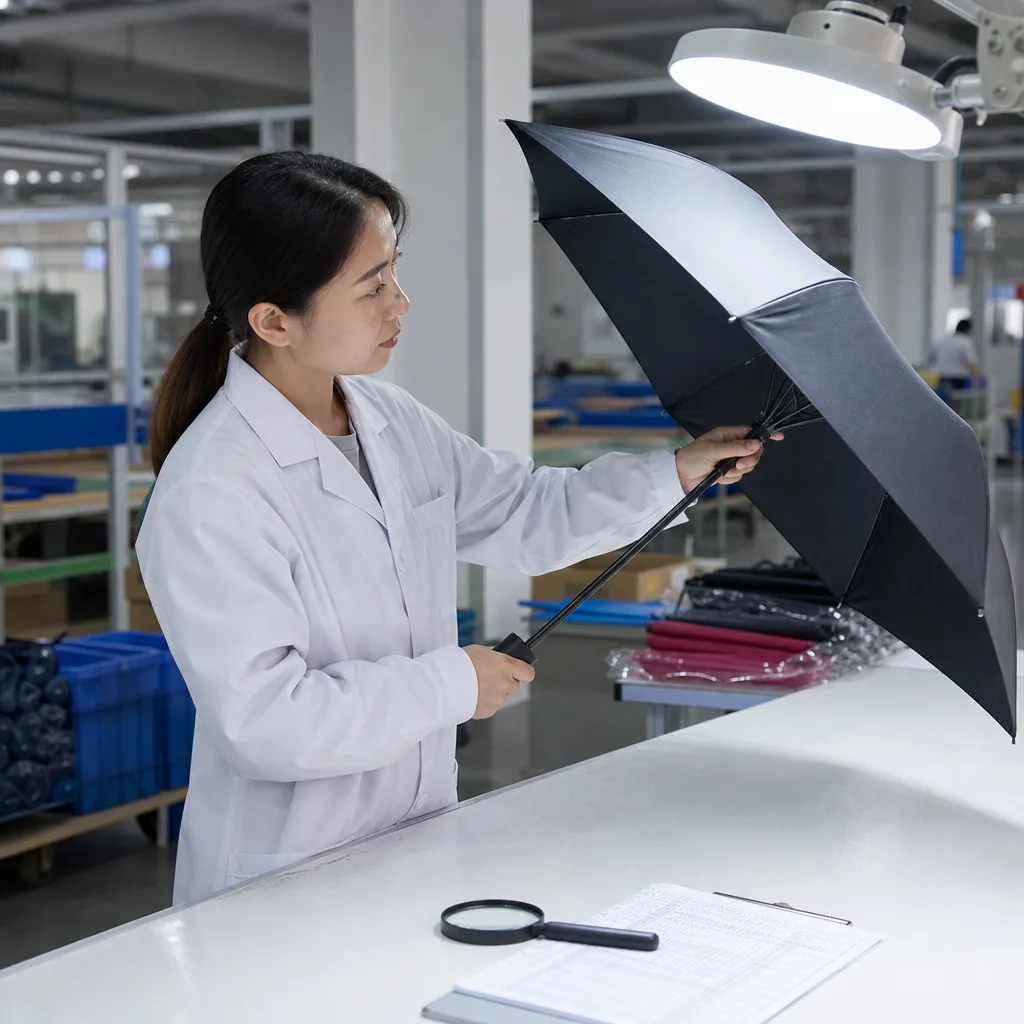
For OEM umbrella buyers, a new handle, cap, runner, or plastic tip can look like a small design change, but on the factory floor it affects tooling, sampling, MOQ, and the whole delivery schedule. The real custom umbrella mold cost is not just the mold invoice; it includes trial shots, fit testing with ribs and shafts, color approval, and the risk of rework before mass production.
Know Which Parts Usually Require New Tooling
Separate decoration from molded-part changes before you price the job. Most promotional and retail umbrellas can stay on stock tooling: 190T or 210T pongee canopy colors, screen printing, heat-transfer logos, woven labels, sleeve printing, and standard handle color changes. A 23" 8K auto-open straight umbrella with a black EVA J-handle, metal shaft, plastic tips, and stock runner can usually proceed to artwork proofing and a pre-production sample without OEM umbrella tooling. Custom umbrella mold cost enters the quote when the request needs a proprietary handle shape, nonstandard ferrule, unique top cap, branded rib tip, custom runner button, safety cap, or embedded metal/plastic nameplate outside the factory’s tooling library. Those parts control fit, tolerances, assembly order, and sometimes carton packing, so they are structural changes—not cosmetic upgrades.
Handles cause the most quotation risk because small design edits can change the frame assembly. Printing a logo on a rubberized straight handle is cosmetic; changing grip diameter, adding finger grooves, inserting a zinc-alloy badge, or matching a protected retail silhouette requires tooling review before pricing. The umbrella handle mold MOQ is usually higher than canopy-only customization because injection molding needs stable resin color, shrinkage checks, trial fitting, and enough volume to amortize the mold. Quote EVA soft grip, ABS, PP, wood-effect plastic, and zinc-alloy insert parts separately because each material fills, cools, and assembles differently. A handle only 3 mm wider can reduce sleeve fit, lower carton count, or interfere with an automatic open/close button, creating cost, lead-time, and delivery risk.
Do not ignore small molded parts. A custom ferrule can change canopy tension and top-notch position. A new runner profile can affect spring travel on manual, auto-open, and auto-open-close frames. Longer rib tips may require revised panel allowance on 21", 23", 27", or 30" umbrellas. Once a part changes fit, movement, or safety clearance, the project moves from logo decoration to custom umbrella development and needs sample fitting, pull tests, opening-cycle checks, and pre-production approval before bulk production. For a canopy-only logo order, umbrella sample lead time is often 5–7 days. With new molded components, allow 20–35 days for prototype sampling and testing before mass production approval, depending on mold complexity and revision count. This is where custom umbrella mold cost affects MOQ, lead time, and production risk together.
Estimate the Cost Impact of Mold Decisions
Price OEM umbrella tooling by part, because a handle change carries far less engineering risk than a frame change. An ABS straight or crook handle is usually the lowest-cost mold: about $800–$2,500 depending on cavity count, engraved logo detail, Pantone color match, matte or leather-grain texture, and whether the insert is threaded, riveted, or bonded. TPR over-molded grips require a second mold set plus bond-control checks between hard ABS and soft TPR, so the tooling and sample approval cost rise. Metal components sit in a higher bracket: die-cast zinc alloy handles, aluminum runners, and custom ferrules typically require $2,000–$6,000, with CNC samples approved before the production die is cut. Estimate custom umbrella mold cost as a component-by-component risk calculation, not a blended line item.
A custom handle mold is cheaper than a full frame redesign because it does not change the umbrella’s load path. The factory can usually keep the existing steel or fiberglass shaft, runner, rib assembly, canopy cutting die, and sewing pattern. By contrast, changes to rib length, stretcher position, runner travel, spring force, or shaft diameter require checks for opening tension, spring release, rib-tip clearance, canopy tension, and wind behavior. On a 23-inch auto-open umbrella with an 8K fiberglass frame, even a small runner or shaft change may require new rib-assembly jigs and 500–1,000 open-close cycle tests. At ZheBrella, umbrella handle mold MOQ typically starts around 1,000–3,000 pieces; a true frame redesign usually needs 5,000–10,000 pieces or more to absorb engineering time, failed trials, and fixture cost.
Amortization decides whether custom umbrella development is worth the order size. A $1,500 ABS handle mold adds $1.50 per umbrella at 1,000 pieces, $0.30 at 5,000 pieces, and $0.15 at 10,000 pieces, before material or finish changes. Heavier ABS, TPR, or rubberized coating can add another $0.08–$0.35 per unit depending on part weight and surface finish. A $5,000 metal tooling package is hard to justify at 1,000 pieces because it adds $5.00 per umbrella; at 10,000 pieces, the tooling burden drops to $0.50. Umbrella sample lead time follows the same risk curve: handle-only projects often need 7–12 days for 3D print or CNC proofing and 18–25 days for mold sampling, while frame tooling can add 35–60 days before mass production. Confirm approval gates before locking FOB price, delivery date, or AQL 2.5 inspection timing.
Understand MOQ and Sampling Consequences
Custom-molded parts push MOQ up because the factory must amortize tooling, resin setup, color matching, and injection-machine changeover across enough units to make the run stable. A stock 23-inch auto-open umbrella with an existing ABS handle may start at 500–1,000 pieces, but a new ergonomic handle, logo-shaped end cap, special runner tip, or proprietary plastic hub often moves the umbrella handle mold MOQ to 3,000–5,000 pieces. For complex OEM umbrella tooling, especially parts requiring two-color injection or soft-touch TPR overmolding, 10,000 pieces is not unusual. The custom umbrella mold cost is only one part of the decision; the bigger consequence is that the buyer loses the flexibility of a low-volume stock-frame program. Once steel mold cutting begins, changes to grip angle, button position, wall thickness, or logo depth are no longer cheap edits on a drawing—they become machining changes, welding repairs, or a second tool.
Sampling also becomes a sequence, not a single pre-production sample. A normal stock umbrella sample with 190T pongee canopy and screen-printed logo can often ship in 5–7 days if materials are on hand. With custom umbrella development, the first 3D print or CNC handle mockup may take 5–10 days, the trial injection sample another 12–20 days after mold cutting, and the assembled approval sample usually follows after fit correction. Our standard practice at ZheBrella is to test the molded part on the actual frame, not a loose component on a desk. A handle that looks correct can still bind the auto-open button, leave a gap at the shaft collar, or feel unbalanced on a 27-inch 8K frame. On 16K golf umbrellas, the heavier rib set exposes weak handle inserts and poor screw-post design quickly.
Custom parts can delay fabric and print confirmation because final artwork placement depends on the assembled umbrella geometry. If a molded crook handle changes overall length, or a special cap affects how the umbrella sits during packing, the buyer may need a revised carton layout, hangtag position, or barcode label location. More importantly, frame fit checks must happen before approving canopy tension on 8K or 16K structures; a slightly different runner height can change panel pull, vent alignment, and the way a double-canopy windproof umbrella opens. That is why an umbrella sample lead time of 25–45 days is realistic for custom-molded programs, compared with 7–14 days for stock-frame sampling. Buyers should confirm the custom umbrella mold cost, MOQ, and approval milestones before ordering fabric, because dyed pongee, UV UPF 50+ coating, or sublimation panels may be wasted if the molded component forces a late frame change.
Prevent Quality Problems During Tooling Validation
Treat tooling validation as insurance against rework, not as a formality added to custom umbrella mold cost. Before approving OEM umbrella tooling, verify every dimension that controls fit: handle bore diameter, shaft insertion depth, runner clearance, ferrule fit, cap thread pitch, logo plate recess, and auto-open button cutout. Use calipers for nominal dimensions and go/no-go gauges to confirm operators can assemble parts at line speed. A plastic handle 0.3 mm too tight can crack during press-fitting on a 23" auto-open shaft; 0.3 mm too loose can rotate after 500 open-close cycles. For EVA, ABS, PP, and rubberized handles, reject parting-line flash, sink marks around screw bosses, sharp button edges, and Pantone color drift checked under D65 lighting, not only under factory fluorescent lamps.
Validate assembly tolerance on the production frame, not a sample-room substitute. Manual, auto-open, and auto-open-close umbrellas load the handle, spring, runner, and collar differently, especially on 10K or 16K windproof frames with fiberglass ribs and stronger springs. During custom umbrella development, ZheBrella builds a 50–200 piece pilot run using production shafts, runners, tips, 190T or 210T pongee canopy fabric, and the actual molded handle. Those units are cycled 300–1,000 times, based on buyer risk level, to catch sticking buttons, cracked collars, weak shaft retention, canopy interference, loose caps, and poor fit before the mold is released for mass production.
Use the pilot run to protect MOQ, cash, and schedule. If the umbrella handle mold MOQ is 1,000 or 3,000 pieces, do not place full material orders until pilot units pass inspection; one incorrect handle dimension can scrap finished frames, printed canopies, and export cartons. Inspect pilot and pre-production units to AQL 2.5 for open-close action, rib alignment, cap tightness, handle cracks, logo position, coating scratches, and color mismatch between molded parts and printed canopy panels. Standard umbrella sample lead time is often 7–15 days, and tooling validation can add 10–25 days, but that buffer costs less than discovering after 5,000 units that the button jams or the handle seam opens in transit.
Build the Right Commercial Terms Up Front
Set commercial terms before steel cutting because tooling control affects unit price, reorder leverage, and whether you can move production later. Quote OEM umbrella tooling as a separate NRE line, not buried in the umbrella unit price, and define who owns each mold after full payment. The agreement should list the paid tool by part name, cavity count, steel or aluminum grade, resin such as ABS or PP, expected shot life, storage location, and approval status. A paid invoice does not automatically grant exclusivity. If the buyer pays 100% of the custom umbrella mold cost, the contract must state ownership, permitted use, and whether the factory may use the tool or derived design for other customers. For umbrella handle mold MOQ, tie the minimum to annual volume as well as the first PO. Handle and runner molds may target 100,000 to 300,000 shots, but low reorder volume, frequent color changes, corrosion, or poor resin drying can make long-term storage and maintenance uneconomical.
Define mold maintenance as a scope of work, not a favor. The factory should cover normal cleaning, rust prevention, setup, and routine adjustment during production. The buyer should pay for design revisions, logo changes, abnormal wear caused by a requested material switch, and repairs needed after tooling transfer. Exclusivity also needs duration and purchase conditions: for example, the factory cannot sell a private ergonomic grip, special top cap, or patented-looking runner to other customers for 24 months if the buyer meets the agreed annual quantity. At ZheBrella, paid tooling is photographed, tagged, and linked to sample approvals and production POs to reduce repeat-order disputes. Transfer rights should be written into the contract, but buyers should not assume transfer is free or low risk. A mold built around one injection press, runner system, or resin grade may require rework at the next factory, reducing the savings from the original custom umbrella mold cost.
Quote FOB and DDP as separate scenarios when custom parts change packing, carton strength, and logistics cost. Molded handles, long tips, EVA cases, and retail gift boxes can increase carton volume faster than the canopy or frame. A 23-inch auto-open umbrella with a standard straight handle may pack 36 pieces per export carton; a bulky hook handle or molded clamshell box may reduce that to 24 pieces. Under FOB Ningbo or Shanghai, the buyer absorbs the freight impact through higher CBM and inland trucking. Under DDP, the seller must price duty, dimensional weight, customs classification, last-mile delivery, and packaging failure risk into the offer. Custom umbrella development also needs a dated PO schedule: allow 10 to 20 days for 3D drawing and prototype review, 25 to 45 days for tooling, and 7 to 12 days of umbrella sample lead time after first shots are approved.
Frequently Asked Questions
When is a new umbrella mold worth the investment?
A new mold usually makes sense when the program needs proprietary handle branding, a signature shape, or repeat orders large enough to spread tooling cost across multiple runs. For short campaigns, existing molds with custom printing are often more economical.
Does a custom handle mold always increase MOQ?
Usually yes, because the supplier must recover tooling setup and run material efficiently. Many factories can keep MOQ lower if the handle uses an existing frame interface and only the outer shape changes.
When does an OEM umbrella project require a new mold instead of using an existing one?
A new mold is usually needed when the handle shape, runner, cap, tips, or plastic parts require a unique structure or dimensions. If only the logo, color, fabric, or print changes, existing molds can often be used to reduce tooling cost and shorten sampling time.
How long does custom umbrella mold development usually add to the schedule?
Simple plastic handle or accessory molds typically add about 15–30 days before approved samples are ready. More complex structural tooling, such as special runners or frame components, can add 30–45 days depending on engineering review and mold testing.
Does paying for umbrella tooling reduce the MOQ for a custom order?
Not always. Tooling covers mold creation, but MOQ is still affected by material purchasing, color matching, frame setup, and production efficiency. For molded custom parts, factories may require higher MOQs such as 1,000–3,000 pieces to spread setup and testing costs.
Looking to Launch Your Custom Umbrella Line?
ZheBrella is a Zhejiang-based OEM/ODM umbrella manufacturer with 17 years of export experience. Free design, low MOQ from 100 pieces, windproof construction, full-color print.
Get Free Quote Now »People Also Search For
Related Articles
Umbrella Handle Molds and Tooling Costs for OEM Projects
Learn how handle molds affect OEM umbrella cost, MOQ, and lead time, from 3D drawings and tooling fees to sample approva...
Read More »
ODM Umbrella Tooling and Molds: Cost, Ownership, and DFM Rules
Plan ODM umbrella tooling with clearer mold scope, DFM checkpoints, and ownership terms to reduce delays, fit issues, an...
Read More »Umbrella Handle Mold Development for Custom OEM Projects
Learn how custom umbrella handle molds are quoted, sampled, textured, tested, and scaled for OEM programs without delayi...
Read More »