Executive Stick Umbrellas: Buyer Guide for Retail Brands
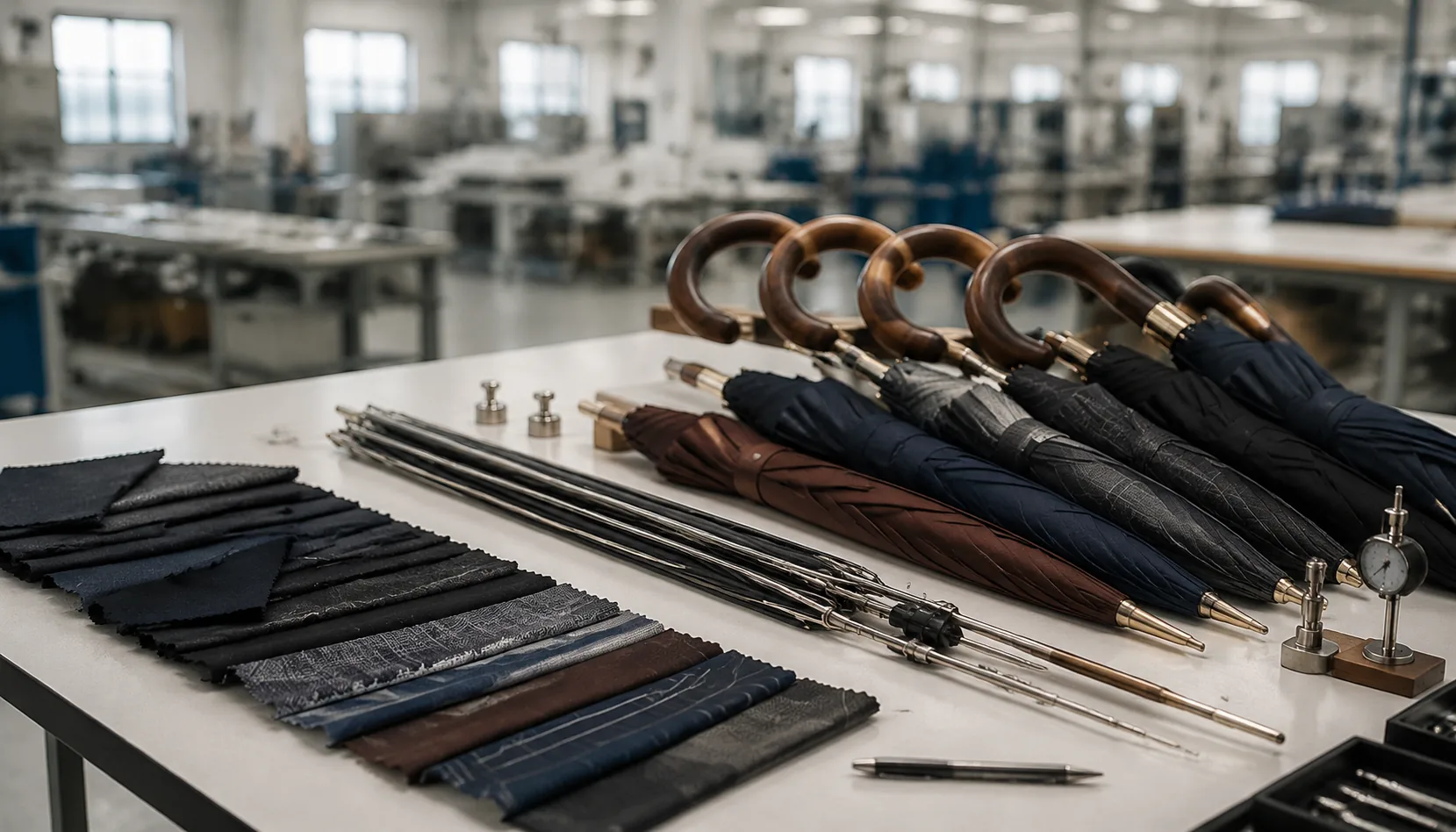
For retail brands, an executive stick umbrella looks simple until frame count, rib temper, fabric density, handle finish, and auto-open reliability start affecting returns and margin. As an executive stick umbrellas manufacturer working on the Songxia factory floor, we check 8K frame alignment, 190T versus 210T pongee coating, wooden handle fit, spring action, carton strength, MOQ planning, QC points, and shipping terms before a buyer locks the spec.
Positioning Executive Stick Umbrellas in a Retail Line
The 23–25 inch stick umbrella sits in the retail line where a compact folding umbrella starts to feel too disposable but a golf umbrella is too large for daily city use. For department stores, I usually position a 23 inch model as the entry premium SKU and a 25 inch model as the stronger executive SKU for men’s accessories, travel, or gift departments. A 23 inch canopy gives enough shoulder coverage for one person, while 25 inch feels more substantial on the rack without becoming awkward in elevators, cars, or office lobbies. For corporate gift ranges, the same size band works because the panels are large enough for clean screen printing or heat-transfer logos, but the umbrella still ships efficiently in cartons compared with 27 inch or 30 inch options.
Silhouette matters more than many buyers expect. A straight shaft with a curved J handle is the classic executive look, especially with crook wood or stained maple handles; it reads well in premium private-label programs and photographs better than plastic grips. Wooden handle umbrellas should use proper sanding, consistent varnish, and a tight ferrule fit, because cheap handle finishing is visible before the customer even opens the canopy. EVA grip versions are less formal but practical for rainy commuter markets, outdoor staff programs, and retail buyers who want a more modern, non-slip feel. For an executive stick umbrellas manufacturer, the key is matching handle style to channel: crook wood for department stores, EVA for functional corporate programs, and straight wood for minimalist private-label assortments.
For construction, I would not under-spec the frame on this category. An 8K umbrella frame with steel shaft and fiberglass ribs is a reliable baseline; all-steel ribs reduce cost but bend more easily after inversion, while full fiberglass improves wind recovery but raises the quote. Most retail umbrella sourcing briefs use 190T or 210T pongee with black, navy, charcoal, or bottle green as core colors, then add UPF 50+ coating, Teflon water repellency, or contrast binding for higher tiers. In stick umbrella OEM projects, confirm manual versus auto-open early, because the runner, spring, shaft diameter, and carton dimensions change. If the umbrella is being sold as premium, I would rather improve rib quality, handle finish, and AQL 2.5 inspection than spend the budget on unnecessary packaging.
Frame Choices: Steel Shaft, Fiberglass Ribs, and 8K Builds
For executive stick umbrellas, I like a steel shaft when the buyer cares about a straight, solid “boardroom” feel more than shaving grams. A 14 mm black electroplated steel shaft gives better torsional rigidity than a light aluminum tube, so the canopy does not wobble when a customer plants the tip and walks in gusty rain. The tradeoff is weight: a 23" or 27" wooden handle umbrella with steel shaft usually lands 40–90 g heavier than the same build with aluminum, depending on wall thickness and runner design. Fiberglass ribs are where I do not recommend cutting corners. Steel ribs look strong on paper, but once bent, they stay bent; fiberglass ribs flex, recover, and reduce returns after wind events. For retail umbrella sourcing, the clean specification is often steel shaft plus fiberglass ribs, with nickel-plated or black zinc stretchers and a 190T or 210T pongee canopy with water-repellent coating.
An 8K umbrella frame is sufficient for most executive retail lines when the canopy is 23" or 27", the fabric is standard 190T pongee, and the product is positioned for office commuting, hotels, banks, law firms, or corporate gifting. Eight ribs give a round enough canopy shape, keep sewing tolerance manageable, and hold unit cost down versus 10K or 16K frames. In our factory testing, a well-built 8K stick umbrella with 5.0–5.5 mm fiberglass ribs and a 14 mm steel shaft can survive normal wind-tunnel targets around 35–45 mph if the runner, notch, and tips are not cheapened. For a stick umbrella OEM order, I would rather improve rib material and joint riveting before adding rib count, because poor rivets on a 16K frame still fail faster than clean riveting on an 8K frame. This is where an executive stick umbrellas manufacturer should show actual frame samples, not just CAD drawings.
Move to reinforced 16K ribs, 10K ribs, or a thicker shaft when the umbrella is oversized, premium-priced, or expected to face coastal wind. A 30" golf-style executive stick umbrella with double-canopy venting puts much more load on the frame than a 23" city umbrella, so 16K fiberglass ribs or mixed fiberglass-and-steel construction can be worth the added cost. The same applies when using heavier canopy materials, such as coated 210T pongee, laminated blackout fabric for UPF 50+, or decorative jacquard that increases drag. A thicker 16 mm steel shaft improves stability, but it also changes balance at the wooden handle, so the grip diameter and ferrule weight need to match. For retail brands buying from an executive stick umbrellas manufacturer, my rule is simple: choose 8K for clean daily-carry margin, upgrade ribs for wind claims above 50 mph, and upgrade the shaft only when canopy diameter or brand positioning justifies the extra freight and shelf weight.
Canopy Fabric, Coating, and Print Specifications
For executive stick umbrellas, canopy fabric is where retail buyers should not chase the lowest quote. 190T pongee is the normal commercial baseline: tight enough for smooth printing, soft enough to fold cleanly, and more premium than plain 170T polyester. 210T pongee costs more but gives a denser hand feel, better drape over a 23" or 27" stick frame, and slightly improved resistance to seam stress after repeated opening. I usually recommend 190T for promotional retail programs and 210T for department-store or corporate gift lines where the umbrella will be handled before purchase. Polyester alternatives can reduce cost, but they look flatter, crease more sharply, and often show more needle puckering along the panel seams. A serious executive stick umbrellas manufacturer should quote fabric weight, yarn density, colorfastness target, and whether the canopy is piece-dyed or made from stock fabric, because shade variation becomes visible when eight panels are sewn together.
Water-repellent finishing should be specified, not assumed. Standard pongee usually receives a WR finish that beads light rain, but for retail umbrella sourcing I prefer a Teflon-style treatment when the buyer wants a cleaner shake-off and fewer water marks on dark navy, black, or burgundy canopies. For sun protection, an optional black PU coating can bring the canopy to UPF 50+, but it changes the umbrella’s behavior: the inside becomes opaque, the hand feel is stiffer, and sewing tension must be adjusted to avoid seam ripples. On wooden handle umbrellas, this matters because the product is sold as formal and clean, not sporty. Our standard practice at ZheBrella is to test coated fabric before bulk cutting, especially on 8K umbrella frame models, because heavy coating can pull differently across long stick umbrella panels compared with compact 21" folding umbrellas.
Logo execution should be locked before sampling because print placement affects cutting, sewing, and inspection. The cleanest retail option is one-panel branding, usually centered 120–160 mm above the hem depending on umbrella size, with screen printing for solid logos and heat transfer for gradient or small-detail artwork. Multi-panel repeats are possible, but panel matching must be controlled or the logo rhythm looks uneven around the canopy. For higher-end stick umbrella OEM orders, buyers often add a woven label near the seam, a branded snap strap, and printed or woven sleeve branding so the product still carries identity when closed on a retail hook. Sleeve fabric should match the canopy lot; otherwise black and navy differences are obvious under store lighting. Before bulk production, approve a physical strike-off for color, adhesion, and rub resistance, then include print registration, coating defects, and label position in the AQL 2.5 inspection checklist.
Mechanisms, Handles, and Retail-Ready Packaging
For executive stick umbrellas, the mechanism decision should be made before artwork, because it changes shaft diameter, runner clearance, and even carton height. Manual stick umbrellas are simpler and usually more durable for conservative retail lines: fewer moving parts, lower claim rate, and easier AQL 2.5 inspection because the runner lock is visible. Auto-open models feel more premium at the shelf, but the spring must be specified properly, not just copied from a cheap promo frame. On a 23" or 27" 8K umbrella frame, I prefer a tempered steel center shaft with a stainless or zinc-plated spring tested to 500 open-close cycles before bulk approval. Weak springs give that half-open hesitation buyers hate; overly strong springs can crack plastic runners or loosen rib rivets after vibration during ocean freight.
Handles are where retail customers judge value in three seconds. Wooden handle umbrellas should use beech, maple, or rubberwood with moisture content controlled around 8–12%, otherwise the lacquer can haze or the J-handle can develop hairline checks after a dry warehouse season. EVA and PU leather-wrapped handles are easier for color matching, but they do not carry the same executive feel as stained wood with a clean metal collar. Ferrules should be crimped tightly, not only glued, and tips should match the frame finish: black nickel for darker retail programs, chrome for classic business lines, and matte gunmetal when the canopy uses 190T or 210T pongee with a Teflon coating. A serious executive stick umbrellas manufacturer will also align the sleeve fabric, snap button, woven label, and handle logo method before sampling, because mismatched trims make a high-cost umbrella look like leftover stock.
Retail-ready packaging is not decoration; it is part of retail umbrella sourcing cost control. For stick umbrella OEM projects, a basic export pack might use one polybag, a matching pongee sleeve, 12 pieces per inner carton, and 24 or 36 pieces per master carton depending on 23", 27", or 30" length. Retail programs normally add a hang tag with care instructions, GS1 barcode sticker, country-of-origin mark, warning label, and sometimes an anti-theft loop position agreed with the store fixture team. Gift boxes raise perceived value but add CBM fast; a rigid box for a 27" auto-open umbrella can reduce container loading by 20–30% versus sleeve-only packing. Our standard practice at ZheBrella is to confirm barcode scan quality, carton drop resistance, and mixed-SKU carton markings during pre-production, not after mass packing, because repacking finished umbrellas is slow and scratches handles.
Ordering, Inspection, and Shipping Terms to Confirm
Lock the approved sample before mass production, because executive stick umbrellas have too many small parts that can drift: shaft plating tone, wooden handle stain, ferrule shape, runner tension, logo position, and canopy color under D65 light. For retail umbrella sourcing, a serious factory should quote 5–7 days for a plain sample and 7–12 days for a printed or custom-handle sample after artwork approval. For a stick umbrella OEM order, practical MOQ is usually 500–1,000 pcs per color for stock 23" or 27" models, and 1,200–3,000 pcs if you need custom pongee color, private mold handle, branded tip cup, or retail sleeve. An executive stick umbrellas manufacturer should issue a sealed pre-production sample with the exact 190T or 210T pongee, 8K umbrella frame, wooden handle finish, woven label, hangtag, and carton marks before cutting bulk fabric.
Bulk lead time should be written by process, not guessed as one number. For standard wooden handle umbrellas with screen printing, 25–35 days after deposit and sample approval is normal; custom dyed fabric, heat-transfer panels, or gift-box packing can push that to 40–50 days. Inspection terms should state AQL 2.5 for major defects and AQL 4.0 for minor defects unless your retailer requires stricter limits. On the floor, I want inspectors to open and close every sampled umbrella at least three cycles, check rib symmetry, runner lock, shaft straightness, handle pull strength, cap tightness, canopy tension, and water repellency after a spray test. Carton checks matter too: confirm 5-ply export cartons, inner polybag thickness, barcode scanability, carton drop test on one corner, three edges, and six faces, plus gross weight within courier or warehouse limits.
Confirm FOB versus DDP pricing before you compare suppliers, because a low unit price can hide expensive inland handling or weak packing. FOB Ningbo or Shanghai should include export carton, local trucking, customs declaration, and port charges up to vessel loading; ocean freight, insurance, destination duty, and final delivery sit with the buyer. DDP is useful for promotional distributors and retail launches without import staff, but it must list destination address type, duty rate assumptions, VAT treatment, and whether delivery is to warehouse dock or Amazon-style appointment. Our standard practice at ZheBrella is to separate product cost, mold or sample fees, inspection cost, and freight so buyers can see what changes when quantity moves from 1,000 to 5,000 pcs. For executive stick umbrellas manufacturer quotes, also confirm payment terms, overrun allowance of 3–5%, spare parts policy, and whether failed inspection triggers rework before balance payment.
Frequently Asked Questions
Are executive stick umbrellas usually auto-open or manual?
Most retail executive stick umbrellas use auto-open mechanisms because the larger shaft provides enough space for a reliable spring system. Manual builds are still used for lower-cost orders or minimalist wooden-handle designs.
What is a practical MOQ for private-label stick umbrellas?
MOQ depends on fabric color, handle type, and print method, but many OEM programs start around 500–1,000 pieces per color. Custom molded handles or dyed fabric usually require higher minimums.
What MOQ should retail brands expect for executive stick umbrellas?
For OEM stick umbrellas, typical MOQ is 500–1,000 pieces per color or design. Custom wooden handles, exclusive fabric colors, or molded parts may require higher MOQs depending on material availability.
Is an 8K frame strong enough for retail executive umbrellas?
An 8K frame is standard for classic executive stick umbrellas and works well for daily city use. For premium or wind-resistant lines, buyers often upgrade to fiberglass ribs, reinforced stretchers, or 10K/12K frame options.
Which fabric is better for executive stick umbrellas, 190T or 210T pongee?
190T pongee is cost-effective and suitable for mid-range retail programs, while 210T pongee has a denser hand feel and better perceived quality. Many retail brands choose 210T for executive umbrellas because it prints cleanly and supports premium positioning.
Looking to Launch Your Custom Umbrella Line?
ZheBrella is a Zhejiang-based OEM/ODM umbrella manufacturer with 17 years of export experience. Free design, low MOQ from 100 pieces, windproof construction, full-color print.
Get Free Quote Now »People Also Search For
Related Articles
Executive Stick Umbrellas: Buyer Specs for Retail Brands
Compare executive stick umbrella specs, from 8K/16K frames and pongee fabrics to handles, QC, MOQs, and shipping terms f...
Read More »
Cane Handle Stick Umbrellas: Buyer Specs for Retail Brands
Specify cane handle stick umbrellas with 8K frames, 190T/210T pongee, auto-open options, and QC checks for retail and gi...
Read More »
Wooden Shaft Umbrellas for Retail: OEM Buyer Guide
Source wooden shaft umbrellas with clear specs for canopy fabric, ribs, handle finish, auto-open parts, MOQ, and retail-...
Read More »