Executive Stick Umbrellas: Premium OEM Spec Guide
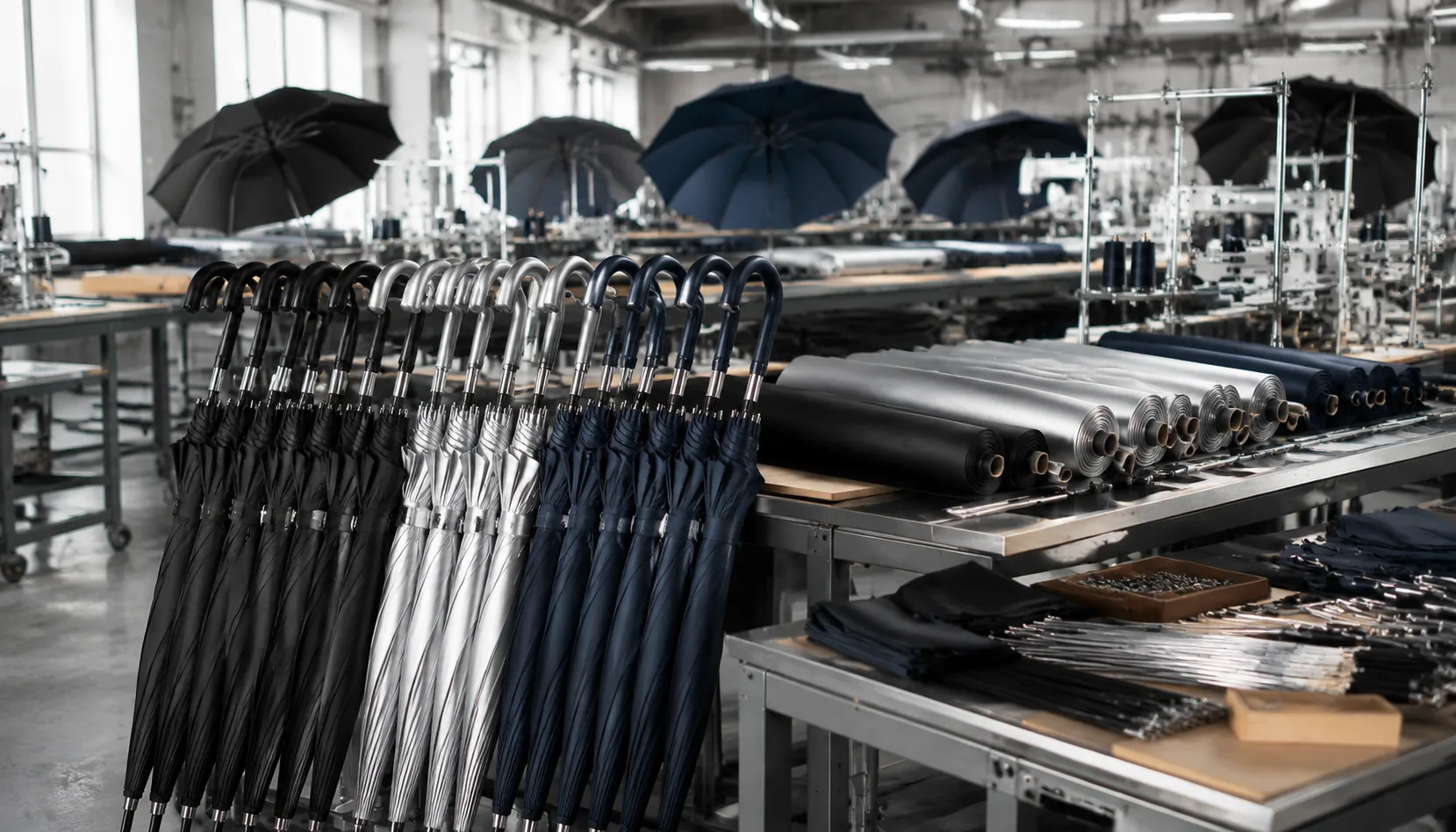
For corporate buyers, executive stick umbrellas look simple until shaft straightness, rib tension, canopy hand-feel, handle finish, and logo placement start affecting approval samples and repeat orders. On our Songxia factory floor, the difference between a premium spec and a costly remake often comes down to locking the right materials, tolerances, packaging, and QC checkpoints before bulk cutting begins.
Define the Executive Umbrella Positioning
An OEM stick umbrella factory should define this category by specification control before discussing gift-box artwork. For executive stick umbrellas, our standard practice at ZheBrella is to lock a golden sample for canopy tension, shaft straightness, opening force, handle finish, and logo position, then inspect bulk production under AQL 2.5 with separate checks for stitching, fabric defects, rib symmetry, and runner lock engagement. Common premium builds use 210T pongee with Teflon water-repellent finish, optional UPF 50+ coating for retail or travel programs, and wind-resistant frame designs tested around 40–50 mph depending on rib material and canopy size. Typical MOQ starts around 500–1,000 pieces per color for custom fabric and branding, with 25–35 days production after sample approval. FOB Ningbo or Shanghai is normal; DDP can work for corporate buyers who need landed cost certainty.
Choose Frame Structure and Rib Count
Frame choice decides whether executive stick umbrellas feel like premium corporate umbrellas or just oversized rain tools with a logo. For 23" and 27" stick models, steel ribs still give the crispest opening tension and the straightest canopy line, especially when paired with a black electroplated metal shaft. The tradeoff is corrosion risk if plating is thin, so I specify salt-spray-tested coating and clean rivet finishing for retail or long-term gifting programs. Fiberglass ribs cost more, but they flex under gusts instead of taking a permanent bend, which matters for hotel, finance, and airline clients who do not want returns after the first windy commute. A fiberglass shaft is lighter and non-corrosive, but it can feel less formal than a metal shaft; for wooden handle umbrellas, a steel shaft with fiberglass ribs is often the best balance of executive weight, durability, and presentation.
Rib count changes both performance and appearance. An 8K frame is the standard build: eight ribs, eight panels, efficient sewing, lower unit cost, and enough strength when the canopy is 190T or 210T pongee with proper tip stitching. For business gift umbrellas, 8K is acceptable when the budget is tight or the order is mainly for event distribution. A 16K frame uses sixteen ribs, usually with narrower panels, so the canopy forms a smoother circle and looks more tailored when photographed or displayed in a lobby. That roundness is why many premium corporate umbrellas move to 16K even when the buyer does not fully understand the engineering. It simply looks more expensive, especially with a natural wood crook handle, metal ferrule, and tight color-matched binding.
The penalty for 16K is real: more ribs, more joints, more sewing operations, higher inspection time, and usually 80–150 grams of extra finished weight depending on rib material and shaft diameter. A 27" 8K steel-frame stick umbrella may land around 520–620 grams, while a 16K version can move into the 680–780 gram range before adding a heavy wooden handle. As an OEM stick umbrella factory, our standard practice is to confirm the target hand feel before quoting, because a CEO gift can tolerate weight better than a daily commuter umbrella. For executive stick umbrellas, I normally recommend 16K fiberglass ribs with a metal shaft when the goal is premium appearance and wind resistance, and 8K fiberglass ribs when the buyer needs a cleaner FOB price, faster lead time, and easier bulk packing.
Select Canopy Fabric and Weather Features
For executive stick umbrellas, 210T pongee is the fabric I recommend first because it gives the right balance of dense hand feel, clean drape, and reliable printing surface for premium corporate umbrellas. A 23" or 27" straight umbrella with 8K or 16K ribs looks cheap quickly if the canopy feels thin, even when the frame is strong. 210T pongee usually lands around 75–85 g/m², accepts screen print and heat-transfer logos cleanly, and folds smoothly around the long shaft without the stiff plastic noise you get from low-grade polyester. For cost-controlled business gift umbrellas, 190T pongee is acceptable, but I would keep it for larger giveaways or price-sensitive tenders where the buyer still wants a woven fabric rather than PVC or POE. The tradeoff is simple: 190T saves cost, but the color depth, wrinkle recovery, and perceived value are lower when the umbrella is opened in a boardroom or hotel lobby.
Waterproof performance should be specified as a coating system, not just a sales phrase. Standard practice is water-repellent treatment on the outer face plus a PU or similar backing where needed; droplets should bead and roll after a short shake, and seams should not wick water during a 3–5 minute spray test. For wooden handle umbrellas, especially with dark walnut, maple, or lacquered crook handles, I prefer a canopy finish that dries quickly so water does not run down and stain the handle during storage. UPF 50+ is a useful option for golf clubs, outdoor hospitality, and travel retail, but it should be confirmed by fabric testing, not assumed from dark color alone. Black, navy, charcoal, and deep bottle green usually perform well, while white and light beige need tighter control because coating shade variation is more visible under sunlight.
Wind resistance on premium models comes more from structure than fabric thickness. A double-canopy vented design lets gusts escape through the upper layer, reducing inversion on 27" and 30" stick umbrellas; paired with fiberglass ribs and stretchers, a good sample should survive 50+ mph wind-tunnel cycles better than a heavy steel-rib frame that bends permanently. For an OEM stick umbrella factory order, I would specify colorfastness of at least Grade 4 for dry rubbing and Grade 3–4 for wet rubbing, with better control required for red, royal blue, and black canopies because dye transfer can ruin white logos or shirt cuffs. Bulk production should also include shade-band approval before cutting, especially when matching Pantone colors across panels, sleeves, and tie straps. Our standard practice at ZheBrella is to check fabric lot consistency before panel cutting, because once eight panels are sewn into a canopy, shade mismatch is expensive to repair.
Specify Handles, Tips, and Branding Areas
Handle choice changes the whole perceived value of executive stick umbrellas, so I would lock it before final artwork. A real wooden crook handle, usually beech, maple, or ash with clear lacquer, gives the best boardroom look and pairs well with 23" or 27" frames. For heavier 30" golf-style stick umbrellas, a thicker wood crook or straight EVA grip is safer because the leverage on the shaft is higher in wind. Leather-look PU grips are common for premium corporate umbrellas, but buyers should ask for abrasion testing because cheap PU can peel after 3–6 months in a car trunk. Strap material also matters: matching pongee 190T/210T straps with metal snap buttons look cleaner than Velcro, while a debossed PU strap can carry a subtle logo without crowding the canopy.
Tips and ferrules are not decorative afterthoughts; they protect the umbrella during daily use and export handling. For business gift umbrellas, I prefer metal tips on the rib ends and a nickel-plated or gunmetal ferrule at the crown, especially when the canopy uses dark navy, black, or charcoal 210T pongee. Plastic tips reduce cost, but they can look soft on a premium spec and may whiten after impact. The center shaft is usually steel or fiberglass; if the buyer wants a classic executive profile, a black electroplated steel shaft with 8K or 10K fiberglass ribs gives a good balance of stiffness and wind recovery. Ask the OEM stick umbrella factory to confirm tip pull strength, ferrule fit, and open-close smoothness during AQL 2.5 inspection, not only canopy measurements.
Branding should be planned around how the umbrella is actually carried, opened, photographed, and gifted. The safest logo position is one or two canopy panels, printed by screen print for solid corporate colors or heat transfer for gradients; keep the mark at least 35–50 mm above the hem so stitching and panel curvature do not distort it. Handle badges work well on wooden handle umbrellas: a small metal plate, laser-engraved wood insert, or epoxy dome badge gives a private-label feel without turning the canopy into an advertisement. Woven labels can be sewn into the closing strap, sleeve seam, or inner canopy edge, and they are useful for retail barcodes or care symbols. For gift presentation, use a matching sleeve plus kraft, black rigid, or magnetic gift box; FOB lead time is usually 25–35 days after artwork approval, longer if custom molds or plated badges are required.
Lock Samples, QC, MOQ, and Shipping Terms
For executive stick umbrellas, I lock the sample process in two stages: prototype sample and pre-production sample. The first round checks frame geometry, shaft straightness, canopy panel alignment, handle fit, and print placement on wooden handle umbrellas or plated metal handles. The pre-production sample is the one I treat as binding, because that is where the factory confirms the final fabric lot, coating, ferrule, tip, and stitch density before bulk cutting starts. At an OEM stick umbrella factory, you also need to confirm whether the mechanism is manual or auto-open, because the spring force, button travel, and lock engagement change the internal assembly tolerance. Our standard practice is to approve one sealed golden sample, then freeze all materials so there is no quiet substitution on the bulk line.
QC for premium corporate umbrellas should not stop at a visual check on finished goods. I insist on AQL 2.5 for the final inspection, with separate attention to canopy wrinkles, frame symmetry, open-close function, tip cracks, handle finish, and carton count. For auto-open models, the QC sheet needs a function test on every lot: trigger force, full-open travel, rebound, and whether the runner catches cleanly under repeated cycles. Rib tension review matters more than many buyers think; if the ribs are too loose, the canopy sags and flaps, and if they are too tight, the fabric tears near the stretcher tips after transport. For business gift umbrellas, I also check color consistency across 10 to 20 random units, because one mismatched panel on a corporate order looks sloppy on arrival.
MOQ planning usually depends on the frame, handle, and decoration method, but for executive stick umbrellas the practical range is often 300 to 1,000 pieces per color or artwork set. Lower quantities are possible for simple stock components, but once you specify wooden handle umbrellas, custom engraving, or a special canopy fabric, the economics change fast. Carton packing should be confirmed before production: inner polybag, divider, 12 or 24 pieces per export carton, then drop-test the master carton so the tips and ferrules do not punch through. For shipping terms, FOB works best when the buyer already has a forwarder and wants control of freight, while DDP is useful for corporate buyers who want one landed price and no customs handling. For executive stick umbrellas moving into Europe or the U.S., I normally quote both so procurement can compare landed cost instead of only factory cost.
Frequently Asked Questions
Are executive stick umbrellas usually manual or auto-open?
Both are possible, but auto-open mechanisms are common for corporate gifts because they feel convenient and premium. Manual open can be chosen for a cleaner traditional design.
What canopy fabric is best for a premium stick umbrella?
210T pongee is usually the better choice for executive programs because it has a smoother feel and better print surface. 190T pongee can work when budget is the main constraint.
What shaft and rib materials are best for premium executive stick umbrellas?
For premium corporate use, a steel or fiberglass shaft is common, with fiberglass ribs preferred when wind resistance matters. A typical spec is 23"-27" for the canopy and 8K-16K ribs depending on the umbrella size and rigidity target.
What branding methods work best on wooden handle umbrellas?
Screen printing and heat transfer are common on the canopy, while laser engraving or metal logo plates work well on wooden handles and ferrules. For a premium look, many buyers combine one canopy logo with a subtle handle marking.
What is a typical MOQ and lead time for OEM executive stick umbrellas?
For most OEM runs, MOQ is often 500-1,000 pieces per design, depending on fabric and handle customization. Lead time is usually 25-40 days after artwork approval and deposit, with packaging adding a few extra days if it is fully custom.
Looking to Launch Your Custom Umbrella Line?
ZheBrella is a Zhejiang-based OEM/ODM umbrella manufacturer with 17 years of export experience. Free design, low MOQ from 100 pieces, windproof construction, full-color print.
Get Free Quote Now »People Also Search For
Related Articles
Stick Umbrellas with Wooden Shafts: OEM Buyer Spec Guide
Compare wooden shaft stick umbrella specs, from rib materials and canopy fabric to handle finish, MOQ, QC checks, and sh...
Read More »
Wooden Shaft Stick Umbrellas: Retail Buyer Spec Guide
Compare wooden shaft umbrella specs for retail programs, including canopy fabric, ribs, handles, finishing, QC checks, M...
Read More »
Executive Stick Umbrellas: Buyer Guide for Retail Brands
Compare executive stick umbrella specs, from 8K frames and wooden handles to 190T/210T pongee, auto-open parts, MOQ, QC,...
Read More »