Wooden Shaft Stick Umbrellas: Retail Buyer Spec Guide
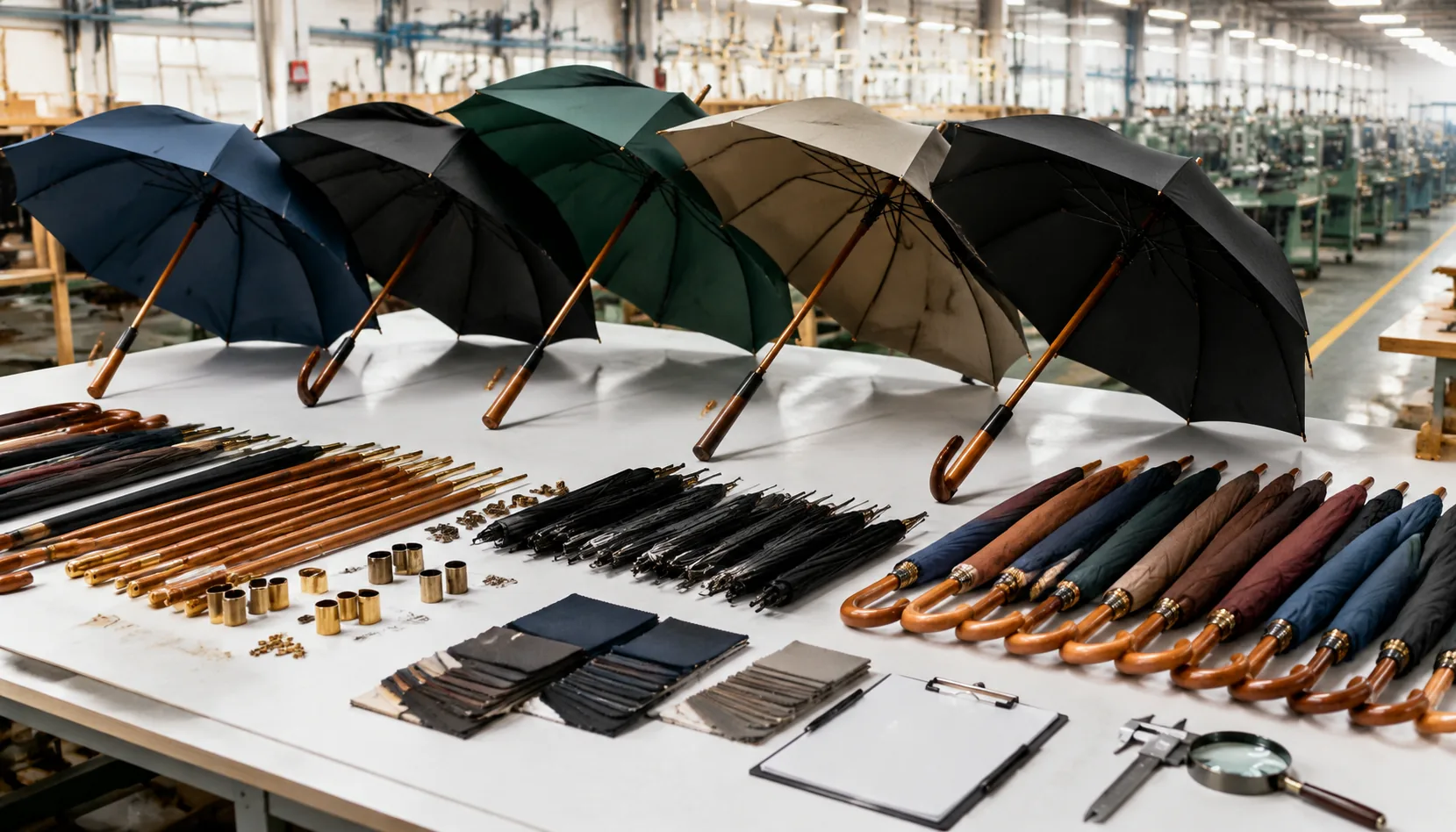
Retail buyers comparing wooden shaft umbrellas are usually balancing shelf appeal against breakage risk, margin, and delivery timing. On our Songxia factory floor, the details that decide whether a stick umbrella survives retail use are not just the wood color or handle shape, but the canopy fabric weight, rib temper, runner fit, ferrule finishing, carton packing, and the QC points checked before shipment.
Position Wooden Shaft Umbrellas in Retail Lines
Retail buyers choose wooden shaft umbrellas when the umbrella has to look intentional, not disposable. A straight wood shaft, crook or straight wooden handle, metal runner, and 190T or 210T pongee canopy give the product a classic profile that works well for fashion boutiques, hotel lobbies, museum shops, winery gift stores, and executive gift programs. Compared with compact folding umbrellas, wooden stick umbrellas present better on a floor stand or wall rack because the silhouette is visible before the customer opens the product. For retail, I usually prefer 8K steel ribs for a traditional price point, fiberglass ribs for a lighter windproof claim, and 16K only when the brand wants a more architectural look. Buyers should not treat wooden shaft umbrellas as basic rain tools; they are visual merchandise, and the handle finish, tip color, ferrule, tie wrap, and canopy print alignment matter as much as the rain performance.
The common retail specification sits around 23 inch, 24 inch, or 25 inch rib length, but buyers need to separate rib length from arc and open diameter. A 23 inch stick umbrella often gives about a 46 to 48 inch arc and roughly 39 to 41 inch open diameter, depending on rib curvature. A 25 inch version can reach around a 50 to 52 inch arc and 43 to 45 inch diameter, which supports a stronger shelf claim such as “full coverage” or “hotel guest size.” The mistake I see often is buyers listing only “23 inch umbrella” on a carton or hangtag, then expecting the same coverage from two different factories. Rib bend, notch position, canopy seam allowance, and cap tension can change the finished diameter by 1 to 2 inches. Our standard practice at ZheBrella is to confirm rib length, arc, open diameter, and closed length on the pre-production sample before artwork approval.
For premium programs, custom wooden handle umbrellas should be specified like retail accessories, not low-cost event giveaways. A museum may want a 24 inch 8K wooden shaft with matte black pongee, inside label, and a one-color screen print; a hotel may prefer a 25 inch auto-open with fiberglass ribs, Teflon water-repellent coating, and a woven name label near the tie wrap. Fashion brands often request color-matched handles, nickel or gunmetal tips, and tighter AQL 2.5 inspection on scratches, crooked shafts, runner looseness, and canopy puckering. MOQ usually starts around 500 to 1,000 pieces per color for OEM classic umbrellas, with 25 to 35 days production after sample approval, longer for custom molded handles or dyed wood finishes. For FOB Ningbo or Shanghai, retail stick umbrellas pack efficiently in long master cartons, but DDP buyers should watch carton length because oversize charges can erase margin.
Specify Wood Shaft and Handle Construction
For wooden shaft umbrellas, the shaft and handle spec should be locked before sampling because wood behaves differently from metal or fiberglass once it moves through humidity, container heat, and retail storage. Natural wood gives the best classic look, but buyers must accept visible grain variation, slight color differences, and small mineral marks; if you need a uniform shelf display, painted wood or a darker stained finish is safer. For retail stick umbrellas, common shaft diameters run about 12–14 mm on 23" and 27" models, with the handle usually matched in beech, maple, or laminated wood depending on price target. Bamboo-style finishes are usually stained or heat-treated wood with segmented color effects, not always true bamboo, so the material description on the PO should be precise.
Curved handles remain the most popular for wooden stick umbrellas because they hang cleanly on store fixtures and feel traditional in the hand, but the bend is also where poor drying or rushed shaping creates cracks. Straight handles look cleaner for golf, hotel, and corporate programs, especially on custom wooden handle umbrellas with laser engraving or a small metal logo plate, but they need a balanced length so the umbrella does not feel top-heavy. Moisture content matters more than most buyers realize: wood that is too wet can shrink after assembly, while wood that is too dry can split during compression packing. A practical factory control target is roughly 8–12% moisture content before varnishing, with incoming wood checked by meter rather than judged by surface feel.
Varnish consistency is not cosmetic only; uneven varnish lets moisture enter through end grain, around ferrules, and at handle joints, which raises the risk of cracking during ocean transit or after air-conditioning cycles in retail warehouses. I prefer specifying two varnish coats plus a light sanding pass for OEM classic umbrellas, with the buyer approving a tolerance board that shows acceptable grain, stain depth, and gloss level under neutral light. Carton packing should separate handle curves with paper sleeves or molded spacers, especially for 16K heavy frames where pressure points are higher. For FOB shipments, add a pre-shipment inspection line item for shaft straightness, handle pull strength, varnish holidays, and visible cracks under AQL 2.5, not just canopy printing and rib function.
Match Canopy Fabric to Price and Brand Level
For wooden shaft umbrellas sold through standard retail channels, 190T pongee is usually the right starting point because it balances drape, print clarity, and landed cost better than polyester taffeta. On a 23" or 27" stick umbrella, 190T pongee gives a clean canopy surface without making the frame feel top-heavy, which matters when the shaft and curved handle are natural wood rather than aluminum. I would specify 8 panels for most retail stick umbrellas, with panel grain and shade checked before sewing so one darker panel does not sit next to seven lighter ones. For private-label programs, ask the factory to control seam allowance at roughly 8–10 mm and keep the crown point centered within 5 mm; crooked top alignment is one of the fastest ways a classic umbrella starts looking cheap on the shelf.
210T pongee is the better fabric when the brand wants a denser hand feel and a more premium opening sound. It is not just “thicker”; the tighter weave holds darker navy, black, burgundy, and forest green more evenly, especially on wooden stick umbrellas where buyers often choose traditional colors with subtle logos. For custom wooden handle umbrellas, I normally pair 210T pongee with fiberglass ribs or reinforced steel ribs depending on the target price, because a premium canopy on a weak 8K frame creates the wrong customer experience. If the design uses 10K or 16K ribs, the panel cutting must be more disciplined: each panel should be matched to rib spacing, and the sewer should avoid pulling the fabric off-grain or the finished canopy will twist after closing.
UPF 50+ coating makes sense when the retail story is dual sun-rain use, but buyers should treat it as a specification, not a sticker. A black UV coating under 190T or 210T pongee improves shade performance but slightly changes the hand feel and can reduce light transmission enough to make inside branding less visible. For OEM classic umbrellas, confirm whether the coating is PA, PU, or silver/black UV treatment, then test water repellency after printing because heat-transfer logos can affect local beading. Our standard practice at ZheBrella is to inspect canopy symmetry before final packing under AQL 2.5, including rib-to-seam alignment, top notch tension, and edge binding consistency. For wooden shaft umbrellas positioned above entry level, those details matter as much as the fabric weight because the customer sees the canopy shape before they ever notice the shaft finish.
Choose Ribs, Stretchers, and Opening Hardware
For wooden shaft umbrellas, the frame is not trying to win a compact-folding contest; it is selling strength, silhouette, and hand feel on a retail rack. I normally steer buyers toward fiberglass ribs when the product needs wind recovery, especially on 23" and 27" canopies where rib flex matters. Fiberglass ribs can bend and return without taking a permanent set, so they are safer for rainy commuter use and resort retail. Steel ribs are cheaper and look crisp when new, but once a steel rib twists near the rivet or stretcher joint, the umbrella usually comes back as a return. A sensible mid-market build is 8K fiberglass ribs with steel stretchers, while a higher-spec model uses full fiberglass ribs and stretchers for better corrosion resistance and smoother flex. For OEM classic umbrellas, do not judge only by rib material; check rivet tightness, rib tip alignment, and whether the stretcher wire gauge matches the canopy size.
The choice between 8K and 16K is partly structural, but mostly visual. An 8K frame is the standard commercial look: clean panel layout, lighter weight, easier printing registration, and lower sewing tolerance risk on 190T or 210T pongee. A 16K frame gives wooden stick umbrellas a fuller, more traditional profile, with narrower panels and a more “gentleman” appearance that works well for department stores, golf clubs, hotels, and museum shops. The tradeoff is cost and inspection discipline: twice the rib count means more rivets, more tips, more sewing seams, and more chances for uneven tension. On 16K retail stick umbrellas, I want to see the canopy sit round without scalloping between panels, and I reject frames where alternating ribs pull higher or lower at full opening. Buyers should also remember that 16K does not automatically mean windproof; poor stretcher geometry can fail before a well-made 8K fiberglass frame.
Opening hardware is where many pretty samples become weak production orders. Manual opening is the correct choice for most wood shaft umbrellas because it keeps the shaft continuous, preserves the classic look, and avoids the bulky spring assemblies used in auto-open systems. The runner should slide smoothly without scraping the wood finish, and premium metal runners are worth specifying for custom wooden handle umbrellas because plastic runners can look cheap against a stained maple, beech, or ash shaft. I prefer a metal runner with a clean push-button notch, firm spring catch, and no sharp burrs where the user’s thumb lands. For AQL 2.5 inspection, we open and close samples repeatedly, checking runner lock security, spoke symmetry, cap tightness, and whether the ferrule stays straight after handling. Since wooden shaft umbrellas ship longer and take more carton space than compact models, the value has to be obvious in durability, finish consistency, and hardware feel.
Control Quality, MOQ, and Import Logistics
Quality control on wooden shaft umbrellas has to start before final packing, because most expensive disputes are visible long before the carton is sealed. For retail stick umbrellas, I recommend AQL 2.5 for major defects and a tighter internal patrol on wood parts: check for shaft scratches, dents at the runner travel zone, uneven varnish, color mismatch between shaft and crook handle, glue marks around the handle joint, and loose handle torque after repeated open-close cycling. A wood shaft may look acceptable under warm sewing-room light but show sanding waves or varnish bubbles under daylight, so inspection should include angled light, not just a straight visual check. Metal tips, ferrules, springs, and stretchers also need rust-spot checks, especially after ocean-freight humidity or if plated parts were stored near wet finishing areas.
Canopy inspection should be treated as functional, not cosmetic only. On wooden stick umbrellas, poor canopy tension causes sagging panels, crooked logo placement, and noisy flapping even when the frame itself is strong. Inspectors should open each sampled umbrella fully, check rib alignment, runner lock strength, stitch balance at panel seams, top notch seating, cap tightness, and whether the canopy pulls evenly without twisting the shaft. For custom wooden handle umbrellas, printing and branding checks should include screen-print registration, heat-transfer adhesion, woven label placement, and barcode readability for retail distribution. Our standard practice at ZheBrella is to include carton drop checks, humidity-aware packing with polybags or paper sleeves, and a final open-close test on sampled goods before release.
MOQ and logistics planning should be set early because OEM classic umbrellas are not as flexible as simple folding models. A realistic MOQ is usually 500–1,000 pieces per color or handle style, with 30–45 days production after deposit and approved pre-production sample; add 7–10 days if the buyer requests a custom stained wood finish, engraved handle, special hangtag, or retail inner box. FOB Ningbo or Shanghai works well for buyers with their own forwarder and consolidated shipments, while DDP is safer for smaller retailers that need landed-cost clarity, import duty handling, and delivery to a warehouse or event site. For wooden shaft umbrellas, confirm HS code, carton dimensions, gross weight, fumigation or wood-related documentation if required by destination rules, and whether spare parts or overage units are included before booking freight.
Frequently Asked Questions
Are wooden shaft umbrellas heavier than metal shaft umbrellas?
Usually yes, especially with 16K frames or larger canopies. Buyers should request sample weights because wood density, rib material, and handle size change the final feel.
Can logos be printed on wooden handles?
Yes, common methods include pad printing, laser engraving, and small metal badge application. Engraving looks premium but requires a clean wood finish and sufficient handle surface area.
What specs should a retail buyer confirm before ordering wooden shaft stick umbrellas?
Confirm canopy size, panel count, fabric weight such as 190T or 210T pongee, rib material, shaft diameter, handle finish, tip style, logo method, carton packing, and test requirements. For retail programs, also request a pre-production sample and AQL inspection standard before mass production.
What is a typical MOQ for custom wooden shaft umbrellas?
For OEM wooden stick umbrellas, a typical MOQ is 500 to 1,000 pieces per style for standard fabric colors and 1,200 to 3,000 pieces if custom-dyed fabric or special wooden handles are required. Logo printing can usually start at lower quantities than fully customized components.
How long does production and shipping take for wooden stick umbrella orders?
Sampling usually takes 5 to 10 days after artwork confirmation, and bulk production is commonly 25 to 45 days depending on order size and material availability. Ocean FOB shipping is often 25 to 40 days to major ports, while DDP timelines depend on destination, customs clearance, and final delivery address.
Looking to Launch Your Custom Umbrella Line?
ZheBrella is a Zhejiang-based OEM/ODM umbrella manufacturer with 17 years of export experience. Free design, low MOQ from 100 pieces, windproof construction, full-color print.
Get Free Quote Now »People Also Search For
Related Articles
Stick Umbrellas with Wooden Shafts: OEM Buyer Spec Guide
Compare wooden shaft stick umbrella specs, from rib materials and canopy fabric to handle finish, MOQ, QC checks, and sh...
Read More »
Wooden Stick Umbrellas: Retail and Hospitality Buyer Guide
Choose wooden stick umbrellas for hotels and retail lines with canopy size, shaft, rib, handle, printing, MOQ, and inspe...
Read More »
Wooden Shaft Umbrellas for Retail: OEM Buyer Guide
Source wooden shaft umbrellas with clear specs for canopy fabric, ribs, handle finish, auto-open parts, MOQ, and retail-...
Read More »