Wooden Stick Umbrellas: Retail and Hospitality Buyer Guide
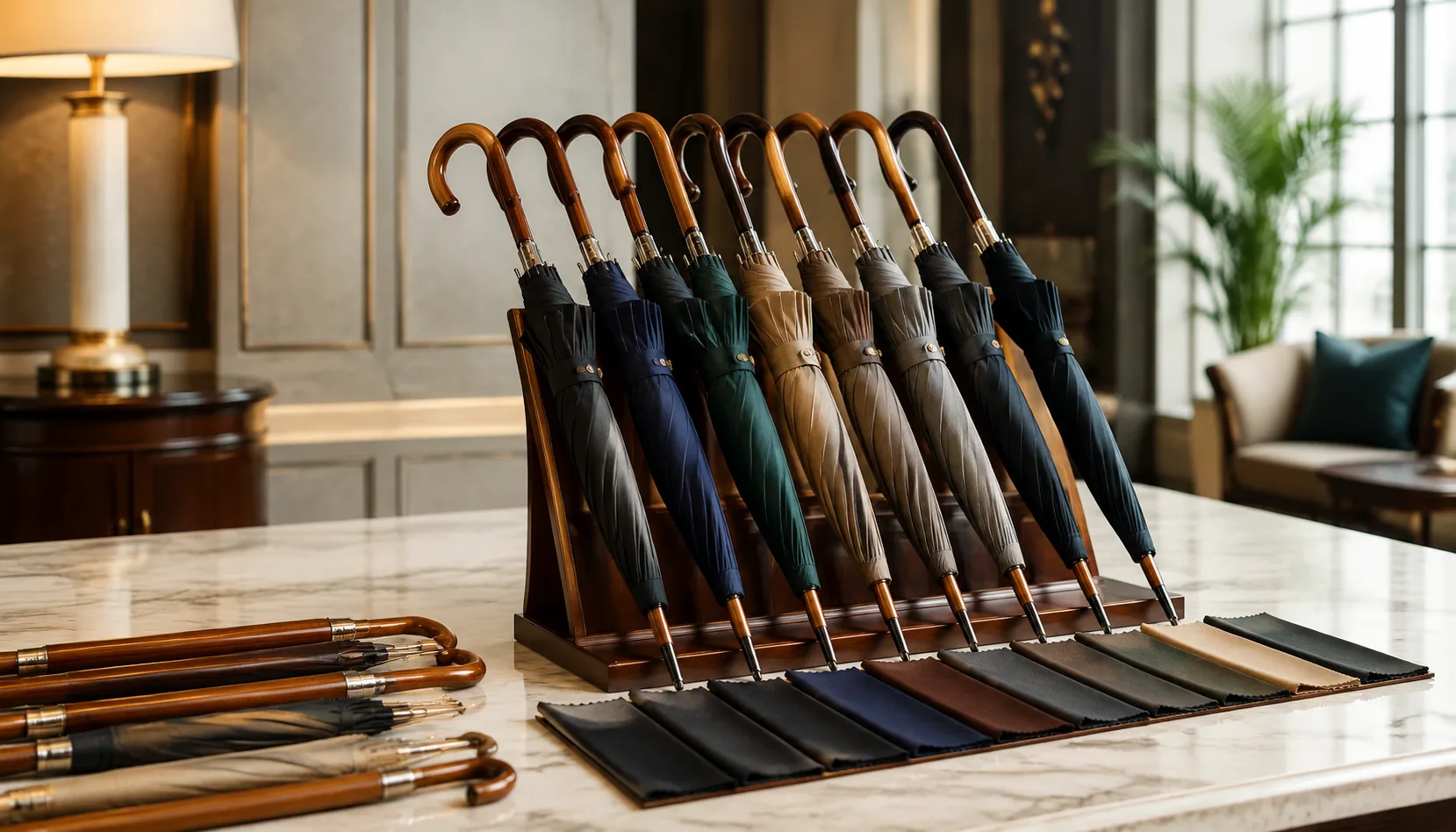
For hotel purchasing teams and retail buyers, wooden stick umbrellas look simple until the first shipment exposes loose handles, warped shafts, weak ribs, or logo print that shifts after rain testing. On our Songxia factory floor, we treat wooden stick umbrellas as a specification-controlled product: canopy diameter, shaft moisture, rib gauge, handle finish, print method, MOQ, and final inspection all need to match the sales channel before production starts.
Where Wooden Stick Umbrellas Fit Best
Wooden stick umbrellas fit best where the umbrella is part of the guest experience, not just rain protection. Hotels, resorts, private clubs, and serviced apartments choose them because a varnished maple, beech, or ash shaft looks deliberate in a lobby stand, at a concierge desk, or beside a valet podium. A 23" or 27" classic stick umbrella with a J-handle, 8K fiberglass ribs, and 190T or 210T pongee canopy feels more permanent than a folding umbrella, even when the actual FOB cost difference is modest. For hospitality programs, I usually recommend black, navy, forest green, or deep burgundy canopy colors with one-panel screen printing or a woven label; oversized logos make the product look like a giveaway instead of a house amenity.
Retail buyers use wooden stick umbrellas when they want a heritage look and higher perceived ticket value. A boutique retail walking umbrella can justify better shelf pricing with a natural wood handle, metal tip cup, matching ferrule, and a clean 23" canopy profile. The trade-off is obvious: these are not compact-portability products. A straight wooden shaft does not fit inside a handbag or backpack, and shipping cartons are longer, usually around 88–95 cm depending on finished length. But the silhouette sells well for menswear shops, museum stores, country clubs, outdoor lifestyle brands, and city gift shops because customers see it as an accessory, closer to a cane or walking piece than a disposable rain item.
For wooden shaft umbrellas OEM projects, the specification should balance appearance with field durability. Solid wood looks better than imitation plastic grain, but it needs consistent moisture control, smooth sanding, and stable lacquer; otherwise handles can dull, crack, or show glue-line defects after warehouse storage. Our standard practice at ZheBrella is to pair wood shafts with fiberglass ribs for better wind recovery, steel center rods only where the buyer is chasing cost, and AQL 2.5 inspection for canopy seam tension, rib-tip alignment, handle pull strength, and lacquer finish. A hospitality umbrella supplier should also confirm replacement quantities, because hotels lose umbrellas through guest carry-off. For most branded programs, a MOQ of 500–1,000 pieces per color is realistic, with 25–35 days production after artwork approval.
Canopy Size, Fabric, and Panel Construction
Panel construction matters because a wood shaft umbrella is usually judged at close range: in a hotel lobby stand, beside a retail cash wrap, or in a gift box. An 8-panel canopy should have balanced grain direction, even seam allowance, and a neat top notch around the runner so the fabric does not pull into a star shape after opening. For wooden shaft umbrellas OEM orders, logos are safest on one or two opposite panels if the mark is large, while all-over repeating prints need careful panel matching so the artwork does not jump at the seams. Hospitality umbrella supplier projects often add branding on the tie strap, sleeve, or woven label because guests notice those touchpoints before the canopy is opened. Heat transfer works for crisp multicolor logos on 190T or 210T pongee; screen printing is still stronger for simple one- or two-color marks above 500 pieces. Sleeve printing, button engraving, and woven labels should be confirmed in the pre-production sample before AQL 2.5 inspection.
Wood Shaft, Handle, and Rib Specifications
Rib choice changes the real service life more than most buyers expect. Steel ribs keep cost down and give a crisp, traditional frame action, especially in 8K construction on 23" or 27" models, but they add weight and can permanently bend when guests force the canopy against wind or use the umbrella as a walking stick. Fiberglass ribs cost more, usually adding a noticeable few dollars depending on size and rib count, but they flex back better and reduce breakage in hospitality use where umbrellas are borrowed, returned wet, and handled roughly by many users. A hospitality umbrella supplier should be honest here: steel is fine for controlled indoor-to-car service, while fiberglass or a steel shaft with fiberglass ribs is the better choice for resorts, golf properties, and coastal hotels. For stronger builds, 10K or 16K ribs with 190T or 210T pongee canopy fabric can pair well with a wooden shaft, but the frame balance must be tested so the umbrella does not feel top-heavy at the curved handle.
Opening Mechanism and User Experience
For wooden stick umbrellas, I usually recommend manual-open for hotels and auto-open for retail, unless the buyer has a very specific guest-service use case. Manual-open has fewer failure points: no launch spring, less impact at the runner, and easier control when a bellman opens the umbrella near a car door or lobby entrance. A good manual runner should move cleanly over the wooden shaft without grinding, but not so loose that it drops by itself after 200–300 cycles. For auto-open, the spring must be matched to the canopy size and rib weight; a 23" umbrella with 8K fiberglass ribs needs less force than a 27" model with steel ribs and a heavy 210T pongee canopy. We cycle-test auto-open samples at least 500 times before approving production because weak springs often look fine on day one and fail after one rainy weekend.
Guest safety is where cheap auto-open mechanisms create complaints. If the spring is too aggressive, the canopy snaps open close to the face, which is a real issue for hospitality umbrella supplier programs where guests are not thinking about mechanism behavior. The runner button should be recessed enough to avoid accidental release, and the notch area must be deburred so fingers do not get pinched. For a classic stick umbrella used at hotel entrances, I prefer a shaft diameter around 12–14 mm for adult hand comfort and better torsion resistance; thin shafts may look elegant but twist under wind load. Tip length also matters: 70–90 mm is practical for walking stability, while overly long metal tips scratch lobby stone floors and elevator panels. Rubber ferrules can be specified for resorts, hospitals, and serviced apartments.
Daily hotel use exposes small design mistakes faster than showroom testing. Strap placement should let staff wrap the canopy quickly without fighting the handle curve; if the strap is sewn too high, wet panels bunch at the runner, and if it is too low, the folded umbrella looks sloppy in a lobby stand. For wooden shaft umbrellas OEM orders, our standard practice is to check runner smoothness after varnishing, because excess lacquer on the shaft changes friction and can make the umbrella feel sticky. A retail walking umbrella can tolerate a firmer runner because the owner uses it occasionally, but a hotel loaner may be opened 20–50 times per day in bad weather. For wooden stick umbrellas sold through gift shops, auto-open adds perceived value, but for front-desk lending pools, a durable manual mechanism usually gives fewer returns and fewer guest-handling problems.
QC, MOQ, and Delivery Terms
QC on wooden stick umbrellas has to start before final assembly, because a bad shaft cannot be corrected after the runner, ribs, and canopy are locked in. We inspect wood grain consistency, varnish thickness, color matching against the approved swatch, and common finish defects such as orange peel, pinholes, dents, raised fibers, glue marks, and uneven stain near the crook handle. For wooden shaft umbrellas OEM orders, the buyer should approve both a dry indoor sample and a wet-rub sample, because darker walnut or mahogany finishes can bleed if the sealing coat is too thin. On the frame side, we check rib alignment, stretchers, runner travel, rivet tightness, tip positioning, and whether the 8K or 16K frame opens symmetrically without canopy twisting. Steel ribs need anti-rust oil or electroplating control, while fiberglass ribs need clean bonding at joints with no whitening or cracks after flex testing.
Final inspection should include canopy tension, stitch density, panel matching, printing position, and water repellency, not only appearance. A classic stick umbrella with 23 inch or 27 inch panels in 190T or 210T pongee should have even scallop height, no loose threads around the top notch, no puckering at rib tips, and no needle holes enlarged by over-tension. For logo orders, screen print adhesion, heat-transfer edge lifting, and color migration must be checked after a 24-hour rest, especially on dark navy, black, or red fabric. Our standard practice at ZheBrella is AQL 2.5 for major defects and AQL 4.0 for minor defects unless a retail customer requires tighter sampling. Major defects include broken ribs, crooked shaft, rust marks, failed auto-open mechanism if used, leaking cap, wrong logo color, or carton quantity errors. Hospitality buyers should also request carton drop checks and handle scratch checks, because hotel umbrellas are handled roughly at concierge desks.
MOQ depends more on wood finish and branding method than on the umbrella shape itself. A normal retail walking umbrella with stock beech or maple shaft, black pongee canopy, and one-position logo printing can often start around 300 to 500 pieces per color. Custom stained wood, engraved handles, metal logo plates, matched ferrules, or private-label woven tags usually push MOQ to 1,000 pieces because the shaft finishing line and hardware suppliers require batch setup. FOB Ningbo or Shanghai pricing is the cleanest basis for distributors who already consolidate cargo; DDP is workable for hospitality umbrella supplier programs going to the United States or Europe, but duties, carton volume, and destination accessorial charges must be confirmed before quotation. Typical lead time is 7 to 12 days for pre-production samples, 25 to 35 days for standard logo production, and 40 to 55 days for custom wood finish or retail packaging orders after artwork, deposit, and sample approval.
Frequently Asked Questions
Are wooden stick umbrellas heavier than metal-shaft umbrellas?
Usually yes, especially with a solid wood shaft and curved handle. Buyers can balance weight by choosing fiberglass ribs or a moderate canopy size instead of an oversized build.
Can hotels order wooden umbrellas with room-number or property branding?
Yes. Branding can be printed on canopy panels, straps, sleeves, or handle tags, while room-number programs usually need clear packing lists and carton labeling for distribution.
What specifications should hotels use for wooden stick umbrellas?
Hotels typically choose 23-inch or 27-inch canopies, a wooden shaft, fiberglass or metal ribs, a curved wooden handle, and 190T pongee fabric. For lobby or guest-use umbrellas, buyers often request logo printing on 1-2 panels and a matching sleeve.
What is the usual MOQ for custom wooden shaft umbrellas?
A practical MOQ is usually 500-1,000 pieces per design, depending on fabric color, handle type, and logo printing method. Custom wood colors, special tips, or private-label packaging may require a higher MOQ.
How should buyers inspect wooden stick umbrellas before shipment?
Inspection should check canopy diameter, frame opening and closing, shaft straightness, handle finish, logo placement, stitching, waterproof performance, and carton packing. For B2B orders, AQL 2.5 for major defects and AQL 4.0 for minor defects is commonly used.
Looking to Launch Your Custom Umbrella Line?
ZheBrella is a Zhejiang-based OEM/ODM umbrella manufacturer with 17 years of export experience. Free design, low MOQ from 100 pieces, windproof construction, full-color print.
Get Free Quote Now »People Also Search For
Related Articles
Wooden Stick Umbrellas: Buyer Guide for Premium Lines
Source premium wooden stick umbrellas with proper shaft, ribs, pongee fabric, handles, packaging, AQL 2.5 checks, MOQ, a...
Read More »
Wooden Shaft Stick Umbrellas: Retail Buyer Spec Guide
Compare wooden shaft umbrella specs for retail programs, including canopy fabric, ribs, handles, finishing, QC checks, M...
Read More »
Stick Umbrellas with Wooden Shafts: OEM Buyer Spec Guide
Compare wooden shaft stick umbrella specs, from rib materials and canopy fabric to handle finish, MOQ, QC checks, and sh...
Read More »