Hotel Amenity Umbrellas: Spec Choices for Guest Use
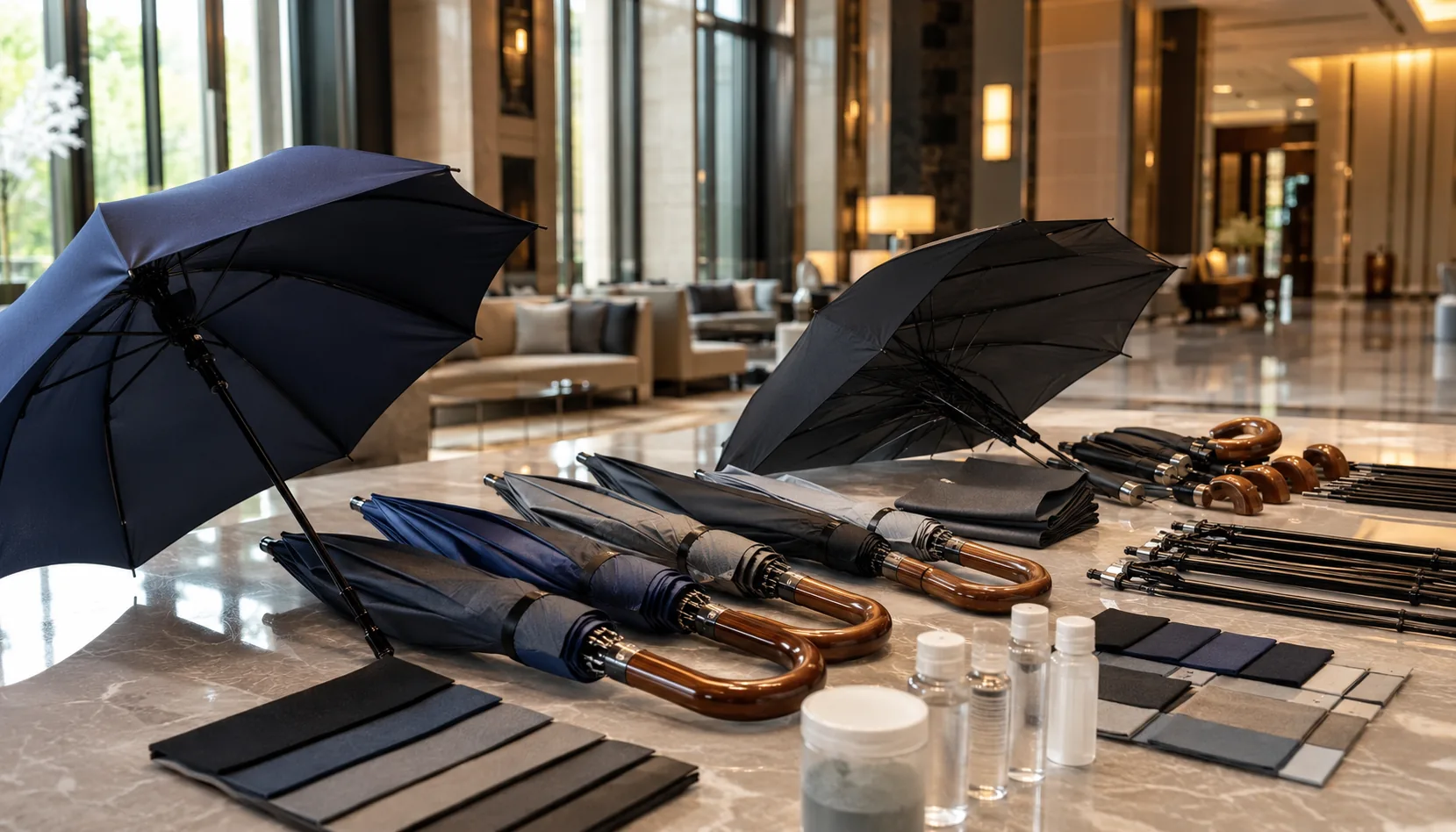
Buying guest umbrellas looks simple until guest rooms, lobby stands, and replacement orders start drifting in size, color, and durability. From a factory standpoint, the failures usually trace back to a few spec decisions: frame gauge, opening diameter, logo placement, and carton pack-out. When those details are set correctly up front, hotel amenity umbrellas stay consistent for guests, easier to replenish, and more predictable on cost.
What hotel programs need from an umbrella spec
The first mistake in hotel amenity umbrellas is treating every touchpoint as the same product. They are not. Guest rooms need a compact, low-effort unit that fits a closet sleeve or luggage bench, usually a 21 inch or 23 inch umbrella with an 8K frame so it stays light and does not snag robes, bags, or door hardware. Lobby stands and bell desk stock do better at 27 inch or even 30 inch because coverage matters more than pack size when a guest steps into rain with a suitcase. Shuttle service sits in between: a 23 inch or 27 inch canopy is easier to store by the driver seat and less likely to hit mirrors or passengers during loading. Concierge handouts should be treated as high-turn inventory, where replacement rate is the real cost driver, not unit price alone. That usage split changes the build. Guest room umbrellas should favor pongee 190T or 210T with a simple water-repellent finish rather than heavy UV or Teflon coatings unless the property is resort-focused and actually needs UPF 50+ performance. For lobby and valet pools, darker canopies hide scuffs better, while shuttle programs usually want reflective piping or a printed room-number code for returns control. On the factory side, the cleanest hotel programs are the ones that assign one SKU for rooms and one for public areas, not one umbrella trying to survive every job badly.
Mechanism choice is where hotels either reduce complaints or create them. For repeated guest use, an auto-open umbrella is usually the right default for lobby stands, concierge issue, and shuttle vehicles because one-button deployment matters when a guest is juggling a phone, key card, and luggage. Manual open still makes sense for guest room umbrellas if the property wants lower repair rates, because auto springs and runners take the hardest abuse from users who force the shaft shut at the wrong angle. I would not spec auto-open-close for standard hotel circulation unless the property is willing to accept a higher replacement rate; that mechanism is excellent in executive gifting, but guests are rough on it. Frame material matters more than most buyers think. Steel ribs are cheaper and look acceptable in a sample carton, but they bend permanently after door-pinches, wind inversion, or guests leaning on them like a cane. Fiberglass ribs recover better after inversion, do not corrode in coastal properties, and are safer when umbrellas are opened hundreds of times by untrained users. An 8K or 10K fiberglass frame on a 23 inch canopy is the practical sweet spot; 16K looks fuller but adds weight, more sewing points, and more failure opportunities. At ZheBrella, our standard practice for hospitality programs is a fiberglass main frame with a steel shaft only when the buyer explicitly wants a lower target cost.
Procurement should lock the operating spec before discussing color cards or handle shapes. A serious hotel program will define where each umbrella lives, the expected annual loss rate, and whether branding is subtle screen print, heat transfer, or no logo at all. Once those basics are fixed, the commercial side is straightforward: most factories will quote MOQ at 300 to 500 pieces per color for stock frames, while custom handle molds or woven sleeve labels push MOQ higher. Lead time is typically 25 to 35 days for repeat builds and 35 to 45 days for first orders with preproduction samples. If the order will be replenished across properties, ask for AQL 2.5 inspection with special attention on open-close cycling, canopy centering, tip security, and runner smoothness. Hotels also need to read freight terms carefully. Many buyers ask for FOB DDP comparisons because a resort in Hawaii, Miami, or Vancouver may prefer delivered pricing, but umbrella cartons are bulky and dimensional weight can erase a cheap unit price quickly. Ask for packed carton size, net and gross weight, and units per master carton before approving. For most branded hospitality runs, the better value is a durable mid-range spec that survives a season of guest use, not the cheapest frame that looks fine at check-in and fails by the third storm.
Build choices that survive daily hotel handling
For hotel amenity umbrellas, canopy cloth is where many buyers either save money intelligently or create a replacement problem six months later. A 190T pongee cover is fine for dry-climate properties and standard guest room umbrellas that spend most of their life in a closet or bell stand; it folds slightly slimmer, dries faster after light rain, and keeps unit cost down. But if the hotel entrance sees daily curbside use, I would move to 210T pongee without much debate. The denser weave resists pinhole wear at rib tips better, holds black or navy color more evenly under lobby lighting, and feels less flimsy in a guest’s hand. It also performs better with Teflon top coating because the surface is tighter, so water beads instead of wetting through after repeated use. For upscale properties, a matte 210T with a subtle UV coating is a better long-term spec than shiny economy fabric. It simply looks less tired after hundreds of check-in and check-out cycles.
Frame choice matters more than buyers think, especially at windy porte-cocheres and revolving-door entrances. An 8K frame on a 23 inch umbrella is the practical baseline: fewer panels, lower weight, faster opening, and fewer stitch lines that can distort after hard use. A 16K frame looks more refined and creates a rounder canopy edge, but it adds more joints, more sewing, and more opportunities for misalignment if the supplier is chasing price. I only recommend 16K when the hotel is clearly prioritizing appearance in valet, concierge, or luxury suite programs. For mainstream properties, 8K with fiberglass ribs is the tougher build because the ribs flex and recover instead of taking a permanent bend like cheap plated steel. If the entrance gets crosswinds above 35 to 40 mph, a double-canopy vented construction is worth the added cost. A well-built vented 27 inch model will dump pressure instead of inverting, and a decent windproof frame should comfortably survive 50 plus mph gust testing.
Mechanism, shaft finish, and handle material decide whether the umbrella still feels respectable after a year of abuse. A basic manual runner lasts longer than many low-end automatics, but in hospitality an auto-open umbrella is usually the right compromise because guests can deploy it one-handed while carrying luggage. I would avoid auto-open-close for room stock unless the hotel specifically wants a compact foldable style; the spring set is more failure-prone under careless handling. For straight umbrellas, black electrophoresis shafts hide scratches far better than bright chrome, and a 14 mm to 16 mm steel shaft gives better rigidity than thin-wall tubing. On handles, ABS with a rubberized overmold holds up better than soft EVA foam, while sealed wood works if the property wants a warmer look and accepts minor finish wear. At ZheBrella, our standard quoting practice is to keep MOQ realistic at 300 to 500 pieces per color for custom hotel logos, with typical production in 25 to 35 days and FOB DDP terms set clearly before sampling.
Branding and presentation for hospitality programs
On hotel amenity umbrellas, the canopy logo matters less than where a guest actually sees it. For a 21-inch or 23-inch umbrella in 190T or 210T pongee, the cleanest placement is usually one exterior panel, centered between the rib pockets and kept 35 to 45 mm off the edge so the mark does not distort when the canopy is under tension. Two opposite panels work if the hotel wants visibility from both directions, but more than that starts to look like promo merchandise rather than hospitality equipment. Sleeves and hang tags do different jobs: the sleeve is what housekeeping sees on the cart and in the closet, while the hang tag is where you put room-use instructions, property code, or a replacement SKU. For guest room umbrellas, small logos are where buyers get into trouble. On woven pongee, anything under about 25 mm wide or lines thinner than 0.6 mm will soften in screen print, especially on dark navy, forest, or burgundy canopies.
If the brand book has fine serif lettering, metallic gradients, or a crest with multiple enclosed spaces, switch from simple screen print to heat transfer or woven sleeve labeling, but do it with open eyes. Heat transfer holds finer detail, yet on textured 190T fabric it can feel stiffer and the carrier edge may show under certain light; that is acceptable for a discreet hotel mark, not for luxury retail presentation. The frame choice also affects presentation more than people expect. An auto-open umbrella with fiberglass ribs and a matte black shaft reads cleaner than mixed nickel hardware, and on a 10K or 16K frame the denser rib pattern can visually crowd a large panel logo. Color consistency across reorders is where hotel groups usually lose control. Our standard practice at ZheBrella is to lock the Pantone reference, keep a signed strike-off on the actual canopy fabric, and retain one sealed approval sample, because the same white ink can look different on 190T navy pongee versus black pongee with a Teflon coating.
Packaging should follow the property workflow, not a retail habit copied from consumer umbrellas. If the umbrellas are being staged into rooms, the most practical pack is individual polybag or recycled sleeve, printed hang tag, then export carton counts that match housekeeping issue quantities, usually 12 or 24 pieces per carton rather than random mixed counts. Retail-style boxing only makes sense when the hotel plans to sell units in a lobby shop, place them in VIP welcome kits, or present them as part of an amenity set with slippers and robes; otherwise the box adds cost, cube, and damage points with no operational benefit. For most hotel amenity umbrellas, MOQ is often 300 to 500 pieces for a stock-color canopy with one-color print, but custom printed boxes, woven labels, or multi-property assortments can push the workable MOQ closer to 1,000. Ask for FOB/DDP quotes both ways. On DDP, oversized presentation boxes move landed cost faster than buyers expect, while under FOB you still need carton marks by property code if the order will be split to several hotels.
MOQ, lead times, and sourcing terms to confirm early
Ask for MOQ in three layers, not one headline number, because umbrella factories quote differently depending on fabric and trim. For hotel amenity umbrellas built on a standard 23 inch straight frame with 8K fiberglass ribs and an auto-open umbrella mechanism, a workable starting point is 300 to 500 pieces per colorway if you use stock 190T or 210T pongee and a one-color screen print. The number usually jumps to 800 to 1,000 pieces per colorway if you require custom Pantone-dyed canopy fabric, matching sleeve, or molded handle color. Clear POE, PVC, or EVA canopies are a separate conversation and often need higher minimums because film thickness, welding setup, and packing losses are less forgiving than woven pongee. Also confirm whether the MOQ applies per SKU, per logo color, or per shipment. A hotel group buying navy, black, and beige guest room umbrellas can get burned if the supplier says 1,000 pieces minimum but really means 1,000 of each color, not 1,000 total split across three shades.
Sample timing should be pinned down before artwork approval, because delays usually come from printing and handle sourcing, not sewing. A blank fit sample on an existing 21 inch or 23 inch frame can be ready in 2 to 3 days, but a branded pre-production sample with canopy print, care label, and sleeve normally takes 5 to 7 days if the factory has stock fabric. If you need a woven label, custom hangtag, or heat-transfer logo placement approval, plan on 7 to 10 days. Bulk production for hotel amenity umbrellas is typically 25 to 35 days after sample sign-off and deposit for 1,000 to 3,000 units; in peak rain-season bookings or before Canton Fair shipping crunches, 35 to 45 days is safer. Our standard practice at ZheBrella is to lock carton configuration before production starts: 24 or 36 pieces per export carton for straight umbrellas is common, with master carton weight kept under about 18 kg so hotel receiving teams are not wrestling oversized boxes. Ask for carton dimensions, net and gross weight, units per inner pack, and whether sleeves are packed on or separate.
FOB works best when the buyer already has a forwarder consolidating China-origin goods, especially if umbrellas are moving with linens, slippers, or other hospitality items from multiple vendors. You control the ocean rate, can compare sailings, and avoid padded freight baked into the unit price. For most hotel groups, FOB Ningbo is the cleanest default because Songxia factories truck there efficiently and documentation is routine. DDP is better when the procurement team wants landed-cost simplicity and does not want to manage customs classification, duties, port exams, and final-mile delivery to a U.S. or EU warehouse. But do not accept a vague FOB DDP quote line; require the supplier to separate ex-factory cost, export charges, freight, duty assumptions, and destination delivery scope. I have seen buyers think DDP included palletization, appointment delivery, and duty, only to learn it covered curbside drop and a low duty estimate. If the order is under roughly 500 cartons or tied to a fixed property-opening date, DDP often reduces headaches even when the nominal unit cost is higher.
QC points that reduce complaints and replacements
Most complaints on hotel amenity umbrellas start with basic function, so the first control point is a written pass/fail standard before cartons are sealed, not a vague “opens OK” note on the inspection sheet. For a 21 inch or 23 inch auto-open umbrella, I would set button actuation at roughly 18 to 28 N, with full spring launch and lockout in one motion, no half-open hesitation, tooth skipping, or runner bounce-back. Manual frames should slide smoothly with no pinch points and no exposed burrs on the notch, runner, or top cap. Tip safety matters more than buyers expect in guest room umbrellas: top tips and end caps should not detach under a 70 N pull test, and ferrules should have no sharp flash that can scratch luggage or skin. Canopy tension should be even across all 8K or 10K panels, with no loose quadrant, no rib pocket twist, and no inversion under a controlled fan test around 45 to 50 mph for fiberglass ribs. Water repellency should be checked with a spray test after 30 minutes of conditioning; 190T or 210T pongee should bead cleanly, not wet out along stitch lines.
AQL 2.5 only works if the defect classification is fixed before mass production. On hotel amenity umbrellas, I would classify broken ribs, failed auto-open, detached tips, punctured canopy, or severe handle wobble as critical or major depending on the retailer’s policy, because each one leads directly to replacement cost or front-desk complaints. Stitching needs a measurable rule: 8 to 10 stitches per inch on pongee seams, no skipped stitches longer than 10 mm, no backstitch unraveling, and no seam grin that shows pinholes when the canopy is under normal opening tension. For printed canopies, define alignment by panel and logo size, not by “visual approval.” A practical standard is plus or minus 3 mm for small one-color marks and plus or minus 5 mm for larger transfer or screen prints, with no rotated logo, ghosting, color contamination, or heat-transfer wrinkles near the rib line. Our standard practice is to check print orientation against the closing strap position as well, because a misaligned mark that disappears into a fold is technically usable but commercially defective.
Handle wobble is one of the easiest issues to miss in the line and one of the fastest ways to make a cheap umbrella feel unacceptable at a hotel. Set a simple acceptance rule before shipment: no perceptible lateral play above about 1.5 mm at the handle end after 20 open-close cycles, no twist between shaft and handle, and no cap gap where adhesive squeeze-out or incomplete crimping is visible. For straight handles in ABS, wood, or rubberized PP, check pull resistance and finish consistency; for folding units, inspect the joint between lower shaft and grip after salt-humidity exposure if the goods will sit in coastal properties. Sampling should follow AQL 2.5 at final random inspection, but I also prefer first-off approval and in-line audits at 10 percent, 50 percent, and 80 percent of packed quantity so problems do not hide inside MOQ-heavy orders. Whether terms are FOB or DDP, the buyer should require the factory to record pass/fail photos, lot numbers, and carton traceability before booking, because replacement claims are much harder to sort once mixed export pallets leave the warehouse.
Frequently Asked Questions
What umbrella spec works best for guest-room use in hotels?
A mid-size auto-open umbrella with a fiberglass frame, 190T or 210T pongee canopy, and a compact sleeve usually works best. It balances ease of use, lower breakage risk, and enough surface area for hotel branding.
Should hotels source FOB or DDP for umbrella programs?
FOB is better when the hotel or its buying agent already manages freight and customs. DDP is easier for multi-property programs that want one landed price and fewer import steps.
What size umbrella works best for hotel guest-room programs?
Most hotels choose 23-inch to 27-inch straight umbrellas for guest rooms and lobbies. A 23-inch model is easier to store in closets, while 27-inch provides better rain coverage for two guests.
What branding options are practical for hotel amenity umbrellas?
Common options include one-panel logo printing, woven handle labels, sleeve printing, and custom hang tags. For hotels, single-color logo printing is usually the most cost-effective and keeps replacement batches consistent.
How should hotels specify pack-out for umbrellas?
A typical pack-out is one umbrella in an individual sleeve, 12 pieces per inner carton, and 24 or 36 pieces per export carton. Buyers can also request room-number labels, barcode stickers, or mixed carton packing by property.
Looking to Launch Your Custom Umbrella Line?
ZheBrella is a Zhejiang-based OEM/ODM umbrella manufacturer with 17 years of export experience. Free design, low MOQ from 100 pieces, windproof construction, full-color print.
Get Free Quote Now »People Also Search For
Related Articles
Hotel Guest-Room Umbrellas: Buyer Spec Guide for OEM Orders
Build durable hotel umbrellas with the right straight or folding frame, handle, canopy fabric, branding, packaging, MOQ,...
Read More »
Hotel Guest Room Umbrellas: Buyer Spec Guide for Brands
Plan hotel guest umbrellas with durable frames, branded canopies, room-ready packaging, AQL 2.5 inspection, MOQ planning...
Read More »
Hotel Guest Umbrellas: Specs for Lobby and In-Room Use
Choose hotel guest umbrellas by size, frame strength, auto-open reliability, logo placement, MOQ, and FOB/DDP terms for ...
Read More »