Funeral Home Umbrellas for Chapel, Graveside, and Staff Use
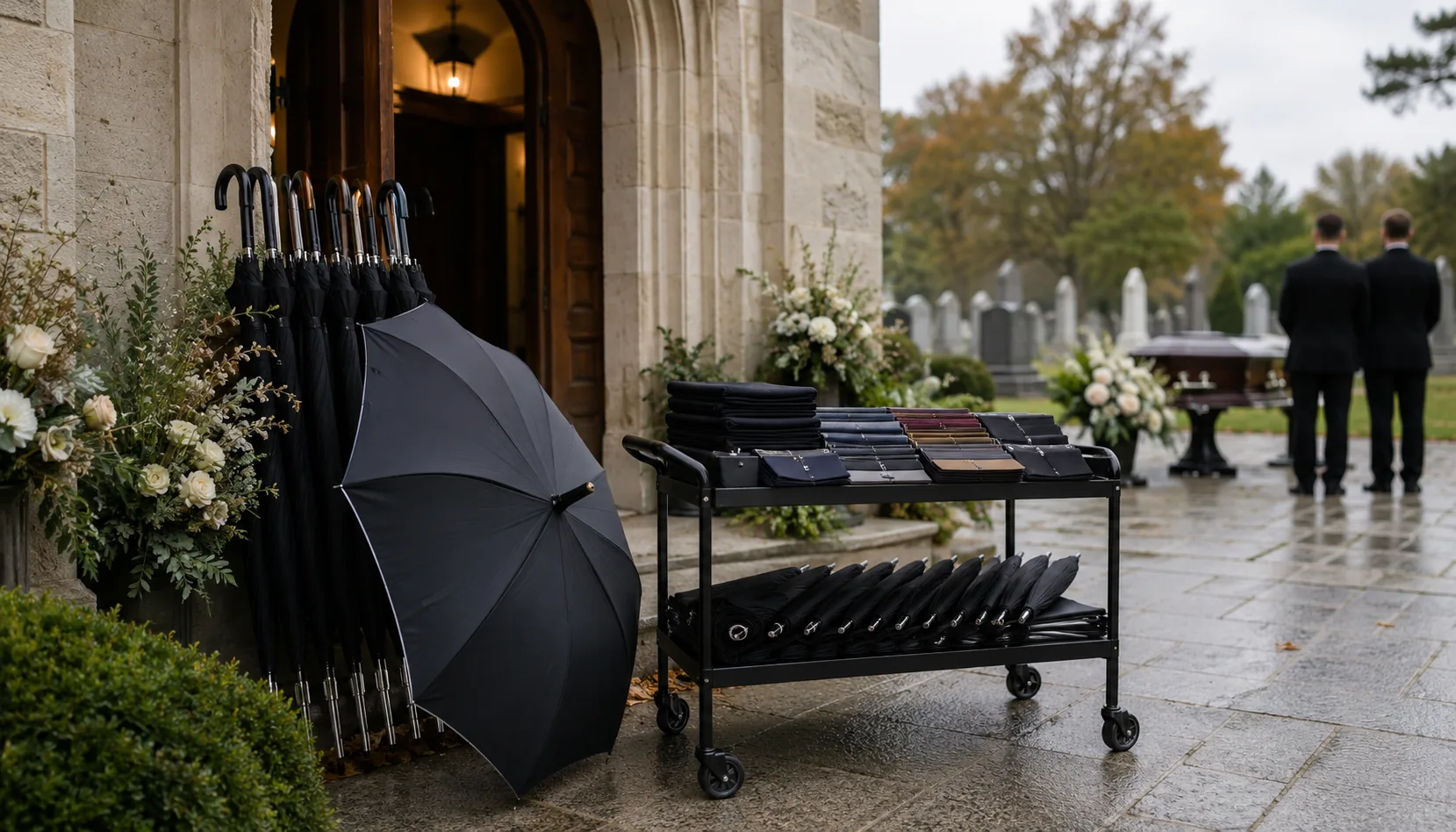
For funeral directors, an umbrella program has to do more than keep guests dry: it needs to open cleanly at the curb, present a quiet, uniform look at the graveside, and survive repeated staff handling without frame failures. On the factory floor, that means funeral home umbrellas built around dependable auto-open runners, subdued printing that stays crisp on dark canopies, and QC checks on spring action, stitch tension, and carton packing before lead times are promised.
Where Funeral Homes Use Umbrellas Day to Day
Most day-to-day use starts before anyone sits down. The busiest minutes are chapel arrivals, when families step out of sedans, limousines, or removal vans and need dry cover from curb to door without any fumbling. That is why funeral home umbrellas usually work best as 27-inch or 30-inch auto-open stick umbrellas, not compact folders. One hand is often managing a door, flowers, or paperwork, so a fast runner matters more than saving trunk space. For a sober, uniform look, black pongee umbrellas in 190T or 210T fabric are the right baseline; they dry faster than bargain polyester, wrinkle less, and with a Teflon finish they stop soaking your vestibule tile five minutes later. I would spec 8K or 10K frames with fiberglass ribs rather than all-steel frames, because they flex back better when a driver snaps one open in crosswind beside the hearse. If branding is necessary, discreet logo umbrellas with a small white or charcoal print on one panel keep the service professional instead of turning it into event merchandise.
The cemetery is where weak umbrellas get exposed fast. Graveside service umbrellas need more canopy area and better wind behavior because staff are holding position for fifteen to forty minutes, not escorting for a quick walk to the chapel door. A 30-inch straight umbrella or a double-canopy vented model earns its keep if your sites see gusts above 35 mph; better builds with fiberglass ribs and a reinforced shaft can survive 50+ mph before inverting. For clergy, pallbearers, and family escort, a balanced straight handle is easier to control on wet grass than a bulky golf grip. Staff also use umbrellas while staging floral sprays, keeping memorial folders and register books dry, shielding tablets used for music or livestream coordination, and directing traffic near the cemetery road. Strong sun matters almost as much as rain. A black outer canopy with a UV-treated inner surface rated UPF 50+ makes a real difference for crews standing through summer services, especially on open ground with no tree cover.
Quantity planning should follow operating flow, not promotional-buyer logic. A single branch with one chapel and one active graveside team usually needs 24 to 36 pieces in circulation: 6 to 8 at the main entrance, 4 to 6 split between hearse and lead car, 6 reserved for graveside deployment, and the rest cycling through drying, cleaning, or replacement. If you want one clean setup, use 27-inch entrance and escort units plus a smaller block of 30-inch cemetery units. Multi-location groups should standardize SKUs across branches, receive against AQL 2.5 for visible defects and opening function, and keep 10 to 15 percent extra stock centrally because umbrellas disappear into vehicles, get borrowed by part-time staff, or come back with bent ferrules after storm weeks. Custom funeral home umbrellas are rarely a one-time order. MOQ for custom black sticks is commonly 100 to 300 pieces per style, with 25 to 35 days production after artwork approval, plus freight time under FOB or DDP terms, so reorder planning should sit on the operations calendar, not wait for an emergency purchase.
Best Specs for Presentation, Weather, and Ease of Use
The best working size for funeral home umbrellas is still a 23-inch or 27-inch auto-open stick frame, because deployment speed matters more than brochure aesthetics when pallbearers are moving and a family is stepping from chapel to coach in rain. A 21-inch straight umbrella is fine for one staff member but too tight when you need to shield a mourner at the shoulder; a 30-inch golf frame looks bulky, catches more wind, and is awkward around vehicle doors and cemetery paths. A 23-inch canopy opens to about 40 to 42 inches across, while 27-inch gives closer to 46 to 48 inches, which is why many buyers split orders between staff issue and family escort use. I strongly prefer a steel or aluminum shaft with fiberglass ribs over a basic all-steel frame: fiberglass flexes and recovers after gusts, while cheap steel ribs take a permanent set, twist the runner, and never close cleanly again. That is exactly why auto-open stick umbrellas dominate professional fleets.
Rib count is where buyers often spend money for the wrong reason. An 8K umbrella is sufficient for everyday chapel exits, parking-lot transfers, and most graveside coverage if the frame spec is honest: 10 mm shaft, 3.5 mm fiberglass ribs, reinforced top notch, and a spring that snaps the canopy fully open instead of stopping halfway. Eight panels also keep replacement canopies straightforward and weight manageable for ushers who may carry the umbrella for hours. A 16K silhouette, by contrast, is chosen mostly for presentation. The denser panel layout creates a rounder canopy edge and a more tailored profile, which reads more formal outside a chapel entrance or during a high-visibility procession. It is not automatically stronger in wind than 8K; strength comes from rib material, rib profile, and vent construction, not from having more spokes. If you want a middle ground, 10K gives a cleaner look than 8K without the extra weight and sewing complexity of 16K. For discreet logo umbrellas, 8K and 10K also give larger print panels and cleaner logo placement.
Fabric is where all-weather service is won or lost. For black pongee umbrellas, 190T pongee is the minimum I would buy for institutional use because it keeps the canopy light and dries reasonably fast, but 210T has a better hand, hangs flatter on a straight frame, and resists pinholing at the rib tips after repeated opening cycles. Add a Teflon water-repellent finish so rain beads and shakes off before the umbrella goes back into a stand, and specify a UV-blocking coating rated UPF 50+ because graveside service umbrellas are used as often in hard summer sun as in drizzle. If your location sees open-field wind, a double-canopy vented version with fiberglass ribs can be tested to survive gusts above 50 mph, which matters far more than adding decorative trim. At ZheBrella, our standard practice is AQL 2.5 inspection on spring action, seam slippage, tip alignment, and handle straightness, because a funeral umbrella that hesitates, leaks at the cap, or shows a crooked canopy looks careless in the worst possible moment.
Discreet Branding That Fits the Setting
The most appropriate branding on funeral home umbrellas is the kind a family barely notices from 10 feet away. For chapel entry and procession use, I usually steer buyers to a tonal one-color print on black 190T or 210T pongee rather than a contrasting white mark. On black pongee umbrellas, a gloss-black screen print over a matte canopy, or the reverse, gives just enough visibility in daylight without turning the panel into an advertisement in flash photography. Keep the art small, usually 80 to 100 mm wide, placed on one lower panel near the closing strap so it reads when the canopy is down, not when it is open over mourners. If the order is for 23-inch or 27-inch auto-open stick umbrellas with 8K fiberglass ribs, a discreet deboss on the PU handle patch or a laser mark on a straight wood handle often looks more dignified than any canopy print.
For graveside service umbrellas, exterior silence matters more than clever decoration, so I prefer secondary branding points that staff can identify up close while guests see a clean canopy. A woven tag stitched inside the canopy seam, a small sleeve label on the storage cover, or a subtle engraving on the ferrule cap does that job without putting a logo into every photograph. Discreet logo umbrellas also hold up better when the decoration method matches the substrate: woven tags for pongee, debossing for molded rubber handles, laser engraving for maple crooks, and heat transfer only when the artwork has fine lettering that screen mesh cannot hold cleanly. I would avoid shiny metallic ink, oversized strap labels, or anything reflective on POE, PVC, or EVA models; those materials already catch light, and the effect feels wrong in a funeral setting. Good factories check logo position, stitch tension, and thread color under AQL 2.5, because a black-on-black brand mark only works if the placement is exact.
The real operational decision is not the logo treatment; it is whether each branch gets its own artwork or the whole chain runs one standard program. Branch-specific umbrellas sound sensible until reorders start: separate screens, separate carton marks, higher risk of mixed packs, and longer lead times if one location suddenly needs 300 replacements before a rainy week. Our standard practice at ZheBrella is to keep the frame, canopy cloth, and pack-out identical across the program, then localize only the sleeve label or interior woven tag when buyers insist on branch ID. That keeps MOQ practical, often 300 to 500 pieces per artwork instead of forcing a full production run per branch, and repeat orders can usually ship FOB Ningbo in 25 to 30 days or DDP in roughly 35 to 45. If a chain wants consistency, one national mark on all funeral home umbrellas is easier to replenish, easier to audit, and cleaner for staff training than six slightly different black umbrellas circulating between chapels.
Quality Control Standards for Repeat Branch Use
The cheapest umbrella on a freight quote is usually the most expensive unit in branch use, because staff do not destroy umbrellas in one dramatic wind event; they wear them out through 20 to 30 open-close cycles a week, constant vehicle loading, and fast handoff between directors, attendants, and guests. For funeral home umbrellas, I would hold finished goods to AQL 2.5 and treat color consistency as a hard pass-fail item, especially on black pongee umbrellas in 190T or 210T. Mixed dye lots show up immediately under chapel lighting, and even a slight charcoal-to-jet-black shift looks sloppy when six or eight units are lined up at the entrance. The same inspection should measure seam strength at panel joins and tie-band stitches, because repeated wet folding pulls hardest at those points long before the canopy fabric itself fails. On 23-inch and 27-inch auto-open stick umbrellas, smooth runner travel matters as much as fabric quality; if the spring hesitates or the runner catches on the shaft, staff will feel it within the first week.
The physical checks need to go beyond a quick tabletop sample. For graveside service umbrellas, inspectors should sight every shaft for straightness, confirm ferrules and tips are fully seated with no sharp flashing, and reject ribs that twist unevenly when opened under load. Steel shafts are acceptable for a formal black stick umbrella, but I prefer fiberglass ribs, or at least fiberglass end sections, because they recover better after side gusts and car-door knocks. At ZheBrella, our standard practice is to cycle random samples through repeated opening and closing, then recheck the locking notch, top cap, and handle fit; loose hooks and wandering tips are what branches complain about after 60 days, not on receiving day. If the program also calls for discreet logo umbrellas, print registration and ink rub resistance should be checked after drying, because a subtle one-color mark that scuffs or transfers onto wet hands defeats the whole point of keeping branding understated.
MOQ, Shipping Terms, and Reorder Planning
For custom funeral home umbrellas, the real MOQ is driven less by assembly and more by fabric allocation, print setup, and how many SKUs you insist on splitting. A plain black 190T pongee or 210T pongee stick umbrella in 23 inch or 27 inch, usually 8K with steel shaft and fiberglass ribs, can often start at 300 pieces per style if the artwork is a simple one-color screen print and the handle, ferrule, and tip are standard. Once buyers ask for discreet logo umbrellas by branch location, separate carton marks, woven labels, or mixed mechanisms such as manual-open and auto-open stick umbrellas in the same run, 500 pieces is the more realistic floor. POE, PVC, or EVA guest umbrellas can also push the MOQ higher because film sourcing and welding loss are less forgiving than black pongee umbrellas. On a clean production schedule, 30 to 45 days ex-factory is normal after sample sign-off and deposit, and that is before freight booking, export documents, and destination customs time.
FOB works best when the importer already consolidates containers from several suppliers and knows exactly how they want freight handled. If you are bringing in chapel supplies, textiles, and promotional goods through one U.S. or EU hub, FOB Ningbo gives better control over sailing schedules, palletization, customs broker instructions, and inland drayage costs. It also makes sense when the order is large enough to optimize carton loading, such as pairing 23 inch staff umbrellas with 30 inch guest coverage models for graveside service umbrellas in the same shipment. Our standard practice is to quote master carton counts, gross weight, and cubic meters early, because long stick umbrellas consume volume faster than buyers expect, especially at 25 to 30 pieces per export carton. DDP is usually the cleaner option when the customer is supplying multiple funeral home branches directly, needs landed-cost certainty, or is replenishing mid-season without a procurement team that wants to manage tariffs, port exams, and last-mile appointments.
Reorder planning is where buyers either save money or create their own stock problem. The disciplined approach is to lock one core spec for 12 months: same black canopy shade, same shaft plating, same rib construction, same sleeve, and the same logo position. That lets the factory hold matching fabric lots and replacement trim, so the second and third runs are less likely to show color drift or handle substitutions. For funeral home umbrellas, I usually tell buyers to forecast in two layers: a base stock of 23 inch black pongee umbrellas for ushers and staff, then a seasonal buffer for weather-heavy months and memorial event clusters. If annual usage is 1,200 pieces, ordering 500 and then reordering at the 250-piece on-hand mark is safer than waiting until inventory is nearly gone, because production still needs 30 to 45 days and ocean freight can add another 20 to 35 days. Keep incoming inspection at AQL 2.5 and record defect patterns by batch; it makes the next reorder far more predictable.
Frequently Asked Questions
Are 16-rib umbrellas practical for funeral service operations?
They can be, but mainly for premium front-of-house presentation because 16K umbrellas look fuller and more formal while adding weight and cost. Many operators use 8K fiberglass auto-open styles for daily staff use and reserve 16K units for family escort or higher-end branches.
Which fabric is better for a formal black umbrella: 190T or 210T pongee?
210T pongee usually gives a denser, richer black appearance and a slightly more premium hand feel. 190T is still common for cost control and can work well when the program prioritizes basic durability and discreet single-color branding.
What umbrella specifications work best for graveside services?
Most funeral homes choose 23-inch auto-open stick umbrellas with black pongee fabric, fiberglass ribs, and a straight or curved handle. A windproof frame and water-repellent canopy help staff cover guests quickly during cemetery services.
Can funeral home umbrellas include a logo without looking promotional?
Yes. Buyers usually request tone-on-tone printing, a small one-panel logo, or a discreet handle tag so the umbrella remains formal. Black, charcoal, or dark gray imprint colors are common for memorial and chapel use.
What is a practical MOQ and lead time for custom funeral umbrellas?
A typical OEM order starts around 500–1,000 pieces, depending on frame and printing requirements. Production usually takes 30–45 days after sample approval, with additional time for ocean or air freight.
Looking to Launch Your Custom Umbrella Line?
ZheBrella is a Zhejiang-based OEM/ODM umbrella manufacturer with 17 years of export experience. Free design, low MOQ from 100 pieces, windproof construction, full-color print.
Get Free Quote Now »People Also Search For
Related Articles

Airport and Transit Umbrellas: Specs for Passenger and Crew Use
How airports, rail operators, and transit contractors can source passenger and crew umbrellas with the right size, durab...
Read More »
Branded Umbrellas for Healthcare Systems: Buyer Specs and Use Cases
How hospitals, clinics, and pharmacies can source branded umbrellas that balance patient comfort, staff durability, comp...
Read More »
Custom Umbrellas for Insurance Claims and Roadside Teams
Design insurance and roadside-assistance umbrellas for field inspections, policyholder support, and storm response with ...
Read More »