High-Contrast Branding for Dark Umbrella Canopies
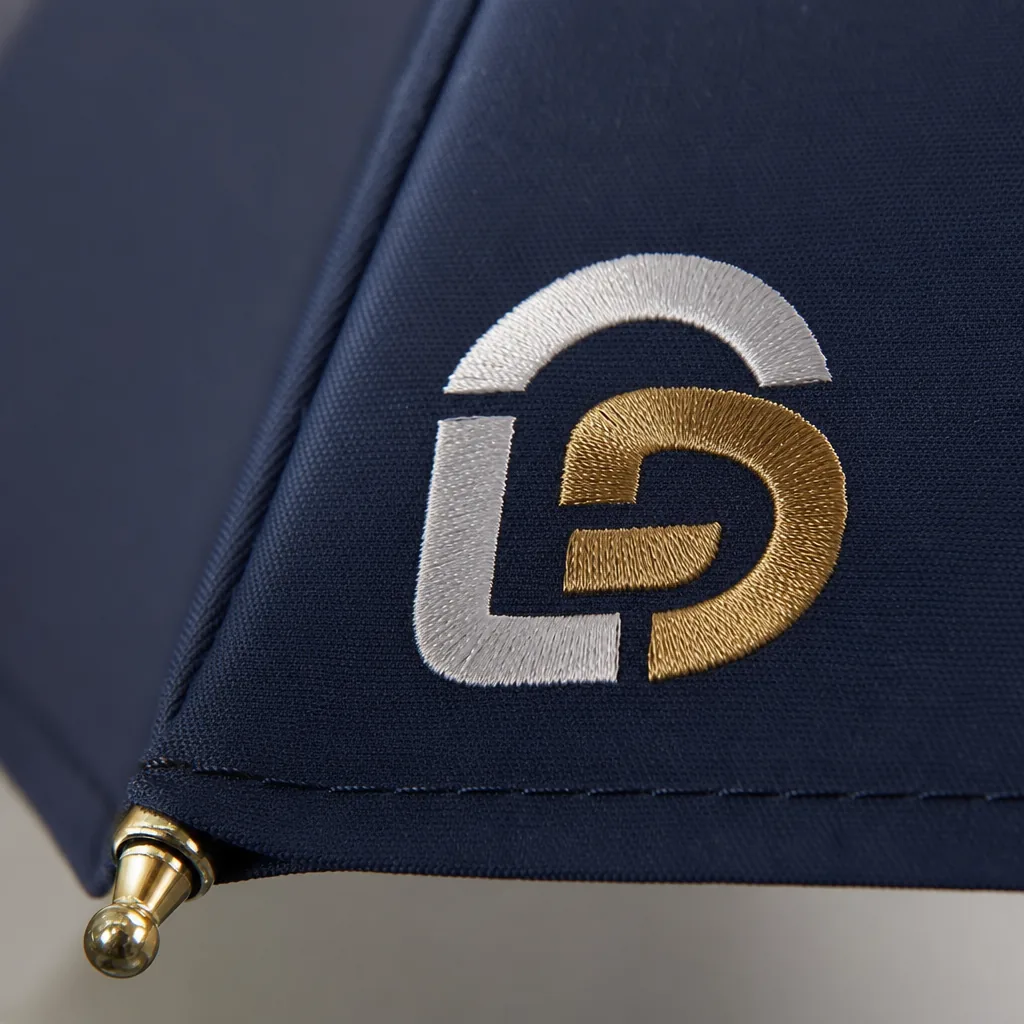
On black, navy, and charcoal canopies, a logo that looks sharp on a screen can disappear once the fabric curves, gets wet, or sits under low light. In factory production, dark canopy umbrella branding comes down to controlled contrast, the right ink system for the fabric, and proofing that catches problems before bulk printing. Buyers should evaluate readability at real viewing distance, not just approve artwork on a white background.
Why dark canopies need a different logo strategy
Black, navy, and charcoal canopies reduce logo legibility because the fabric absorbs light and leaves less contrast for the ink. A logo that looks sharp on a white-background PDF can lose hairlines, small text, and halftones once printed on 190T or 210T pongee, stretched over ribs, and viewed under rain clouds, street lighting, or indoor event lights. For dark canopy umbrella branding, judge the artwork on a curved 23" panel at arm's length, not only on a flat screen. A 2.5" chest-style mark may pass a mockup but read as a dark patch on black fabric. Use thicker strokes, wider letter spacing, simplified icons, and solid fills. Dark red, forest green, and royal blue usually need an opaque white underbase; otherwise, switch to a reversed logo in white or light gray.
A white logo on black umbrella fabric is the safest choice when buyers need instant recognition on promotional, retail, or event umbrellas. On 210T pongee, opaque white screen ink gives strong coverage if deposit, drying, and curing are controlled so the print does not crack across fold lines after repeated closing. Metallic ink fits executive 27" and 30" branded storm umbrellas when the brief calls for a quieter premium finish, but it is less bright than white and should be approved against the actual canopy lot. Silver normally reads better than gold on navy; gold can look muted on charcoal unless the mark is large. ZheBrella samples white and metallic versions side by side because Pantone references alone do not predict visibility on dark woven fabric.
Use reflective logo print for night visibility, not as a substitute for metallic decoration. It works best on commuter umbrellas, golf umbrellas, and double-canopy vented windproof models where the mark should catch headlights in rain. The tradeoff is hand feel and folding behavior: reflective transfer film can feel heavier than standard screen print, and a large reflective block near the panel edge can reduce folding neatness on compact 21" auto-open-close umbrellas. A reversed logo is the better choice when the original artwork has a dark wordmark or detailed icon. Convert the mark to white, light gray, or reflective silver, then remove small details that may fill in on fabric. For dark canopy umbrella branding, approve a strike-off in daylight, low indoor light, and wet fabric conditions before mass production under AQL 2.5 inspection.
Ink coverage, opacity, and edge clarity
For dark canopy umbrella branding on woven pongee 190T or 210T, specify an opaque ink system, not a translucent fashion ink. A white logo on black umbrella panels will look gray, uneven, or yarn-streaked if the printer relies on a single pass without an underbase. Use a blocked white underbase plus top color, or two-pass high-opacity white where the logo itself is white. For high-contrast logo printing, call out wet-film target samples, Pantone tolerance on the approved drawdown, and opacity checks under both indoor light and daylight. Avoid artwork below 5 mm text height, thin serif strokes, hairlines, and QR-style marks; pongee yarn texture pulls ink along the weave and turns sharp corners into sawtooth edges.
Control edge clarity through screen setup and handling, not extra ink volume. A 120-160 mesh screen with matched emulsion thickness usually holds cleaner detail on 190T/210T pongee than a coarse mesh that floods the fabric. Specify registration tolerance, such as no visible drift and reject panels above 0.5 mm misalignment, especially for multi-color or underbase prints. Squeegee pressure should deposit ink without forcing it through the weave, and curing temperature must suit any PU or water-repellent coating so the canopy does not gloss, scorch, or lose repellency. For reflective logo print on branded storm umbrellas, glass-bead ink or reflective transfer needs controlled pressure and dwell time; place logos away from seam tension, vent overlaps, and rib contact zones. Use AQL 2.5 inspection for pinholes, edge sawtoothing, opacity mismatch between panels, and registration drift before packing.
Logo size, stroke weight, and safe detail levels
For dark canopy umbrella branding, artwork must be built larger and heavier than the same logo used on cartons, brochures, or garment chest prints. On 190T or 210T black pongee, keep positive white strokes at 1.2 mm minimum after printing; for reverse-out gaps, use 1.5 mm because ink gain, woven texture, and canopy tension can close small counters. Screen printing can hold 6 pt type only when the font is a bold sans serif with open spacing; use 8 to 10 pt for distributor names, URLs, dates, and event copy. Heat-transfer film gives sharper edges than screen ink, but thin hairlines still disappear once the panel curves and folds. For a one-panel logo on a 23 inch umbrella, plan a 15% to 30% enlargement from the approved flat proof so the mark reads on a curved, moving canopy instead of a flat layout.
Panel count directly affects logo break-up. An 8K frame gives wider triangular panels, so one-panel high-contrast logo printing stays cleaner and avoids most rib-seam interruption. A 16K frame has narrower panels and more rib lines; it can look more premium on branded storm umbrellas, but it is less forgiving for detailed marks, small type, and thin outlines. When a logo crosses two or more panels, each rib becomes a visual cut, and small letters may look misaligned even when sewing tolerance is acceptable. Keep detailed artwork inside one panel unless the mark is a simple block symbol, a large wordmark, or a reflective logo print designed for visibility rather than close reading. On 16K canopies, increase logo height another 10% to 20% and remove secondary text below 10 pt, especially on double-canopy vented windproof models where panel movement is higher in gusts.
Safe detail also depends on the print system and viewing distance. A 21 inch promotional manual-open umbrella can carry a smaller one-color mark because users view it close in hand, while a 27 inch golf umbrella or 30 inch storm model needs bolder artwork to read from 10 to 30 feet away. For reflective logo print, avoid fine serifs, distressed textures, and narrow bridges; reflective transfer material is thicker than plastisol or PU transfer and can lift during repeated folding if details are too thin. On black, navy, forest green, or charcoal fabric, convert gradients to solid fills, open tight counters in letters such as A, e, and R, and approve a production-size strike-off before bulk cutting. AQL 2.5 inspection can flag misregistration, pinholes, and transfer peeling, but it cannot make an over-detailed white logo on black umbrella fabric readable after PO approval.
Test methods for visibility in real use
Test dark canopy umbrella branding in the four conditions where buyers actually need recognition: daylight, indoor retail lighting, rain, and evening streets. For daylight, open the sample and photograph it at 5, 10, and 15 meters, straight on and at a 45-degree angle; the curve of 190T or 210T pongee can reduce contrast near panel edges. Under indoor retail lighting, compare the logo under cool white LED and warmer hotel or lobby light. A white logo on black umbrella fabric may look clean in a factory close-up but lose edge definition under yellow lighting, especially with thin type or small icon details. For rain testing, spray the opened umbrella for 3 to 5 minutes, shake it twice, then check whether water beading makes the print look gray, softens fine strokes, or weakens a high-contrast logo printing decision.
Evening proofing matters most for commuter, security, hotel, event, and branded storm umbrellas. Ask the supplier for photos at 5, 10, and 15 meters under streetlights and car headlights, with the canopy held at normal walking height. Treat a reflective logo print separately from metallic silver ink: reflective film or reflective transfer should flare under direct light, while standard silver ink can look flat when wet. Before approving bulk production, request three proofs: a material strike-off on the actual canopy fabric, an opened-umbrella photo set covering daylight, indoor retail lighting, rain, and evening street conditions, and one wet-canopy video showing the logo while the umbrella moves. These checks are cheap compared with receiving 1,000 umbrellas that pass AQL 2.5 for placement but fail the buyer’s real requirement: readable branding at distance.
Cost and production planning for premium contrast printing
For dark canopy umbrella branding, treat the decoration method as a cost driver, not an artwork detail. Standard screen print or heat transfer is the cleanest route for a white logo on black umbrella: it normally has the lowest MOQ, the fastest strike-off cycle, and the least packaging impact because the ink layer is thin. Reflective logo print sits in the middle. It improves nighttime visibility on branded storm umbrellas, but reflective transfer film or reflective ink usually needs tighter heat, pressure, and rub-test control, so buyers should expect a higher unit cost and a longer approval window than standard high-contrast logo printing. Special-effect inks such as silicone raised print, glow ink, metallic ink, rubberized transfer, and high-density puff print are premium production projects. MOQ usually starts around 1,000 pieces, and lead time can move to 35-50 days because the factory must confirm strike-off color, adhesion, wash or rub performance, and panel stacking behavior before bulk sewing.
Packaging can change the landed cost as much as the ink. Standard print usually fits normal individual polybags and export cartons, while reflective print may need extra surface protection if the logo area is large or placed near fold lines. Raised silicone, puff, metallic, and rubberized transfers may require tissue between printed panels, larger polybags, stronger export cartons, or lower carton quantity to prevent pressure marks before FOB shipment. That raises CBM and can push DDP cost above the target even when the FOB unit price looks acceptable. To hold the order inside a target FOB range, lock the umbrella specification before pricing decoration: 23" or 30" canopy, manual or auto-open-close frame, fiberglass vs steel ribs, 8K/10K/16K rib count, pongee 190T/210T or POE/PVC canopy, and any Teflon or UPF 50+ coating. Use premium ink only on the logo area that needs visibility; keep secondary marks in standard print.
Frequently Asked Questions
What is the most readable logo color on a black umbrella?
White is usually the clearest choice because it gives the strongest contrast on dark fabric. Reflective silver can work better for events or night use, but it is less like a standard brand color.
Do dark canopies require a different proof than light ones?
Yes. A proof on white fabric can look very different from the same art on black or navy cloth, so the buyer should approve a dark-fabric strike-off or lab dip comparison before bulk production.
What artwork details usually fail first on a dark umbrella canopy?
Thin strokes, small reversed text, and low-opacity gradients are the first to disappear on black or navy polyester. For most umbrella panels, buyers should keep positive lines at least 0.6-0.8 mm and avoid reversed text below about 8 pt after scaling.
When should a buyer choose reflective print instead of standard white ink?
Reflective print is the better choice when the umbrella will be used at night, in traffic environments, or for event staff who need added visibility. Buyers should expect higher unit cost and usually a stricter artwork review because reflective coatings can soften very fine details.
How many proofing rounds are normal before mass production of dark-canopy logo umbrellas?
For OEM umbrella orders, 1-2 digital proof rounds and 1 pre-production sample are typical before bulk production. If the logo uses metallic or reflective effects on a dark canopy, adding 3-5 extra days for physical sample confirmation is common.
Looking to Launch Your Custom Umbrella Line?
ZheBrella is a Zhejiang-based OEM/ODM umbrella manufacturer with 17 years of export experience. Free design, low MOQ from 100 pieces, windproof construction, full-color print.
Get Free Quote Now »People Also Search For
Related Articles
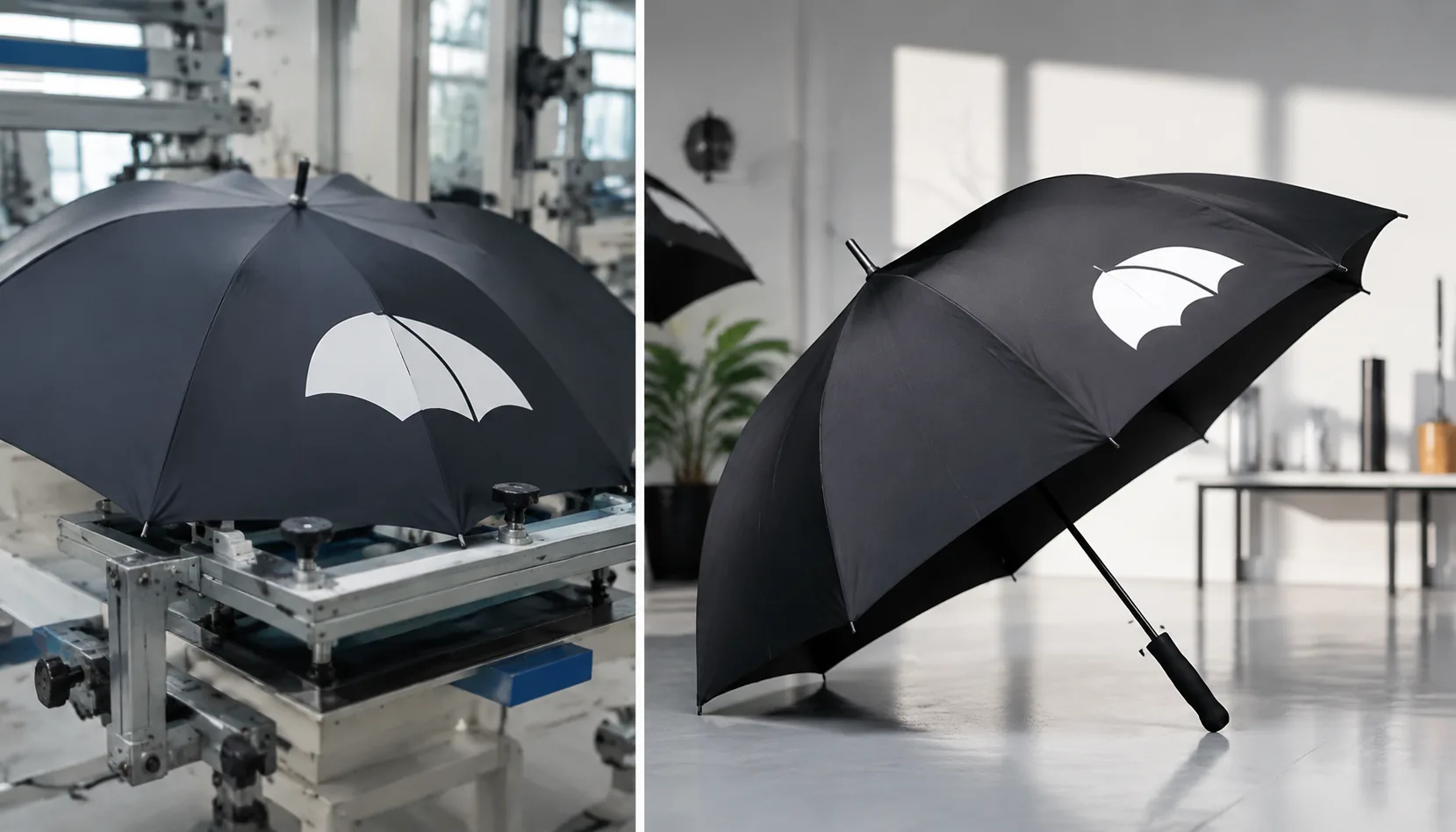
White Ink Underbase for Logos on Dark Umbrella Canopies
Learn when white ink underbase improves logo opacity on dark pongee canopies, how it affects cost, sampling, AQL checks,...
Read More »
Colorfast Logo Printing for Branded Umbrella Canopies
Reduce logo fading, bleeding, and transfer issues by matching ink, fabric, coating, and QC tests before branded umbrella...
Read More »Repeat Pattern Printing for Branded Umbrella Canopies
Plan repeat-pattern umbrellas with correct scale, panel sequencing, 190T/210T fabric choices, sampling steps, and QC che...
Read More »