How to Specify a Promotional Stick Umbrella for Bulk Orders
Bulk buyers usually find out too late that a stick umbrella quote can look competitive while the frame grade, canopy density, print tolerance, and carton pack are all underspecified. On our Songxia production floor, the failures are predictable: 8K ribs that twist in gusts, 190T pongee swapped for thinner cloth, and approvals that ignore AQL 2.5 and lead-time reality. Getting promotional stick umbrella specs right upfront is what keeps a promo order on budget without turning daily-use performance into a claim problem.
Define the use case and target price band
Define the use case before you price the frame. A straight umbrella that works for a one-day expo giveaway is usually the wrong build for a hotel entrance, campus store, or corporate gift program. For giveaway volume, the brief often lands on a 21 inch or 23 inch manual or auto-open stick umbrella with an 8K plated-steel frame, steel shaft, and 190T pongee or budget polyester canopy, typically ordered at 3,000 to 10,000 pieces to keep landed cost down. That spec is acceptable when service life is short and some rib deformation or canopy looseness is tolerable. By contrast, campus, hospitality, and gift use means more opening cycles, more UV exposure, more side gusts, and lower tolerance for bent ribs, runner failure, or weak canopy tension. Writers covering promotional stick umbrella specs should separate giveaway, corporate gift, campus, and hospitality requirements before discussing print area, color matching, or handle styling. That keeps the buyer from mixing a hard unit cap with a wind-resistance requirement, or expecting premium presentation from an entry-level steel frame.
Use the target price band to lock the frame, canopy, and risk level. In stick umbrella wholesale, the low-cost band is usually a 21 inch or 23 inch 8K steel-rib build with a steel shaft, 190T pongee, standard auto-open hardware, and FOB China terms; the trade-off is lower durability, tighter print limits, and a higher replacement rate. The mid band can support a thicker shaft wall, better runner spring quality, and 210T pongee, which improves canopy hand feel and auto-open consistency without moving fully premium. For corporate gift, campus, and hospitality programs, a straight umbrella OEM spec should usually step up to fiberglass end ribs or a full fiberglass ribs umbrella frame in 23 inch or 27 inch sizes, because fiberglass flexes back after side gusts while steel tends to stay bent. Hospitality buyers often also need vented canopies and tighter canopy symmetry, with wind ratings around 40 to 50+ mph on upgraded builds. Campus programs add another constraint: repeat orders. That makes MOQ, fabric continuity, AQL 2.5 inspection, and 35 to 50 day lead times nearly as important as first cost. The real decision is total replacement and complaint cost over the program, not the lowest initial FOB.
Choose frame, rib count, and opening mechanism
For most bulk programs, keep 8K as the baseline in your promotional stick umbrella specs. An 8-rib frame is the standard build on 23-inch and 27-inch straight umbrellas, so it holds unit cost down, uses widely available replacement components, and carries less production risk across stick umbrella wholesale suppliers. Move to 16K only when the visual brief justifies it. Sixteen ribs create narrower canopy panels and a rounder, denser silhouette that reads as more decorative at first glance, but the buyer pays for that look through higher material consumption, longer assembly time, and added frame weight. It is not a durability upgrade by default. For tenders driven by landed cost and repeatability, write 8K as the default specification and treat 16K as an approved appearance upgrade for premium campaigns, hotel use, or gift programs where presentation matters more than the lowest unit price.
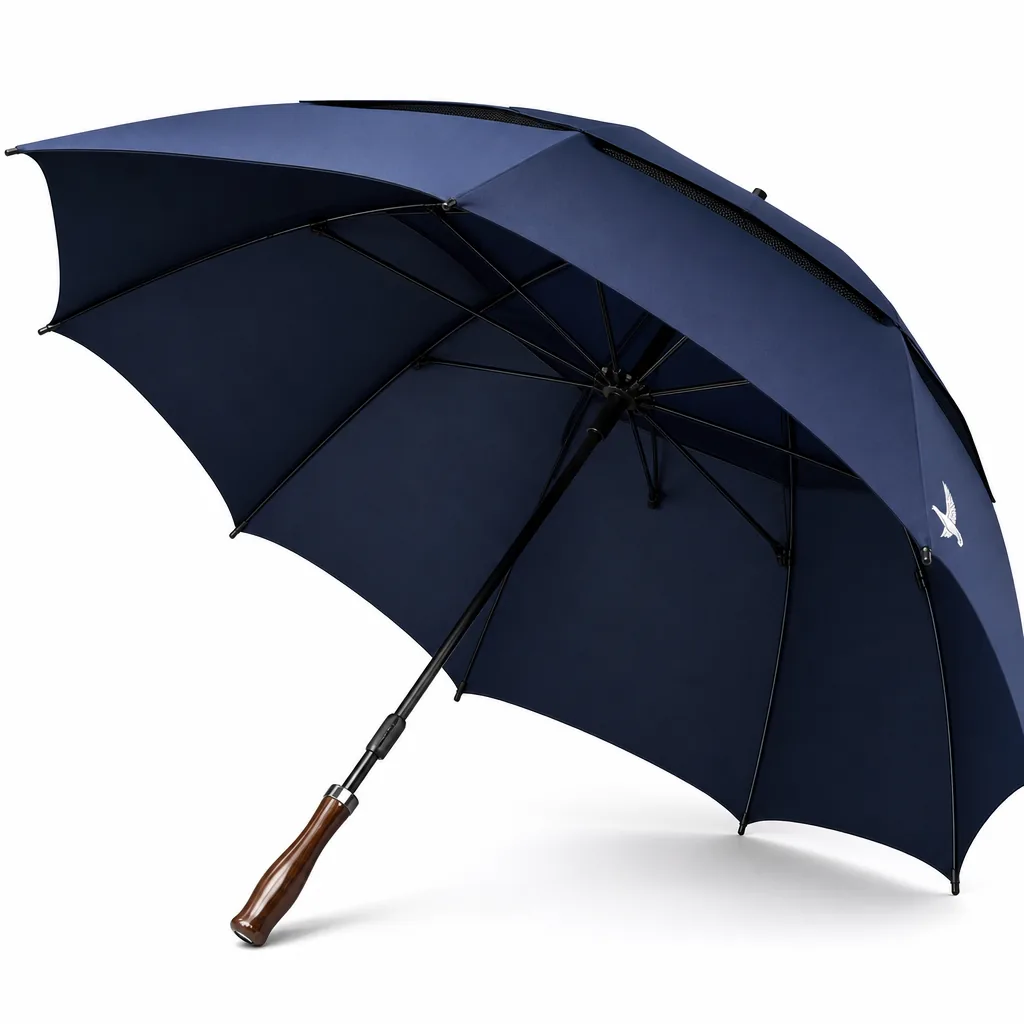
Frame material has a bigger effect on field performance than rib count. Entry-level straight umbrella OEM orders often use a steel shaft with steel ribs, especially on 21-inch and 23-inch manual-open models, because steel is low cost and sufficiently rigid for light-duty use. The risk is how steel fails: after overload, ribs usually stay bent, and thin plating can start rust at the runner, top notch, and rib joints. A fiberglass ribs umbrella costs more upfront, but it flexes and rebounds better under wind load, particularly on 27-inch and 30-inch canopies. A steel shaft with full fiberglass ribs, or at minimum fiberglass end ribs, is the practical upgrade for outdoor promotions, golf-style umbrellas, and higher-use programs. If wind performance matters, pair that frame with a vented double canopy; a well-built fiberglass frame can handle gusts above 50 mph, while a basic all-steel frame usually inverts or deforms sooner.
Choose the opening mechanism by use case, not habit. Manual open is acceptable for low-MOQ, price-led orders, but an auto-open stick umbrella is the better specification for commuter programs, event staffing, stadium hospitality, and hotel door teams because users can open it one-handed while carrying a badge, phone, or bag. The tradeoff is mechanical complexity: auto-open frames add a spring, latch, and tighter internal tolerances, so low-grade mechanisms are more likely to stick or misfire after repeated cycles. To reduce quoting errors and factory substitution risk, specify the opening mechanism, shaft material, and rib material as separate line items instead of writing only "metal frame." That gives buyers tighter promotional stick umbrella specs, cleaner RFQs, and more consistent comparisons when multiple factories quote the same bulk order.
Select canopy fabric and branding layout
Fabric is the first cost and quality call in promotional stick umbrella specs because canopy cloth drives print sharpness, hand feel, and how the sample looks under real rain and event lighting. Standard polyester is usually the lowest-cost choice for stick umbrella wholesale, but on a 23-inch or 27-inch straight frame it feels flatter, sounds crisper in rain, and tends to show more surface variation under large solid-color logos. For most bulk orders, 190T pongee is the better baseline: the smoother surface gives cleaner logo edges, more even color across 8 panels, and a softer hand that buyers notice immediately when comparing pre-production samples. If the artwork includes small text, thin strokes, or dense fills, 210T pongee is the safer upgrade because the tighter weave improves visual consistency and slightly improves water beading with the same ink set. That gain shows up most clearly on white or light-color canopies, where fuzzy detail and uneven color blocks are harder to hide. On a straight umbrella OEM program, saving a few cents on canopy fabric can create a larger cost later if the approval sample misses brand standards and forces another sampling round.
Panel count controls both shape and usable branding area. Most straight umbrellas are 8K in 21-inch, 23-inch, and 27-inch sizes; 10K and 16K frames look rounder, but each panel is narrower, so wide logos, URL lines, and long slogans fit less cleanly. On a standard 23-inch 8K canopy, one panel usually gives enough printable area for a single logo, repeated marks, or alternating-panel artwork. Full-panel graphics look stronger but carry more risk because the artwork runs close to seam lines and panel tips, where registration tolerance matters most; on dark canopies, thin borders and close-fit shapes are more likely to expose misalignment. Edge artwork near the skirt is easier to control and keeps the crown area clean, while alternating-panel layouts usually read better at event distance and cost less than full coverage. Match the print method to the layout: screen printing is still the standard for 1-color and 2-color logos at MOQ 500 to 1,000 pieces on polyester or 190T pongee, while heat transfer or sublimation is better for photo graphics or full-panel art on white or light 190T or 210T pongee. For a fiberglass ribs umbrella or auto-open stick umbrella with a vented double canopy, confirm vent cuts, overlap, and seam placement before sampling, since artwork scaling errors usually cause more rework than print defects.
Match handles, tips, and packaging to distribution needs
Handle selection drives three outcomes at once: landed cost, shelf perception, and transit damage. On giveaway-grade 23-inch and 27-inch models, EVA is usually the lowest-cost grip and stays comfortable in hand, but it scuffs inside export cartons and shows wear quickly on a retail peg. PP handles are harder, lighter, and more stable than EVA in humid sea freight, which makes them a practical choice for stick umbrella wholesale, provided the mold parting lines and surface finish are clean enough that the handle does not read as cheap. ABS suits an auto-open stick umbrella when retail presentation matters: it holds gloss, matte, metallic spray, and rubber-paint finishes more consistently than PP, but it is less drop-tolerant than EVA during handling. Wood straight handles and wood crook handles still deliver the highest perceived value for hospitality programs, golf events, and heritage retail, but only when the wood is properly dried before assembly; otherwise it can shrink around the ferrule or loosen after transit. Strong promotional stick umbrella specs start with the sales channel, then match handle material, frame, and finish to the buyer’s actual use case and complaint risk.
Tips and packaging should be specified with the same discipline because they affect breakage, freight, and receiving speed. For high-volume programs, PP or ABS tips are usually safer than metal, especially on 8K or 16K frames using fiberglass ribs umbrella construction, where lower weight and controlled flex reduce damage in transit. Metal tips can lift sample presentation in a straight umbrella OEM program, but they also dent, scratch adjacent handles, and create more safety concerns at crowded events. Pack-out matters just as much: crook handles waste carton space, so under DDP terms the dimensional-weight penalty can outweigh any small material savings; even trimming hook depth by 5 mm to 8 mm can improve cube efficiency without changing hand feel. Use matching pongee sleeves or clear PVC/PE sleeves when printed canopies need abrasion protection, and tie hangtags at the top notch or handle neck with short elastic or cotton string so they do not crease the canopy. Individual polybags keep white and light-color canopies cleaner, but they slow receiving, add labor at unpack, and weaken sustainability claims. For most bulk orders, export cartons packed 24 or 36 pieces, adjusted to handle shape and the typical 33-inch to 39-inch closed length, protect the umbrellas better than adding more plastic.
Lock in OEM order terms before sampling and mass production
Lock commercial terms before sampling because MOQ changes with build complexity. For a basic straight umbrella OEM program, a 23-inch or 27-inch manual frame with 8K steel ribs, a black metal shaft, and 190T pongee is usually workable at 500 to 1,000 pieces per color. Once the spec moves to an auto-open stick umbrella, fiberglass ribs umbrella frame, 10K or 16K construction, double-canopy venting, full inside-and-outside print, custom handle mold, Teflon finish, or UPF 50+ silver coating, MOQ commonly rises to 2,000 to 3,000 pieces. Buyers should freeze the exact promotional stick umbrella specs before requesting a final quote: size, opening mechanism, rib material, canopy fabric, coating, print method, handle, and carton pack-out. That discipline protects margin and timing. If the supplier prices a 23-inch 8K steel frame but the approved sample shifts to a 27-inch fiberglass build with added coating or packaging changes, unit cost, carton count, and production days all move.
Run sample approval in written stages so problems surface before mass production. First approve artwork on the real canopy layout, since a logo that looks centered on a flat file can shift after sewing across 8, 10, or 16 panels. Next approve the pre-production sample for mechanics and materials: 21-inch, 23-inch, 27-inch, or 30-inch size; manual or auto-open; 190T or 210T pongee; steel or fiberglass ribs; and any POE, PVC, or EVA clear-canopy detail. Then approve print quality against the actual method, whether screen print for spot colors or heat-transfer or sublimation for full coverage. Tie sign-off to a tolerance sheet covering canopy color, shaft finish, handle shape, and opening force.
Write QC and shipping terms into the PO before production starts. AQL 2.5 is the standard inspection benchmark for export umbrellas, but it only works when defects are defined in advance: color mismatch, scratched ferrule, misaligned logo, sticky spring, broken runner, and carton short count should be listed as acceptance criteria. Production windows also need to match the build: 7 to 10 days for a counter sample after artwork approval, about 25 to 35 days for a standard printed stick umbrella wholesale order, and 35 to 50 days for custom molds, special coatings, or complex packaging. FOB Ningbo usually fits distributors that already control consolidation and ocean freight. DDP is often the lower-risk option for importers managing landed cost and deadline exposure, because freight, duty handling, and final delivery accountability are fixed earlier. Those terms matter as much as frame and fabric because they directly control cost visibility, delivery risk, and claims leverage.
Frequently Asked Questions
What is the most common promotional stick umbrella specification?
A common bulk spec is an 8K straight umbrella with steel shaft, fiberglass or steel ribs, 190T pongee canopy, and auto-open function. This balances branding area, durability, and unit cost for promo programs.
When should buyers upgrade from steel ribs to fiberglass ribs?
Upgrade when the umbrellas will be used in windy cities, commuter programs, or higher-value corporate gifting. Fiberglass ribs usually improve flex and reduce permanent deformation compared with all-steel rib sets.
For a budget promotional stick umbrella, which specs usually keep costs controlled without making the umbrella feel disposable?
A common value spec is an 8-rib frame, auto-open function, polyester or 190T pongee canopy, and fiberglass ribs paired with a metal shaft. This setup usually balances cost and durability better than all-metal frames, especially for event giveaways and retail promo programs.
What QC checkpoints should buyers confirm before approving a bulk stick umbrella order?
Ask for checks on opening and closing function, canopy alignment, logo position, rib and runner fit, and carton drop condition. For mass production, many buyers use AQL 2.5 for major defects and request a pre-shipment inspection after at least 80% of cartons are packed.
What MOQ and lead time are typical for OEM straight umbrellas with custom printing?
For most factories, MOQ is commonly 500 to 1,000 pieces per color or design, depending on frame and printing method. Production lead time is often 35 to 45 days after sample approval and deposit, while repeat orders can be faster if materials are already booked.
Looking to Launch Your Custom Umbrella Line?
ZheBrella is a Zhejiang-based OEM/ODM umbrella manufacturer with 17 years of export experience. Free design, low MOQ from 100 pieces, windproof construction, full-color print.
Get Free Quote Now »People Also Search For
Related Articles
Manual Open Compact Umbrellas for High-Volume Promo Orders
Learn when manual compact umbrellas outperform auto-open styles on cost, defect risk, and packing for large promotional ...
Read More »
Travel Umbrella Specs Buyers Should Lock Before Sampling
Define compact umbrella specs before sampling: folded length, weight, ribs, pongee grade, mechanism, and packaging to cu...
Read More »
Vented Golf Umbrellas: How Buyers Specify Windproof Builds
Learn how to spec vented golf umbrellas with double-canopy construction, rib materials, QC targets, MOQs, and lead times...
Read More »