Vented Golf Umbrellas: How Buyers Specify Windproof Builds
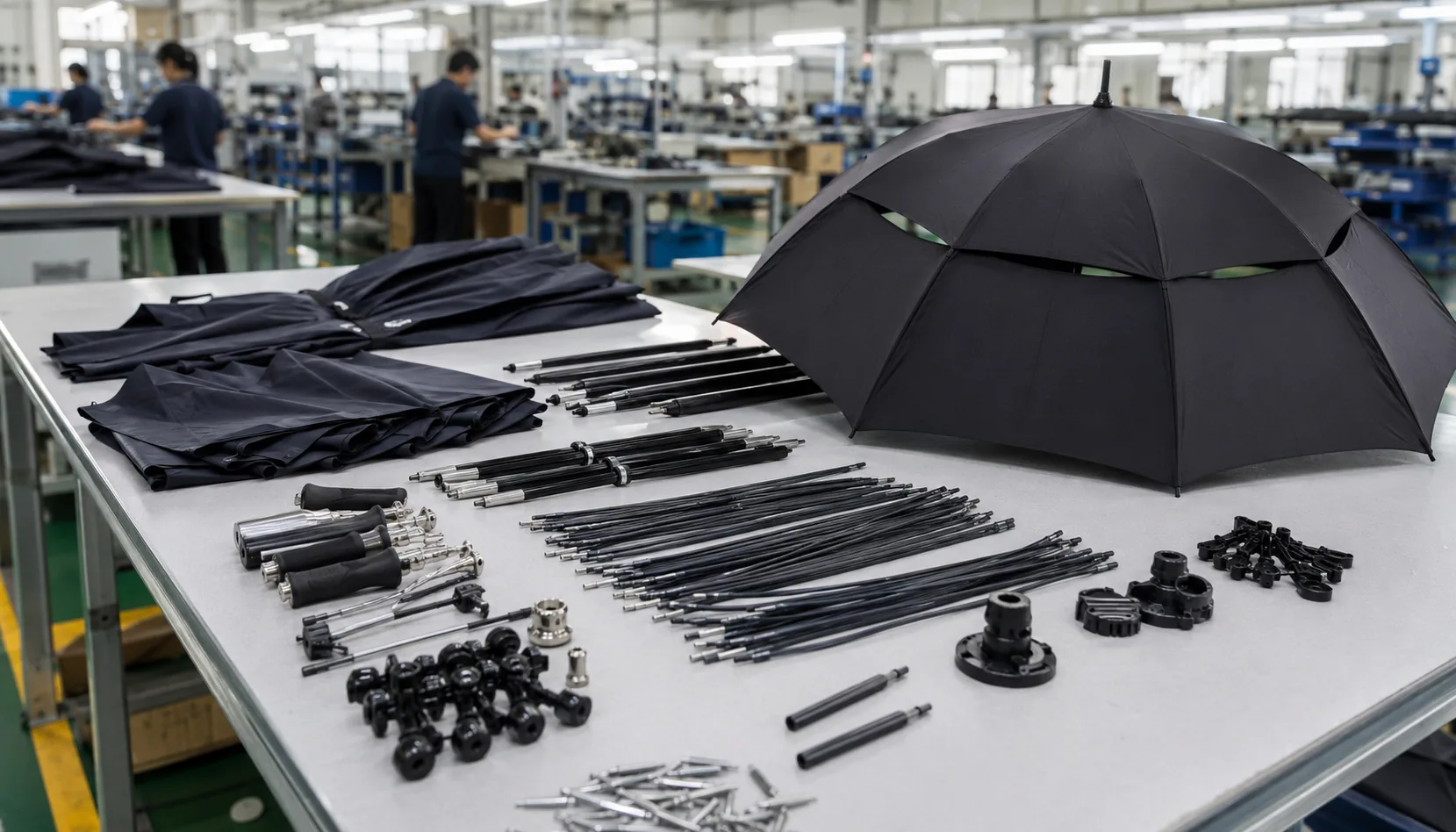
When buyers source a windproof golf style, the real risk is not the sketch or logo file—it is whether the double-canopy, rib gauge, and opening cycle spec will survive mass production and shipment. As a vented golf umbrella supplier in Songxia, we see OEM briefs fail when vent size, fiberglass mix, and QC tolerances are left vague, because those details decide wind performance, MOQ feasibility, and lead time on the factory floor.
What Makes a Vented Golf Umbrella Different
The feature that separates a vented golf umbrella from a standard single-canopy golf umbrella is pressure management, not just size. A double-canopy windproof umbrella uses two layers of canopy fabric with vent gaps engineered between the top and lower panels, so gusts can pass through instead of ballooning the cover and inverting the frame. On the factory floor, the difference shows up in pattern cutting and panel alignment: vent openings have to be consistent around all 8K or 16K sections, and the top canopy cannot be stitched too tight or it chokes airflow. A well-built 27-inch or 30-inch vented model usually pairs 190T or 210T pongee with a fiberglass rib umbrella frame, because fiberglass flexes and recovers better than painted steel under repeated wind load. Serious buyers also ask for actual wind testing data; a decent vented frame should survive 50+ mph in controlled testing, while cheap single-canopy builds often fail first at the stretcher joint or top notch.
Size selection is usually driven by use case more than aesthetics. A 27-inch build is the most common commercial spec because it gives broad coverage without becoming awkward in crowded retail environments, hotel entrances, or tournament merchandising. It works well for an auto-open golf umbrella program where the target is everyday usability, manageable carton dimensions, and a retail price that still allows margin after decoration and freight. A 30-inch build creates a more premium silhouette and wider arc coverage, so buyers use it for resorts, VIP gifting, country clubs, and outdoor event sponsorship where two-person coverage matters. The tradeoff is real: larger canopies add fabric weight, increase frame stress, and raise both master carton volume and per-unit shipping cost.
For sourcing, experienced buyers do not treat venting as a cosmetic option; they specify the whole windproof system together. A reliable vented golf umbrella supplier should be able to quote canopy fabric, rib material, shaft diameter, opening mechanism, and test standard in one package, whether the program is private-label retail or golf umbrella OEM production. Our standard practice is to confirm rib composition, usually fiberglass ribs with a fiberglass or steel shaft hybrid, vent geometry, and handle fit before sample approval, then inspect finished goods to AQL 2.5 because vent stitching defects and panel misalignment are common failure points. On larger FOB DDP umbrella orders, buyers also pay attention to how 27-inch versus 30-inch units pack out, since container efficiency changes quickly when you move up in length and canopy depth.
Frame Specs That Control Wind Performance
Wind performance is decided by the frame long before the canopy goes on. For a true double-canopy windproof umbrella, fiberglass ribs are the default because they flex under load and recover shape instead of taking a permanent bend the way cheap thin-wall steel often does after one hard inversion. On a 30-inch vented golf umbrella, we usually pair 8 fiberglass ribs with a 14 mm or 16 mm fiberglass or black-plated steel shaft, depending on target price and weight. Fiberglass gives better corrosion resistance in humid coastal markets and won’t flash-rust at the rib joints if the umbrella is packed damp after an event. Steel still has a place: it is stiffer, cheaper, and useful when a buyer wants a lower FOB cost, but it adds weight and transfers gust shock more harshly into the runner and top notch. A serious vented golf umbrella supplier should be able to quote both builds with honest weight and failure-rate differences, not just swap materials on paper.
Rib count matters, but not in the way many first-time buyers assume. Most golf umbrellas stay with an 8K format in 27-inch or 30-inch sizes because longer rib length already creates a large coverage arc, and fewer ribs leave cleaner vent channels between the upper and lower canopy. That airflow release is what makes the vented structure work in 40 to 50+ mph gust testing, not simply adding more metal. A 16K frame looks dense and premium on fashion umbrellas, but on a large golf frame it adds too many connection points, more total weight, and more sewing positions that can drift off tolerance during assembly. For a fiberglass rib umbrella used in tournaments, resorts, or corporate gifting, 8K is usually the best balance of wind stability, replacement-part simplicity, and print presentation. At ZheBrella, our standard practice is to reserve higher rib counts for smaller street umbrellas unless the customer has a very specific visual brief.
The opening system also changes both durability and user experience. An auto-open golf umbrella uses a spring-driven shaft and runner that gives one-handed deployment, which buyers like for car-to-clubhouse use and promotional distribution, but the spring force has to be matched to canopy size and frame weight. If the spring is underspecified, the umbrella opens sluggishly and stresses the runner latch; if overspecified, it slams the frame open and shortens cycle life at the rib tips and stretcher joints. Manual open frames are simpler and usually survive more abuse in rental fleets because there are fewer failure points, but they feel less convenient for retail. For golf umbrella OEM programs, I usually recommend auto-open with fiberglass ribs and either a fiberglass shaft or reinforced steel shaft, then require cycle testing plus an AQL 2.5 inspection standard before shipment. That matters even more on FOB DDP umbrella orders, where replacing a failed batch after arrival costs far more than the small savings from a lighter-duty mechanism.
Canopy Materials, Water Resistance, and Branding Space
For a vented golf build, 190T pongee is the default fabric because it balances cost, clean sewing, and reliable print results across a 27 inch or 30 inch canopy. It has a slightly lighter hand feel than 210T, dries faster after a storm, and works well for screen printing on large promo runs where buyers want bold spot colors on 8 panels. A 210T canopy feels denser and smoother in the hand, and that extra yarn count usually gives sharper edges on fine logos, gradients, and heat-transfer artwork, especially for retail-facing programs. In hard rain, both fabrics perform well once the backing and water-repellent finish are right, but 210T generally looks less wrinkled after folding and reopening, which matters when a vented golf umbrella supplier is quoting for brand-image campaigns rather than pure giveaway volume.
Water resistance is not just about fabric thickness; it comes from the full build, including the coating, seam consistency, and how the vent is cut and stitched. A double-canopy windproof umbrella usually uses a solid lower canopy plus a vented upper layer so pressure can escape in gusts, and that construction helps the frame survive 50+ mph better when paired with a fiberglass rib umbrella frame instead of basic electroplated steel. Buyers adding UV performance often specify black-UV or silver-UV coating on pongee and then ask for UPF 50+ test reports, but they should confirm whether the claim applies to the finished canopy or only the base fabric. Our standard practice on golf umbrella OEM projects is to check water spray, colorfastness, and opening cycles together, because an auto-open golf umbrella that sheds water well but misaligns at the vent is still a reject at final inspection.
Branding space on vented golf styles needs to be planned earlier than many buyers expect. The top vent layer interrupts artwork across the crown area, so large centered logos often need to be resized, shifted lower on each panel, or split across alternating panels to avoid distortion around the vent opening. On 8K and 10K layouts, the cleanest presentation usually comes from keeping primary logos on the lower canopy panels and using the upper vent layer for smaller repeat marks or accent color blocking. A serious vented golf umbrella supplier will flag this before sampling, because print registration changes once the vent seam allowances are added. For FOB DDP umbrella orders with retail packaging, we also see buyers request one outside logo set plus one inside closing strap print, which is easy to execute on 190T or 210T if the artwork is locked before bulk cutting.
Order Planning: MOQ, Sampling, Lead Times, and Terms
For this category, MOQ is driven less by canopy size and more by how many parts you insist on customizing. If you use a stock 23 inch or 27 inch frame with an existing straight handle mold, a realistic OEM start point is 300 to 500 pieces per colorway for a double-canopy windproof umbrella. Once you ask for a new ABS handle mold, custom ferrule, or a non-standard 10K or 16K frame, the factory usually wants 1,000 to 3,000 pieces to amortize tooling and assembly risk. A serious vented golf umbrella supplier should also separate canopy-print MOQ from frame MOQ, because a fiberglass rib umbrella with stock black frame parts can often run mixed artwork more flexibly than a fully color-matched frame set. If the project is positioned as golf umbrella OEM for retail rather than promotion, buyers should also confirm whether the quoted MOQ is per SKU, per print, or per shipment, because those are not the same thing on the floor.
Sampling timelines tell you a lot about whether the supplier is actually organized. A blank stock-frame sample can usually go out in 2 to 4 days, while a printed pre-production sample on 190T or 210T pongee normally takes 5 to 7 days after artwork approval. If you are developing a custom auto-open golf umbrella with Pantone-matched handle, woven label, and hangtag set, expect 10 to 14 days for a proper pre-production sample and longer if a new mold is involved. Mass production for repeat orders is commonly 25 to 35 days after sample sign-off and deposit, while first orders with custom components are more realistically 35 to 50 days. Our standard practice is to lock canopy layout, rib specification, opening mechanism, and carton marks before bulk cutting starts, because late changes on vent alignment or panel artwork create rework fast and usually push the ex-factory date.
Terms matter because freight and packaging can move the landed cost more than buyers expect. FOB means the factory delivers cleared cargo to the named China port, usually Ningbo or Shanghai, and the buyer controls ocean freight, insurance, and destination charges. DDP puts more responsibility on the seller, including freight, customs handling, and final delivery, which can simplify FOB DDP umbrella orders for smaller importers but needs very clear written assumptions on duty rates and delivery address type. Packaging changes also affect carton efficiency: one umbrella in a sleeve and plain export carton may pack 24 or 36 pieces per carton, while adding a color box, retail insert, or thicker EVA strap can reduce carton count and increase chargeable volume. For long 30 inch golf styles, even a small carton size increase can materially raise sea freight cube and courier sample costs, so buyers should request carton dimensions, gross weight, and pieces per carton before approving final packing.
QC Standards Buyers Should Put in the PO
Put the QC terms in the PO as measurable pass/fail points, not vague language like "good quality." For a double-canopy windproof umbrella, I would specify opening force, lock engagement, and release consistency across a defined sample size. A practical checkpoint is 20 consecutive open-close cycles per sampled unit with no runner sticking, no spring hesitation, and no canopy tip inversion. For an auto-open golf umbrella, the shaft should extend cleanly and lock on the first trigger press; on manual frames, the runner should slide without scraping or side-play. Frame symmetry matters more than many buyers realize: when the umbrella is fully opened, opposite ribs should sit level, stretchers should mirror evenly, and the top notch must stay centered. On a fiberglass rib umbrella, also call out no rib whitening, cracking, or resin flake at the bend points after cycling, because that is where weak raw material shows up first.
Canopy and vent construction need their own checkpoints because many wind complaints actually start in sewing, not in the frame. In the PO, specify stitch density, seam straightness, panel matching, and vent alignment between the upper and lower canopies. On 190T or 210T pongee, I look for skipped stitches, puckering at the panel joins, loose thread ends, and uneven edge binding near the vent openings. If the vents are off-center by even a few millimeters, the umbrella will look twisted when opened, and that gets rejected immediately by retail buyers. Water-spray performance should also be written down: after a controlled spray test, the canopy should shed water evenly, with no leakage through needle holes beyond the agreed tolerance and no coating rub-off. If you are working with a vented golf umbrella supplier on logo-heavy programs, add print registration, color tolerance, and placement measurements too, especially for golf umbrella OEM jobs where one canopy panel may carry oversized branding.
AQL 2.5 is the most common pre-shipment inspection level for umbrella export, and it is a sensible baseline for appearance, function, and packing defects. That said, not every order carries the same risk. For promotional campaigns tied to a tournament, product launch, or fixed event date, pre-shipment inspection is essential because there is no recovery time once goods miss the handout window. The same applies to first orders from a new vented golf umbrella supplier, first-time tooling, or mixed FOB DDP umbrella orders where carton marks, barcode labels, and pack assortments must match exactly across shipping modes. Our standard practice is to separate critical defects such as failed opening, broken ribs, sharp burrs, and severe water leakage from minor appearance issues, then inspect packed cartons for count accuracy, inner pack method, and transit protection. If buyers write those standards into the PO before production starts, they avoid the usual argument at shipment stage about what "windproof" or "acceptable" was supposed to mean.
Frequently Asked Questions
Does a vented golf umbrella always perform better in wind than a standard single-canopy umbrella?
Usually yes, but only if the frame is matched to the vented design. A double-canopy with fiberglass ribs and a stable shaft generally outperforms a vented model built with low-grade steel components.
What MOQ should buyers expect for a custom vented golf umbrella?
MOQ often starts around 500 to 1,000 pieces for standard molds with custom canopy printing. If you need custom handles, tips, or packaging, the MOQ may increase and add time to sampling and production.
What wind-resistance target should buyers ask a factory to validate for a vented golf umbrella?
For a standard 30-inch vented golf umbrella, many buyers ask for internal wind-testing in the 30-40 mph range, with no rib inversion or canopy tearing during short-cycle testing. The exact pass standard should be written into the PO because test methods vary by factory.
How does rib material affect cost and breakage rates on OEM golf umbrellas?
Fiberglass ribs usually cost more than basic metal ribs, but they reduce permanent bending and improve recovery after gusts. For distributor programs, buyers often choose fiberglass ribs with a metal shaft to balance durability and unit cost.
What MOQ and lead time are typical for a custom double-canopy golf umbrella order?
A common MOQ is 500-1,000 pieces per color for OEM production, depending on fabric color, handle mold, and packaging requirements. Typical lead time is about 35-50 days after sample approval and deposit, with extra time needed for new molds or branded retail packs.
Looking to Launch Your Custom Umbrella Line?
ZheBrella is a Zhejiang-based OEM/ODM umbrella manufacturer with 17 years of export experience. Free design, low MOQ from 100 pieces, windproof construction, full-color print.
Get Free Quote Now »People Also Search For
Related Articles
Fiberglass vs Steel Umbrella Frames: What Buyers Should Specify
Compare fiberglass and steel umbrella frames, including 8K and 16K ribs, so you can match wind resistance, weight, MOQ, ...
Read More »
Auto-Open Umbrella Mechanisms: What Buyers Should Specify
Specify the right auto-open mechanism for retail, promo, or travel umbrellas. Learn what to ask for on spring force, but...
Read More »
Hotel Amenity Umbrellas: Spec Choices for Guest Use
Specify durable hotel umbrellas with the right size, branding, and pack-out so guest-room and lobby programs stay consis...
Read More »