How Umbrella Frames Are Built for Durability and Cost Control
When buyers source umbrellas, the frame usually determines whether the order survives wind tests, stays within MOQ, and still lands at target cost. In umbrella frame construction, small choices such as rib count, shaft material, ferrule design, and joint assembly affect strength, weight, corrosion resistance, and line efficiency on the factory floor. The right specification is not just about making an umbrella open and close; it is about building a repeatable frame that performs well without driving up scrap, labor, or tooling expense.
Frame architecture: shaft, ribs, stretchers, and joints
In umbrella frame construction, the shaft sets the baseline for load capacity, opening alignment, and long-term wobble. Steel shaft umbrellas stay the lowest-cost option, but buyers need the full spec: shaft diameter, wall thickness, plating, and ferrule fit. A thin-walled shaft may feel fine on day one and then rattle, corrode, or bend after a few hundred open-close cycles. The most common cost-controlled build is a steel shaft with fiberglass ribs, because fiberglass ribs flex under gust load instead of kinking like low-gauge steel. That combination usually gives a smoother opening feel, especially when the top notch, runner track, and rivet holes are cut cleanly and the moving parts have minimal side play. In practice, the shaft controls stiffness; the rib system controls recovery after wind load; and poor joint fit turns both into warranty risk.
Most failures happen at the ribs, stretchers, and joints, not in the canopy. Fiberglass ribs usually last longer than steel ribs in repeated flexing, while steel stretchers add stiffness but often deform at the elbow or rivet point if the frame takes repeated impact. The common failure points are the runner, stretcher rivet, top spring, and tip socket; burrs, loose pins, or cracked resin at rib ends create a harsh opening feel and can tear the canopy at the tips. Rib count matters when it matches size and use: 8K frames are common on 21-inch and 23-inch compact umbrellas where unit cost and weight matter most; 10K frames improve roundness and reduce panel flutter on mid-size folding umbrellas; 16K frames give better edge support on larger canopies and vented styles, but they add material and assembly cost. An OEM umbrella factory should lock the frame architecture before canopy cutting and inspect joints to AQL 2.5 so opening feel, lifespan, and rejection rates stay predictable.
Fiberglass versus steel in real production terms
In umbrella frame construction, the material choice should match the failure mode. Fiberglass ribs weigh less than comparable steel members, flex under gust load, and are less likely to stay bent after impact. That reduces breakage on 21" and 23" folding umbrellas, especially auto-open-close models where repeated opening cycles stress the joints, stretchers, and tips. In production terms, the common field failures are snapped stretcher arms, bent ribs, and loose tip connections. Steel still has the lowest raw-material cost and the widest sourcing base for high-volume programs, but it adds carry weight and needs reliable plating or coating to slow rust at rivets, welds, and ferrules. If the umbrella will sit in humid warehouses, move through coastal distribution, or be carried daily, corrosion risk shows up quickly in returns and complaints. For buyers comparing quotes, fiberglass usually lowers breakage risk and after-sales cost; steel lowers the initial unit price.
Rib count alone does not make a frame durable. An 8K or 16K umbrella can still fail early if the wire gauge is thin, the spring is weak, or the joint geometry is poor. In other words, frame stiffness comes from the full assembly, not the headline rib count. A hybrid build with fiberglass ribs and a steel shaft is often the better balance for mid-range retail, golf, vented, and double-canopy programs, because it cuts bent-rib claims without pushing cost as high as all-fiberglass construction. That is why an OEM umbrella factory will usually reserve steel shaft umbrellas for budget-driven campaigns, short-use giveaways, or promotions where the buyer accepts a shorter service life to hit the lowest landed cost. For a 1,000-piece order, a straight steel shaft with basic steel ribs can be acceptable if the coating spec is clear and the expected use is limited. If the umbrella must handle travel abuse, daily commuting, or stronger wind exposure, fiberglass ribs are the safer spend.
Material specs buyers should ask for in RFQs
Buyers should specify umbrella frame construction in measurable terms, not adjectives. For the frame, list rib material, rib diameter, stretcher thickness, and rib count: for example, 3.0 mm fiberglass ribs with 1.5 mm middle stretchers, or 0.45 mm electroplated steel ribs when FOB cost is the main constraint. For steel shaft umbrellas, state the shaft outer diameter and wall thickness, such as 14 mm x 0.45 mm or 12 mm x 0.35 mm, plus the finish and part material for the runner, top notch, and tips, such as nylon, ABS, or metal. These details affect weight, opening force, breakage risk, and carton count, especially on 23 inch and 27 inch auto-open styles. Also fix the rib count early: 8K and 16K ribs change frame stiffness, spring force, and the user feel on opening. If you need a wind claim, write the test condition, such as internal cycle testing or 50+ mph wind simulation on selected SKUs, so the OEM umbrella factory can quote the right frame and QC plan.
Canopy specs need the same precision because they drive price, hand feel, and complaint rate. Do not write only “pongee”; specify 190T or 210T pongee, panel count, fabric utilization, and whether the canopy is single-layer or double-canopy vented. State the finish as a production requirement: standard water-repellent finish, Teflon coating, silver UV coating, black UV coating, or a UPF 50+ target if sun protection matters. For clear canopies, name the resin and construction, such as POE, PVC, or EVA, and include gauge and softness to reduce cracking and odor issues in cold weather. To help a factory quote accurately, include finished arc size, closed length, manual open, auto-open, or auto-open-close mechanism, handle material, logo method, packaging, AQL 2.5, MOQ by color, and shipping term such as FOB or DDP. Print method also changes cost and lead time; screen print, heat transfer, and sublimation each need different artwork prep, panel yield, and inspection steps.
How frame choices affect MOQ, sampling, and lead time
MOQ and lead time stay lowest when umbrella frame construction stays inside existing tooling. The real constraint is usually a non-standard runner, ferrule, top notch, or handle interface that needs a new mold, a revised stamping die, or both. At an OEM umbrella factory, a standard 23-inch, 8K compact with stocked fiberglass ribs and common nylon or zinc-alloy joints can often be sampled in 5 to 10 days. If the brief changes to a custom rib curve, square shaft, or a special auto-open-close hinge, sample time usually moves to 15 to 25 days because the factory must run tooling trials, tune spring force, and verify repeated open-close cycles before canopy sewing starts. That mechanical work also affects MOQ. Stocked components can support orders around 500 to 1,000 pieces, while new molds and dies are harder to justify below 1,000 to 3,000 pieces.
Mixed materials raise cost and extend lead time because they tighten tolerances across the full frame set. Steel shaft umbrellas with fiberglass ribs are common because they balance stiffness, wind recovery, and unit cost, but adding aluminum middle tubes, carbon inserts, or custom resin joints increases the number of fit checks and can force changes to rivet length, punching pressure, and assembly sequence. The same issue appears in 8K 16K ribs: a 16K frame looks denser, but it adds alignment points and often requires canopy pattern changes to prevent waviness at the edge. To speed production, standardize the parts buyers rarely inspect closely: shaft diameters, runner molds, spring sets, and common black electroplated steel or natural fiberglass finishes. Keep the customization on the canopy print, handle print, tie wrap, or sleeve. With stocked frame parts, pre-production samples with logo canopy are often ready in 7 to 12 days, and bulk orders under 10,000 pieces usually ship in 25 to 35 days after approval. New molds, special joints, or unusual material mixes can push bulk timing to 35 to 50 days, especially when the order also requires AQL 2.5 inspection or extra drop, salt-spray, or wind testing before shipment.
Quality checkpoints for OEM umbrella frames
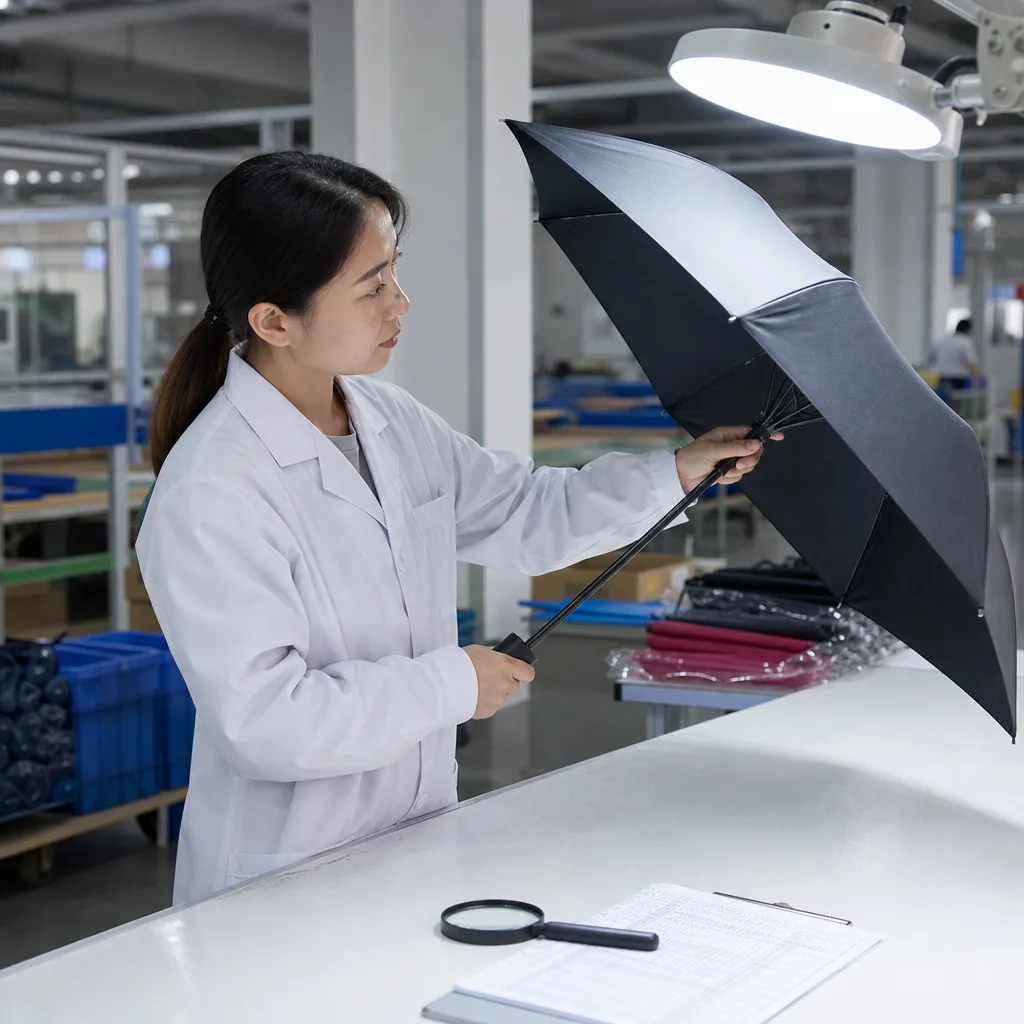
Most umbrella frame construction defects start at the moving joints, so the first QC gate should be the rivet, runner, and spring interface before any canopy is sewn on. Inspect rib-to-stretcher and stretcher-to-runner rivets for zero side play and no binding; a loose rivet causes wobble, while an over-crimped joint raises opening force and can crack plated steel parts during repeated use. On fiberglass ribs, check rib ends and ferrule seats for resin-rich, brittle areas that split under load. On steel shaft umbrellas, inspect the shaft slot, interior burrs, runner track, and lock points, then confirm even nickel or black electrophoretic coating on contact surfaces. These checks matter more on 8K 16K ribs frames because each added joint increases the chance of misalignment. A practical inspection standard is smooth travel from closed to full open, clean lock engagement, and no catch points or metal scraping.
Spring force and opening cycles define whether the frame survives shipping compression and field use. Measure the force needed to release the runner and confirm one-action deployment without double-triggering; the target should stay consistent across 21" and 23" folding frames as well as 27" and 30" golf frames. For OEM release, use a cycle test plan with 500 opening-and-closing cycles for basic promotional frames and 1,000 cycles or more for retail programs, then record failures by mode: loose rivets, spring fatigue, shaft deformation, rib cracking, or rising opening force. Corrosion testing should cover rivets, springs, cut edges, shaft interiors, and mixed-metal fittings with salt-spray or humidity exposure, because fiberglass ribs do not protect attached steel parts. In an OEM umbrella factory, buyers should pair these tests with AQL 2.5: use AQL for lot-level visual and functional acceptance, then require retained samples from each batch for spring-force, cycle-life, and corrosion validation before shipment.
That separation keeps cost control and durability aligned. AQL 2.5 works well for appearance defects and obvious assembly faults, but it should not be the only release standard for umbrella frame construction. Put the durability test plan in the PO: sample size, test hours or cycle count, pass/fail limits, and which defects trigger rework or hold. For example, specify no loose rivets, no spring loss that prevents first-action opening, no corrosion on plated contact points after the agreed salt-spray or humidity exposure, and no structural failure on the sample set. Buyers can also match the test load to the program: lighter promotional umbrellas usually need simpler frame checks, while steel shaft umbrellas and higher-count rib systems need stricter joint and corrosion control. Clear test criteria reduce dispute at inspection, shorten approval time, and make supplier pricing easier to compare across quotes.
Frequently Asked Questions
What rib count is best for a durable but cost-conscious umbrella?
For most promotional and retail umbrellas, 8K or 10K offers a good balance of strength and cost. If wind resistance is a priority, 16K frames with fiberglass ribs usually perform better but cost more.
Can I mix steel and fiberglass in the same frame?
Yes. Many factories use a steel shaft with fiberglass ribs or stretchers to reduce breakage without pushing the price as high as a full fiberglass build. The exact combo depends on target wind rating and budget.
How does rib count affect umbrella durability and cost?
Higher rib counts such as 16K usually improve canopy support and wind stability, but they also add material and labor cost. For most OEM orders, 8K is the common balance between price and everyday durability, while 16K is often chosen for stronger wind performance or premium positioning.
Is a fiberglass rib frame always better than a steel rib frame?
Not always. Fiberglass ribs flex better in wind and resist corrosion, while steel ribs can be cheaper and stiffer but may add weight and rust risk if the coating is weak. Many factories use a mixed structure, such as fiberglass ribs with a steel shaft, to control cost while improving performance.
What frame specifications should a distributor request before placing an OEM umbrella order?
Buyers should confirm rib count, rib diameter, shaft thickness, open/close mechanism, coating type, and salt-spray or wind-test requirements. If you need stable pricing, ask the factory to quote by frame BOM so changes in steel or fiberglass specs are clearly reflected in the unit cost.
Looking to Launch Your Custom Umbrella Line?
ZheBrella is a Zhejiang-based OEM/ODM umbrella manufacturer with 17 years of export experience. Free design, low MOQ from 100 pieces, windproof construction, full-color print.
Get Free Quote Now »People Also Search For
Related Articles
Umbrella Rib Riveting Process for Stronger OEM Frames
See how rib riveting, hole alignment, and pull-force checks improve frame strength and consistency in OEM umbrella manuf...
Read More »Umbrella Frame Riveting Process Control for OEM Production
See how rivet size, setting force, hole tolerance, and line checks prevent loose ribs, stiff runners, and field failures...
Read More »
Umbrella Frame Assembly Tolerances and QC Checks for Buyers
Learn which frame tolerances, weld points, and QC checks reduce defects in umbrella production and protect bulk orders f...
Read More »