Umbrella Frame Riveting Process Control for OEM Production
In OEM umbrella production, most field complaints trace back to tiny metal joints that were slightly off long before final assembly: a rib loosens, a runner binds, or the frame develops play after repeated opening cycles. On our Songxia lines, controlling the umbrella frame riveting process means matching rivet size, hole tolerance, and setting force to each frame design, then catching drift with line checks before a bulk order leaves the factory.
Why Riveting Controls Frame Strength
Most frame failures start at the joint, not the tube wall. In the umbrella frame riveting process, the rib-to-stretcher, stretcher-to-runner, and top rib-to-notch joints must hold two conditions at the same time: low lateral play and smooth rotation through repeated opening-cycle tests. When the rivet is set too tight, the runner drags, stretchers scuff, and auto-open or auto-open-close frames begin binding after only a few cycles. When it is too loose, the rib eyelet develops wobble and the whole frame loses stability sooner, especially on 16K frames where narrower ribs distribute load across more joints than a standard 8K layout. That matters in OEM umbrella production because rivet head diameter, shank length, and setting pressure drive durability, rework, and return risk. A frame can pass day-one visual inspection and still fail early if joint fit varies from frame to frame. The risk is higher when one rivet standard is used across different stack-ups, since steel ribs and fiberglass ribs do not tolerate the same joint clearance or deformation under load.
Alignment is the second control point because a small offset changes the geometry of the entire frame. If the notch sits off-center by 1 to 2 mm, or rib and stretcher holes are not concentric, the umbrella opens unevenly: one panel goes tight, another sags, and canopy tension shifts across the frame. Steel ribs may mask part of that error by deforming slightly, but fiberglass ribs push more stress back into the riveted joint, which speeds fatigue near the ferrule or end-cap connection. This shows up early on 21 inch and 23 inch folding frames, where shorter runner travel increases linkage stress during opening-cycle tests. A rivet pull test should therefore sit beside functional cycling and inline movement checks, because binding, side-play, and off-center tracking usually appear before complete breakage. Final release should use AQL 2.5 inspection with clear reject points: spun rivet heads, sharp burrs, eccentric peening, visible gap at the rib eyelet, side-play in the runner linkage, and any frame that hesitates or kicks sideways during manual opening.
The control method is simple, but it only works if riveting is treated as a mechanical quality point rather than a cosmetic step. First-piece setup should verify joint feel at the runner and every major articulation point, then confirm the rivet pull test standard by frame type before bulk production starts. Inline checks should separate 8K, 10K, and 16K frames instead of applying one generic tolerance, because rib count changes joint loading and failure mode. The same logic applies to material stack-up: steel ribs and fiberglass ribs need different riveting windows if the goal is consistent opening force and fatigue life. For the buyer, this is a cost and risk issue more than an assembly detail. Tight process control reduces hidden fatigue failures, lowers warranty claims, and prevents similar-looking frames from performing differently in the field. Suppliers that control the umbrella frame riveting process at joint level usually hold more stable quality and fewer production delays caused by rework or late-stage sorting.
Rivet, Hole, and Material Specifications
In the umbrella frame riveting process, joint fit drives service life more than nominal rib strength. For steel ribs, 2.0 mm and 2.2 mm iron or stainless rivets remain standard, and stamped holes should stay within about +/-0.05 mm; once the hole opens beyond target, the joint can start walking after only a few hundred open-close cycles. Fiberglass ribs need different process control because the laminate at the eye can crack if the shank expands too aggressively during setting. Use a slightly longer shank, lower upsetting pressure, and a thin flat washer to spread load and prevent the rivet head from cutting into the fiberglass surface. That setup matters most in OEM umbrella production for 23-inch and 27-inch auto-open and auto-open-close frames, where runner impact loads are higher than on manual frames and the outer rib and stretcher joints see the earliest wear.
Shank length is the variable many factories still miss. On thin steel ribs, a rivet protrusion of about 1.2 to 1.5 times shank diameter before setting usually forms a tight shop head without adding drag at the joint. Fiberglass ribs need more stack allowance because the assembly often includes the rib, stretcher eye, and a nylon or metal washer; if the shank is short, the head mushrooms unevenly, and if it is long, the joint can loosen after tumble handling. Steel ribs tolerate higher clamp load because the substrate resists compression. Fiberglass ribs do not: over-clamping can create hidden damage that only appears in a rivet pull test or after repeated wind loading. In 8K and 10K compact frames, failures usually show first at the outer rib joint. In 16K fashion frames, they more often appear at the stretcher connection because the higher rib count adds more friction points across the frame.
Plating and shaft material change both wear rate and corrosion risk on export orders. Plain iron rivets with a light nickel flash may pass packing inspection, then show red rust within weeks when paired with steel ribs under a moisture-trapping canopy. Nickel-plated iron is usually limited to low-cost domestic programs. For FOB or DDP export orders, zinc-plated rivets with clear passivation, or stainless rivets where budget allows, hold up better through humid ports and retail storage. Pairing also matters at the joint: a hard rivet running in a softer steel eye can oval the hole, while a rough-plated shank increases abrasion against fiberglass ribs. A practical control plan checks burrs, joint rotation torque, plating flake, and corrosion together, then verifies performance through cycle testing and AQL 2.5 inspection. A stable umbrella frame riveting process should leave the joint free-moving, aligned, and intact after salt-humidity exposure and repeated opening tests.
Setting Force and Assembly-Line Controls
Set the pneumatic riveting station by frame family and joint location, then lock the regulator to the BOM-backed setting sheet. In OEM umbrella production, a stretcher-to-runner joint on a 21-inch 8K compact frame does not use the same force as a main-rib joint on a 27-inch golf frame, so the umbrella frame riveting process cannot rely on operator feel. Shop air may supply 0.6-0.8 MPa, but the riveting machine should run only inside a validated process window established with trial samples, typically narrowed to 0.03-0.05 MPa. Keep that window on a readable station gauge with upper and lower limit marks so operators can confirm settings before parts run. The reason is practical: over-setting expands the rivet too aggressively, binds the joint, and can initiate hairline cracks in drilled fiberglass ribs; under-setting leaves axial play that later shows up as frame wobble, poor opening symmetry, loose runner tracking, and uneven canopy tension at the tips. That is a direct cost and durability issue, not just a cosmetic one.
Control should begin with first-piece approval and continue through final packing. Each riveting station should have a visible pressure gauge, a go/no-go sample board, and setup records that separate steel ribs from fiberglass ribs and distinguish 8K, 10K, and 16K structures. First-piece signoff should check rivet head diameter, joint free movement, opening and closing force, and side-to-side play before release. Add a rivet pull test at setup and again mid-run on higher-risk frames, especially auto-open-close styles where spring load amplifies a weak joint. After startup, hold the process with hourly gauge verification, lot-based patrol checks, and AQL 2.5 inspection at final packing, with targeted checks at the notch, runner, and stretcher joints. Quarantine any lot where operators start hand-bending joints or re-squeezing rivets; that usually indicates machine drift, mixed rivet length, or rib-hole tolerance error. Catching the problem at the riveting station is cheaper than finding it after sewing or in final QC, when the buyer sees a crooked umbrella but not the root cause.
In-Process Tests Buyers Should Require
Treat joint integrity, not appearance, as the main control point in the umbrella frame riveting process. Require a documented rivet pull test on the first approved piece of each shift, after any die change, and then every 300-500 frames, with results logged by frame code and joint position. On 21 inch and 23 inch folding frames, the highest-risk joints are usually stretcher-to-rib and runner-to-shaft, especially on steel ribs, where poor flare or off-center setting shows up early as free spin, plating cracks, or separation. The pass standard should be written into the control plan: no cracked plating around the rivet head, no free rotation at the joint, and no separation under the supplier’s defined pull load. If the factory cannot produce pull-test records in real time, it is not controlling a fatigue-critical joint; it is screening cosmetics. That is weak OEM umbrella production control and a direct durability risk once the frame enters repeated open-close use.
Control side-play and runner function separately, because a frame can feel acceptable in a hand check and still fail after packing or retail use. Require a go/no-go side-play limit by joint position, checked at line start and during routine patrols, since excess play usually traces back to undersized rivet shanks, drifting eyelet holes, or unstable setting pressure. Material matters here: fiberglass ribs tolerate flex better than steel ribs, but a loose joint still causes cap and notch misalignment and uneven canopy opening. Runner smoothness should be checked at every line start for scratch points, rebound, and half-locking at the spring catch; on auto-open styles, verify runner travel with spring force, because an over-compressed spring can hide bad riveting until field use. For cycle testing, require 50-100 open-close cycles on sampled manual umbrellas at line start and every 1,000 pieces; for auto-open umbrellas, confirm lock reliability, spring reset, and full canopy tension with no rib lag. Review 8K, 10K, and 16K frames separately, then tie these in-process records to final AQL 2.5 inspection so shipment sampling confirms process control instead of discovering preventable defects late.
How Riveting Specs Affect Cost and Lead Time
Cost pressure starts before bulk assembly. In the umbrella frame riveting process, tighter limits on radial play, rivet cap height, or clinch depth require fixture changes, punch-stroke resets, and more first-article checks at rib-to-stretcher joints and notch positions. On a standard 8K or 10K folding frame with steel ribs, that usually adds about half a day. On a 16K fashion frame or a 27-inch golf frame built with mixed fiberglass ribs and steel ribs, setup and verification can add 1 to 2 full days because there are more pivot points to align. Early-run scrap risk also rises. A rivet head landing just 0.15 to 0.20 mm out of spec can create stiff opening, canopy skew, or cracked rib coating, which slows line speed until settings stabilize. For buyers, that is not cosmetic rework; it is measurable cost in labor, lower early yield, and more inspection hours per lot.
Pre-production controls get stricter when rivet settings are tied to opening force, wind resistance, or cycle life. In OEM umbrella production, visual approval is not enough; the frame should pass opening and closing cycle checks, wobble measurement at the top notch, and a rivet pull test on critical joints before bulk release. This matters more on auto-open-close frames than on manual 23-inch straight umbrellas because spring force amplifies small variation in rivet set. If the buyer asks for acceptance bands narrower than the factory's normal control limit, MOQ often has to increase to absorb added tooling time and inspection burden, especially for custom hardware colors or nonstandard shank diameters. Final outgoing inspection may still run at AQL 2.5 inspection, but tighter in-process limits add labor and usually raise the unit price.
Lead time usually shifts on hardware sourcing, not on the riveting machine. If the frame needs stainless, black-nickel, brass-plated, or salt-spray-tested rivets instead of common iron or standard plated steel, sourcing can add 5 to 12 days depending on stock. That holds sample approval open because actual rivet hardness, head finish, and corrosion performance must be confirmed on the production frame. MOQ can also rise if the rivet supplier requires a minimum run for a custom cap profile or coating batch. For planning, a normal FOB order with stock hardware may remain in the 35 to 45 day range, while a special-rivet program can extend FOB to 45 to 60 days. DDP can move further if customs documents must declare a different metal composition or if the cargo misses vessel cutoff after late hardware receipt.
Frequently Asked Questions
What rivet issue most often causes umbrella frame failure?
Under-set rivets are common because they allow side play between ribs and stretchers. This creates uneven canopy tension and accelerates fatigue during repeated opening and wind loading.
Should fiberglass ribs use the same riveting settings as steel ribs?
No. Fiberglass ribs can crack if the rivet is over-compressed, while steel ribs usually tolerate higher setting force. The factory should approve separate machine settings during PP sample production.
What rivet-related defects should a buyer ask the factory to separate during inline inspection?
Ask for defect data by loose rivet, over-set rivet, cracked rib hole, misaligned joint, and runner interference. These defect codes make it easier to trace whether the issue comes from rivet diameter, punch force, or hole tolerance before a 3,000 to 10,000 piece order is completed.
How many pull tests per order are reasonable for OEM umbrella frame approval?
For bulk production, many buyers require pull tests at first article, once per shift, and again per finished lot. A practical control plan is 5 to 10 frame samples per model per production day, with failed samples triggering machine reset and 100% recheck of the affected lot.
Can the same riveting settings be used for fiberglass ribs and steel ribs?
No. Fiberglass ribs usually need tighter control on hole fit and lower setting force to avoid cracking around the joint, while steel ribs can tolerate higher force but may bind if the rivet head is over-compressed. Buyers should ask suppliers to approve separate process parameters for each frame material before mass production.
Looking to Launch Your Custom Umbrella Line?
ZheBrella is a Zhejiang-based OEM/ODM umbrella manufacturer with 17 years of export experience. Free design, low MOQ from 100 pieces, windproof construction, full-color print.
Get Free Quote Now »People Also Search For
Related Articles
Umbrella Frame Riveting Process: Strength Specs for OEM Orders
Set rivet diameter, pull-force checks, and AQL 2.5 sampling for OEM umbrella frames to reduce rib loosening, wobble, and...
Read More »
Umbrella Frame Riveting Quality: Controlling Joint Failure
Learn how rivet selection, hole tolerance, and pull testing reduce loose ribs, twisted stretchers, and frame failures in...
Read More »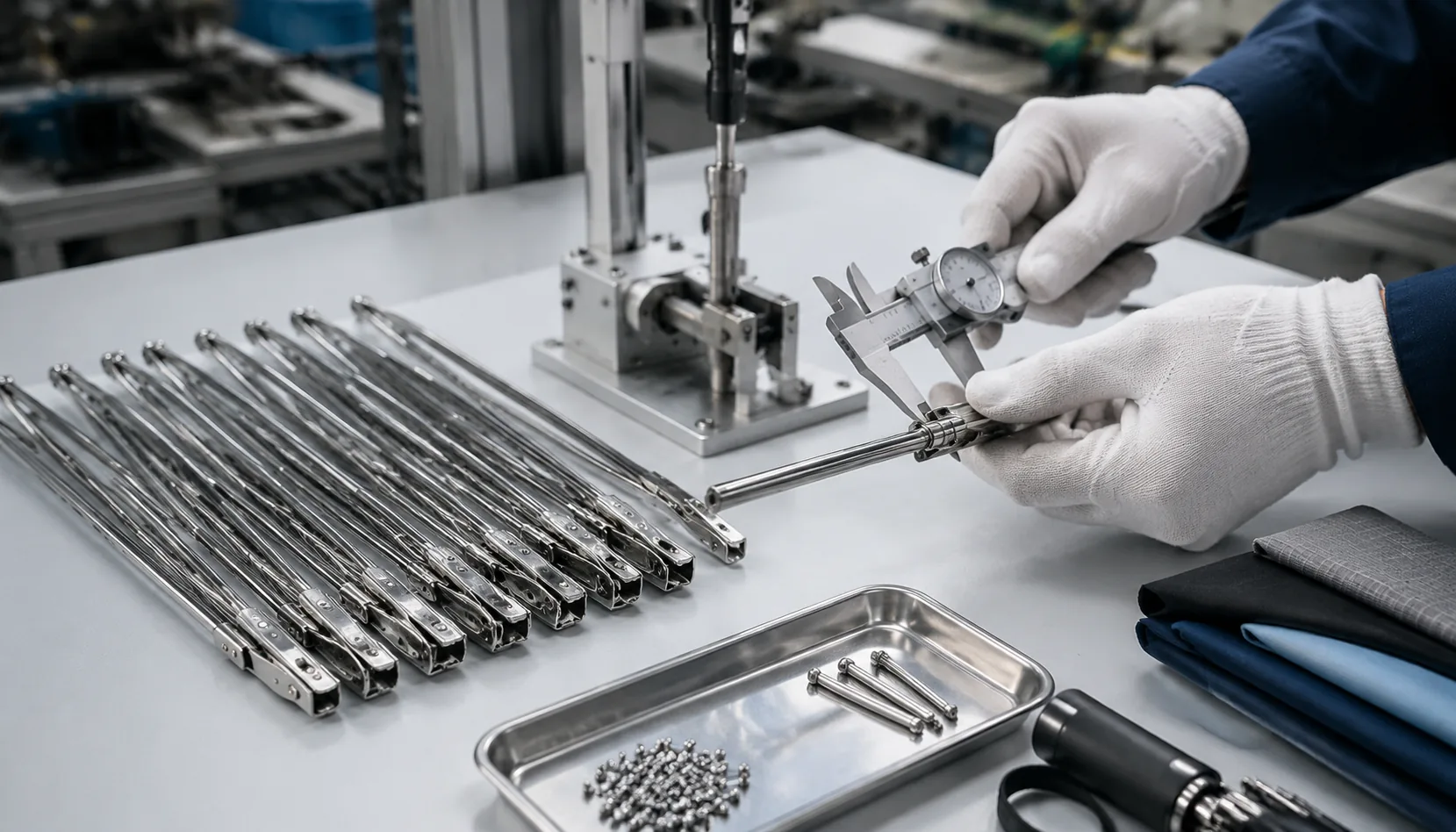
Umbrella Frame Riveting Quality: Tolerances and Pull Tests
Specify rivet fit, pull strength, and in-process checks to reduce loose ribs, canopy sag, and field failures in OEM umbr...
Read More »