Umbrella Frame Riveting Process: Strength Specs for OEM Orders
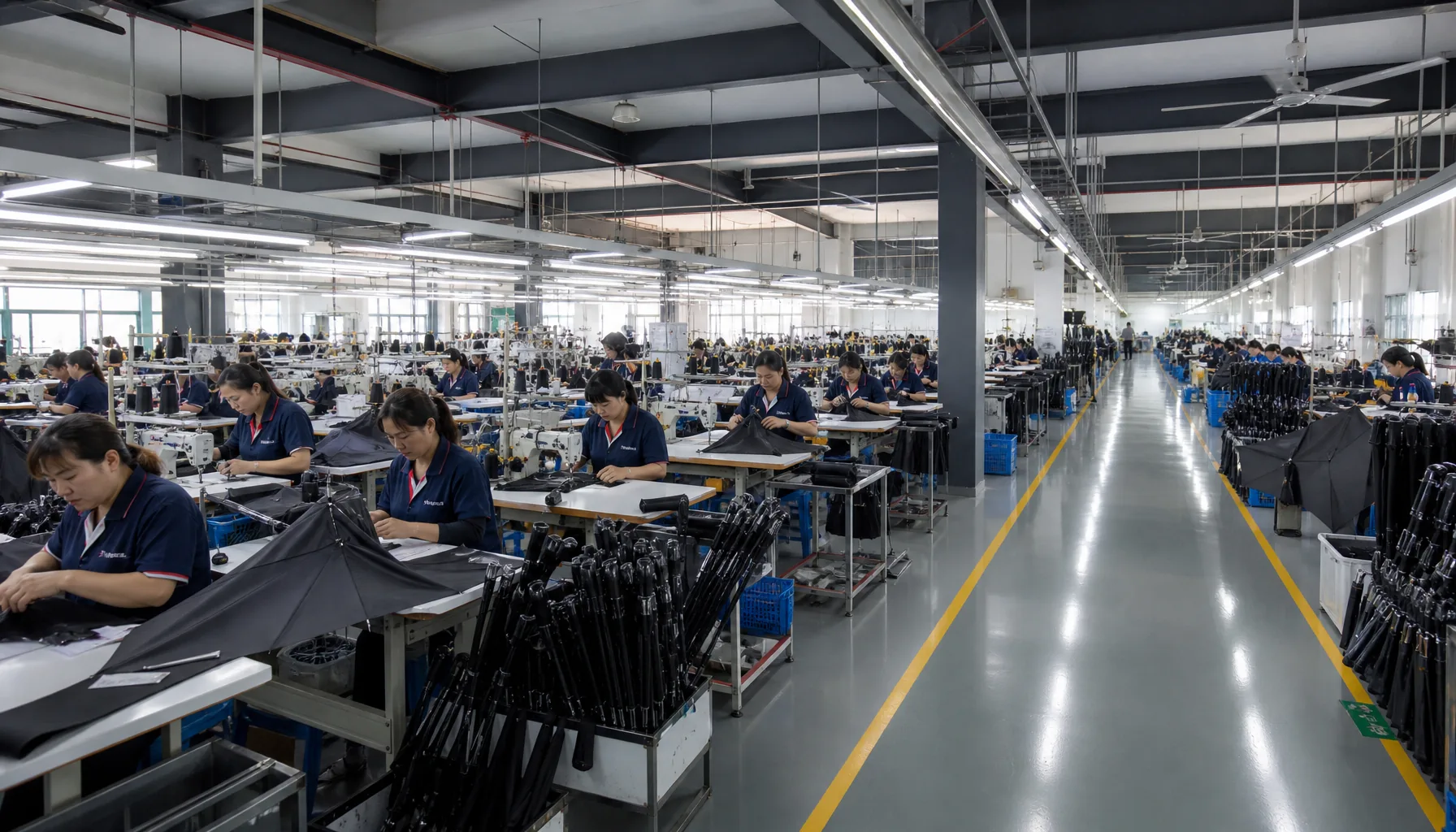
Rib loosening usually starts long before the umbrella reaches a rain test; it starts when rivet diameter, hole clearance, and setting pressure are treated as “standard” instead of controlled specs. On our Songxia production floor, the umbrella frame riveting process is checked by pull-force targets, wobble inspection, and AQL 2.5 sampling before bulk frames move to canopy assembly. For OEM buyers, these controls decide whether a frame survives daily opening cycles or comes back as a field return.
Why Riveting Controls Frame Durability
Riveting is the small operation that decides whether an umbrella frame feels tight after 500 openings or starts shaking in the first rainy season. In the umbrella frame riveting process, each semi-tubular rivet locks a moving joint: rib to stretcher, stretcher to runner, rib tip area to the canopy load path, and notch to top rib assembly. If the rivet head is under-pressed, the joint has side play; if over-pressed, the rib ear is crushed and the joint binds. Both conditions show up later as wobble, uneven opening, canopy panel misalignment, and broken thread at the rib-tip sewing points. For OEM umbrella frames, I normally want rivet rotation smooth but not loose, with no visible gap between washer, rib ear, and stretcher fork after cycling. A good joint should survive repeated open-close action without the rivet walking out or polishing an oval hole into the steel or fiberglass fitting.
The failure pattern is different on 8K and 16K frames because the load is distributed differently. On an 8K 23 inch straight umbrella, each rib carries a larger share of wind load, so loose riveting usually appears first at the main rib-to-stretcher joint and the runner connection; once one rib lags, the canopy pulls off-center and the opposite ribs are overloaded. On 16K frames, especially 27 inch or 30 inch golf umbrellas, each rib carries less individual load, but there are twice as many joints, so consistency becomes the problem. A few loose rivets can create a “soft zone” where one quadrant opens later than the others. With fiberglass umbrella ribs, the rib itself may bend and recover, but the metal joint plate or rivet hole can still deform if the rivet set is poor. Steel ribs are less forgiving; they often kink near the punched hole after repeated wobble.
For production control, riveting strength cannot be judged only by shaking the finished umbrella by hand. We use a rivet pull test on sampled frames, then cycle opening, closing, and manual side-loading before canopy sewing, because bad riveting is cheaper to catch before 190T or 210T pongee is attached. In an AQL 2.5 inspection, I classify loose joint play, cracked rib ears, missing washers, off-center rivet heads, and restricted runner movement as functional defects, not cosmetic defects. The umbrella frame riveting process also affects printing quality indirectly: if the frame opens unevenly, screen-printed logos and heat-transfer panels look twisted even when the canopy was cut correctly. For OEM orders, the practical specification should define rivet material, head diameter tolerance, washer use, pull-test target, and cycle-test requirement, instead of only saying “strong frame.” That wording prevents arguments after shipment when the real issue is joint stability, not fabric or assembly labor.
Choosing Rivets for Steel and Fiberglass Frames
Rivet choice decides whether OEM umbrella frames feel tight after 500 open-close cycles or start rattling before the carton leaves the warehouse. In the umbrella frame riveting process, we normally use low-carbon steel rivets for painted steel ribs and stretchers, brass or nickel-plated brass where smoother pivot action is needed, and stainless steel for coastal or marine promotional orders. Typical shaft diameters run 2.0–2.4 mm for compact 21" and 23" frames, 2.5–3.0 mm for 27" golf umbrellas, and up to 3.2 mm on 30" heavy-duty frames with 10K or 16K layouts. A rivet that is too thin shears at the stretcher joint; one that is too thick crushes the rib wall and makes the runner feel heavy. Head style also matters: flat heads sit cleaner under 190T or 210T pongee canopies, while semi-tubular or rolled heads give better grip at high-stress crown and notch positions.
Steel-to-steel joints are the easiest to control because rib wall thickness and hole tolerance stay predictable after stamping. For painted or powder-coated steel ribs, we specify rivets with enough shank length to roll cleanly without splitting the coating around the hole. Zinc-plated steel is acceptable for most retail and promotional umbrellas, but I avoid plain blackened rivets on coastal orders because salt air quickly attacks exposed edges after riveting. If the umbrella will ship to beach resorts, cruise lines, or humid tropical markets, plated hardware is not cosmetic; it is a warranty decision. Nickel plating gives a cleaner look for visible joints, while stainless rivets reduce red rust risk but require tighter setting pressure because they do not deform as easily as mild steel.
Fiberglass umbrella ribs need a softer approach because the material flexes well but does not like point compression. For fiberglass-to-steel mixed frames, the rivet hole must be cleanly drilled or molded, not punched, and we often add small washers or use a wider head to spread the load. A proper rivet pull test should check both joint separation and rib cracking, because a joint can pass pull force while still showing white stress marks around the fiberglass hole. Our standard practice at ZheBrella is to include rivet tightness and visible cracking in AQL 2.5 inspection, especially on double-canopy vented windproof models rated for 50+ mph gusts. The best mixed-frame designs use steel at the shaft, notch, runner, and stretcher pivots, with fiberglass umbrella ribs handling flex at the outer span.
Setting Production Parameters on the Riveting Line
Riveting parameters should be locked before bulk production, not adjusted by feel after defects appear. For most OEM umbrella frames, the line leader sets pneumatic rivet machine pressure by frame type: lower pressure for thin steel U-channel ribs, higher controlled pressure for fiberglass umbrella ribs with metal end fittings, because crushed fiberglass will fail later even if it looks tight at the table. In the umbrella frame riveting process, we normally define pressure range, punch travel, rivet diameter, washer use, and allowable head flattening on the production sheet. A good target is a rivet head formed evenly without sharp burrs, with free rotation at the joint and no side play beyond the approved sample. Positioning jigs matter as much as pressure; rib-to-stretcher angles, notch alignment, and top hub seating must be held by fixed stops so the operator cannot “eyeball” an 8K, 10K, or 16K frame into shape.
Operator checks should happen every bundle, not just during final AQL 2.5 inspection. After riveting, the operator should open the frame manually and check runner travel from handle stop to top spring, rib symmetry across all panels, and whether stretchers lift evenly without one rib lagging. For auto-open and auto-open-close models, the check must include smooth release, full canopy crown lift, and positive lock at the runner; a frame that opens 95% on the bench will become a customer complaint once 190T pongee fabric adds resistance. A practical rivet pull test should be defined by product grade, for example sampling riveted joints with a pull gauge and recording failure mode: rivet slip, stretcher deformation, or rib cracking. The pass condition should match the approved engineering sample, not only a generic force number, because a 23-inch folding frame and a 30-inch golf frame carry very different loads.
Line balancing keeps riveting quality consistent across a 5,000- or 50,000-piece OEM order. One fast operator feeding poorly aligned parts can overload the next station and hide defects until canopy sewing, where correction is expensive. The better setup is separate stations for rib pre-positioning, rivet insertion, press operation, and functional opening checks, with WIP limits between stations and first-piece approval at each shift change. Our standard practice at ZheBrella is to record machine pressure, jig code, operator ID, and first-hour defect rate so a drifting press or worn jig can be traced before shipment. Final bulk control should combine inline sampling with finished-frame audits: check runner travel, rib spacing at full open, rivet burrs, spring engagement, and smooth auto-open action after riveting. That is where the umbrella frame riveting process protects both wind resistance and assembly efficiency downstream.
Testing Rivet Strength Before Mass Shipment
Sampling follows AQL 2.5 inspection for major defects, but rivet checks need smarter distribution than just pulling random finished cartons. We take samples across production time, operators, and riveting machines, because a dull punch or wrong rivet length can create a whole-hour batch problem. For example, on a 5,000 piece OEM order, inspection may follow a General Level II sample size for finished umbrellas, then add focused destructive checks from each frame assembly lot. Loose rivets, missing washers, cracked rib ends, failed runner lock, and asymmetric frame opening are treated as major defects; broken joints during normal cycling are critical. Double-canopy vented windproof umbrellas need extra inspection because the canopy releases wind pressure unevenly and the frame sees repeated torsion, not only vertical load. For these models, we add open-position shake checks, canopy inversion recovery checks, and closer review of stretcher rivets before FOB or DDP shipment release. That is where the umbrella frame riveting process decides whether a “windproof” claim survives real use.
Buyer Specs to Add to the Tech Pack
The tech pack should lock the frame before you discuss canopy color, because weak riveting is usually hidden until a rainy event exposes it. For OEM umbrella frames, specify the exact frame material and rib count: for example, 23 inch 8K black steel shaft with fiberglass umbrella ribs, 27 inch 8K fiberglass shaft and ribs, or 30 inch 10K steel frame for golf umbrellas. Do not write only “windproof frame.” State rib diameter, stretcher thickness, runner material, and whether the joint uses single or double rivets. For the umbrella frame riveting process, I prefer nickel-plated brass or stainless steel rivets on export orders, not raw iron rivets, because iron heads can bleed rust onto 190T or 210T pongee after salt-air storage. If the buyer wants matte black rivets, require electrophoretic or baked finish, not simple spray paint. Also specify that rivet heads must be flat seated, no sharp burrs, no cracked rib channel, and free rotation without loose wobble.
Add a measurable rivet pull test requirement instead of relying on “good quality” wording. For a standard 21 inch or 23 inch promotional umbrella, a practical minimum is 80–100 N pull force at rib-to-stretcher joints; for 27 inch and 30 inch golf umbrellas, I would raise that to 120–150 N depending on rib material and canopy loading. The test method should define sample size, pulling direction, and failure judgment: rivet head separation, rib tearing, stretcher deformation, or joint slippage all count as failures. Corrosion should also be written into the PO: 24 hours neutral salt spray for basic indoor promotion stock, 48 hours for retail umbrellas, and 72 hours if the product ships to coastal markets or sits in DDP inventory for months. Our standard practice at ZheBrella is to check rivet rotation after opening and closing cycles, because a rivet can pass static pull force but still bind the frame under auto-open impact.
Inspection language should connect the umbrella frame riveting process to AQL 2.5 inspection, with critical defects set at zero tolerance for missing rivets, cracked main ribs, failed runner lock, or exposed sharp metal. Major defects should include loose rivets, visible rust, off-center riveting that bends the rib, and canopy puncture caused by the joint. Minor defects can cover light cosmetic marks if function is unaffected. MOQ may change when you tighten these specs: custom stainless rivets, 16K rib counts, color-matched rivet heads, or special fiberglass tooling can push MOQ from 500–1,000 pieces to 2,000–3,000 pieces per SKU. Build in lead-time allowance for PP sample approval: usually 7–10 days for an existing 8K or 10K frame, 12–18 days for custom rib length or rivet finish, and another 25–35 days for bulk production after approval. If PP samples fail pull or corrosion tests, do not release fabric cutting; fixing frames after canopy sewing wastes more time than holding the line upfront.
Frequently Asked Questions
Should fiberglass-rib umbrellas use the same rivets as steel-rib umbrellas?
Not always. Fiberglass ribs need rivets and hole tolerances that avoid cracking under flex, while steel ribs can usually handle tighter crimping pressure.
Can rivet strength be checked during a third-party inspection?
Yes. Buyers can request pull tests, open-close cycle checks, and visual rivet deformation checks under AQL 2.5 before FOB or DDP shipment release.
What rivet diameter is commonly used for OEM umbrella frames?
For most OEM umbrella frames, rivet diameters typically range from 2.0 mm to 3.0 mm depending on rib material and canopy size. Fiberglass ribs usually need tighter control on hole tolerance and rivet head size to avoid cracking or loosening during repeated opening and closing.
What pull-force standard is used for umbrella rivet testing?
Many factories set a minimum pull-force requirement between 8 N and 15 N for small to mid-size umbrella frame joints, but the exact spec should match the rib design and customer application. The key is to test enough samples to catch weak riveting before mass shipment.
How does AQL 2.5 apply to umbrella frame inspections?
AQL 2.5 is commonly used for general defects in umbrella frame QC, such as loose rivets, uneven riveting, or wobbling ribs. For a batch inspection, the sample size depends on order quantity, and critical defects may still require a stricter acceptance rule than AQL 2.5.
Looking to Launch Your Custom Umbrella Line?
ZheBrella is a Zhejiang-based OEM/ODM umbrella manufacturer with 17 years of export experience. Free design, low MOQ from 100 pieces, windproof construction, full-color print.
Get Free Quote Now »People Also Search For
Related Articles
Umbrella Frame Riveting Process Control for OEM Production
See how rivet size, setting force, hole tolerance, and line checks prevent loose ribs, stiff runners, and field failures...
Read More »
Umbrella Frame Riveting Process: Strength, Alignment, QC
See how rivet diameter, hole tolerance, and press settings affect umbrella frame strength, opening smoothness, and AQL 2...
Read More »Umbrella Frame Riveting Quality: Controlling Joint Failure
Learn how rivet selection, hole tolerance, and pull testing reduce loose ribs, twisted stretchers, and frame failures in...
Read More »