How Umbrella Jigs and Tooling Improve OEM Consistency
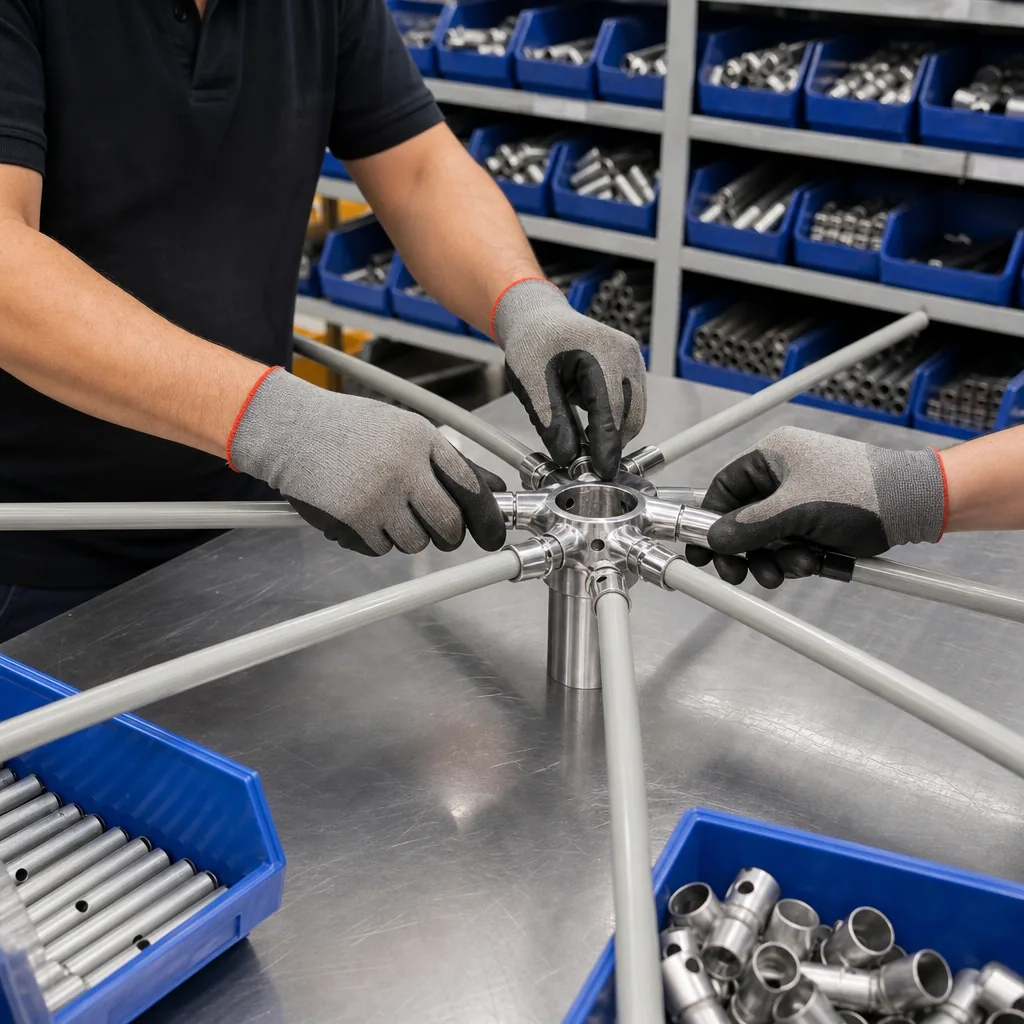
OEM buyers usually see inconsistency first in small details: rib alignment, tip position, canopy tension, runner travel, and handle fit that drift from one purchase order to the next. On our Songxia factory floor, umbrella production tooling is what turns those details from operator judgment into repeatable assembly points, using jigs, fixtures, gauges, and templates to control variation before inspection has to catch it.
Where Tooling Affects Umbrella Quality Most
The highest-risk umbrella production tooling sits in frame preparation: rib forming, shaft cutting, notch positioning, and runner travel checks. A steel rib bent 1.5 mm off at the crown end can pull a properly sewn canopy out of round; fiberglass ribs tolerate wind flex better, but 8K and 10K golf frames still need matched curvature so one weak rib does not flatten the dome. Frame assembly fixtures lock rib angle, stretcher length, notch height, and tip spacing, removing operator judgment from a 5,000-piece OEM run. On 23-inch auto-open umbrellas, ZheBrella typically holds shaft cutting to ±0.5 mm and notch placement to ±0.3 mm because spring load, latch engagement, and runner abrasion all depend on those dimensions. When fixtures drift, defects appear as hard-opening units, tilted canopies, early runner wear, and rework that AQL 2.5 inspection catches only after fabric, frame parts, and assembly labor are already consumed.
Canopy panel cutting is the next control point because small errors multiply across eight or more panels. A worn die or drifting laser bed that cuts 190T pongee panels 2 mm off can cause puckering at the top cap, twisted seams, or short coverage at the rib tips after sewing. On 16K windproof umbrellas, tolerance is tighter because the higher rib count leaves less fabric stretch to hide cutting variation. Umbrella assembly jigs and cutting templates hold grain direction, seam allowance, vent overlap, and logo orientation from the first bundle to the last. This is critical in custom umbrella manufacturing using screen print, heat-transfer, or sublimation artwork, where a few degrees of panel rotation can make a retail logo look crooked. Stable cutting tools also stop sewing operators from compensating with hand tension, a common cause of uneven stitch lines, canopy imbalance, and inconsistent dome shape.
Handle fitting and packing fixtures reduce two different risks: functional failure and shipment damage. Wooden crook handles, EVA grips, and plastic straight handles need controlled insertion depth, adhesive volume, and alignment to the canopy seam; otherwise the umbrella can look twisted even when the shaft is straight. On auto-open-close models, handle fixtures protect button position and prevent over-pressing of the internal mechanism. Packing gauges control sleeve length, tip clearance, ferrule protection, color-ratio separation, and carton shape before FOB or DDP handling adds compression risk. A 30-inch golf umbrella and a 21-inch folding umbrella fail differently when bundled too tightly, so ZheBrella treats packing gauges as production tools, not warehouse accessories. Proper umbrella production tooling improves OEM umbrella consistency by removing operator variation from repeatable steps across shifts, subcontract sewing lines, and peak-season temporary labor.
Frame and Mechanism Fixtures for Repeatable Assembly
Repeatable frame assembly comes from hard stops, calibrated contact points, and part-specific nests, not visual alignment by the operator. For 8K, 10K, and 16K frames, umbrella assembly jigs should lock the center shaft, notch, runner, stretcher joints, rib tips, and rivet points into one fixed geometry before springs, link wires, and fasteners are installed. Fiberglass and steel require different fixture design: fiberglass ribs need wider, lower-pressure supports to prevent off-axis rebound, while steel ribs must stay flat because an over-forced jig can leave a permanent bend. Good umbrella production tooling controls rib pitch, stretcher angle, runner position, and tip arc before any 190T pongee, POE, PVC, or coated canopy is sewn. On a 23-inch promotional umbrella, a 2–3 mm rib-tip mismatch can twist a panel; on a 30-inch golf umbrella, the same error creates canopy sag, uneven tension, and higher inversion risk during wind testing.
Auto-open and auto-open-close frames need tighter control because spring preload, pin height, button-slot alignment, and runner stroke determine whether the lock engages cleanly. If workers set compression by hand, a 1 mm preload difference can make one unit snap open too hard while another opens halfway or fails to lock at the top. Frame assembly fixtures should set spring position and pin placement in the same controlled operation, with runner travel checked against shaft coating clearance and latch engagement. The runner must move without rub marks, but it still needs enough lock depth to survive repeated cycling. At ZheBrella, auto-open mechanisms are cycled before canopy attachment because fabric tension can hide a weak lock during a quick bench check. A frame that feels acceptable once may still fail after 300–500 open-close cycles if compression length or pin height varies between shifts.
The commercial benefit is defect reduction before final AQL 2.5 inspection, when failures are expensive because the umbrella has already been sewn, printed, packed, and barcoded. In custom umbrella manufacturing programs that mix 21-inch, 23-inch, 27-inch, and 30-inch sizes, controlled fixtures keep opening speed, lock sound, runner travel, and closing force consistent across batches. OEM umbrella consistency is not just passing a pull test or supporting a 50+ mph wind-tunnel claim on a vented double-canopy model; buyers need every unit to open cleanly, lock positively, and close without a lagging rib. Well-built umbrella production tooling also protects upstream value: aligned frames reduce canopy stress, prevent heat-transfer logos from distorting over uneven panels, cut rework, and help protect FOB or DDP shipment dates.
Cutting and Sewing Templates for Canopy Accuracy
Canopy accuracy is fixed before sewing: the cutting template must define panel arc, grain direction, seam allowance, notch position, and tip reinforcement location for both pongee 190T and 210T. These fabrics handle differently under stacking, heat, and blade pressure, so one loose “triangle” pattern will not hold shape across bulk cutting. For a basic 23-inch 8K umbrella, small variation may be absorbed in sewing tension; on 27-inch golf frames, 10K builds, or 16K canopies, error compounds around the cap. A 1.5 mm miss per panel can shift the ferrule, twist the cover, or create uneven tip pull. Reliable umbrella production tooling uses hardened steel cutting dies or CNC-cut acrylic templates matched to rib length, runner height, and target canopy tension, so the bulk cover repeats the geometry approved at pre-production sample stage.
Printed canopies need tighter control because the template must protect both fabric geometry and artwork registration. Logo repeats, borders, sublimation gradients, and full-panel screen prints should reference fixed print marks, not only the panel edge. If panels are cut after printing, registration marks must survive handling and heat setting; if printing follows cutting, the fixture must hold 190T or 210T pongee flat without stretching the bias edge. A 3 mm logo drift can look acceptable on one loose panel but becomes obvious when eight, ten, or sixteen panels meet at the top cap. Umbrella assembly jigs help stabilize sewing and tip attachment, but they cannot correct rotated grain, uneven seam allowance, or artwork cut off-register. For OEM umbrella consistency, defect reduction has to start at cutting, not at final inspection.
Double-canopy and vented windproof umbrellas require separate templates for the upper canopy, lower canopy, binding, vent overlap, and Velcro or tack-point locations. Both layers must register to the same rib structure while leaving the designed vent gap; if the upper layer is short or the lower layer is over-tensioned, the canopy will pucker at the notch or sag unevenly between ribs. The risk increases on 16K constructions because more seams and rib points must align. At ZheBrella, approved cutting dies are locked only after pre-production covers pass fit checks on the actual frame assembly fixtures. Bulk-cut panels are then checked before sewing under AQL 2.5 logic. This is where umbrella production tooling lowers rework risk: straighter tips, cleaner print alignment, fewer skewed covers, and less trouble during final assembly in custom umbrella manufacturing.
Handle, Ferrule, and Finishing Tooling That Prevents Rework
Handle attachment should be controlled by keyed nests, not operator eyesight, because the handle sets the visible logo orientation when the umbrella is closed. For wooden crook handles, EVA grips, plastic J handles, and straight rubberized handles, umbrella assembly jigs should index three points before pressing: shaft diameter, logo face, and handle seam. Even 5–10 degrees of handle rotation can make a corporate logo read off-center. Press-fit tooling needs matched bushings for each shaft type; a 10 mm steel shaft and a 12 mm fiberglass shaft should not share the same guide, or the press can leave skewed handles, crushed tube ends, and hidden stress cracks. Adhesive fixtures should meter glue, set insertion depth, and hold dwell time so adhesive does not creep onto the runner, stain the grip, or create a weak joint that twists after repeated open-close cycling. This is where umbrella production tooling directly protects OEM umbrella consistency.
Ferrules, tips, and strap buttons require the same controls because small alignment errors usually surface at final QC, when repair is slow and visible. Ferrule press fixtures should hold the shaft and tip concentric so plated ferrules do not sit loose, angle to one side, or make canopy points look uneven on 8K, 10K, or 16K frames. Strap-button jigs should locate the button against the closure strap and panel seam, preventing straps that pull the canopy off-center or leave the logo face misaligned. During finishing, soft-lined nests for metal tips, logo plates, and ferrules prevent scratched hardware during pressing, wiping, and packing. Good frame assembly fixtures turn defect reduction into prevention: fewer crooked handles, rattling ferrules, glue marks, off-center logos, and scuffed parts. In custom umbrella manufacturing, catching these issues before canopy attachment saves labor, lowers scrap risk, and avoids damaging a finished 21-inch folding or 23-inch stick umbrella during rework.
What Buyers Should Ask About Tooling During Supplier Review
Ask whether the factory has dedicated umbrella assembly jigs for your exact SKU, not a borrowed setup from a similar 23-inch stick umbrella or 21-inch 3-fold compact. A 10K fiberglass frame with a 190T pongee canopy loads differently from an 8K steel frame; runner height, rib arc, tip spacing, notch position, and canopy indexing all change panel tension after sewing. During supplier review, require photos or a live line walk-through of frame assembly fixtures for rib riveting, stretcher alignment, shaft straightness, top cap tightening, and pre-print canopy positioning. The supplier should identify which fixtures are fixed, which are adjustable, and which must be replaced when moving from manual-open to auto-open or auto-open-close mechanisms. For OEM umbrella consistency, request fixture IDs, calibration records, and maintenance logs tied to the model. If the factory cannot show controlled umbrella production tooling records, expect more shade variation, uneven tips, crooked logo placement, and higher AQL 2.5 findings at final inspection.
Treat first-article approval as a documented production control, not a verbal OK from the sewing line. Ask how the factory records canopy diameter, rib length, closed length, unit weight, logo placement tolerance, color standard, opening force, and water-repellency results after Teflon or UV UPF 50+ treatment. For printed OEM orders, the first article should include screen position marks, heat-transfer temperature and dwell time, or sublimation color references checked under D65 lighting. In custom umbrella manufacturing, freeze the approved bill of materials, tooling setup sheet, artwork position, and workmanship standard before bulk cutting starts. ZheBrella keeps one sealed golden sample and one working sample on the line so operators have a physical benchmark during 3,000- to 30,000-piece runs. Buyers should confirm who signs the first article, where the record is stored, and whether any later material, print, or fixture change triggers re-approval.
Changeover control decides whether umbrella production tooling prevents defects or carries them into bulk production. Ask how the supplier resets tooling between SKUs: line-clearance checks, recorded jig settings, trial-run quantity, defect review, and named sign-off should happen before mass production restarts. A shift from a 27-inch golf umbrella to a 30-inch double-canopy vented model may require different rib-crown fixtures, longer sewing gauges, new cutting dies, and a separate wind-test plan if the specification claims 50+ mph performance. Custom molds and special tooling also change MOQ, sampling cost, and lead time. A unique handle, patented runner, molded EVA grip, POE dome canopy die, or special ferrule can add 7 to 20 days, $150 to $1,500 in sampling or mold fees, and a higher MOQ to cover setup loss and spare parts. Confirm tooling ownership, exclusive storage, reorder access, and whether the added time still fits FOB Ningbo or DDP delivery dates.
Frequently Asked Questions
Does better tooling reduce umbrella MOQ?
Not usually by itself. MOQ still depends more on material purchasing, fabric color, print setup, and packaging, but good tooling can reduce scrap and make repeat orders more stable.
When is custom tooling justified for an umbrella project?
It is usually justified when a buyer needs a unique handle, ferrule, packaging format, or a repeat program with large volume. The tradeoff is upfront tooling cost against lower defect risk and more consistent repeat production.
Which umbrella parts benefit most from jigs and fixtures in OEM production?
Frame assembly, rib positioning, runner alignment, shaft drilling, tip placement, and canopy marking benefit the most. These areas directly affect opening tension, canopy symmetry, and repeatable appearance across bulk orders.
Can tooling reduce quality differences between a first order and a repeat PO?
Yes. When the factory keeps approved fixtures, templates, and production settings for a buyer’s SKU, repeat POs can follow the same dimensions, stitch positions, and assembly sequence, reducing variation between batches.
Does custom tooling increase MOQ or lead time for OEM umbrellas?
For standard umbrella structures, existing factory tooling is usually enough and does not change MOQ. For special frame sizes, unique handles, or nonstandard canopy shapes, custom tooling may add about 7–20 days before bulk production, depending on complexity.
Looking to Launch Your Custom Umbrella Line?
ZheBrella is a Zhejiang-based OEM/ODM umbrella manufacturer with 17 years of export experience. Free design, low MOQ from 100 pieces, windproof construction, full-color print.
Get Free Quote Now »People Also Search For
Related Articles
Umbrella Frame Assembly Jigs: Tolerances for OEM Consistency
Learn how frame jigs, rib angle tolerances, runner fit, and in-line checks reduce wobble, canopy strain, and rejects in ...
Read More »
Umbrella Frame Assembly QC for OEM Production Runs
Plan frame assembly checks for OEM umbrellas, from rib alignment and runner fit to cycle tests, AQL sampling, lead-time ...
Read More »
Umbrella Frame Assembly Line: Rivets, Jigs, and Tolerance Control
Learn how umbrella frames are assembled with rivets, jigs, and tolerance checks so bulk OEM orders open smoothly and pas...
Read More »