Inline Umbrella Production QC: Control Points From Cutting to Assembly
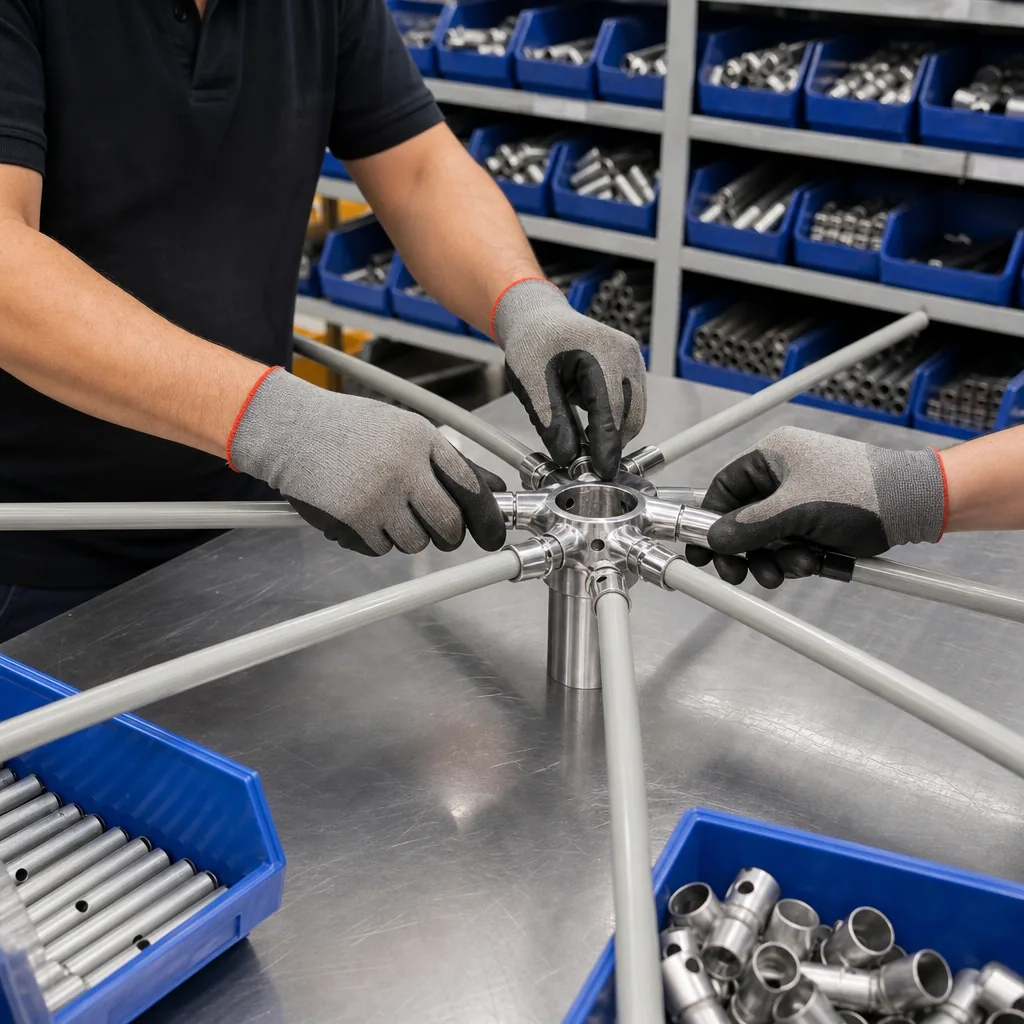
Inline umbrella production qc is what keeps a good order from turning into a costly rework pile at final inspection. In the factory, most failures start earlier—fabric cutting drift, panel mismatch, weak stitching, loose ribs, poor frame fit, or handle assembly errors that only show up after packing. From the cutting table to the assembly line, the right control points catch defects when they are still cheap to fix and keep output stable shift after shift.
Why Inline QC Matters More Than End-of-Line Sorting
Inline umbrella production qc is cheaper because each defect becomes harder to fix after the next operation. A canopy cut 6 mm off on a 16K umbrella does not stay a cutting error; it can shift seam alignment, distort print registration, and change the closed-canopy profile. At canopy cutting inspection, operators should confirm panel symmetry, grain direction, and fabric shrink behavior before sewing starts. If the problem is caught at the lay table, the loss may be one marker file or one fabric lay. If it is found after sewing, the factory pays for seam opening, re-stitching, and possible panel replacement across the lot. On a 10,000-piece order, that difference shows up in labor hours, fabric waste, and missed ship dates, not just reject counts.
The same cost gap applies to frame assembly defects. A bent ferrule, twisted runner, or rib deformation found at assembly usually means disassembly and rebuild; the same fault found during in-process factory inspection can be corrected by replacing one part at the station. Good umbrella assembly quality control should include rib length checks, point-to-point symmetry, torsion checks, and open-close cycle tests before the canopy is fully secured. On a 23" auto-open frame, a misplaced notch or out-of-tolerance steel rib can cause poor tension, tip breakage, and visible canopy puckering. End-of-line sorting cannot cheaply fix that because the frame is already built and the canopy is already attached.
Mispacked assortments are even more expensive late in the process. If a carton packed for mixed colors or sizes is wrong, the fix is not a quick relabel; workers must reopen cartons, recount units, and often break approved bundles to rebuild the order. That is why the most effective control points are inline umbrella production qc at cutting, sewing, frame build, and packing. Catching print panel mismatch during sewing or rib deformation during assembly protects the labor already spent and reduces rework, freight, and lead-time risk. Final inspection still matters, but it should verify a controlled process, not discover problems that should have been stopped hours earlier.
Incoming Material Checks Before Production Starts
Before cutting starts, run incoming checks on every component that can affect fit, durability, or print accuracy. For frames, confirm the bill of materials against the spec sheet: fiberglass ribs versus steel ribs, rib count such as 8K, 10K, 16K, and the stated open diameter or size class, usually 21", 23", 27", or 30". Verify straightness, spring tension, rivet security, and finish consistency on shafts, runners, springs, and ferrules; a mixed gloss level or plating color usually signals a supplier process drift. On fabric, confirm pongee 190T or 210T, the canopy coating, and any UPF 50+ or Teflon claim before the roll enters canopy cutting inspection. Check GSM, weave uniformity, shade match, and dye lot against the approved master standard. Handles, tips, labels, and small hardware should be checked for dimensions, surface finish, and fit, because loose tips, undersized ferrules, or misprinted labels create frame assembly defects later in the line.
Use a simple incoming lot record for each shipment: supplier, lot number, quantity, defect count, and AQL 2.5 acceptance result for visible defects. Fit-test a sample frame with tips, top caps, and ferrules to confirm the parts lock without wobble or split seams; the same approach applies to snaps, Velcro, thread, and elastic. For packaging, inspect cartons for ECT or burst strength, print registration, adhesive quality, and moisture damage, then verify that the box matches the packed umbrella, sleeve, and polybag without crushing the canopy or frame ends. This is the point to reject warped cartons, soft corners, or off-color labels before they reach in-process factory inspection. Good inline umbrella production qc starts with traceable incoming checks on frames, fabric, handles, tips, labels, and cartons; it is cheaper to block a bad lot at receiving than to pay for rework, scrap, and delayed shipment after assembly starts.
Process Controls at Cutting, Sewing, and Canopy Preparation
Cutting is the first hard gate in inline umbrella production qc, so the controls have to start with marker accuracy, panel direction, and traceability. For 190T or 210T pongee, the marker should follow the warp and weft, with the same lay orientation on every bundle; a 2–3 mm drift per panel can stack into a crooked hem, uneven canopy tension, and poor fit on both 8K and 16K frames. Operators and line QC should record fabric roll number, color lot, panel count, size, and logo version before the first cut, then label each panel at the cutter output so mixed bundles do not enter sewing. Canopy cutting inspection must also verify print alignment against the approved master sample: if one logo is centered but the opposite panel is 5 mm off, the defect will show immediately when the umbrella opens.
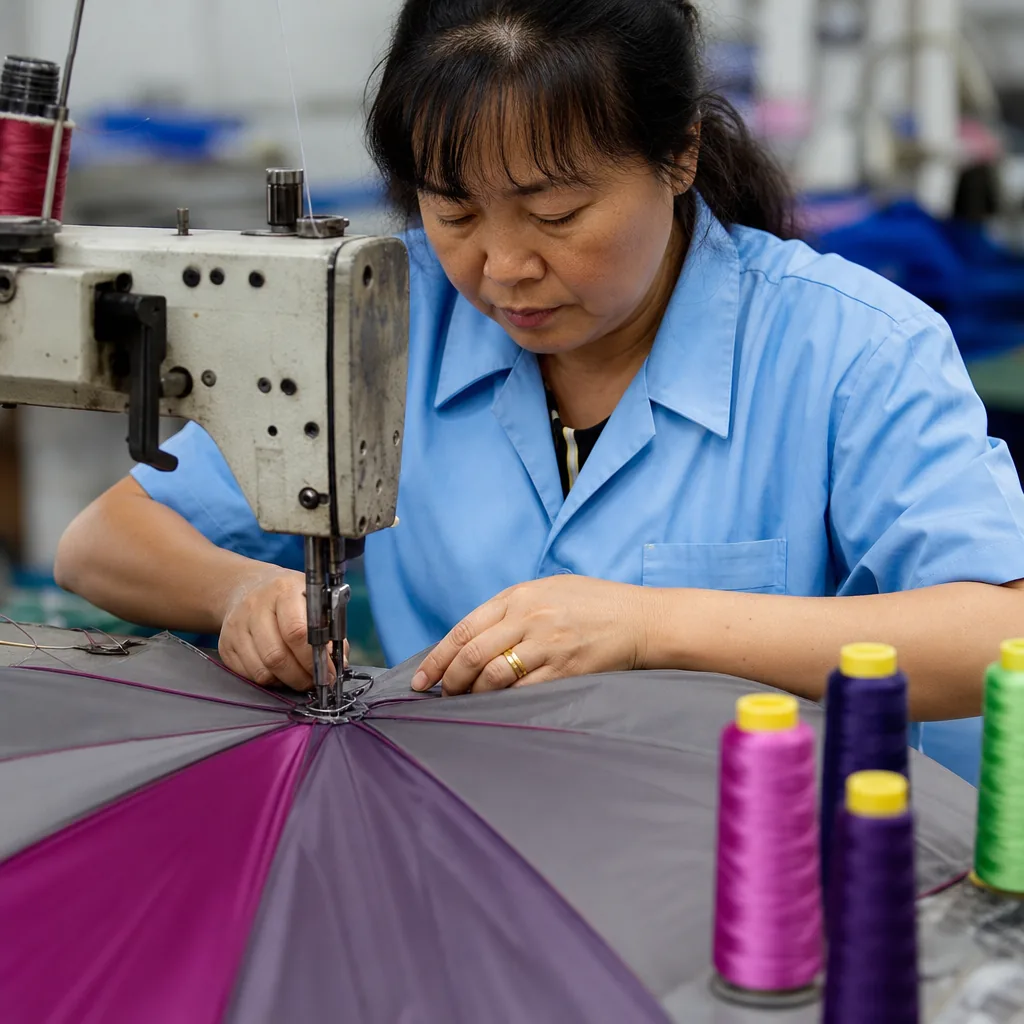
During sewing, umbrella assembly quality control should focus on stitch consistency, seam reinforcement, and panel-to-panel shade control. Hold stitch length steady at about 3–4 mm, depending on fabric and needle size, and lock both seam ends so the panel does not split under runner load or repeated opening cycles. Line QC should check seam allowance, skipped stitches, loose ends, and whether the seam line tracks the panel edge without wavering. Shade matching needs the same discipline: two panels with the same color code can still read differently if they came from different rolls, so compare panels side by side before feeding them to the canopy line and quarantine any mixed lot before it reaches assembly. Record the defect code, roll number, and panel pair on the in-process factory inspection sheet so the hold is traceable and does not turn into frame assembly defects later.
To prevent mix-ups between 8K and 16K builds, the inspection sheet should capture rib count, canopy size, panel pattern, and logo version at every handoff. The operator should tag each bundle with a job card, and line QC should match it to the work order before sewing starts; one wrong bundle can contaminate an entire cart. Good inline umbrella production qc also requires checking seam orientation against the frame layout, because a flipped panel can shift the vent opening, tie strap position, or print repeat during final assembly. If the order includes multiple artwork versions, record the approved artwork code on the bundle label, panel label, and inspection sheet, and require a second check before rework is released back to the line. This keeps the sewing floor from cross-mixing styles and gives a clear record if a defect is found at final assembly or packing.
Assembly-Line Checks for Frames, Mechanisms, and Fit
Assembly-line checks start at rib mounting and runner setting, before canopy attachment or mechanism testing. For inline umbrella production qc, inspect rivet set depth, hinge clearance, rib-plane alignment, shaft concentricity, ferrule fit, and any weld or swage joints on every frame; on 8K and 10K structures, even a 1–2 mm error can create twist, uneven tension, or one-side collapse. The runner should travel without drag, latch at the same point each cycle, and leave no metal shavings at the slot or stop. Verify that shaft sections seat fully and that the frame reaches a stable open position before it moves to the next station. These checks catch frame assembly defects early, when rework is still cheap and before fabric hides the problem.
Canopy attachment combines canopy cutting inspection with umbrella assembly quality control. Confirm panel length match, notch accuracy, and grain direction before sewing, then verify centering after mounting: the top notch must sit tight, the cap washer must cover the crown evenly, and each tip should keep equal overhang. If the notch is loose, pierced too large, or the washer is undersized, the canopy will drift during opening and create off-center panels or crown puckering. Inspect tip-pocket seating, tie-point symmetry, hem clearance, and rib tip contact so the fabric does not rub under load. Keep the same fit standard across 21" and 23" compact umbrellas, and check 27" and 30" frames for even load distribution across the span. This in-process factory inspection step prevents repeat rejects later in packing.
Auto-open and auto-open-close models need basic cycle testing before packing, not after. Run 3–5 manual cycles per unit on the line and confirm opening smoothness, button return, lock reliability, and full closure without rebound. The runner must seat fully in the notch, the release button must reset cleanly, and the shaft must not creep back once locked; a unit that slips, binds, or fails to reset is a reject. Add a quick shake check to confirm the latch holds under normal hand force and the top-notch assembly stays secure. This final gate protects cost and lead time by stopping bad units before cartonization and keeps inline umbrella production qc focused on the outcomes buyers notice: smooth operation, centered canopy, and a frame that stays locked.
Using Inline Data to Protect Final AQL and Shipment Dates
The fastest way to protect AQL 2.5 is to stop defects at the station, not at final packing. In inline umbrella production qc, the line should track a defect Pareto by process step and hour: canopy cutting inspection catches panel-length drift, print-register error, seam mismatch, and shade variation before they become full-lot rework; frame assembly defects show up as loose rivet heads, bent ribs, weak spring tension, misaligned runner stops, or failed open-close cycles; and umbrella assembly quality control confirms handle fit, tip insertion, button response, and final mechanism travel. When the team updates counts every hour, supervisors can see whether one cutting marker, one operator, or one frame lot is driving the repair rate. That lets the factory isolate the root cause while the order is still moving, instead of discovering it after cartons are packed and the final sample misses AQL 2.5.
Hourly line audits turn in-process factory inspection into a shipment control tool. A 60- to 90-minute audit can check rib symmetry, canopy tension, stitch density, coating contamination, and smooth cycling on manual, auto-open, or auto-open-close umbrellas before defects spread across the next batch. The key metric is not just the defect count but the repair rate versus first-pass yield: if rework rises in one hour, line drift is already happening. Buyers should ask for daily reports that show completed quantity, open defects by station, repaired and scrapped pieces, output versus plan, and corrective action taken. That matters most when lead times are tight or the order must hit a fixed event date, because FOB and DDP shipments leave little room for slippage; a daily report gives both sides time to adjust labor, release replacement parts, or move freight before the vessel closes or the delivery window slips.
Frequently Asked Questions
How often should inline QC check an umbrella line during production?
For new styles, checks are often done at start-up, then hourly, plus after any material or operator change. Higher-risk items such as auto-open umbrellas or multi-panel prints usually need tighter frequency.
What defects are best caught inline instead of at final inspection?
Panel shade variation, off-position logos, loose stitching, skewed canopy attachment, and weak mechanism assembly are best caught inline. Once umbrellas are fully assembled and packed, these issues take much more time to sort and repair.
What are the most critical QC checkpoints in inline umbrella production?
The most critical checkpoints are canopy cutting, panel stitching, frame alignment, and final assembly fit. Most factories inspect these at 100% in-line for the first 1-3 production runs, then switch to AQL sampling once the process stabilizes.
How many defects should be checked during in-process umbrella inspection?
Buyers typically focus on appearance, dimensions, seam strength, open-close function, and frame symmetry, which usually covers 10-15 key defect types. For OEM orders, it is common to define acceptance criteria by AQL 2.5 for major defects and 4.0 for minor defects.
When should factory inspection happen to prevent final inspection failures?
Inspection should start at cutting, continue after stitching and frame assembly, and finish with pre-pack checks before carton sealing. Catching issues at the first two stages can reduce rework and final rejection rates by a noticeable margin, especially on new styles or first orders.
Looking to Launch Your Custom Umbrella Line?
ZheBrella is a Zhejiang-based OEM/ODM umbrella manufacturer with 17 years of export experience. Free design, low MOQ from 100 pieces, windproof construction, full-color print.
Get Free Quote Now »People Also Search For
Related Articles
Inline Umbrella Assembly QC Before Final AQL Inspection
Build better OEM orders with inline assembly QC checkpoints that catch frame, canopy, handle, and packaging defects befo...
Read More »Heat-Seal, Sewing, and Assembly Controls in Umbrella Canopy Production
Compare sewing and heat-seal controls in canopy assembly so buyers can reduce leaks, puckering, and panel mismatch befor...
Read More »In-Line Umbrella Assembly QC Before Final AQL Inspection
See how line checks for ribs, runners, springs, canopy tension, and packaging reduce rework before AQL 2.5 final inspect...
Read More »